DOPAMINE Neurotransmitter in the brain Several dopamine systems in - - PDF document

dopamine
SMART_READER_LITE
LIVE PREVIEW

DOPAMINE Neurotransmitter in the brain Several dopamine systems in - - PDF document

10/29/2014 ROLE OF DOPAMINE IN CIRCADIAN ENTRAINMENT TO REWARD Proof-of-principle study using in-vivo electrophysiology in the SCN of mice Aarti Purohit UVA Department of Biology Lowe College Science Scholar DOPAMINE Neurotransmitter in


slide-1
SLIDE 1

10/29/2014 1

ROLE OF DOPAMINE IN CIRCADIAN ENTRAINMENT TO REWARD

Proof-of-principle study using in-vivo electrophysiology in the SCN of mice

Aarti Purohit UVA Department of Biology Lowe College Science Scholar

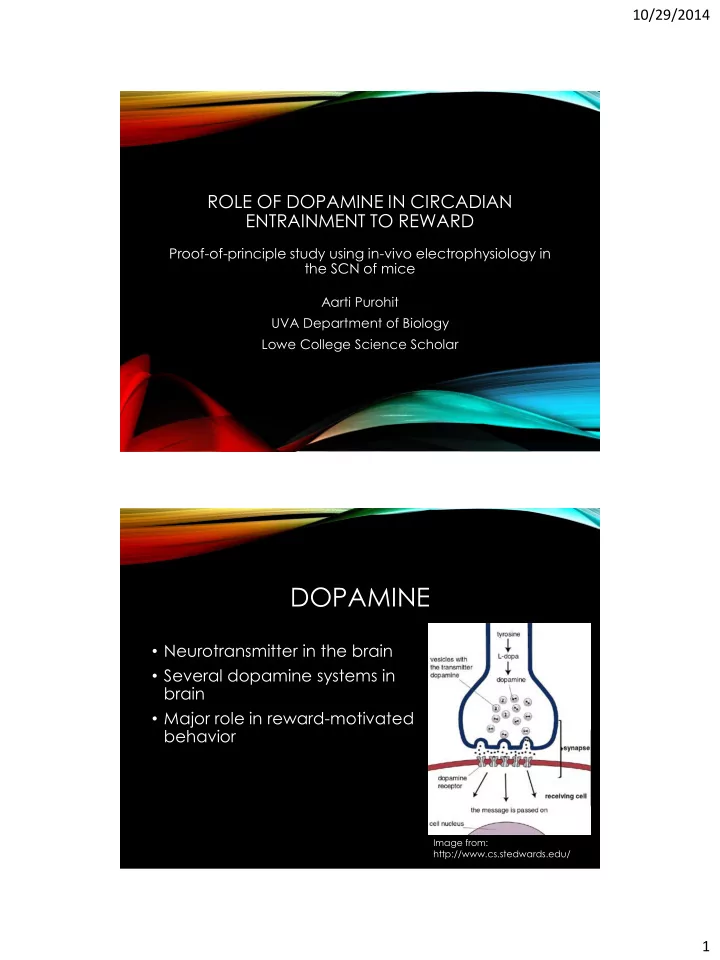
  • Neurotransmitter in the brain
  • Several dopamine systems in

brain

  • Major role in reward-motivated

behavior

DOPAMINE

Image from: http://www.cs.stedwards.edu/

slide-2
SLIDE 2

10/29/2014 2

SUPRACHIASMATIC NUCLEUS (SCN)

‡ Master biological clock & circadian rhythms ‡ Rhythms are endogenous but regulated by environmental cues ‡ Photic vs. non-photic input ‡ Ex: jetlag

Images from: Allen Brain Atlas

CENTRAL PREMISE

‡ Premise 1: SCN has receptors for dopamine (D1R) ‡ Premise 2: SCN neurons should have light/dark rhythmicity

Video from: Welsh DK, Takahashi JS, Kay SA. 2010. Suprachiasmatic nucleus: cell autonomy and network

  • properties. Annu. Rev. Physiol.

72:551–77

slide-3
SLIDE 3

10/29/2014 3

TECHNIQUE 1: “DREADDs"

‡ “Designer Receptor Exclusively Activated by Designer Drugs”

‡ Example of “designer drug”: clozapine-N-oxide (CNO)

‡ Cre recombinase used to target DREADD receptors to ONLY neurons that express D1R receptors

TECHNIQUE 2: RECORDING IMPLANTS

‡ Records action potentials from single cells ‡ Freely behaving mice ‡ Long-term recordings

Image from: Anikeeva, P. et al. Optetrode: a multichannel readout for

  • ptogenetic control in freely moving mice. Nature Neurosci. 15, 163–170 (2012).

Image from: http://neuralynx.com

slide-4
SLIDE 4

10/29/2014 4

EXPERIMENTAL DESIGN

‡ Step 1: surgically implant 4 mice with electrodes targeted at the SCN ‡ Step 2: entrain mice to 12 hr light: 12 hr dark cycle ‡ Step 3: Activate dopamine system and monitor SCN activity

‡ day & night ‡ before & after injecting CNO: 30 min wait time

RESULTS

‡ 4 mice injected; 1 headstage had wiring issues ‡ Several units had day/night rhythmicity as well as CNO responsiveness ‡ Interesting action potential shapes recorded

slide-5
SLIDE 5

10/29/2014 5

Mouse 0298 Mouse 0351 Mouse 0353

DATA ANALYSIS

From Matlab: computational software

slide-6
SLIDE 6

10/29/2014 6

EXAMPLE: CELL #11

June 9 Baseline Day Firing Rate: 5.94 Hz June 9 Baseline Night Firing Rate: 10.39 Hz June 10 Baseline Day Firing Rate: 6.98 Hz June 10 CNO Day Firing Rate: 3.34 Hz

EXAMPLE: CELL #28

June 16 Baseline Day Firing Rate: 0.49 Hz June 16 Baseline Night Firing Rate: 0.62 Hz June 17 Baseline Day Firing Rate: 0.43 Hz June 17 CNO Day Firing Rate: 0.19 Hz

slide-7
SLIDE 7

10/29/2014 7

SIGNIFICANCE

‡ Interesting action potential shape of SCN neurons

‡ Very fast recovery period?

‡ Proof of principle study successful: neuronal activity can be controlled ‡ Next steps:

‡ repeat experiment with more mice and proper targeting ‡ Induce dopamine production in brain (ex. leptin/ghrelin) and monitor SCN activity

ACKNOWLEDGEMENTS

‡ Mentor: Professor Ali Guler ‡ Many thanks go to the generous donors of the College Science Scholars program who make these summer research awards possible: Charles Henry Leach, II Foundation; Wendy

  • R. Van Besien and Stephen M. Van Besien; Lois A. Fitton &
  • W. Christopher Draper, Jr.; Sharon B. Parente & John W.

Risner; The Jefferson Trust; J. Randolph and Rossie Carter Hutcheson; Entigence Corporation; Robert Atkinson ‡ Special thanks to Mary Baroody Lowe and Jeffrey A. Lowe; The UVa Parents Fund and Committee ‡ The College Science Scholars Program ‡ Ryan Grippo & Aundrea Rainwater

14