Domain Analysis Die Monopoly Game Board 2 played with played on - - PowerPoint PPT Presentation

domain analysis
SMART_READER_LITE
LIVE PREVIEW

Domain Analysis Die Monopoly Game Board 2 played with played on - - PowerPoint PPT Presentation

Domain Analysis Die Monopoly Game Board 2 played with played on Count 2 takes turn defines a using location on 2..8 40 Player Piece Square is on represents 0..8 SWEN-261 Character Location Introduction to Software Property


slide-1
SLIDE 1

SWEN-261 Introduction to Software Engineering

Department of Software Engineering Rochester Institute of Technology

Domain Analysis

Die Count Player Monopoly Game Piece Character Board Square Location defines a location on played with 0..8 2 40 2..8 represents is on played on takes turn using 2 Utility Property Jail

slide-2
SLIDE 2

The domain for a software system defines the context in which the software operates.

  • This is also referred to as the application domain.
  • Retail sales
  • Banking
  • Customer contact management
  • Checkers playing
  • The domain model describes the ubiquitous world

in which the system's experts and users exist and work on a daily basis.

  • Domain entities
  • Domain language
  • Associations/relationships between entities

2

slide-3
SLIDE 3

Domain analysis provides an understanding of the application problem space.

Application Domain What are the entities and associations within this domain? Domain Model What entities and associations are important for this application?

Use the language of the application and user! It does not define the implementation.

Class Model What software structure and relationships will provide the implementation of this application?

The domain model influences the naming and structure in the software class model.

slide-4
SLIDE 4

The domain model identifies important aspects

  • f the application not the implementation.
  • Only use vocabulary from the problem

statement

  • For example, a unique identifier needed to store

data with no meaning to the user would not be in a domain model.

  • Establishes a common understanding of the

problem for customer/user and software team

slide-5
SLIDE 5

Domain model definition starts with an analysis of the nouns in the domain.

  • The steps in the noun analysis include
  • Identify the nouns in the problem statement and

language of the domain experts and users.

  • Identify any words that might be specializations of
  • ther nouns.
  • Identify any nouns that might be attributes or

properties of other nouns.

  • Identify any other associations between nouns.

5

slide-6
SLIDE 6

The domain model is typically drawn using a simplified class diagram notation.

  • Show the following information
  • Domain entities
  • Attributes in domain entities
  • Associations between domain entities
  • Use user vocabulary
  • Attributes do not indicate data type
  • Associations come from the problem statement
  • Place label on the association line
  • Usually completes a phrase between two domain

entities: DE1 association DE2 (LineItem records-sale-of Product)

  • Indicate multiplicity, if known
  • Use inheritance, if appropriate
slide-7
SLIDE 7

An association should describe the relationship between two domain entities.

  • All associations should have an arrow to

indicate the direction to read the association.

  • Use the active voice for the verb when possible.
  • An association of "has" or "contains" does not

describe much about the relationship.

  • Reverse the direction and rephrase the

association

Customer Address is shipping location for has * 1

slide-8
SLIDE 8

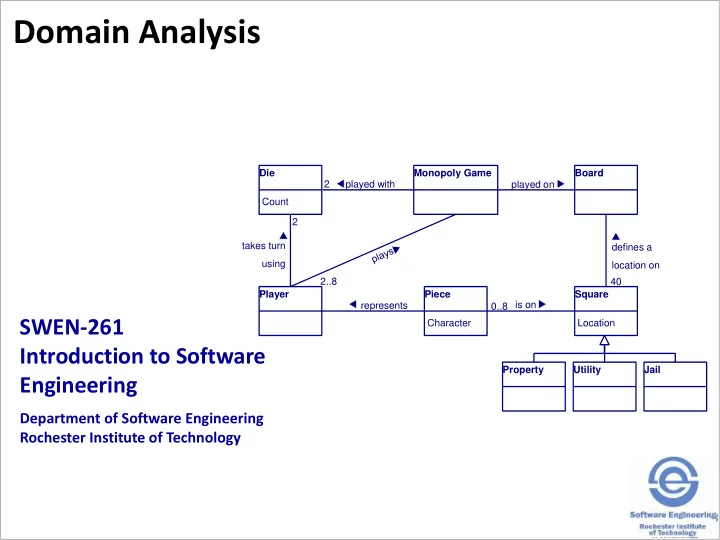
This partial domain model for a game of Monopoly demonstrates these ideas.

Arrows indicate direction for reading the associations.

Die Count Player Monopoly Game Piece Character Board Square Location defines a location on played with 0..8 2 40 2..8 represents is on played on takes turn using 2 Utility Property Jail

slide-9
SLIDE 9

Domain analysis continues through the project.

  • The domain model continues to evolve as you

learn more about the project.

  • Working on the project gives you a different

understanding of the domain.

  • New features change your understanding of the

domain.

  • When user stories are refined during backlog

refinement more details may come out about the domain.

  • Keep your domain model up-to-date so that there

is always a common understanding between the development team and Product Owners.

9