Does magnetic-field-angular-momentum misalignment strengthens or - - PowerPoint PPT Presentation

does magnetic field angular momentum misalignment
SMART_READER_LITE
LIVE PREVIEW

Does magnetic-field-angular-momentum misalignment strengthens or - - PowerPoint PPT Presentation

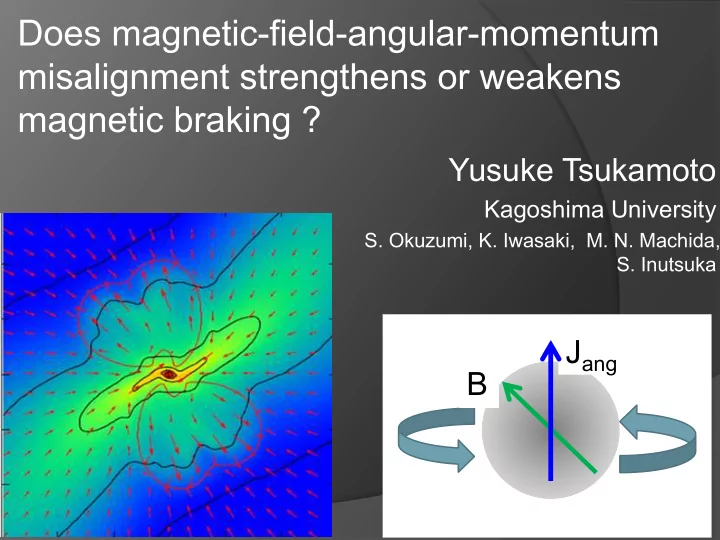
Does magnetic-field-angular-momentum misalignment strengthens or weakens magnetic braking ? Yusuke Tsukamoto Kagoshima University S. Okuzumi, K. Iwasaki, M. N. Machida, S. Inutsuka J ang B Outline Introduction: Observation of magnetic


slide-1
SLIDE 1

Yusuke Tsukamoto

Kagoshima University

  • S. Okuzumi, K. Iwasaki, M. N. Machida,
  • S. Inutsuka

Does magnetic-field-angular-momentum misalignment strengthens or weakens magnetic braking ?

Jang B

slide-2
SLIDE 2

Outline

ž Introduction:

— Observation of magnetic field and turbulence of the

cloud core

— Magnetic braking and its anisotropic impact — Discrepancy among the previous studies

ž Results

— Dependency of central angular momentum evolution

  • n the initial condition and magnetic resistivity

— Strong magnetic braking in isothermal collapse phase

in perpendicular cloud cores

ž Summary and discussion

slide-3
SLIDE 3

Strong magnetic field and weak turbulence in cloud cores

ž Magnetic field of the

cloud cores is strong.

ž Turbulence is weak

µ = M/Φ (M/Φ)crit = 2 − 4

μ=1

OH Zeeman Obs. Troland+08

μ~4.8

Mturb < 1

Lada+07

Pipe Nebula Ward-Tompson+06 Taurus:○,ρOph:▲

slide-4
SLIDE 4

Magnetic braking and its anisotropic impact

ž In the core with observed B

and subsonic turbulence, magnetic braking is dynamically important.

J flux

100AU μ=5 μ=20 μ=100 Bate+ 14 weak B field strong B field

slide-5
SLIDE 5

Jang B

Matsumoto+04

θ=0゜ θ=90゜

Magnetic braking and its anisotropic impact

ž What kind of structure does the magnetic braking

imprint to the rotation structure? →it introduces anisotropy of the angular momentum!

ž Matsumoto+04 showed that magnetic braking

enforces J and B to be aligned.

Solid: J|| Dashed: J⊥

θ=45゜ θ=45゜

J⊥ J||

J⊥selectively decreases

slide-6
SLIDE 6

Jang B

Matsumoto+04

θ=0゜ θ=90゜

Magnetic braking and its anisotropic impact

Solid: J|| Dashed: J⊥

θ=45゜ θ=45゜

J⊥ J||

J⊥selectively decreases

ž What kind of structure does the magnetic braking

imprint to the rotation structure? →it introduces anisotropy of the angular momentum!

ž Matsumoto+04 showed that magnetic braking

enforces J and B to be aligned.

slide-7
SLIDE 7

Dependence of magnetic braking timescale on B direction

ž Timescale of magnetic braking

→is given as the time in which Alfven wave sweeps the region whose inertia equals to the central inertia

tb,⊥ = ∫ dr vA(𝑠) = ∫ rdr Bc = 𝑆𝑑

2 − 𝑆2

2 𝐶𝑑

ρext (𝑆4 − 𝑆𝑑

4) = 𝜍𝑑𝑆4

tb,⊥ = 1 2 ()1 + 𝜍𝑑 𝜍𝑓𝑦𝑢

1 2 − 1 3 (4 𝜌𝜍𝑓𝑦𝑢 )1/2 𝑆𝑑

𝐶𝑑

ž The magnetic

braking is strong in the core with B⊥J with simple B geometry (Moschouvias+ 85)

slide-8
SLIDE 8

Random distribution of magnetic field and

  • utflow direction

ž This suggests: 1.

The magnetic braking is dynamically important but it does not enforce J || B.

2.

The magnetic field is dynamically unimportant at the observed scale(turbulence is strong or magnetic field is weak)

Hull+14 Hull+17

Serpens SMM1

slide-9
SLIDE 9

ž エンベロープ内では磁場配位は砂時計型

→広がった分「腕」が稼げる →より効率的な磁気ブレーキ

ž Rc/Rextは解析から決めるのは困難(Joos+12ではRext=Rcore→過大評価)

→シミュレーションしてみる必要がある

Girart+06 NGC 1333 IRAS 4A

t∥ 𝑢⊥ = & 𝑆𝑑 𝑆𝑓𝑦𝑢 +

2

& 𝜍𝑑 𝜍𝑓𝑦𝑢 +

1 2

magnetic braking timescale of hourglass B field

slide-10
SLIDE 10

Does magnetic braking really enforce B || J?

ž Ideal MHD studies — Magnetic braking is efficient when B||J

→J⊥B tends to realized (Hennebell+09, Joos+12). ⇔ B||J tends to be realized (Mouschovias+85, Matsumoto+04)

ž Resistive MHD study — Magnetic braking efficiency is almost unchanged

(non-ideal MHD:Masson+16)

Joos+12 Matsumoto+04

θ=0゜ θ=90゜

J_ang B θ

θ=0゜ θ=90゜

slide-11
SLIDE 11

Masson+16

θ=0゜ θ=40゜

J_ang B θ

Does magnetic braking really enforce B || J?

ž Ideal MHD studies — Magnetic braking is efficient when B||J

→J⊥B tends to realized (Hennebell+09, Joos+12). ⇔ B||J tends to be realized (Mouschovias+85, Matsumoto+04)

ž Resistive MHD study — Magnetic braking efficiency is almost unchanged

(non-ideal MHD:Masson+16)

slide-12
SLIDE 12

Purpose of this study

ž Resolve the discrepancy of the previous studies ž Reveal the nature of the magnetic braking in cloud

core collapse

ž We particularly focus on

— The Initial conditions

○ Matsumoto+04: Bonnor-Ebert sphere, α=0.5 ○ Joos+12: , α=0.25

— Magnetic diffusion(ohm, ambipolar diff.)

○ Matsumoto+04, Joos+12:ideal MHD ○ Masson+: resistive MHD (uniform sphere, α=0.25)

α = E$% 𝐹'()*

slide-13
SLIDE 13

α

0.6 0.2

θ

0.4

0 45 90

α = E$% 𝐹'()* M/Φ (M/Φ)012$ = 4.0

Simulations start from cloud core

Numerical methods and models

ž methods: non-ideal Godunov SPMHD (Iwasaki+11,

YT13) with FLD (Whitehouse+05)

ž Initial condtions: uniform cloud cores with M = 1 Msolar

(β=0.03)

ž Both ideal and resistive (Ohm+ambipolar diff.) MHD

simulations are conducted.

slide-14
SLIDE 14

α=0.2, θ=90 α=0.2, θ=45 α=0.2, θ=0 α=0.4, θ=90 α=0.4, θ=45 α=0.4, θ=0 α=0.6, θ=90 α=0.6, θ=45 α=0.6, θ=0 600 AU

Matsumoto+17

slide-15
SLIDE 15

Evolution of central J (ρ>10-12g/cc Ideal simulaiton)

ž As α of initial core decreases, J of θ=90 increases quickly ž We obtained the consistent results with previous studies

θ=0 θ=45 θ=90

α=0.6

α=0.4

Joos+12 Matsumoto+04

Central density

consistent large α small consistent consistent consistent

α=0.2

slide-16
SLIDE 16

ž In all simulations with magnetic diffusion, J of the central region

decreases as θ increases. (consistent with Matsumoto+04)

ž Difference between θ=0, 45 is quite small and roughly consistent with

Masson+16

θ=0 θ=45 θ=90 α=Eth/Egrav=0.6 ρ>10-12 g/cc region α=0.4 α=0.2

central density

Masson+16

consistent Roughly consistent

Evolution of central J (ρ>10-12g/cc, resistive)

slide-17
SLIDE 17

Why do the results depend on the initial condition?

ž When and how the

magnetic braking changes the gas angular momentum have been ambiguous because previous studies only investigate the J evolution

  • f the central disk

ž To reveal the physical

mechanism, we should investigate the angular momentum evolution of fluid elements.

Previous studies investigate how mean J of disk changes under the mass accretion We follow J evolution of fluid elements →We can answer when and how J is changed

slide-18
SLIDE 18

Non-spherical collapse and apparent enhancement of magnetic braking

Shell with M(r)=0.01 Msun Shell with M(r)=0.1 Msun

B

Collapse is not spherical symmetric !

Fluid elements with small/large J selectively accretes to the central region in core with θ=0, 90

slide-19
SLIDE 19

Angular momentum evolution of the spherical shell Ideal:α=0.4

isothermal isothermal

ž In isothermal collapse phase:

magnetic braking is stronger in model with θ=90

ž Ideal: strong magnetic braking in

adiabatic/rotationally supported phase.

ž Non-ideal: magnetic braking is

suppressed in adiabatic/rotationally supported phase.

resistive θ=45゜ θ=0゜ θ=90゜

Shell with M(r)=0.01 Msun Shell with M(r)=0.01 Msun Shell with M(r)=0.01 Msun

B

slide-20
SLIDE 20

Angular momentum evolution of the spherical shell Ideal:α=0.4

isothermal isothermal

ž In isothermal collapse phase:

magnetic braking is stronger in model with θ=90

ž Ideal: strong magnetic braking in

adiabatic/rotationally supported phase.

ž Non-ideal: magnetic braking is

suppressed in adiabatic/rotationally supported phase.

resistive θ=45゜ θ=0゜ θ=90゜

Shell with M(r)=0.01 Msun Shell with M(r)=0.01 Msun Shell with M(r)=0.01 Msun

B Tomisaka00

Angualr momentum distribution at first core formation Angualr momentum distribution after first core formation

slide-21
SLIDE 21

Comparison between ideal and resistive

ž Evolution in isothermal

phase is essentially the same.

ž Magnetic resistivity (Ohm

and ambipolar) changes the angular momentum evolution in ρ>10-13g cm-3

ideal resistive ideal resistive ideal resistive θ=45゜ θ=0゜ θ=90゜

slide-22
SLIDE 22

Summary and discussion

ž We investigated the magnetic

braking in misaligned cloud cores and almost all previous results are reproduced.

ž Results — In isothermal collapse phase,

magnetic braking is strong when B ⊥ J →If magnetic filed is dynamically important in isothemal phase or envelope (r~1000AU scale), B || J realizes!

— Once magnetic diffusion is included

(more realistic simulation), the central angular momentum (or disk size) is always larger in B||J case

ž Discussion

— With multiscale observation

  • f polarization, we can

determine the scale at which the magnetic braking is dynamically important !

slide-23
SLIDE 23

Summary and discussion

ž Hull+13 showed that B of core scale is not

aligned with outflow direction (J direction)

ž This suggests : — The magnetic braking is efficient but it does not

enforce J || B.

— The magnetic field is dynamically unimportant at

the observed scale(turbulence is strong or magnetic field is weak)

Hull+13 Hull+17

slide-24
SLIDE 24

Remaining questions

ž Magnetic field is weak in the core scale?

— How can we explain the Zeeman obs?

ž Turbulence in cloud core is strong?

— Simulations tends to produce the cores with strong

turbulence(supersonic, Klessen+05)

— Observation does not show supersonic line width. i.e.,

subsonic turbulence (Andre+06, Lada+07). Angular momentum problem also becomes serious. μ=1

OH Zeeman Obs. Troland+08

μ~4.8 Hull+13

slide-25
SLIDE 25

Remaining questions

Klessen+05

ž Magnetic field is weak in the core scale?

— How can we explain the Zeeman obs?

ž Turbulence in cloud core is strong?

— Simulations tends to produce the cores with strong

turbulence(supersonic, Klessen+05)

— Observation does not show supersonic line width. i.e.,

subsonic turbulence (Andre+06, Lada+07). Angular momentum problem also becomes serious.