DOE Technical Assistance Program The Parker Ranch installation in - - PowerPoint PPT Presentation

doe technical assistance program
SMART_READER_LITE
LIVE PREVIEW

DOE Technical Assistance Program The Parker Ranch installation in - - PowerPoint PPT Presentation

DOE Technical Assistance Program The Parker Ranch installation in Hawaii Richard Faesy & Jim Grevatt Designing Effective Energy Futures Group & VEIC Residential Retrofit Programs DOE Technical Assistance Program Team 4 Program


slide-1
SLIDE 1

1 | Designing Effective Residential Retrofit Programs eere.energy.gov

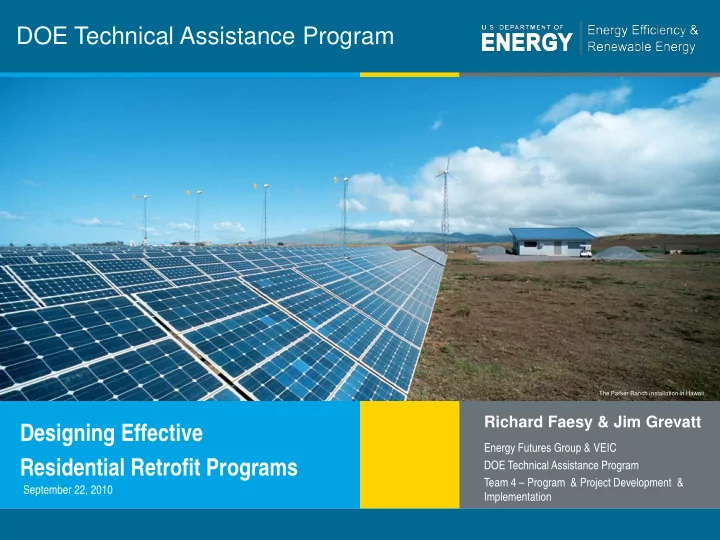
The Parker Ranch installation in Hawaii

DOE Technical Assistance Program Designing Effective Residential Retrofit Programs

Richard Faesy & Jim Grevatt

Energy Futures Group & VEIC DOE Technical Assistance Program Team 4 – Program & Project Development & Implementation September 22, 2010

slide-2
SLIDE 2

2 | Designing Effective Residential Retrofit Programs eere.energy.gov

Overview

  • Technical Assistance Project (TAP) Overview
  • Retrofit Program Design Elements
  • Q&A
  • Next Steps
slide-3
SLIDE 3

3 | Designing Effective Residential Retrofit Programs eere.energy.gov

What is TAP?

DOE’s Technical Assistance Program (TAP) supports the Energy Efficiency and Conservation Block Grant Program (EECBG), the State Energy Program (SEP) and the Better Buildings grantees by providing state, local, and tribal officials the tools and resources needed to implement successful and sustainable clean energy programs.

slide-4
SLIDE 4

4 | Designing Effective Residential Retrofit Programs eere.energy.gov

How Can TAP Help You?

TAP offers:

  • One-on-one assistance
  • Extensive online resource

library, including:

  • Webinars
  • Events calendar
  • TAP Blog
  • Best practices and

project resources

  • Facilitation of peer exchange

On topics including:

  • State and local capacity

building

  • Energy efficiency and

renewable energy technologies

  • Program design and

implementation

  • Financing
  • Performance contracting
slide-5
SLIDE 5

5 | Designing Effective Residential Retrofit Programs eere.energy.gov

Provider Network Resources

State and Local Capacity Building

  • Trainings
  • Workshops
  • Peer-to-peer matching

Technical

  • Renewable energy siting and development
  • Review of technical specs for RFPs
  • Strategic planning, energy management, and conservation strategies
  • Green building technologies
  • Building codes

Program Design and Implementation

  • Policy and program development
  • Coordinating rate-payer funded dollars with ARRA projects and programs
  • Sustainable community and building design
  • State and regional EE and RE assessments and planning
  • EE and RE portfolio program design elements

Financial

Program design support and guidance on financing mechanisms such as:

  • Revolving loan funds (RLFs)
  • Property-assessed clean energy (PACE)
  • Loan loss reserves and enhanced credit mechanisms

Performance Contracting

  • Designing and implementing a performance contract
  • Leveraging private investment
  • Reducing institutional barriers
  • Tracking and comparing programs
slide-6
SLIDE 6

6 | Designing Effective Residential Retrofit Programs eere.energy.gov

Who We Are: Team 4

P

VE IC SWE E P ME E A NE E A SE E A VE IC/ NRDC VE IC VE IC ACE E E , NRDC: Na tiona l Suppor t NE E P

slide-7
SLIDE 7

7 | Designing Effective Residential Retrofit Programs eere.energy.gov

Successful Retrofit Program Elements

  • What are the elements of a successful retrofit program?
  • Can you just build it and expect that consumers will

come?

  • Can you market retrofit programs conventionally and

expect they will succeed?

  • Is financing the silver bullet?

Questions

slide-8
SLIDE 8

8 | Designing Effective Residential Retrofit Programs eere.energy.gov

  • A champion to push and lead
  • Supporting foundational policies
  • A structure that supports program goals
  • Stakeholder participation
  • Substantial and stable funding to develop markets
  • Partner with utilities and others with resources,

knowledge and existing delivery mechanisms

  • A comprehensive approach to targeted markets
  • Engagement of and support for private sector

weatherization contractors

  • A comprehensive approach to individual buildings
  • Nimbleness and creativity

Elements of Success

slide-9
SLIDE 9

9 | Designing Effective Residential Retrofit Programs eere.energy.gov

Retrofit Program Design Elements

slide-10
SLIDE 10

10 | Designing Effective Residential Retrofit Programs eere.energy.gov

  • Program design
  • Simplify the process
  • Technical training & support
  • Technical certification (of workers) and accreditation (of businesses)
  • Sales training & support
  • Aggressive marketing
  • Comprehensiveness
  • Facilitators
  • Innovative financing products
  • Rebates
  • Building labeling/rating
  • Implementation entity
  • Quality assurance processes
  • Careful integration with other efficiency and/or renewable energy programs
  • Research and development investments
  • Track performance

Key Program Elements

slide-11
SLIDE 11

11 | Designing Effective Residential Retrofit Programs eere.energy.gov

Program Design

  • Barrier: The pressure to rush a program out the

door before it is fully baked

  • Sample Solutions:

– Resist the pressure; be ready before opening the doors – Take the time and make the effort to get it right – Use best practices first and don’t waste time reinventing the wheel – Plan, execute, evaluate, adjust, repeat – Incentivize individual measures but reward comprehensiveness based on overall % reduction – One-stop-shop and hand-holding for customers – Set up measurement and verification systems up front

slide-12
SLIDE 12

12 | Designing Effective Residential Retrofit Programs eere.energy.gov

  • Barrier: Complicated, confusing & numerous steps

to participation.

  • Sample Solutions:

– One stop shop – Transparent process – Simplified application and enrollment – Singe point of contact – Program and services integration – Clear understanding of roles between players

Simplify the Process

slide-13
SLIDE 13

13 | Designing Effective Residential Retrofit Programs eere.energy.gov

Technical Training & Support

  • Barrier: Inadequately trained and supported

contractors to address EE

  • Sample Solutions:

– Recruit, train and support “Home Performance” contractors to serve as the foundation for program:

  • Maximize energy savings
  • Understand building science
  • Address health and safety
  • House as a system

– Develop and/or link in with local EE training programs and support networks (workforce development & green jobs) – Assess HP contractors supply to meet expected demand – Once trained, they still need on-going TA support

slide-14
SLIDE 14

14 | Designing Effective Residential Retrofit Programs eere.energy.gov

  • Barrier: There is no way for consumers to easily

identify quality contractors.

  • Sample Solutions:

– Programs need to identify and market qualified contractors through certification and accreditation – Trained contractors need to be able to differentiate themselves – Certification reduces consumer transaction and hassle costs – Building Performance Institute (BPI) – NYSERDA example of website list of “qualified” contractors

Certification and Accreditation

slide-15
SLIDE 15

15 | Designing Effective Residential Retrofit Programs eere.energy.gov

Sales Training & Support

  • Barrier: Many contractors with good technical

credentials lack effective sales skills & invisible EE measures are not easy to sell.

  • Sample Solutions:

– Train contractors (or their sales staff) to understand all the benefits and how to sell:

  • Mitigated future fuel price risks
  • Comfort
  • Building durability
  • Health & safety

– Teach how to avoid just cream skimming; sell deeper – Provide sales skills and tools

slide-16
SLIDE 16

16 | Designing Effective Residential Retrofit Programs eere.energy.gov

Aggressive Marketing

  • Barrier: Consumers don’t understand and generally

aren’t concerned about energy issues.

  • Sample Solutions:

– Consumer education to raise consciousness – Drive business to accredited contractors – Use comfort and other non-energy benefits such as safety, health and improved home value to help sell comprehensiveness – Well conceived, well funded, long term campaign – Partner with utilities to get the word out – Advanced customer engagement (e.g. Opower) – Affinity marketing (e.g. neighborhood, faith-based, etc.) – Competitions (e.g. Charlottesville non-profits) – $$: show consumers how much money they can save and rebates – LBNL’s “Driving Demand” paper and webinars

slide-17
SLIDE 17

17 | Designing Effective Residential Retrofit Programs eere.energy.gov

  • Barrier: The tendency of homeowners to desire and

contractors to promote individual measures rather than comprehensive retrofits

  • Sample Solutions:

– Consumer education – Train contractors to take whole-building approach – Reward contractors for comprehensiveness – Design rebates to reward comprehensiveness

Comprehensiveness

slide-18
SLIDE 18

18 | Designing Effective Residential Retrofit Programs eere.energy.gov

  • Barrier: Homeowners alone are not equipped to take

contractors’ recommendations and turn them into completed, quality, on-time, on-budget projects that result in the potential/predicted energy savings.

  • Sample Solutions:

– Program should include facilitators that help homeowners line up contractors and ensure that quality work is done. – Could be the auditor or someone else (including the HP contractor) – Provide coverage for every step in the process and don’t rely on the homeowner to make it happen.

Facilitators

slide-19
SLIDE 19

19 | Designing Effective Residential Retrofit Programs eere.energy.gov

Innovative Financing Products

  • Barrier: There is a lack of readily available,

low-cost, long-term financing available with minimal hassles and delays.

  • Sample Solutions:

– Unsecured loan products with:

  • Low interest rates
  • Long loan terms
  • Easy qualification

– PACE – Energy Mortgages – On-bill financing – Minimized transaction hurdles and delays!

slide-20
SLIDE 20

20 | Designing Effective Residential Retrofit Programs eere.energy.gov

Rebates

  • Barrier: Homeowner uncertainty and conservatism

about the benefits of energy efficiency

  • Sample Solutions:

– Motivate homeowners – Offer rebates, especially during launch – HomeStar? – Rebates:

  • Defray costs, overcome financial barriers
  • Serve as a marketing strategy to consumers
  • Act as sales “hook” for contractors
  • Lend credibility if coming from trusted source

– Rebate individual measures but reward comprehensiveness at a higher incentive level – Rebates could go to customers or upstream for discounts – Adjust over time and in response to changing markets

slide-21
SLIDE 21

21 | Designing Effective Residential Retrofit Programs eere.energy.gov

Building Labeling

  • Barrier: Banks and home-buyers do not value

efficiency because they cannot easily assess the efficiency of buildings.

  • Sample Solutions:

– Rate/label homes to provide consumer information

  • n:
  • Energy costs
  • Greenhouse gas emissions
  • Efficiency Rating

– Demonstrate building improvement post-retrofit – Create market recognition for efficiency – Provide comparisons and benchmarks – Serve as the basis for Time of Sale initiatives – Tie into national efforts for uniformity and consistency

slide-22
SLIDE 22

22 | Designing Effective Residential Retrofit Programs eere.energy.gov

Implementation Entity

  • Barrier: Uncertainty about which delivery model to

adopt

  • Sample Solutions:

– In-house (if taxpayers are willing to pay for more municipal employees) – Utility – For-profit firm vs. non-profit organization – Large company with deep resources vs. less expensive smaller outfit – Local vs. national (or team of both)

slide-23
SLIDE 23

23 | Designing Effective Residential Retrofit Programs eere.energy.gov

Quality Assurance

  • Barrier: Sub-standard work can and does happen all

too often

  • Sample Solutions:

– Install a rigorous set of QA processes:

  • Spot checking
  • Discipline for bad behavior
  • Sliding scales of inspections depending on contractor performance
  • Clear categories for warnings/probation/termination with teeth
slide-24
SLIDE 24

24 | Designing Effective Residential Retrofit Programs eere.energy.gov

  • Barrier: Lack of comprehensive data results in under-

reporting of success, inability to justify programs and insufficient feedback mechanisms to help improve programs.

  • Sample Solutions:

– Measurement & Verification (M&V) is:

  • Critical for measuring successes, impacts and for program

improvement

  • Energy & non-energy impacts

– Data collection protocols are under development by DOE – Some tools to help collect data are currently available – Team 4 EM&V webinars: October 20 & December 9

Collecting Data

slide-25
SLIDE 25

25 | Designing Effective Residential Retrofit Programs eere.energy.gov

  • Barrier: Lack of clarity about how to measure program

performance

  • Sample Solutions:

– Standard measures:

  • # jobs
  • $/job

– Identify indicators of superior performance:

  • Comprehensiveness: lost-opportunities minimized
  • Customer satisfaction
  • Nobody on probation
  • Positive trends and measures of growth
  • Regular (monthly) desktop monitoring of data

– Program management tools

Measuring Program Performance

slide-26
SLIDE 26

26 | Designing Effective Residential Retrofit Programs eere.energy.gov

Other Program Elements to Consider

  • Integration with other EE and RE programs

– Efficient heating & cooling equipment programs – Refrigerator/freezer replacement programs – PV and/or solar hot water programs – Incentivize whole-house approaches – Utility & other program coordination

  • Low-income component
  • R&D
slide-27
SLIDE 27

27 | Designing Effective Residential Retrofit Programs eere.energy.gov

Related Resources

  • EPA Home Performance with ENERGY STAR:

– http://www.energystar.gov/index.cfm?fuseaction=hpwes_profiles. showSplash

  • ACEEE Summer Study on Energy Efficiency in Buildings

Proceedings

– 2010: “Retrofit Program Delivery Models for Home Performance with ENERGY STAR: The Climate to Retrofit Is Now”, Patricia Plympton

  • Driving Demand Paper

– LBNL

slide-28
SLIDE 28

28 | Designing Effective Residential Retrofit Programs eere.energy.gov

Accessing TAP Resources

3) Ask questions via our call center at 1-877-337-3827 or email us at solutioncenter@ee.doe.gov

We encourage you to:

1) Explore our online resources via the Solution Center 2) Submit a request via the Technical Assistance Center

slide-29
SLIDE 29

29 | Designing Effective Residential Retrofit Programs eere.energy.gov

Title: Residential Building Audits and Retrofits Host: Casey Murphy, ICF International Date: September 1, 2010 Time: 1:00 – 2:00 EDT Title: Low-to-No Cost Strategy for Energy Efficiency in Public Buildings Host: Carolyn Sarno, Northeast Energy Efficiency Partnerships Date: September 14, 2010 Time: 2:00 – 3:00 EDT Title: Stretch/Reach Codes Host: Isaac Elnecave, Midwest Energy Efficiency Alliance Date: September 15, 2010 Time: 2:00 – 3:00 EDT Title: Loan Loss Reserves: Lessons from the Field Host: Merrian Fuller, Lawrence Berkley National Laboratory Date: September 20, 2010 Time: 2:00 – 3:15 EDT Title: Taking Advantage of Qualified Energy Conservation Bonds (QECBs) Host: Mark Zimring, Lawrence Berkley National Laboratory Date: September 22, 2010 Time: 3:00 – 4:30 EDT Title: Energy Saving Performance Contracting (ESPC) Basics Host: Meg Giuliano, ICF International Date: September 23, 2010 Time: 1:30 – 2:30 EDT Title: “Green” Codes and Programs Host: J.C. Martel, Southwest Energy Efficiency Alliance Date: September 24, 2010 Time: 2:00 – 3:00 EDT Title: Designing Effective Renewables Programs Host: Cheryl Jenkins, Vermont Energy Investment Corporation Date: September 28, 2010 Time: 2:00 – 3:00 EDT Title: Driving Demand for Home Energy Improvements: Lessons from the Field Host: Sarah Busche, National Renewable Energy Laboratory Date: September 29, 2010 Time: 3:00 – 4:15 EDT

Upcoming Webinars

For the most up-to-date information and registration links, please visit the Solution Center webcast page at www.wip.energy.gov/solutioncenter/webcasts

Please join us again:
slide-30
SLIDE 30

30 | Designing Effective Residential Retrofit Programs eere.energy.gov

Questions & Comments

Richard Faesy Energy Futures Group rfaesy@energyfuturesgroup.com Phone: 802-482-5001 ex. 2 Cell: 802-355-9153 Jim Grevatt Vermont Energy Investment Corp. jgrevatt@veic.org Phone: 802-658-6060 ex. 1156 Cell: 802-338-1558