Do You Need a Lawyer? 1 You are a recent Richmond physics grad- - - PowerPoint PPT Presentation

do you need a lawyer 1
SMART_READER_LITE
LIVE PREVIEW

Do You Need a Lawyer? 1 You are a recent Richmond physics grad- - - PowerPoint PPT Presentation

Do You Need a Lawyer? 1 You are a recent Richmond physics grad- uate and get this cool job working for an outdoor recreation equipment company. Your boss is getting a sales pitch for a new bungee jumping system to be used on Bridge Day at the


slide-1
SLIDE 1

Do You Need a Lawyer? 1

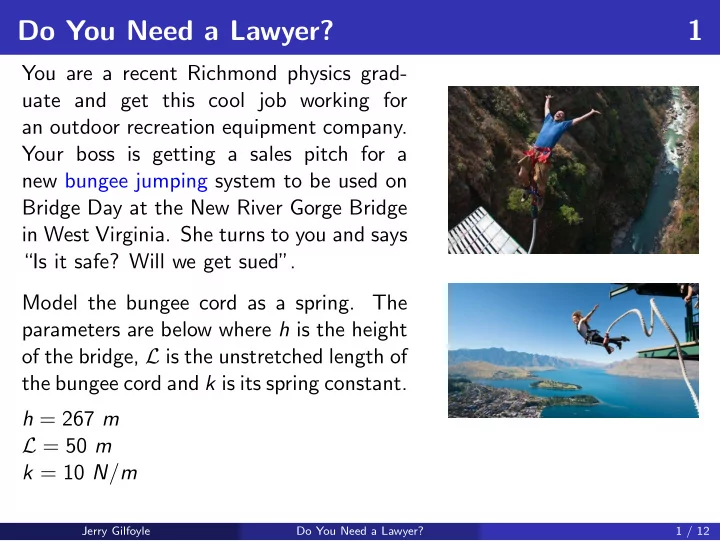
You are a recent Richmond physics grad- uate and get this cool job working for an outdoor recreation equipment company. Your boss is getting a sales pitch for a new bungee jumping system to be used on Bridge Day at the New River Gorge Bridge in West Virginia. She turns to you and says “Is it safe? Will we get sued”. Model the bungee cord as a spring. The parameters are below where h is the height

  • f the bridge, L is the unstretched length of

the bungee cord and k is its spring constant. h = 267 m L = 50 m k = 10 N/m

Jerry Gilfoyle Do You Need a Lawyer? 1 / 12

slide-2
SLIDE 2

Do You Need a Lawyer? 2

You are a recent Richmond physics grad- uate and get this cool job working for an outdoor recreation equipment company. Your boss is getting a sales pitch for a new bungee jumping system to be used on Bridge Day at the New River Gorge Bridge in West Virginia. She turns to you and says “Is it safe? Will we get sued”. Model the bungee cord as a spring. The parameters are below where h is the height

  • f the bridge, L is the unstretched length of

the bungee cord and k is its spring constant. h = 267 m L = 50 m k = 10 N/m

Well?

Jerry Gilfoyle Do You Need a Lawyer? 1 / 12

slide-3
SLIDE 3

Some Work Examples 3

A cart is pulled across a flat surface with a rope at an angle θ = 60◦ to the horizontal for a distance x = 3 m. The magnitude of the force is | F| = 3 N and the mass of the cart is m = 5 kg. Assume the cart rolls with no effect due to friction. What is the work done by the force?

Jerry Gilfoyle Do You Need a Lawyer? 2 / 12

slide-4
SLIDE 4

Integrating the Velocity 4

Time Velocity Jerry Gilfoyle Do You Need a Lawyer? 3 / 12

slide-5
SLIDE 5

Integrating the Velocity 5

Time Velocity Time Velocity Jerry Gilfoyle Do You Need a Lawyer? 3 / 12

slide-6
SLIDE 6

Integrating the Velocity 6

Time Velocity Time Velocity Time Velocity Jerry Gilfoyle Do You Need a Lawyer? 3 / 12

slide-7
SLIDE 7

Work and Variable Forces 7

x F(x) Jerry Gilfoyle Do You Need a Lawyer? 4 / 12

slide-8
SLIDE 8

Work and Variable Forces 8

x F(x) x F(x) Jerry Gilfoyle Do You Need a Lawyer? 4 / 12

slide-9
SLIDE 9

Work and Variable Forces 9

x F(x) x F(x) x F(x) Jerry Gilfoyle Do You Need a Lawyer? 4 / 12

slide-10
SLIDE 10

Variable Forces 10

A spring, when stretched, exerts a restoring force that pulls the spring back to its equilibrium position.

  • Fs = −k

s The vector s is the displacement of the end of the spring from its equilibrium position. A one-dimensional force F1 = 5 N is applied to a spring stretching it from its relaxed, equilibrium state a distance of | s1| = s1 = 0.12 m. Then, an additional force F2 = 2 N is added and the spring stretches another ∆s = 0.05 m. What is the work done by the spring for this last part? The spring constant is k = 42 N/m.

s ∆ Finally Initially

Jerry Gilfoyle Do You Need a Lawyer? 5 / 12

slide-11
SLIDE 11

Mechanical Energy Conservation 11

v

f

∆v ∆x ∆t Velocity Position x i

f

x vi (m) (m/s) Time (s) Time (s)

Jerry Gilfoyle Do You Need a Lawyer? 6 / 12

slide-12
SLIDE 12

Quarks on Springs 12

Two quarks, an up and an anti-down are bound together (much like atoms bind together to make molecules) to form an object known as a pi meson or pion (π+). The force between the quarks can be modeled as a spring force to explain their confinement in the

  • pion. If the spring with the up quark attached is stretched a distance s from equilibrium

and released from rest, then what is the kinetic energy and speed of the up quark when the spring passes through its equilibrium point and becomes relaxed in terms of the spring constant k and the quark mass mq? Treat the position of the anti-down quark as fixed.

anti down anti down

Initially

v=0

Finally

v up quark up quark Jerry Gilfoyle Do You Need a Lawyer? 7 / 12

slide-13
SLIDE 13

The Birthplace of Asteroids 13

The asteroid belt is a region of

  • ur Solar System occupied by many

large rocks and is located between the orbits of Mars and Jupiter. Its center is about rA = 4.0 × 10¹¹ m from the Sun. Suppose an asteroid from this region fell down to the or- bit of Earth (rE = 1.5 × 10¹¹ M). What is the minimum potential en- ergy it would lose? What will be its minimum speed? Some useful num- bers are below. The asteroid mass is typical for asteroids that cross the Earth’s orbit. Solar mass 1.99 × 1030 kg Earth mass 5.98 × 1024 kg Asteroid mass 3.4 × 10¹⁴ kg

951 Gaspra

First image of an asteroid from a spacecraft (Galileo, 1991).

Jerry Gilfoyle Do You Need a Lawyer? 8 / 12

slide-14
SLIDE 14

‘Proof’ of Mechanical Energy Conservation 14 Red - Total energy Blue - Potential energy Green - Kinetic energy

〈ME〉 = 0.07 ± 0.08 J

0.0 0.1 0.2 0.3 0.4 0.5 0.6

  • 1.0
  • 0.5

0.0 0.5 1.0 1.5 t (s) Energy (J)

Jerry Gilfoyle Do You Need a Lawyer? 9 / 12

slide-15
SLIDE 15

‘Proof’ of Mechanical Energy Conservation 15

Red - Total energy Blue - Potential energy Green - Kinetic energy

〈ME〉 = 0.07 ± 0.08 J

0.0 0.1 0.2 0.3 0.4 0.5 0.6

  • 1.0
  • 0.5

0.0 0.5 1.0 1.5 t (s) Energy (J)

〈 〉

Jerry Gilfoyle Do You Need a Lawyer? 10 / 12

slide-16
SLIDE 16

‘Proof’ of Mechanical Energy Conservation 16

Red - Total energy Blue - Potential energy Green - Kinetic energy

〈ME〉 = 0.07 ± 0.08 J

0.0 0.1 0.2 0.3 0.4 0.5 0.6

  • 1.0
  • 0.5

0.0 0.5 1.0 1.5 t (s) Energy (J) Red - Total energy Blue - Potential energy Green - Kinetic energy

〈ME〉=0.34±0.03 J

0.0 0.1 0.2 0.3 0.4

  • 0.2

0.0 0.2 0.4 0.6 t (s) Energy (J)

Jerry Gilfoyle Do You Need a Lawyer? 10 / 12

slide-17
SLIDE 17

‘Proof’ of Mechanical Energy Conservation 17

Red - Total energy Blue - Potential energy Green - Kinetic energy

〈ME〉 = 0.07 ± 0.08 J

0.0 0.1 0.2 0.3 0.4 0.5 0.6

  • 1.0
  • 0.5

0.0 0.5 1.0 1.5 t (s) Energy (J) Red - Total energy Blue - Potential energy Green - Kinetic energy

〈ME〉=0.34±0.03 J

0.0 0.1 0.2 0.3 0.4

  • 0.2

0.0 0.2 0.4 0.6 t (s) Energy (J)

Which one is better?

Jerry Gilfoyle Do You Need a Lawyer? 10 / 12

slide-18
SLIDE 18

Do You Need a Lawyer? 18

You are a recent Richmond physics grad- uate and get this cool job working for an outdoor recreation equipment company. Your boss is getting a sales pitch for a new bungee jumping system to be used on Bridge Day at the New River Gorge Bridge in West Virginia. She turns to you and says “Is it safe? Will we get sued”. Model the bungee cord as a spring. The parameters are below where h is the height

  • f the bridge, L is the unstretched length of

the bungee cord and k is its spring constant. h = 267 m L = 50 m k = 10 N/m

Jerry Gilfoyle Do You Need a Lawyer? 11 / 12

slide-19
SLIDE 19

Hints for ‘Work and Kinetic Energy’ 19

1 Work done by a force - force and displacement are in the same

direction.

2 Work done against/on a force - force and displacement are in

  • pposite directions.

Jerry Gilfoyle Do You Need a Lawyer? 12 / 12