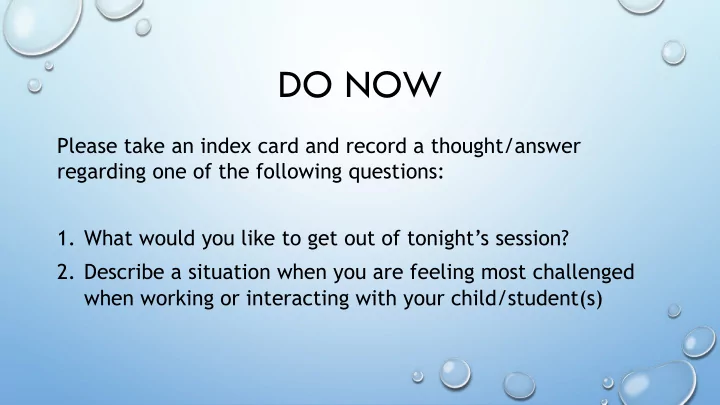
DO NOW Please take an index card and record a thought/answer - - PowerPoint PPT Presentation

do now
SMART_READER_LITE
LIVE PREVIEW

DO NOW Please take an index card and record a thought/answer - - PowerPoint PPT Presentation

DO NOW Please take an index card and record a thought/answer regarding one of the following questions: 1. What would you like to get out of tonights session? 2. Describe a situation when you are feeling most challenged when working or


slide-1
SLIDE 1

DO NOW

Please take an index card and record a thought/answer regarding one of the following questions:

  • 1. What would you like to get out of tonight’s session?
  • 2. Describe a situation when you are feeling most challenged

when working or interacting with your child/student(s)

slide-2
SLIDE 2

CREATING MINDFUL 
 HOMES AND CLASSROOMS

MARLEE SCHWARTZ, PH.D. DEANNA SPOTO, PSY .D. KATONAH-LEWISBORO SCHOOL DISTRICT

slide-3
SLIDE 3

BUT FIRST…A MINDFUL MOMENT

slide-4
SLIDE 4

WHAT IS MINDFULNESS?

Complete awareness: increasing one’s awareness to thoughts, feelings, feelings, physical sensation, behaviors, etc. In the present moment. Attentional control: staying focused on one thing at a time in the moment; opposite of multi tasking

PAYING ATTENTION… ON PURPOSE IN THE MOMENT WITHOUT JUDGEMENT

slide-5
SLIDE 5

DIALECTICAL BEHAVIOR THERAPY (DBT)

slide-6
SLIDE 6

DIALECTICAL BEHAVIOR THERAPY (DBT)

  • Dialectical = two opposite things can be true at the same

time

  • There is always more than one way to think about a

situation

  • A meaningful life has both happiness and sadness, joy and

pain, and all of these aspects are necessary and valuable

  • Much of DBT is helping students see life in “gray”, rather

than “black or white”

  • This is done with balancing acceptance, pushing change, and

validating emotions, while trying to solve problems

  • Mindfulness allows us to achieve a dialectical mindset**
slide-7
SLIDE 7

ASSUMPTIONS OF DBT

  • 1. People are doing the best they can.
  • 2. People want to improve and be better.
  • 3. People need to do better, try harder, be more effective, and more

motivated to change.

  • 4. People may not have caused all of their own problems, and they have

to solve them anyway.

  • 5. All people must learn new behaviors in different situations in their lives

(e.g., home, school, work, community).

  • 6. There is no absolute truth.
slide-8
SLIDE 8

SKILL #1: 
 ACTIVATING “WISE MIND”

slide-9
SLIDE 9
slide-10
SLIDE 10

Rational Mind

  • Reading a

subway map

  • Measuring

ingredients to bake a cake

  • Creating a

budget Wise Mind

  • Taking a

time-out in the middle of a fight to avoid saying something you don’t mean

  • Going with a

“gut” feeling Emotion Mind

  • Riding a

rollercoaster

  • Fighting with

your partner

  • Learning

about the death of a loved one

  • Falling in

love

slide-11
SLIDE 11

HOW TO ACHIEVE “WISE MIND”

  • Observe: Don’t push away thoughts and feelings, just let

them happen, even when they are distressing

  • Describe: Label what you observe with words and without

judgement (e.g. “I feel angry with my son or daughter for talking back to me”)

  • Participate: Experience even negative emotions fully to help

your wise mind make a decision about what to do (instead of acting impulsively or avoiding)

  • Validate: Acknowledge and empathize with your own

feelings, as well as you child’s or student’s feelings.

slide-12
SLIDE 12

SKILL #2: 
 “RIDE THE WAVE” 
 NOTICE THE “META MOMENT”

slide-13
SLIDE 13

EVENT: Something happens in the environment, or you think about something (like a memory)

THOUGHTS: What goes through my mind What I think happened FEELINGS: Emotional reaction Physiological reactions

META MOMENT (URGE): What you WANT to do

  • r say?

ACTIONS: What you do with your words or behaviors CONSEQUENCES: Thoughts, feelings, behaviors, actions, rewards, punishments STOP and breathe Press Pause Be mindful “Ride the Wave” Notice your “best self”

slide-14
SLIDE 14
slide-15
SLIDE 15

“RIDE THE WAVE”
 “NOTICE THE META-MOMENT”

EVENT: Your child will not get off the iPad/ phone to study for his math test FEELING: Frustrated,, Exasperated, Impatient URGE: Yell, scream, and take away the phone for a week. ACTION ☺ ACTION ☹ CONSEQUENCE ☺ CONSEQUENCE ☹

PRESS PAUSE META MOMENT RIDE THE WAVE

PARENT EXAMPLE:

THOUGHT: “He NEVER listens” “I can’t take it anymore!”

slide-16
SLIDE 16

“RIDE THE WAVE”
 “NOTICE THE META-MOMENT”

EVENT: Student is still talking in class after multiple warnings

FEELING: Angry, Annoyed URGE: Raise your voice, send student to principal’s office ACTION ☺ ACTION ☹ CONSEQUENCE ☺ CONSEQUENCE ☹

PRESS PAUSE META MOMENT RIDE THE WAVE

TEACHER EXAMPLE:

THOUGHT: “I want this student OUT of my classroom!”

slide-17
SLIDE 17

QUESTIONS?

slide-18
SLIDE 18

SMALL GROUP DISCUSSION

Share with your group the challenges/needs from your index cards and how you can use the skills (wise mind, ride the wave/meta-moment) to better address these situations with your child/ student.

slide-19
SLIDE 19

LARGE GROUP DISCUSSION