DIY Bl DIY Block ck-Parallel el Da Data An Analysis Scientific - - PowerPoint PPT Presentation

diy bl diy block ck parallel el da data an analysis
SMART_READER_LITE
LIVE PREVIEW

DIY Bl DIY Block ck-Parallel el Da Data An Analysis Scientific - - PowerPoint PPT Presentation

DIY Bl DIY Block ck-Parallel el Da Data An Analysis Scientific Achievement Master Assigner Decomposer DIY is a programming model and runtime for block-parallel Block loading Decomposition Mapping blocks Application analytics on DOE


slide-1
SLIDE 1

DIY DIY Bl Block ck-Parallel el Da Data An Analysis

Work was performed at Argonne and Lawrence Berkeley National Labs. [1] Morozov and Peterka, Block-Parallel Data Analysis with DIY2, LDAV 2016. [2] Morozov and Peterka, Efficient Delaunay Tessellation through K-D Tree Decomposition, SC16. [3] Nashed et al., Parallel Ptychographic Reconstruction, Optics Express 2014.

Scientific Achievement Significance and Impact Research Details

DIY is a programming model and runtime for block-parallel analytics on DOE leadership machines; all parallel operations and communications are expressed in terms of blocks, not processors, which enables the same program to run in- and out-of-core with single or multiple threads. DIY enabled Delaunay and Voronoi tessellation of cosmology dark matter particles to 128K processes and improved performance by 50X [2], and it enabled ptychographic phase retrieval of synchrotron X-ray images on 128 GPUs in real time [3]; DIY won an honorable mention paper at LDAV 2016 [1].

§ Enabling VTK-m by DIY-ing various VTK distributed-memory filters: parallel resampling, multipart dataset redistribution, and stream tracing. § Ongoing preparation for exascale: relaxing synchronization, using deeper memory hierarchy, compatibility with many-core thread models.

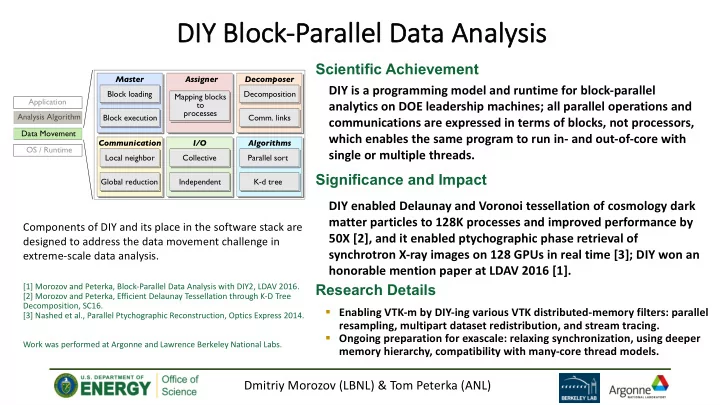
Master Block execution Block loading Assigner Mapping blocks to processes Decomposer

  • Comm. links

Decomposition Communication Global reduction Local neighbor I/O Independent Collective Algorithms K-d tree Parallel sort Data Movement Analysis Algorithm Application OS / Runtime

Components of DIY and its place in the software stack are designed to address the data movement challenge in extreme-scale data analysis.

Dmitriy Morozov (LBNL) & Tom Peterka (ANL)

slide-2
SLIDE 2

Scientific Achievement Fermilab researchers developed two HPC parallel codes using DIY.

  • Pythia8 Monte Carlo event generator

[1]

  • Feldman-Cousins correction [2]

Significance and Impact DIY efficiently utilizes HPC workflows, resources, and HEP community tools. Research Details

  • Allows for extremely short turn-around of

large parameter space explorations (e.g. generator tuning)

  • Paves the way for new and advanced
  • ptimization algorithms, e.g. LHC search

analyses.

Par aralle allel l Ev Event Generation and Analysis with DIY DIY

Scalability: Top: strong scaling of Pythia8 DIY code. Bottom: weak scaling of Feldman-Cousins DIY code.

Work was performed at Argonne and Fermilab under SciDAC HEP

  • n HPC Partnership

[1] Buchanan et al., JINST 2020 (in preparation) [2] Hoche et al., arXiv 2019. [3] Sousa et al., CHEP 2018.

Event generator model for proton-proton collision: Robust predictions of collider events are needed to search for new physics effects. Much of the dynamics is described by tunable parameters. The calculation of event generator predictions is expensive, and must be done for each choice of

  • parameters. A full detector

simulation of these calculations is even more expensive, requiring parallel HPC codes.

slide-3
SLIDE 3

IE IExchange: : Pr Programming

Work was performed at LBNL and ANL Morozov et al., IExchange: Generic Asynchronous Pattern for Interleaved Computation and Communication, in preparation, 2019.

Compute and Exchange Asynchronous Termination Detection Synchronize and End Compute Exchange Messages Synchronous Global Computation of Total Work End

for (max_rounds) { master.foreach(foo); master.exchange(); all_done = reduce(local_work); // synch. collective if (all_done) break; } master.iexchange(bar); void foo() { deque_icoming(); compute(); enqueue_outgoing(); } bool bar() { do { dequeue_incoming(); compute(); enqueue_outgoing(); } while (fill_incoming()); return true; }

Old Synchronous Exchange New Asynchronous IExchange

slide-4
SLIDE 4

IE IExchange: : Termination De Detection

Work was performed at LBNL and ANL Morozov et al., IExchange: Generic Asynchronous Pattern for Interleaved Computation and Communication, in preparation, 2019.

Compute and Exchange Asynchronous Termination Detection Synchronize and End Compute Exchange Messages Synchronous Global Computation of Total Work End Old Synchronous Exchange New Asynchronous IExchange

State 0: local work = 0 State 1: locally entered ibarrier No state: communicate & compute State 2: everyone entered ibarrier Stop State 0: communicate & compute State 1: communicate & compute

Global work > 0 Enter ibarrier Not all others entered ibarrier All others entered ibarrier Global work = 0

slide-5
SLIDE 5

Scientific Achievement

Interleaved asynchronous communication pattern for iterative computations in DIY

  • Eliminates global synchronization on every iteration
  • Easier to use: asynchronous communication and

termination detection handled by DIY

Significance and Impact

Irregular imbalanced workloads can be accelerated using IExchange.

Research Details

  • Asynchronous communication and termination

detection, interleaved with computation

  • Handles non-monotonic progress and/or unknown

amount of global work.

IE IExchange: : As Asyn ynch chronous Co Communication and Co Computation in DIY DIY

Scalability: strong scaling plot shows iexchange up 3.5X faster and 5.4X better efficiency than exchange for particle tracing in Nek5000 thermal hydraulics application.

Work was performed at LBNL and ANL Morozov et al., IExchange: Generic Asynchronous Pattern for Interleaved Computation and Communication, in preparation, 2019.

Compute and Exchange Asynchronous Termination Detection Synchronize and End Compute Exchange Messages Synchronous Global Computation of Total Work End Old Synchronous Exchange New Asynchronous IExchange