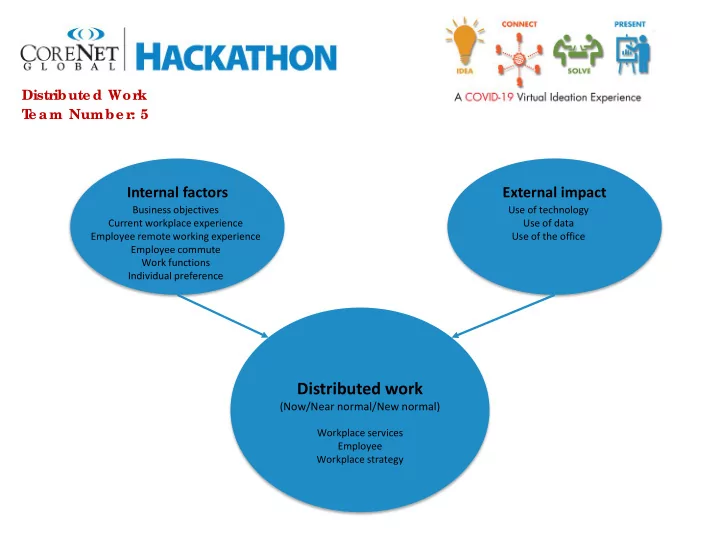
Distributed work (Now/Near normal/New normal) Workplace services - - PowerPoint PPT Presentation
Distribute d Work T e a m Numbe r: 5 Internal factors External impact Business objectives Use of technology Current workplace experience Use of data Employee remote working experience Use of the office Employee commute Work functions
Now (From Covid until Office Return) NEAR NORMAL (Office Return 6 months) NEW NORMAL (Post 6-18 months after return)
Political
- Lockdown Rules – New way of working and Living:
Lockdown / Policing / Quarantine
- Regulation: PPE Wearing
- PPE Required In offices and public places
- Temperature taking
- Forced political decision, rather than the RIGHT thing to do
- New Laws address cleaning
- Medical Profession revamp
- Workplace HSE now applied at home
Economic
- Fear of job loss/earning Risk
- Cost Value Efficiency – GRE Real Estate Portfolios
questioned
- Employees Furloughed: Reduced Salary/No Work
- Employees: Reduced Salary – Less Motivation
- Travel Bans – Savings on Company Travel (Airlines affected)
- Perceived productivity is higher in some sectors
- Construction continues with skeleton staff (country
specific)
- Job Security improvement
- Return to work and wages improve
- Travel Ban continues/Limited
- Benefits packages change to include work experience
solutions/Technology improvements for home
- Global recession continues except for FMCG, Life sciences,
Tech and logistics
- Construction will continue – developers may need financial
restructuring
- New jobs for some
- Y-o-y Salary increases discussed
- Bonus discussions continue
- Some professions look into Leaner teams
- Serviced offices/Flex up down leases/Terms on leases –
challenged
- Some professions/job types will cease to exist.
- Wages stagnate --> cost of living reduces
- Construction spacial distancing implementation
Social
- Home Schooling/Children at home Challenges: requirement
for flexible working hours
- Isolation – effects to wellness
- Ground Hog Day – Monotony
- Family/Friends – Virtual Socialising only
- Employees: Working from Home – Overworked / Tired /
Productivity
- Office utilisation only 20-50%
- Children remain at home through summer / Return to
school September?
- Social distancing remains but more lax
- General wellness improvements until winter in Northern
Hemisphere
- Office becomes a space for social collaboration
- Utilisation in office remains lower than pre-covid
- People priorities self over work, part time work, more time
with family/leisure --> 4 day week prevails.
- Graduate impact: new way of socialising
- WFH is socially acceptable
- WFH policies incl. funding for employee’s home office
Technological
- Mobile Workforce: Increase in Laptop(s) + Mobile Devices
- Connectivity/Bandwidth - Restrictions. Provision of data
cards (depending on bandwidth/location)
- VOIP Increase
- Video conference increase
- Video conferencing remains
- PCs become replaced – workforce DRP (disaster recovery
plans)
- Drive to train and teach virtual collaboration
- Non-video call collaboration gains traction
- Smart buildings: implementing smart sensors, contactless
building entry
- Video conference remains norm
- Travel peaks and than drops off to a lower than pre covid
average
- Agile hub offices increase
- Automation becomes the new norm (robotics)
- Policy for teleworkers incl. Reimbursement of home
internet Environmental
- Social Environment: Workplace Experience – do people
have Study
- Less Commuting / Travel– Less Pollution
- Increased Air Quality
- Workplace will have sptcial distancing
- Pollution improves/Air quality – Less commuting but use of
car will increase in some areas
- Canteens – Limited services
- Cleaning – Visible in workplace and more frequent
- Travel peaks and than drops off to a lower than pre covid
average
- Pollution improves/Air quality – Less commuting
Legal
- Labour law – Employee contracts are followed (country
specific)
- Regulatory
- Labour law – % Employee contracts are amended to more
home working to use office as touchdown
- RE Case Law change – Force Majeure clauses redefined –
Long Stop Dates questioned
- Move to more flexible contracts in GRE
Distribute d Work T e a m Numbe r: 5
PESTEL analysis
Distribute d Work T e a m Numbe r: 5
Impacts Now NEAR NORMAL NEW NORMAL
Workplace services (IFM) N/A
- Covid 19 additional Resources continue to impact WS
- Change control on existing FM contracts --> increased costs
- CAPEX investment to adapt offices for return to work
- Teams operating in two environments --> home and office.
- Employee's home set up deployment
- Wellness: Investing in additional cycle/running facilities (locks and showers)
- Rapid deployment of smart workplace tech I.e occupancy sensors
- Assertive workplace comms and mandatory policies. Active management and
enforcement.
- Strategic encouragement to return workforce to the office –
Branding/Fun/Beneifts
- Catering Facilities onsite remain closed/limited
- Operating costs begin to stabilise
- Collaboration space gets larger, but for less people (less dense)
- Office utilisation lower than pre Covid
- Office becomes “drop in” centre and monthly onsite meetings increase
creating peak days in utilisation
- Typical Monday Meetings collaboration shift to throughout week
- On site amenity space becomes more popular as social space --> demand
more variety and innovation
- WS becomes data hungry to start DRP/Strategy Planning: Collection and
analysis of realtime workplace performance data is mandatory --> birth of the Workplace Performance Manager Employee impact N/A
- Active commuting prevails --> walking, cycling and running
- Driving will increase to maintain social distancing outside major metropolitan
cities I.e. London, Paris, Berlin etc.
- Digital collaboration and working continues
- Work Force Reduction (WFR) kicks in
- Active commuting prevails --> walking, cycling and running
- Driving will increase to maintain social distancing outside
major metropolitan cities I.e. London, Paris, Berlin etc.
- Use of apps to determine non-peak times I.e. city mapper etc. Staggered
commutes into workplaces
- Decentralisation: City Living is questioned for Surburbia. House renters move
into larger homes, with a study space, outside expensive location Workplace strategy N/A
- Portfolios under close review – LTP vamped up
- Immediate reaction unlikely due to “traditional Lease constraints”/Terms
- Those with existing options in flex providers, will utilise memberships in suburban
areas (closer to where people live, outside city centres) – Hub offices may increase (?)
- Flex Leasing is highly considered in LTP
- Smart Building Investment becomes a key topic
- Technology is the new hot topic in buildings – OpEx increases to convert to smart
buildings
- Workplace strategy (layout, worksettings) does a 180, more space, no/limited
workstations.
- Location strategy changes from 'how do people get to the office' to 'how do
people stay away from the centralised office‘
- Companies preparing Disaster Recovery Plans
- Considerations for new leasing models: Flex up/down, less traditional
leasing/hub offices/reduction in office space
- With workplace environment changing to collaboration the “future of office
development” will come into question
- Technology and Smart Buildings becomes new Occupier criteria
Sector Specific Considerations
- FMCG, Life sciences, Tech and logistics, public sector --> continue growth plans
but with constraints on social distancing
- CRE teams in reactive mode
- Other sectors focus on changing business strategy to survive and grow in the new
normal --> CRE teams not a priority until outcome is clear.
- IT departments future role as stand along function challenged
- The workplace is no longer seen as the differentiator between companies.
- CRE sphere of influence/responsibility is now Total. Home, work and
everything in between.
- Investment in coaching teams to work effectively whilst working remotely or
with a split population. New roles within organisations, that sit outside IT, CRE and HR. Scrum master approach.
Impacts description
Distribute d Work T e a m Numbe r: 5
Employee Impact – Employee Profiles
Those that want to Those that don’t have to Those that don’t want to Those that remain undecided
Including those who:
- Like being seen
- Enjoy/Need Collaboration
- Thrive around others
Enjoy time at the office
- ver home
- Are in young adulthood
life stage without proper home office solution
- Need the initial office
stimulation post lockdown Including those who:
- Have accepted a home
working contract – Job profile
- Are in middle adulthood
life stage and invested in home office solution
- Enjoy the new work/life
balance Including those who:
- Are anxious about the
near normal
- Enjoyed homelife
- Do not have a job profile
for home work Including those who:
- Are unsure what is
“deemed” to be the right thing to accept for their career
- Enjoyed Homelife
- 50/50 Job Profilers
Those that have to
Including those who:
- Have a job profile that
service the office: Cleaners, Security, Facilities
D A B C E
Distribute d Work T e a m Numbe r: 5
Government and Legal Support for Distributed Work Personal Preference for Distributed Work Internal Culture Supporting Distributed Work Customer / Client Support for Distributed Work Technology and Infrastructure Support for Remote Working Near Normal Pre-Coronavirus Optimized for Core Office Optimized for Remote Working Arrows show transition from pre-coronavirus to 'near normal'
As we transition to 'Near Normal' we will see continued support for remote working
Distribute d Work T e a m Numbe r: 5
As we transition to a 'New Normal' post-Coronavirus we are likely to see a more balanced distribution between core space and remote working
Government and Legal Support for Distributed Work Personal Preference for Distributed Work Internal Culture Supporting Distributed Work Customer / Client Support for Distributed Work Technology and Infrastructure Support for Remote Working New Normal Pre-Coronavirus Optimized for Core Office Optimized for Remote Working Arrows show transition from 'near normal' to 'new normal'
Distribute d Work T e a m Numbe r: 5
Impact to employee vs. work functions
Employee profiles
A B C D E
Those that don’t have to return Those that don’t want to return Those that want to return Undecided Those that have to return
1 2 3 4 5
Business operations (incl. finance, HR, IT, CRE) Specialist (incl. risk, compliance, legal) Management & executives Sales and delivery Visitors
Work functions
Now phase
Workforce distribution
Core
- ffice
New now Near now phase
Timing
Remote
D C B
5 4 3 2 1
E E B C D A
1 2 3 4
B A
1
E C D
2 3 4 5 5
A
Distribute d Work T e a m Numbe r: 5
Opportunities for CRE Employee experience Cost reduction
Employee choice and flexibility Increased use
- f data
Robotics Smart buildings Workplace sustainability Flexible offices / third spaces Employee wellbeing Hygiene
Distribute d Work T e a m Numbe r: 5
Big data will support workplace performance managers
Available now Workplace performance manager
Macro trends and forecasts
- Industry growth and contractions
- External environmental conditions
- Economic changes
- Technology developments
Efficiency
- Room booking data – who, when and why
- Digital tools usage
- Network analysis – who engages with
who
- Adoption and training completed
- IT helpdesk support tickets - profiled
- Financial performance of departments
Portfolio
- Global workplace locations, assets and class
- Total occupancy costs
- NIA (m2)
- Critical lease dates – expiries, renewals, breaks
- CAPEX investments – past, present, future
Employee
- Experience data
- Health and wellbeing
data
- Commute modes
- Job functions
- Home location
- Sick days
- Education and training
- Satisfaction survey
information (Pulse checks)
- Workplace social
media analytics
Premises
- Real time site and work
setting utilisation
- Catering purchases
- Indoor environmental
performance – temp, CO2, PPM, VOC etc.
- Hard service
performance indicators
- Digitised space and
stack plans
- FF&E data
- Energy use
- Facilities service costs
Investment required