Dissolved Oxygen In Lakes: background, data collection, and analysis - - PowerPoint PPT Presentation

dissolved oxygen in lakes
SMART_READER_LITE
LIVE PREVIEW

Dissolved Oxygen In Lakes: background, data collection, and analysis - - PowerPoint PPT Presentation

Dissolved Oxygen In Lakes: background, data collection, and analysis 10/23/07 Workgroup Meeting 31.16 Table 1. Footnote #9 The dissolved oxygen criteria is intended to apply to The dissolved oxygen criteria is intended to apply to the


slide-1
SLIDE 1

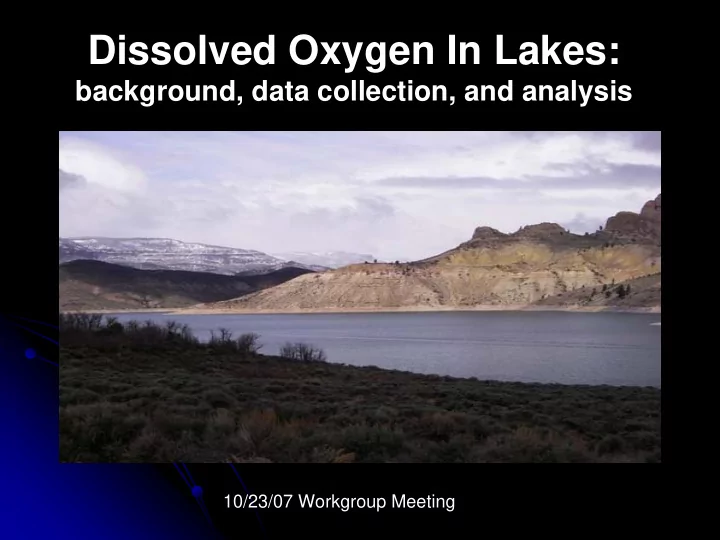
Dissolved Oxygen In Lakes:

background, data collection, and analysis

10/23/07 Workgroup Meeting
slide-2
SLIDE 2

31.16 Table 1. Footnote #9

‘The dissolved oxygen criteria is intended to apply to ‘The dissolved oxygen criteria is intended to apply to the epilimnion and metalimnion strata of lakes and the epilimnion and metalimnion strata of lakes and

  • reservoirs. Dissolved oxygen in the hypolimnion may,
  • reservoirs. Dissolved oxygen in the hypolimnion may,

due to the natural conditions, be less than the table due to the natural conditions, be less than the table

  • criteria. No reductions in dissolved oxygen levels due
  • criteria. No reductions in dissolved oxygen levels due

to controllable sources is allowed.’ to controllable sources is allowed.’

Questions about the interpretation of this footnote arose during temperature criteria development and during discussions of 303(d) listing methodology.

slide-3
SLIDE 3

‘Adequate Refuge’ Concept for Temperature Criteria in Lakes

Adequate refuge depends on concurrent Adequate refuge depends on concurrent attainment of applicable dissolved oxygen attainment of applicable dissolved oxygen

  • standards. (31.16
  • standards. (31.16, Table 1, footnote c, iii)

, Table 1, footnote c, iii)

slide-4
SLIDE 4

Spring Turnover

Wind gases

Lake water is uniform in temperature and oxygen. When wind blows, lake mixes from top to bottom.

slide-5
SLIDE 5

Summer Stratification

Sun and warm air heat the top layer of the lake. Epilimnion is warm and water is less dense. Metalimnion is characterized by rapid temperature change called the thermocline. Hypolimnion is cool and water is more dense.

Epilimnion Metalimnion Hypolimnion

slide-6
SLIDE 6

Summer Stratification

Wind

When wind blows, only epilimnion mixes, and exchanges gases with atmosphere. Waters of epilimnion resist mixing with cooler water due to the density gradient.

Epilimnion Metalimnion Hypolimnion gases

slide-7
SLIDE 7

Summer Stratification

Plankton and other organic material fall to the bottom. Decomposers consume the organic material and oxygen. Oxygen decreases in the hypolimnion throughout the

  • summer. Diffusion is not efficient enough to re-supply oxygen

in the hypolimnion.

Epilimnion Metalimnion Hypolimnion Plankton/organic matter gases Decomposers O2 CO2

slide-8
SLIDE 8

Data Collection

  • Temperature profiles

Temperature profiles

  • D.O. profiles

D.O. profiles

  • pH profiles

pH profiles

  • Chlorophyll

Chlorophyll α α

  • Nutrient data (especially total P)

Nutrient data (especially total P)

Data will be used to create two databases, one for warm lakes/res, and one for cold. The warmwater database will be completed first.

slide-9
SLIDE 9

Sites Collected

  • Adobe Creek

Adobe Creek

  • Arvada

Arvada

  • Aurora

Aurora

  • Barr

Barr

  • Boulder

Boulder

  • Boyd

Boyd

  • Carter

Carter

  • Cherry Creek

Cherry Creek

  • Fruitgrowers

Fruitgrowers

  • Henry

Henry

  • Highline

Highline

  • Horse Creek

Horse Creek

  • Horseshoe

Horseshoe

  • Jackson

Jackson

  • John Martin

John Martin

  • Jumbo

Jumbo

  • Kenney

Kenney

  • Loveland

Loveland

  • Lonetree

Lonetree

  • Meredith

Meredith

  • Milton

Milton

  • Narraguinnep

Narraguinnep

  • Neegronda

Neegronda

  • North Sterling

North Sterling

  • Prewitt

Prewitt

  • Prospect

Prospect

  • Puett

Puett

  • Quincy

Quincy

  • Rio Blanco

Rio Blanco

  • Standley

Standley

  • Sweitzer

Sweitzer

  • Totten

Totten

  • Union

Union

slide-10
SLIDE 10

Warmwater Database

  • Available in early 2008

Available in early 2008

  • Look for relationships between oxygen

Look for relationships between oxygen depletion, chlorophyll concentrations, nutrients, depletion, chlorophyll concentrations, nutrients, and fishery health. and fishery health.

  • Investigate natural variability in

Investigate natural variability in hypolimnetic hypolimnetic D.O. D.O.