Disruptive Physicians: Disruptive Physicians: From Credentialing to - - PowerPoint PPT Presentation

disruptive physicians disruptive physicians from
SMART_READER_LITE
LIVE PREVIEW

Disruptive Physicians: Disruptive Physicians: From Credentialing to - - PowerPoint PPT Presentation

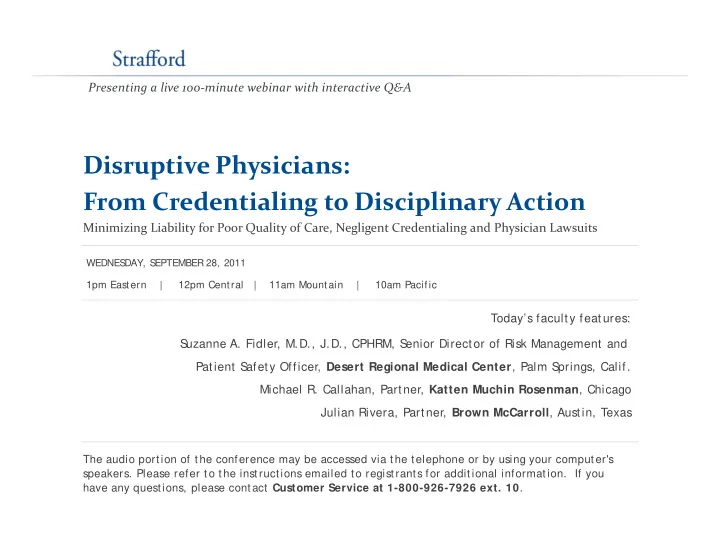
Presenting a live 100 minute webinar with interactive Q&A Disruptive Physicians: Disruptive Physicians: From Credentialing to Disciplinary Action Minimizing Liability for Poor Quality of Care, Negligent Credentialing and Physician Lawsuits


slide-1
SLIDE 1

Presenting a live 100‐minute webinar with interactive Q&A

Disruptive Physicians: Disruptive Physicians: From Credentialing to Disciplinary Action

Minimizing Liability for Poor Quality of Care, Negligent Credentialing and Physician Lawsuits

T d ’ f l f

1pm Eastern | 12pm Central | 11am Mountain | 10am Pacific WEDNES DAY, S EPTEMBER 28, 2011

Today’s faculty features: S uzanne A. Fidler, M.D., J.D., CPHRM, S enior Director of Risk Management and Patient S afety Officer, Desert Regional Medical Center, Palm S prings, Calif. Michael R. Callahan, Partner, Katten Muchin Rosenman, Chicago Julian Rivera, Partner, Brown McCarroll, Austin, Texas

The audio portion of the conference may be accessed via the telephone or by using your computer's

  • speakers. Please refer to the instructions emailed to registrants for additional information. If you

have any questions, please contact Customer Service at 1-800-926-7926 ext. 10.

slide-2
SLIDE 2

Conference Materials

If you have not printed the conference materials for this program, please complete the following steps:

  • Click on the + sign next to “ Conference Materials” in the middle of the left-

hand column on your screen hand column on your screen.

  • Click on the tab labeled “ Handouts” that appears, and there you will see a

PDF of the slides for today's program.

  • Double click on the PDF and a separate page will open.

Double click on the PDF and a separate page will open.

  • Print the slides by clicking on the printer icon.
slide-3
SLIDE 3

Continuing Education Credits

FOR LIVE EVENT ONLY

For CLE purposes, please let us know how many people are listening at your location by completing each of the following steps:

  • Close the notification box
  • In the chat box, type (1) your company name and (2) the number of

attendees at your location

  • Click the S

END button beside the box

slide-4
SLIDE 4

Tips for Optimal Quality

S d Q lit S

  • und Quality

If you are listening via your computer speakers, please note that the quality of your sound will vary depending on the speed and quality of your internet connection. If the sound quality is not satisfactory and you are listening via your computer speakers, you may listen via the phone: dial 1-866-871-8924 and enter your PIN when prompted Otherwise please send us a chat or e mail when prompted. Otherwise, please send us a chat or e-mail sound@straffordpub.com immediately so we can address the problem. If you dialed in and have any difficulties during the call, press *0 for assistance.

Viewing Qualit y

To maximize your screen, press the F11 key on your keyboard. To exit full screen, press the F11 key again press the F11 key again.

slide-5
SLIDE 5

The Challenges of Addressing Disruptive Behavior in the Disruptive Behavior in the Community Hospital Setting

Suzanne A Fidler M D J D CPHRM Suzanne A. Fidler, M.D., J.D., CPHRM Senior Director of Risk Management Patient Safety Officer 949‐631‐0055 drfidler@physicianforlaw.com

5

slide-6
SLIDE 6

The Joint Commission (TJC) The Joint Commission (TJC) “Behaviors that undermine a culture of safety”

  • All accreditation programs must adopt a code of
  • All accreditation programs must adopt a code of

conduct that defines disruptive, unacceptable

  • behaviors. (EP 4)
  • Leaders create and implement a process for

managing disruptive and inappropriate behaviors. (EP 5; Behaviors that Undermine a Culture of Safety, (EP 5; Behaviors that Undermine a Culture of Safety, TJC, Sentinel Event Alert, Issue 40, July 8, 2008)

6

slide-7
SLIDE 7

fi i “ i i h i ” Defining “Disruptive Behavior”

  • No clear definition of what constitutes disruptive behavior

No clear definition of what constitutes disruptive behavior.

  • American Medical Association Code of Medical Ethics:

“disruptive behavior” is defined as “personal conduct, whether verbal or physical that negatively affects or whether verbal or physical, that negatively affects or potentially may negatively affect patient care.”

  • Excluded is “criticism that is offered in good faith with the

aim of improving patient care.”

7

slide-8
SLIDE 8

One Approach

  • Administration delegates the preparation of the policy to

the Chief of Staff Chi f f S ff ll b i h h M di l S ff

  • Chief of Staff collaborates with the Medical Staff attorney

to draft policy

  • At the General Staff Meeting, the policy is presented to

At the General Staff Meeting, the policy is presented to the medical staff

8

slide-9
SLIDE 9

P bl ? Problems?

  • Physicians voice opposition to the policy

Several physicians set up an ad hoc committee to discuss

  • Several physicians set up an ad‐hoc committee to discuss

the policy

  • Other physicians bring sample policies from organizations

such as the American Medical Association

  • Some physicians threaten to move their practices

9

slide-10
SLIDE 10

Ph i i ’ P ti Physicians’ Perspective

  • Medical staff is self‐governing

Physicians are not the only offenders

  • Physicians are not the only offenders
  • Peer Review as a tool by those in positions of power
  • Competition, economic tool

Competition, economic tool

  • Recredentialing process
  • Outspoken or unpopular physicians may be perceived as

“disruptive”

10

slide-11
SLIDE 11

P t ti Off d Protections Offered

  • Establish a clear channel to report disruptive behavior

Objective data collection

  • Objective data collection
  • Ensure code of conduct is incorporated into the medical

staff rules and bylaws

  • Focus on rehabilitation rather than discipline
  • Hospital maintains a culture that is supportive and

f f inculcates a positive collaborative culture of safety

11

slide-12
SLIDE 12

Focus on Rehabilitation, Focus on Rehabilitation, Not Discipline

  • Adopt a standardized mechanism to investigate and

document disruptive behavior p

  • Establish an informal review process
  • Collegial intervention should be established

d d d d

  • Administration provides education and training
  • Appropriate referral process for physicians requiring

evaluation, diagnosis, and treatment g

  • Monitoring procedure for the physicians and safety of

patients

12

slide-13
SLIDE 13

D H t

  • Dr. Hart
  • Dr. Hart is an electrophysiologist who is well trained from

a distinguished medical program. H d h i bli h i

  • He moved to the community to establish a private

electrophysiology cardiology practice.

  • Dr. Hart typically gets irritated if he is paged and the
  • Dr. Hart typically gets irritated if he is paged and the

nurses cannot answer questions such as the interpretation of the rhythm strips, the current vital signs, and test results and test results.

13

slide-14
SLIDE 14

P ti t T Patient Tom

  • Patient Tom is a 55‐year‐old executive with a long history
  • f smoking hypertension and obesity
  • f smoking, hypertension, and obesity.
  • He is at risk for heart disease and has been admitted for

further cardiac testing.

  • Dr. Hart plans to perform an electrophysiology study in

the morning if the patient has no further chest pain.

14

slide-15
SLIDE 15

N J Nurse Jane

  • Nurse Jane is a recent graduate from a local nursing

school and this is her third month working the night shift. g g

  • The nurses are instructed that due to the recent CPOE

(computer provider order entry) implementation, no verbal orders from physicians will be accepted verbal orders from physicians will be accepted.

  • Around 9 p.m., patient Tom complains of chest pain.
  • Nurse Jane checks Tom’s vital signs, listens to his heart,

f and follows the cardiac protocol by administering nitroglycerin.

  • After 10 minutes, patient Tom states that his chest pain

, p p has not improved.

15

slide-16
SLIDE 16

P i D H t Paging Dr. Hart

  • Nurse Jane places a call to Dr. Hart’s exchange.

Dr Hart does not call back within 15 minutes and patient

  • Dr. Hart does not call back within 15 minutes and patient

Tom still has chest pain.

  • Nurse Jane places a second call to Dr. Hart’s exchange.
  • Dr. Hart does not call back, so Nurse Jane places a third

call to Dr. Hart.

16

slide-17
SLIDE 17

D H t’ C ll

  • Dr. Hart’s Call
  • Dr. Hart calls back and Nurse Jane begins to present to Dr.

Hart the purpose of her call using SBAR for effective p p g communication per the hospital’s standards.

  • Dr. Hart interrupts her and demands to know why she did

not give patient Tom additional nitroglycerin not give patient Tom additional nitroglycerin.

  • Before Nurse Jane can answer, Dr. Hart barks the

following orders: stat EKG, start a nitroglycerin, cardiac enzymes blood gas then call with the results enzymes, blood gas, then call with the results.

  • He hangs up before Nurse Jane explains that he will have

to enter the orders per hospital policy and she is not able to read back his orders.

17

slide-18
SLIDE 18

R lt R t Results Return

  • Nurse Jane receives the results and places a call back to
  • Dr. Hart.
  • Dr. Hart returns the call and asks Nurse Jane to read the

results. As Nurse Jane starts to read back the results Dr Hart

  • As Nurse Jane starts to read back the results, Dr. Hart

interrupts her and asks her to read the blood gas.

  • Nurse Jane did not recall that Dr. Hart had ordered the

blood gas.

18

slide-19
SLIDE 19

I t ti Interaction

  • Dr. Hart begins to raise his voice at Nurse Jane, calling her

an “idiot” and demanding that he speak to the charge nurse.

  • Nurse Jane becomes tearful and gets her charge nurse.
  • In the meantime, Dr. Hart hangs up.

g p

  • The charge nurse pages Dr. Hart who calls back again

demeaning the nurse for not ordering the blood gas.

  • The charge nurse tries to explain that CPOE policy

g p p y requires that he enter the orders but Dr. Hart hangs up.

  • Nurse Jane enters an incident report into the hospital

computer system. p y

19

slide-20
SLIDE 20

I Id tifi d f C St d Issues Identified from Case Study

  • Dr. Hart’s interactions

Interrupting

‐ Interrupting ‐ Raising his voice, demeaning, barking orders

  • Dr. Hart did not abide by the CPOE hospital policy and
  • Dr. Hart did not abide by the CPOE hospital policy and

avoided the read‐back protocol

  • Dr. Hart did not promptly return pages
  • Nurse Jane’s experience and failure to initiate the chain of

command Patient Tom’s medical care

  • Patient Tom s medical care

20

slide-21
SLIDE 21

C i t t F i A h Consistent, Fair Approach

Regardless of the following: Dr Hart is the Chair of Cardiology

  • Dr. Hart is the Chair of Cardiology
  • Dr. Hart is extremely popular with the Administration and

facilitates hospital fund‐raising

  • Dr. Hart is the only electrophysiologist in the community

and brings a lot of business to the hospital. f f

  • Dr. Hart plays golf weekly with the President of the

Medical Staff

21

slide-22
SLIDE 22

H t H dl How to Handle

  • If this is Dr. Hart’s first incident (“ informal cup of coffee”).
  • If Dr Hart has a pattern of this behavior and this is his
  • If Dr. Hart has a pattern of this behavior and this is his

third incident.

  • Nurse Jane has performance issues and Dr. Hart was

advocating on behalf of the patient advocating on behalf of the patient.

  • Dr. Hart is unpopular with the nursing staff who are eager

to submit incident reports but overlook other physicians who act similarly.

22

slide-23
SLIDE 23

Ch kli t f F i P Checklist for a Fair Process

 Is the Code of Conduct part of credentialing process?  Did the Code of Conduct define disruptive behavior?  Did the Code of Conduct define disruptive behavior?  Did the physician’s orientation include the Code of

Conduct? h f h d f d?

 Were the facts in the incident report verified?  Was the response to the disruptive behavior prompt and

  • n target?

g

 Was the focus on rehabilitation rather than discipline?

23

slide-24
SLIDE 24

Process for Incident Involving Disruptive Process for Incident Involving Disruptive Behavior: Case Presentation

  • Incident entered into hospital internal reporting system

Event is reviewed and investigated

  • Event is reviewed and investigated
  • Involved staff are interviewed and facts verified
  • Issues are identified

Issues are identified

  • Physician is notified
  • Determine level of intervention

24

slide-25
SLIDE 25

I t ti L l Intervention Levels

 “Informal” cup of coffee intervention  “Awareness” Intervention 

Awareness Intervention

 “Authority” Intervention  “Disciplinary” Intervention

25

slide-26
SLIDE 26

Managing Poor Performance

 Step 1: Plan the intervention

When will the intervention be carried out? When will the intervention be carried out? What are the goals of the intervention? Anticipate the physician’s likely responses? What sources of influence will likely product the

results? h h b k l

What is the back up plan?

 Step 2: Practice the intervention  Step 3: Carry out the intervention  Step 3: Carry out the intervention

26

slide-27
SLIDE 27

B i t th I t ti Barriers to the Intervention

  • Leadership is not on‐board
  • The Code of Conduct is not well‐drafted
  • Definition of “disruptive behavior” is too broad
  • Lack of resources to train and rehabilitate

Insufficient management skills of physician champions

  • Insufficient management skills of physician champions
  • Physicians fear repercussion, peer review, credentialing

file Inconsistent approach depending on hich ph sician as

  • Inconsistent approach depending on which physician was

involved

27

slide-28
SLIDE 28

B i t th I t ti Barriers to the Intervention

  • No central reporting system

Time commitment

  • Time commitment
  • Independent medical staff that are not hospital

employees

  • Physicians provide financial support to the hospital so

tendency to ignore certain behaviors.

28

slide-29
SLIDE 29

Tips to Achieve a Successful Disruptive Tips to Achieve a Successful Disruptive Behavior Approach

  • Ensure strong leadership that will apply policies

consistently consistently

  • Use data to share statistics about the impact of disruptive

behavior: patient safety, claims

  • Obtain physician input
  • Select physician champions
  • Implement a simple policy
  • Carefully define disruptive behavior

29

slide-30
SLIDE 30

Tips to Achieve a Successful Disruptive Tips to Achieve a Successful Disruptive Behavior Approach

  • Establish a process to report and investigate disruptive

behavior allegations

  • Incorporate the code of conduct policy into the

credentialing & recredentialing process

  • Communicate the policy

p y

  • Instill a culture of trust and mentoring
  • Educate the employees and medical staff
  • Establish an effective intervention program focusing on
  • Establish an effective intervention program focusing on

rehabilitation and training and supported by leadership

30

slide-31
SLIDE 31

Legal and Practical Strategies ega a d act ca St ateg es

Michael R. Callahan Julian L. Rivera c ae Ca a a

Katten Muchin Rosenman LLP 312-902-5634 michael.callahan@kattenlaw.com

Ju a e a

Brown McCarroll, L.L.P . 512-479-9753 jrivera@brownmccarroll.com

slide-32
SLIDE 32

A Legal Perspective

Legal issues to be Addressed and Resolved:

  • Compliance with Joint Commission and Bylaw

y Standards

  • State Reporting Obligations
  • National Practitioner Data Bank Reporting Obligations
  • National Practitioner Data Bank Reporting Obligations
  • Negligent Credentialing/Malpractice Issues
  • HR Employment Issue Impact

p y p

  • Peer Review/Confidentiality Issues
  • After Care Obligations and Considerations

32

  • Responding to Third Party Inquiries
slide-33
SLIDE 33

Joint Commission and Bylaw Standards

M st determine health stat s of applicants and e isting

  • Must determine health status of applicants and existing

members of the Medical Staff (MS.06.01.05, EPs 2 and 6) – Must make inquiry as part of appointment/reappointment process process. – Bylaws should contain provisions that accomplish the following:

  • Burden of producing any and all information regarding
  • Burden of producing any and all information regarding

history of disruptive/impaired behavior is on physician.

  • Failure to disclose requested information from

whatever source shall result in withdrawal of whatever source shall result in withdrawal of application from consideration.

  • If information not discovered until after

appointment/reappointment has been completed,

33

pp pp p , physician can be terminated – Data Bank reporting implications.

slide-34
SLIDE 34

Joint Commission and Bylaw Standards

(cont’d)

  • O

i bli ti t it h i i

  • Ongoing obligation to monitor physician

conduct and behavior.

  • Definition of “professional behavior” and

“disruptive behavior” tied to adopted Code of disruptive behavior tied to adopted Code of Conduct and/or Disruptive Behavior Policy needs to be included in Bylaws or cross referenced to Policies. referenced to Policies.

  • Disruptive behavior should be defined as

affecting quality of care or patient safety could be compromised. p

  • Disruptive behavior to be identified and

reported via incident report or other method and assessed with direct involvement by and

34

y communication with the physician and persons reporting the event – identify source of complaint and facts of incident.

slide-35
SLIDE 35

Joint Commission and Bylaw Standards

(cont’d)

  • Any “reasonable suspicion” of impairment also must be

reported to Department Chair, CMO, VPMA, President of Medical Staff and CEO Medical Staff and CEO.

  • Failure of physician to cooperate in review or to submit to

assessment/evaluation/fitness for duty review may result in disciplinary action. Informal options should be available and p y p tried first.

  • Bylaws should make clear that overall goal of any disruptive

behavior/impaired physician policy is to work collaboratively with the physician in order to identify source of issues and to develop a plan to help the physician achieve compliance with standards and policies, in order to remain on Medical Staff – transparency is important.

35

transparency is important.

slide-36
SLIDE 36

Joint Commission and Bylaw Standards

(cont’d)

  • Corrective/Disciplinary action should be the last option

considered after other remedial measures have failed unless action needs to be taken immediately to protect patients, action needs to be taken immediately to protect patients, employees and the general public – state licensure exposure.

  • Joint Commission accredited hospitals must have adopted a

Disruptive Behavior Policy by January, 2009 for all hospital personnel – not just physicians. – Issues and Complications:

  • Some hospitals have adopted a Code of Conduct applicable

to physicians, a Disruptive Behavior Policy applicable to all, a Physician Wellness Committee, an HR Policy applicable to employed physicians as well as a standard for recommending corrective action

36

recommending corrective action.

slide-37
SLIDE 37

Joint Commission and Bylaw Standards

(cont’d)

  • A review of these different policies often times reveals

conflicting definitions of what is described as “unprofessional” or “disruptive behavior” or “impaired “unprofessional” or “disruptive behavior” or “impaired conduct”.

  • The result can be confusion about what pathway to

f ll d ibl h ll b h i i if ti follow and possible challenge by physician if corrective action is taken in lieu of progressive discipline set forth in Code of Conduct or Disruptive Behavior Policy. P li i d b i d d ibl lid d

  • Policies need to be reviewed and possibly consolidated

and behavior which triggers application of resulting policies or Physician Wellness Committee involvement needs to be made uniform

37

needs to be made uniform.

slide-38
SLIDE 38

Joint Commission and Bylaw Standards

(cont’d)

  • All affected individuals should be treated in same

manner irrespective of whether they are independent or employed – easier said than done.

  • Application of different behavior standards and

Application of different behavior standards and consequences standards may result in legal challenge from physicians/employees as well as different standards of patient care if independent different standards of patient care if independent physicians are given more latitude than employed physicians – corporate negligence issues if harm to patients results from inaction

38

to patients results from inaction.

slide-39
SLIDE 39

Data Bank and State Reporting Requirements q

  • Non-disciplinary or remedial measures taken with respect to

disruptive/impaired behavior are not reportable to Data Bank and usually not to the state unless: y – Action involves involuntary termination, suspension or reduction

  • f privileges resignation while under investigation or in lieu of

reportable corrective action, or a mandatory consultation requiring prior approval and requiring prior approval and – Conduct has or may have an adverse impact on patients.

  • Leaves of absence, voluntary reduction of temporary privileges,

monitoring, proctoring, mandatory consultations not requiring prior g, p g, y q g p approval are not reportable.

  • Disciplinary action of any kind could be reportable to state licensing

authorities – check state Medical Practice Act and state board rules.

39

slide-40
SLIDE 40

Data Bank and State Reporting Requirements (cont’d) q

( )

  • A physician under any of these remedial measures who

returns with the ability to exercise full privileges is not reportable to the Data Bank even if determined to be impaired reportable to the Data Bank even if determined to be impaired.

  • If, however, privileges are terminated or reduced or

suspended after the leave or because physician refused to t ti i t did t l ith di l ti cooperate or participate or did not comply with remedial action plan, decisions are reportable to Data Bank. – Must decide if physician does or does not receive a h i f h f ll b i if i d hearing as part of the after care or well-being if terminated plan.

40

slide-41
SLIDE 41

Data Bank and State Reporting Requirements (cont’d) q

( )

– If no hearing, but is reported, hospital and medical staff cannot access HCQIA immunity protections provisions. – A better alternative would be to provide at least some form of p

  • hearing. Scope could be limited. More likely than not physician

may simply resign. Important to give physician forum to fully learn of the allegations against him and opportunity to challenge them. M h k l bili

  • Must check state laws on reportability.

– In Illinois, any determination that impairment exists must be reported even if physician successfully participates in a plan and privileges are maintained or restored. In Texas, danger to the bli i th th h ld public is the threshold. – This difference on how a state versus the Data Bank handles reporting can sometimes complicate effort to get the physician to willingly participate in a plan. Consider State Professional Health P

41

Program.

slide-42
SLIDE 42

Negligent Credentialing/Malpractice Issues

Hospital may have the legal duty to make sure that physician is

  • Hospital may have the legal duty to make sure that physician is

currently competent to exercise each of the clinical privileges given to him or her. If the hospital and medical staff knew or should have known that physician’s behavior or conduct, whether disruptive or impaired, presented a risk to patients and no appropriate remedial measures were taken, a hospital can be held independently liable in the event that a patient is injured as a result of physician’s conduct. p y – Disruptive behavior can cause break down in communication, can interfere with timely delivery of appropriate care and can cause some care givers to treat the patients of the disruptive h i i diff tl I j i lti f h d t physician differently. Injuries resulting from such conduct can expose hospital to corporate negligence claim. – As per studies of Professor Hickson, disruptive physicians can give rise to higher incidence of malpractice

42

can give rise to higher incidence of malpractice.

slide-43
SLIDE 43

Confidentiality Issues

  • Need to make sure that all necessary steps are taken to

maximize protection of disruptive/impaired physician minutes, reports analyses etc under state peer review confidentiality reports, analyses, etc. under state peer review confidentiality statutes/PSO protections.

  • Patient Safety Organization (“PSO”) complications:

– If a hospital is participating in a PSO under the Patient Safety Act and is collecting peer review information, including disruptive behavior/impaired physician materials f i P i S f E l i S h as part of its Patient Safety Evaluation System, such information is strictly privileged and confidential and not subject to discovery or admissibility in state and/or federal proceedings

43

proceedings.

slide-44
SLIDE 44

Confidentiality Issues (cont’d)

– Once reported to a PSO, it cannot be used for disciplinary Once reported to a PSO, it cannot be used for disciplinary purposes against the physician meaning it cannot be relied

  • n if seeking to terminate or suspend the physician for all
  • r some of his or her privileges.
  • There is an exception which would allow hospital to

remove information before it is reported to PSO so that is could be used for disciplinary purposes but this p y p p action could under mine “just culture” goal of trying to convince physician to acknowledge rather than deny behavioral problems.

  • Must remember that if protected under state and/or PSO

confidentiality and privilege protections, hospital cannot introduce information to assert a defense in corporate

44

negligence or other liability action (Frigo v. Silver Cross Hospital).

slide-45
SLIDE 45

HR Employment Issues

  • Need to compare “disruptive behavior” and “impaired

physician” standards as applied to employed physicians and other hospital employees to those physicians and other hospital employees to those applied to independent medical staff members.

  • It is fairly common to see employed physicians held to

a higher or different standard then independent physicians.

  • Process for dealing with disruptive behavior of

g p employed physician also can be different and remedial measures can be imposed with less process and terminations imposed more quickly.

45

p q y

slide-46
SLIDE 46

HR Employment Issues (cont’d)

  • Although these disparate and conflicting standards may be

legally enforceable under contract law but can result in claim that two standards of care or conduct are permitted If lesser that two standards of care or conduct are permitted. If lesser standard applied to independents, who otherwise might have been disciplined or terminated if employed, a patient who is impaired by a disruptive/impaired independent physician impaired by a disruptive/impaired independent physician would have stronger grounds to bring corporate negligence or similar theory against hospital.

  • Terminated employed physicians seldom get same hearing
  • Terminated employed physicians seldom get same hearing

rights as independents but also are rarely reported even though hospital is required to do so under Data Bank requirements.

46

requirements.

slide-47
SLIDE 47

HR Employment Issues (cont’d)

  • Failure to report gives rise to possible liability claims

depending on how hospital responds to third party requests regarding physician’s disruptive behavior/impairment.

  • If physician is reported but without first receiving a
  • If physician is reported but without first receiving a

hearing, then hospital cannot seek HCQIA protections.

47

slide-48
SLIDE 48

After Care Issues

  • Physicians whose disruptive behavior, whether the

result of some form of impairment or not, oftentimes are required to participate in some type of educational

  • r rehab program as a condition of maintaining

privileges. p g

  • Terms of program can be imposed by the program

itself, i.e., Hazelden or Illinois Health Professionals P d/ th h it l th h it Ph i i Program, and/or the hospital through its Physician Wellness Committee.

48

slide-49
SLIDE 49

After Care Issues (cont’d)

  • It is imperative that the hospital monitor compliance

with all elements of the program or Well-Being Agreement.

  • Continued membership and privileges should be

generally made contingent on continued compliance generally made contingent on continued compliance with the program. Should probably also consider monitoring, or proctoring and/or concurrent review of t k th ti i cases to make sure there are no new or continuing problems as well as to enforce strict internal incident reporting requirements about behavior.

49

slide-50
SLIDE 50

After Care Issues (cont’d)

  • If violation of plan does not trigger removal from staff

then need to document why not and what additional remedial measures will be imposed to effectuate compliance.

  • Termination/suspension for violation of program would
  • Termination/suspension for violation of program would

be reportable to Data Bank and probably to the state.

  • Must also decide if violation will result in automatic

termination with or without a hearing for the reasons previously given with respect to HCQIA protections.

50

slide-51
SLIDE 51

Responses to Third Party Inquiries

  • At some point in time, hospital is going to receive a

third party inquiry about the physician as part of another appointment reappointment or employment another appointment, reappointment or employment decision by another facility.

  • Hospital needs to decide how it is going to respond, if
  • at. The circumstances might dictate different

responses, i.e., physician resigns before disruptive or impaired behavior is confirmed; physician resigns in iddl f i ti ti h i i i ft middle of investigation; physician resigns after findings confirmed; physician terminated for failure to cooperate or to comply with after care plan; physician i f ll l i ith b t i ki

51

is successfully complying with program but is seeking appointment/reappointment elsewhere.

slide-52
SLIDE 52

Responses to Third Party Inquiries

  • There is no duty to respond to any third party inquiry

Kadlec Medical Center v. Lakeview Anesthesia Associates (527 F.2d 412 (5th Cir. 2008)) (Circuit Court of Appeals overturned District Court decision that such a duty existed in light of knowledge of y g g hospital and group that employed physician was impaired on Demoral because Louisiana law did not impose such a duty) impose such a duty).

52

slide-53
SLIDE 53

Responses to Third Party Inquiries

(cont’d)

  • Although no duty to respond, if one is provided,

hospital cannot purposefully nor negligently misrepresent the circumstances of physician’s status

  • r mislead the third party (See attached advisory

letter). )

  • Steps to consider if responding

– Make sure that physician signs separate waiver of liability form – this is standard practice.

53

slide-54
SLIDE 54

Responses to Third Party Inquiries

(cont’d)

– Consider having physician sign absolute waiver form.

  • Use of such form was commented on favorably in

y recent 7th Circuit opinion. See Botvinick v. Rush University Medical Center (574 F.3d 414 (7th Cir. 2009)). 2009)).

  • Even if absolute waiver is viewed as

unenforceable, should be able to rely on existing state peer review immunities state peer review immunities.

54

slide-55
SLIDE 55

Responses to Third Party Inquiries

(cont’d)

– Hospital should argue that any response to a third party inquiry is a privileged peer review communication and therefore if sued by the physician, response will be deemed inadmissible. See Soni v. Elmhurst Memorial Hospital – Additional argument to utilize is that most hospitals also have an immunity clause in Medical Staff Bylaws for peer review decisions and Bylaws for peer review decisions and communications which applies to this situation.

55