Discussion Researchers use the discussion to examine their work in - - PDF document

discussion
SMART_READER_LITE
LIVE PREVIEW

Discussion Researchers use the discussion to examine their work in - - PDF document

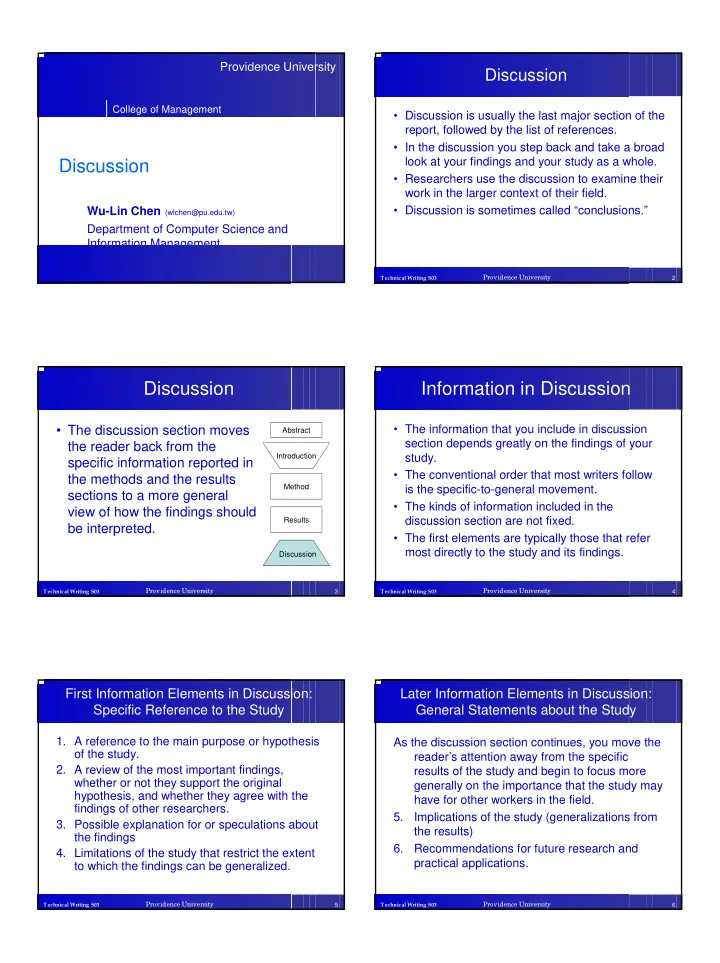
Providence University Discussion College of Management Discussion is usually the last major section of the report, followed by the list of references. In the discussion you step back and take a broad look at your findings and your


slide-1
SLIDE 1

Providence University

College of Management

Discussion

Wu-Lin Chen (wlchen@pu.edu.tw) Department of Computer Science and Information Management

Technical Writing S03

Providence University

2

Discussion

  • Discussion is usually the last major section of the

report, followed by the list of references.

  • In the discussion you step back and take a broad

look at your findings and your study as a whole.

  • Researchers use the discussion to examine their

work in the larger context of their field.

  • Discussion is sometimes called “conclusions.”

Technical Writing S03

Providence University

3

Discussion

  • The discussion section moves

the reader back from the specific information reported in the methods and the results sections to a more general view of how the findings should be interpreted.

Abstract Method Results Introduction Discussion

Technical Writing S03

Providence University

4

Information in Discussion

  • The information that you include in discussion

section depends greatly on the findings of your study.

  • The conventional order that most writers follow

is the specific-to-general movement.

  • The kinds of information included in the

discussion section are not fixed.

  • The first elements are typically those that refer

most directly to the study and its findings.

Technical Writing S03

Providence University

5

First Information Elements in Discussion: Specific Reference to the Study

  • 1. A reference to the main purpose or hypothesis
  • f the study.
  • 2. A review of the most important findings,

whether or not they support the original hypothesis, and whether they agree with the findings of other researchers.

  • 3. Possible explanation for or speculations about

the findings

  • 4. Limitations of the study that restrict the extent

to which the findings can be generalized.

Technical Writing S03

Providence University

6

Later Information Elements in Discussion: General Statements about the Study

As the discussion section continues, you move the reader’s attention away from the specific results of the study and begin to focus more generally on the importance that the study may have for other workers in the field. 5. Implications of the study (generalizations from the results) 6. Recommendations for future research and practical applications.

slide-2
SLIDE 2

Technical Writing S03

Providence University

7

Note

  • The order of discussion elements shown

previously is not strictly followed by all authors.

  • It is conventional to move from specific to

more general information elements.

Technical Writing S03

Providence University

8

Researcher’s Position Towards the Findings

  • Researchers make explicit their own views
  • n the study and its findings.
  • Researchers may take a position with

respect to the explanations, implications, limitations, or applications of the findings.

Technical Writing S03

Providence University

9

Researcher’s Position on Information in the Discussion

Position Information Element One possible explanation is that speed jobs do not tax older workers to their limits. (explanation) We can no longer assume We acknowledge Clearly, that it is satisfactory to seek explanations

  • nly in economic factors. (implication)

that other industries may produce different results. (restriction) this technique has promise as a tool in evaluation of forages. (application)

Technical Writing S03

Providence University

10

Complex Structure in Discussion Statements

  • Typically, the researcher’s position is

carried by the main clause while the information being reported contained in the noun clause.

Technical Writing S03

Providence University

11

Complex Structure in Discussion Statements

Main clause (researcher’s position) Noun clause THAT + + We can conclude with certainty that both theories are able to explain significant amounts of variance.

Technical Writing S03

Providence University

12

Verb Tenses Used in Discussion Statements

  • The type of information you want to

present will determine the verb tenses used in the discussion section.

  • The verb tense most commonly used in

referring to the purpose, the hypothesis, and the findings is the simple past.

slide-3
SLIDE 3

Technical Writing S03

Providence University

13

Verb Tenses in First Discussion Elements: Simple Past Tense

  • Referring to the purpose

– Example: This research attempted to assess two theories of behavior. (some research workers use present perfect tense in referring to the purpose)

  • Referring to the hypothesis

– Example: We originally assumed that physical decrements would be more apparent in speed jobs than in skill jobs.

  • Restating the findings

– Example: The principle of readability was not followed in the income tax booklet of any of the states studied except Virginia.

Technical Writing S03

Providence University

14

Verb Tenses in First Discussion Elements: Past, Present, and Modal Auxiliaries

  • In discussion statements that explain possible

reasons for, or limitations to, the findings, the past, present, or modal auxiliaries may be used.

  • The choice depends on whether the explanation

for the specific findings is restricted to your study (past) or whether it refers to a general condition (present).

  • Modal auxiliaries may also be used to

emphasize the speculative nature of these statements.

Technical Writing S03

Providence University

15

Verb Tenses in First Discussion Elements: Past, Present, and Modal Auxiliaries

  • Explaining the findings

– Example: It is possible that microbial activity caused some immobilization of labial soil phosphorous. (restricted to study) – Example: It is possible that microbial activity causes some immobilization of labial soil phosphorous. (general condition)

  • Limiting the findings

– Example: Our sample was very small. – Example: Other industries may produce different results.

Technical Writing S03

Providence University

16

Verb Tenses in First Discussion Elements: Present Tense

  • When comparing your findings to those of
  • ther researchers, use the present tense.

– Example: These results are in substantial agreement with those of Bates [2].

Technical Writing S03

Providence University

17

Verb Tenses in Latter Elements: Present and Modal Auxiliaries/Tentative Verbs

  • As you move from the specific considerations of your

study to broader, more general statements about the importance of the study as a whole, use simple present tense and modal auxiliaries/tentative verbs.

  • Implications

– Example: It appears that squatter housing market behave as economically rational entities.

  • Recommendations and applications

– Example: The approach outlined in this study should be replicated in other manufacturing plants. – Example: We recommend that the approach outlined in this study be replicated in other manufacturing plants.

Technical Writing S03

Providence University

18

Expressions Indicating the Researcher’s Position

  • The main clause of a complex sentence in the

discussion section often contains special expressions that indicate the researcher’s own point of view, or position, towards the information contained in the noun clauses.

  • At the beginning of the discussion section,

certain expressions make it clear that you are reconsidering the hypothesis of your study.

slide-4
SLIDE 4

Technical Writing S03

Providence University

19

Expressions for Restating the Hypothesis

Main clause (researcher’s position) Noun clause (information) THAT + + It was anticipated The theory led us to infer In line with this hypothesis, we assume The results seem inconsistent with our hypothesis that

  • lder workers in speed jobs

would have poorer performance than younger workers.

Technical Writing S03

Providence University

20

Expressions for Explaining Findings

Main clause (researcher’s position) Noun clause (information) THAT + + These results can be explained by assuming that skill increases with experience. One reason could be It is unlikely that jobs in light manufacturing do not tax

  • lder workers to their limits.

that age of the subjects had much of an effect on attitude.

Technical Writing S03

Providence University

21

Expressions for Suggesting Implications

Main clause (researcher’s position) Noun clause (information) THAT + + suggest imply lend support to the assumption lead us to believe provide evidence that frost affects the pan by breaking its massive structure. These findings