8/6/2009 Opening Discussion Agenda Using NSSE and CLA Opening - - PowerPoint PPT Presentation

8 6 2009
SMART_READER_LITE
LIVE PREVIEW

8/6/2009 Opening Discussion Agenda Using NSSE and CLA Opening - - PowerPoint PPT Presentation

8/6/2009 Opening Discussion Agenda Using NSSE and CLA Opening discussion/foundations 1. How familiar are you with NSSE? in Concert NSSE+ CLA administration 2. What are the benefits and opportunities options created by combining NSSE


slide-1
SLIDE 1

8/6/2009 1

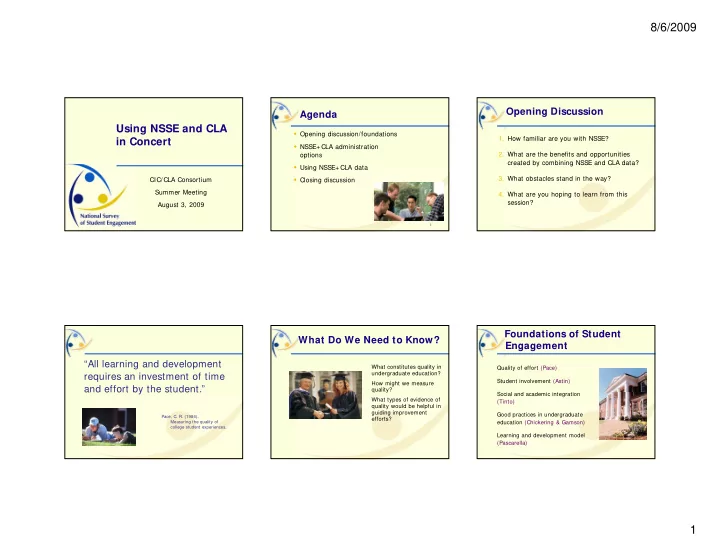
Using NSSE and CLA in Concert

CIC/CLA Consortium Summer Meeting August 3, 2009

Agenda

Opening discussion/foundations NSSE+ CLA administration

  • ptions

Using NSSE+ CLA data Closing discussion

2

Opening Discussion

  • 1. How familiar are you with NSSE?
  • 2. What are the benefits and opportunities

created by combining NSSE and CLA data? created by combining NSSE and CLA data?

  • 3. What obstacles stand in the way?
  • 4. What are you hoping to learn from this

session?

“All learning and development requires an investment of time and effort by the student.” and effort by the student.

Pace, C. R. (1984). Measuring the quality of college student experiences.

What Do We Need to Know?

What constitutes quality in undergraduate education? How might we measure quality? q y What types of evidence of quality would be helpful in guiding improvement efforts?

Foundations of Student Engagement

Quality of effort (Pace) Student involvement (Astin) S i l d d i i t ti Social and academic integration (Tinto) Good practices in undergraduate education (Chickering & Gamson) Learning and development model (Pascarella)

slide-2
SLIDE 2

8/6/2009 2

Path Model for Assessing Change in Student Learning (Pascarella)

Interactions with Agents of Socialization Structural/ Organizational Characteristics

  • f Institutions

Learning and Institutional Environment Quality of Student Effort Student Background/ Precollege Traits g Cognitive Development

Key Challenges

  • 1. How do we interpret

the relationship between engagement scores and measured learning outcomes?

  • 2. How do we use these

in our work?

8

Design Goal

Maximize matching of CLA and NSSE results at the student level

CLA

Affords appropriate analyses

  • f the relationship between

CLA performance and student engagement

9

NSSE

NSSE-CLA Data Collection Timeline

Precollege First year

  • Soph. year

Junior year Senior year

10

BCSSE CLA NSSE NSSE CLA

Student I D Student I D

Two NSSE Administration Options

Standard Administration

For institutions planning to administer NSSE in 2010

Local Administration

For 2007, 2008 or 2009 NSSE participants not participating in 2010

11

NSSE Administration Options

Standard NSSE Administration Local NSSE Administration

CLA administered first (fall). CLA d i i t d fi t (f ll)

First-year

CLA administered first (fall). Participants identified by institution and included in spring NSSE sample (oversample may be necessary). CLA administered first (fall). Participants identified for local NSSE administration (paper) in spring.

Senior

NSSE administered first (spring). NSSE respondents identified by institution using NSSE interface and invited for CLA. Local NSSE administration (paper) in spring as part of CLA administration.

slide-3
SLIDE 3

8/6/2009 3

Standard NSSE Administration: Details

Undergrad Enrollment Paper Sample Size Web+ Sample Size Web-only Sample Size Sampling Fee < 4,000 450 1,800 Census $3,375

Sample Sizes (FY+ Sr) and Fees

13

4,000-7,999 600 2,400 Census $4,500 8,000-12,000 800 3,200 Census $6,000 > 12,000 1,000 4,000 Census $7,500 Oversampling Fees (per student) Web-only $1.50 Paper (NSSE-administered) $7.50 Paper (institution-administered) $2.00

$300 Participation fee also applies

Standard Administration: Special Considerations

Identify first-year CLA participants for inclusion in NSSE sample (oversample fee may apply) Monitor senior NSSE administration (using NSSE W b t l) t id tif CLA i it NSSE Web tool) to identify CLA invitees Promotion is vital: invitation does not ensure participation

14

Local NSSE Administration: Details

Institution administers paper survey Surveys returned to NSSE for scanning and data file preparation Participation fee of $500 $3.00 per survey shipped (nonrefundable)

15

Local Administration: Special Considerations

Institution must… Handle all logistics for survey administration Follow administration protocol for survey p y invitation and administration, in accordance with IRB requirements Implement special procedures to enter student IDs on NSSE surveys, to enable linking with CLA results

16

BCSSE Option

Administer the Beginning College Survey of Student Engagement as a census during

  • rientation or before classes start

A e p e ollege eng gement Assess precollege engagement Assess expectations for engagement during college

Link to first-year CLA and NSSE results For information and registration information, go to www.bcsse.iub.edu

17

Making Sense of Results

Now that you have NSSE data matched with CLA data, what do you do with it? do you do with it?

18

slide-4
SLIDE 4

8/6/2009 4

Sample Assessment Topics: First-Year Students

Examine the relationship between baseline CLA performance and first-year engagement

Are CLA high performers predisposed to high engagement? engagement? Identify students with performance/engagement mismatch:

19

High Engagement Low Engagement High CLA Low CLA

Sample Study Topics: Seniors

Examine the relationship between student activities & experiences and CLA performance

Do students with high levels of senior-year engagement perform better on CLA tasks? engagement perform better on CLA tasks? What is the relationship between CLA performance and involvement in capstone experiences, research with faculty, etc.?

20

Sample Study Topics: Seniors (continued)

Adjusting for precollege achievement scores (SAT/ACT), do seniors who have engaged in deeper ways of learning (analysis, synthesis, integration, reflection) score better on CLA tests? Do students learn more when they write more?

21

Sample Study Topics: First-Year Students w/ BCSSE

Examine the relationship between precollege attributes and first-year engagement

Do students who were highly engaged in high h l f b tt CLA t k ? school perform better on CLA tasks? Do students with high expectations for engagement in college perform better on CLA tasks?

22

What about other data?

Course records Writing portfolio assessments Transfer students Learning communities Other student subpopulations

23

www.nsse.iub.edu 812-856-5824 nsse@iub.edu

Contact Us

Bob Gonyea rgonyea@indiana.edu

slide-5
SLIDE 5

CIC-CLA Consortium: Using NSSE and CLA in Concert

Options for Combining CLA and NSSE Administrations to Maximize Overlap at the Student Level

Institutions already planning to participate in NSSE 2009 Recent NSSE participants (2006, 2007, or 2008) not planning a regular NSSE administration in 2009

NSSE administration type Standard Local Administration mode Web (recommended to maximize NSSE sample); Web+ or Paper are also possible Paper Administration process for entering students (optional) Administer BCSSE before first day of classes. Administer BCSSE before first day of classes Administration process for first-year students CLA administered first (fall). Participants identified by institution and included in spring NSSE sample (oversample may be necessary). CLA administered first (fall). Participants identified for local NSSE administration in spring. Administration process for seniors NSSE administered first (spring). NSSE respondents identified by institution using NSSE interface and invited for CLA. Local NSSE administration (paper) in spring as part

  • f CLA administration.

For information on costs, sample sizes, and other details, refer to the NSSE and BCSSE Web sites. Beginning College Survey of Student Engagement: www.bcsse.iub.edu National Survey of Student Engagement: www.nsse.iub.edu