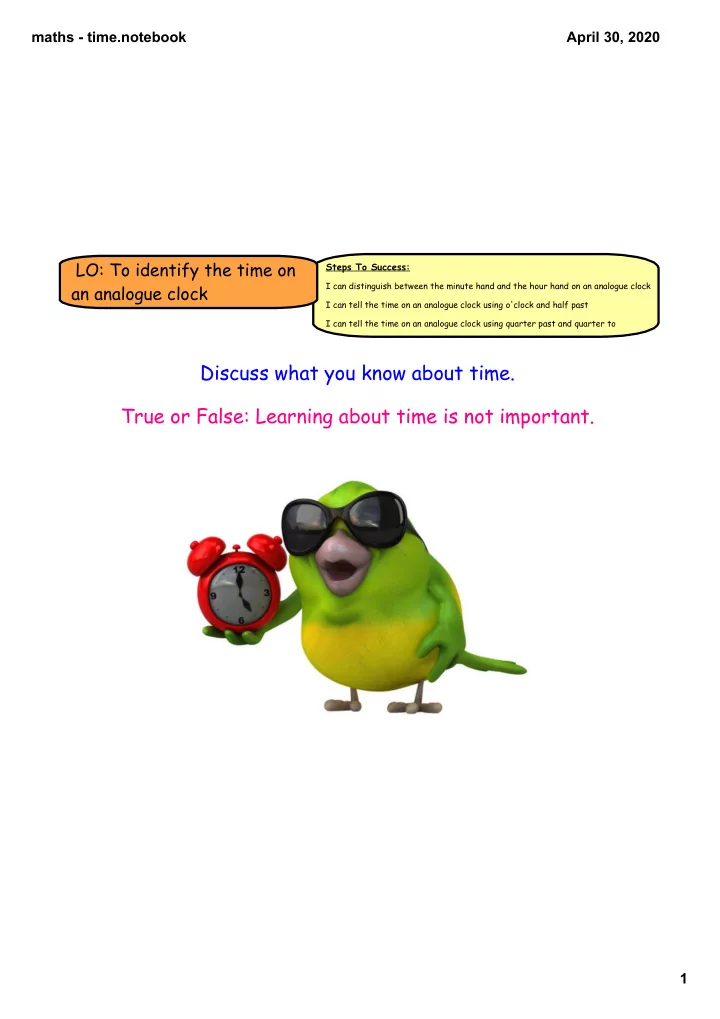
Discuss what you know about time. True or False: Learning about time - - PDF document

discuss what you know about time true or false learning
SMART_READER_LITE
LIVE PREVIEW

Discuss what you know about time. True or False: Learning about time - - PDF document

maths time.notebook April 30, 2020 LO: To identify the time on Steps To Success: I can distinguish between the minute hand and the hour hand on an analogue clock an analogue clock I can tell the time on an analogue clock using o'clock and


slide-1
SLIDE 1

maths ­ time.notebook 1 April 30, 2020

LO: To identify the time on

an analogue clock

Steps To Success:

I can distinguish between the minute hand and the hour hand on an analogue clock I can tell the time on an analogue clock using o'clock and half past I can tell the time on an analogue clock using quarter past and quarter to

Discuss what you know about time. True or False: Learning about time is not important.

slide-2
SLIDE 2

maths ­ time.notebook 2 April 30, 2020

LO: To identify the time on

an analogue clock

Steps To Success:

I can distinguish between the minute hand and the hour hand on an analogue clock I can tell the time on an analogue clock using o'clock and half past I can tell the time on an analogue clock using quarter past and quarter to

Being able to tell the time is extremely important. You need to be able to tell the time in order to go about your day, book appointments, cook food without burning it, meet up with friends, board a plane, time races, watch your favourite TV show and complete all sorts of different activities successfully.

slide-3
SLIDE 3

maths ­ time.notebook 3 April 30, 2020

LO: To identify the time on

an analogue clock

Steps To Success:

I can distinguish between the minute hand and the hour hand on an analogue clock I can tell the time on an analogue clock using o'clock and half past I can tell the time on an analogue clock using quarter past and quarter to

Time can be measured in years, months, weeks, days, hours, minutes and seconds.We use clocks to measure hours, minutes and seconds. True or False: Telling the time can be difficult, justify your opinion. Explain how a digital clock differs from an analogue clock.

slide-4
SLIDE 4

maths ­ time.notebook 4 April 30, 2020

LO: To identify the time on

an analogue clock

Steps To Success:

I can distinguish between the minute hand and the hour hand on an analogue clock I can tell the time on an analogue clock using o'clock and half past I can tell the time on an analogue clock using quarter past and quarter to

An analogue clock is a circular- faced clock with the numbers

  • ne to twelve around the outside

and two hands, a shorter one to measure hours and a longer one to measure minutes. A digital clock is a clock which simply shows numbers to denote the time. The digital time is written in the 4-digit format. For example, a digital clock will display 07:30 not 7:30.

slide-5
SLIDE 5

maths ­ time.notebook 5 April 30, 2020

LO: To identify the time on

an analogue clock

Steps To Success:

I can distinguish between the minute hand and the hour hand on an analogue clock I can tell the time on an analogue clock using o'clock and half past I can tell the time on an analogue clock using quarter past and quarter to

For today's lesson, we will be working with analogue clocks, therefore we will need to remember some key facts to help us work with these analogue clocks. There are 60 seconds in a minute. There are 60 minutes in an hour. There are 24 hours in one day. The hands of a clock move around the clock in the direction of the

  • arrows. Follow this

direction with your finger – this is called clockwise.

slide-6
SLIDE 6

maths ­ time.notebook 6 April 30, 2020

LO: To identify the time on

an analogue clock

Steps To Success:

I can distinguish between the minute hand and the hour hand on an analogue clock I can tell the time on an analogue clock using o'clock and half past I can tell the time on an analogue clock using quarter past and quarter to

The minute hand is the longer hand. It points to a number to tell us how many minutes past or to an hour it is. On this clock the minute hand is pointing to the 12. This means the time is something o‛clock. It is the start of an hour. To work out what o‛clock it is we need to look at the hour hand. The hour hand is the shorter hand. It points to a number to tell us what hour it is. In this example, the clock is telling us that it is 7 o'clock.

slide-7
SLIDE 7

maths ­ time.notebook 7 April 30, 2020

LO: To identify the time on

an analogue clock

Steps To Success:

I can distinguish between the minute hand and the hour hand on an analogue clock I can tell the time on an analogue clock using o'clock and half past I can tell the time on an analogue clock using quarter past and quarter to

Identify the time represented by each analogue clock. Write each answer in numerals and in words, one has been done for you. 10:00 10 o'clock

slide-8
SLIDE 8

maths ­ time.notebook 8 April 30, 2020

LO: To identify the time on

an analogue clock

Steps To Success:

I can distinguish between the minute hand and the hour hand on an analogue clock I can tell the time on an analogue clock using o'clock and half past I can tell the time on an analogue clock using quarter past and quarter to

When the minute hand travels from the 12 to the 6 it has gone halfway around the clock. This takes half an hour. We say it is half past the hour. The minute hand is pointing to the 6 so it is half past. The hour hand is pointing to just passed the 9 so it is half past 9.. You can also write half past 9 as 9:30 as 30 is half of 60, so half an hour equals 30 minutes.

slide-9
SLIDE 9

maths ­ time.notebook 9 April 30, 2020

LO: To identify the time on

an analogue clock

Steps To Success:

I can distinguish between the minute hand and the hour hand on an analogue clock I can tell the time on an analogue clock using o'clock and half past I can tell the time on an analogue clock using quarter past and quarter to

Identify the time represented by each analogue clock. Write each answer in numerals and in words, one has been done for you. 2:30 half past 2

slide-10
SLIDE 10

maths ­ time.notebook 10 April 30, 2020

LO: To identify the time on

an analogue clock

Steps To Success:

I can distinguish between the minute hand and the hour hand on an analogue clock I can tell the time on an analogue clock using o'clock and half past I can tell the time on an analogue clock using quarter past and quarter to

When the minute hand travels from the 12 to the 3 it has gone a quarter way around the clock. This takes a quarter of an hour. We say it is quarter past the hour. The minute hand is pointing to the 3 so it is quarter past. The hour hand is pointing to just passed the 11 so it is quarter past 11. You can also write quarter past 11 as 11:15 as 15 is a quarter of 60, so a quarter of an hour equals 15 minutes.

slide-11
SLIDE 11

maths ­ time.notebook 11 April 30, 2020

LO: To identify the time on

an analogue clock

Steps To Success:

I can distinguish between the minute hand and the hour hand on an analogue clock I can tell the time on an analogue clock using o'clock and half past I can tell the time on an analogue clock using quarter past and quarter to

Identify the time represented by each analogue clock. Write each answer in numerals and in words, one has been done for you. 1:15

quarter past 1

slide-12
SLIDE 12

maths ­ time.notebook 12 April 30, 2020

LO: To identify the time on

an analogue clock

Steps To Success:

I can distinguish between the minute hand and the hour hand on an analogue clock I can tell the time on an analogue clock using o'clock and half past I can tell the time on an analogue clock using quarter past and quarter to

When the minute hand travels from the 12 to the 9 it has gone three quarters way around the clock. It is now a quarter of an hour to the next hour. We say this is quarter to the hour. The minute hand is pointing to the 9 so it is quarter to. The hour hand is pointing just before the 2 so it is quarter to 2. You can also write quarter to 2 as 1:45 as 45 is three quarters of 60, so three quarters of an hour equals 45 minutes.

slide-13
SLIDE 13

maths ­ time.notebook 13 April 30, 2020

LO: To identify the time on

an analogue clock

Steps To Success:

I can distinguish between the minute hand and the hour hand on an analogue clock I can tell the time on an analogue clock using o'clock and half past I can tell the time on an analogue clock using quarter past and quarter to

Identify the time represented by each analogue clock. Write each answer in numerals and in words, one has been done for you. 9:45

quarter to 10

slide-14
SLIDE 14

maths ­ time.notebook 14 April 30, 2020

LO: To identify the time on

an analogue clock

Steps To Success:

I can distinguish between the minute hand and the hour hand on an analogue clock I can tell the time on an analogue clock using o'clock and half past I can tell the time on an analogue clock using quarter past and quarter to

Karen made half past 12 on her

  • clock. Is it

correct? Explain your answer. Explain what times

  • f the day are

significant to you and why. Complete the statements: 1 hour = 60 minutes 2 hours = __ minutes __ hours = 300 minutes

  • - hours = 420 minutes

__ hours = 630 minutes

slide-15
SLIDE 15

maths ­ time.notebook 15 April 30, 2020

LO: To identify the time on

an analogue clock

Steps To Success:

I can distinguish between the minute hand and the hour hand on an analogue clock I can tell the time on an analogue clock using o'clock and half past I can tell the time on an analogue clock using quarter past and quarter to

Task 1 : Identify the time represented by each analogue clock. Write each answer in numerals and in words.

slide-16
SLIDE 16

maths ­ time.notebook 16 April 30, 2020

LO: To identify the time on

an analogue clock

Steps To Success:

I can distinguish between the minute hand and the hour hand on an analogue clock I can tell the time on an analogue clock using o'clock and half past I can tell the time on an analogue clock using quarter past and quarter to

Task 2 : Match the clocks to the correct statements.

slide-17
SLIDE 17

maths ­ time.notebook 17 April 30, 2020

LO: To identify the time on

an analogue clock

Steps To Success:

I can distinguish between the minute hand and the hour hand on an analogue clock I can tell the time on an analogue clock using o'clock and half past I can tell the time on an analogue clock using quarter past and quarter to

Task 3: Draw the times shown on its corresponding clock.

slide-18
SLIDE 18

maths ­ time.notebook 18 April 30, 2020

LO: To identify the time on

an analogue clock

Steps To Success:

I can distinguish between the minute hand and the hour hand on an analogue clock I can tell the time on an analogue clock to five minutes I can use the phrases 'past' and 'to' when writing the time

How do these analogue clocks differ from the analogue clocks we looked at before. Identify the time shown on each analogue clock. How many minutes are in an hour? Why is 15 minutes called ‘quarter past‛? Why is 30 minutes called ‘half past‛?

slide-19
SLIDE 19

maths ­ time.notebook 19 April 30, 2020

LO: To identify the time on

an analogue clock

Steps To Success:

I can distinguish between the minute hand and the hour hand on an analogue clock I can tell the time on an analogue clock to five minutes I can use the phrases 'past' and 'to' when writing the time

One Minute Challenge: Complete the times table calculations: 2 x 5 = 4 x 5 = 1 x 5 = 7 x 5 = 11 x 5 = 0 x 5 = 6 x 5 = 9 x 5 = 8 x 5 = 10 x 5 = 3 x 5 = 12 x 5 = 5 x 5 = 7 x 5 = 11 x 5 = 3 x 5 = 12 x 5 = 8 x 5 = 9 x 5 = 5 x 5 = Explain the importance of the 5 times table in relation to time.

slide-20
SLIDE 20

maths ­ time.notebook 20 April 30, 2020

LO: To identify the time on

an analogue clock

Steps To Success:

I can distinguish between the minute hand and the hour hand on an analogue clock I can tell the time on an analogue clock to five minutes I can use the phrases 'past' and 'to' when writing the time

Here are two different types of clocks (digital and analogue), they both show the same time, 5:35am. Today we will be looking at how to read the time on an analogue clock at 5 minute intervals!

slide-21
SLIDE 21

maths ­ time.notebook 21 April 30, 2020

LO: To identify the time on

an analogue clock

Steps To Success:

I can distinguish between the minute hand and the hour hand on an analogue clock I can tell the time on an analogue clock to five minutes I can use the phrases 'past' and 'to' when writing the time

When reading a clock, the intervals around the clock can go up in an interval of one (1, 2, 3, 4...) when looking at the hour hand or you can read these same intervals as going up in fives (5, 10, 15, 20...) when looking at the minute hand! This is why the 5 times table is important when learning how to read the time!

slide-22
SLIDE 22

maths ­ time.notebook 22 April 30, 2020

LO: To identify the time on

an analogue clock

Steps To Success:

I can distinguish between the minute hand and the hour hand on an analogue clock I can tell the time on an analogue clock to five minutes I can use the phrases 'past' and 'to' when writing the time

An analogue clock has two hands. It has a short hour hand and a long minute hand. You can tell the hour on an analogue lock by reading the number that the hour hand is pointing to. If the hour hand is between two numbers, the number before the hand tells the hour. On this clock the hour hand is between the 6 and the 5, so 5 is the hour, as this is the hour before the hand.

slide-23
SLIDE 23

maths ­ time.notebook 23 April 30, 2020

LO: To identify the time on

an analogue clock

Steps To Success:

I can distinguish between the minute hand and the hour hand on an analogue clock I can tell the time on an analogue clock to five minutes I can use the phrases 'past' and 'to' when writing the time

5

Now let's think about how to read the minutes on an analogue clock. Notice how an analogue clock shows the number 1 through to 12. There are small tick marks between each number. The space between each tick mark and the next represent one minute. So the whole space from one number to the next represent 5 minutes.

slide-24
SLIDE 24

maths ­ time.notebook 24 April 30, 2020

LO: To identify the time on

an analogue clock

Steps To Success:

I can distinguish between the minute hand and the hour hand on an analogue clock I can tell the time on an analogue clock to five minutes I can use the phrases 'past' and 'to' when writing the time

5

When the minute hand points to the one, we are 5 minutes into the

  • hour. We can use the numbers on the clock to skip count by 5s and

see how many minutes have passed when the minute hand points to each number, so here when writing the time we would simply write 5:35

10 15 20 25 30 35 40 45 50 55

slide-25
SLIDE 25

maths ­ time.notebook 25 April 30, 2020

LO: To identify the time on

an analogue clock

Steps To Success:

I can distinguish between the minute hand and the hour hand on an analogue clock I can tell the time on an analogue clock to five minutes I can use the phrases 'past' and 'to' when writing the time

Identify the time shown by the analogue clocks. Determine whether or not you could write the same time in any other way.

5 10 15 20 25 30 35 40 45 50 55 5 10 15 20 25 30 35 40 45 50 55 5 10 15 20 25 30 35 40 45 50 55

slide-26
SLIDE 26

maths ­ time.notebook 26 April 30, 2020

9:20 3:05 12:25 1:35 7:55 4:40

LO: To identify the time on

an analogue clock

Steps To Success:

I can distinguish between the minute hand and the hour hand on an analogue clock I can tell the time on an analogue clock to five minutes I can use the phrases 'past' and 'to' when writing the time

You can simply write the time in numbers, as shown below. However, you can also write time using words, yet this can be a little trickier, as you will need to be able to switch between the two phases 'past' and 'to', depending which hour the time is closest to.

slide-27
SLIDE 27

maths ­ time.notebook 27 April 30, 2020

LO: To identify the time on

an analogue clock

Steps To Success:

I can distinguish between the minute hand and the hour hand on an analogue clock I can tell the time on an analogue clock to five minutes I can use the phrases 'past' and 'to' when writing the time

When the minute hand falls in first half (the blue half) of the clock, we use the phrase 'past' to denote the time and refer to the hour the minute hand has just passed.

20 past 3 3:20 5 past 7 7:05 half past 11 11:30 10 past 4 4:10

slide-28
SLIDE 28

maths ­ time.notebook 28 April 30, 2020

LO: To identify the time on

an analogue clock

Steps To Success:

I can distinguish between the minute hand and the hour hand on an analogue clock I can tell the time on an analogue clock to five minutes I can use the phrases 'past' and 'to' when writing the time

When the minute hand falls in second half (the red half) of the clock, we use the phrase 'to' to denote the time and refer to how many minutes there are until the next, approaching hour.

10 to 6 5:50 20 to 6 5:40 quarter to 11 10:45 5 to 8 7:55

slide-29
SLIDE 29

maths ­ time.notebook 29 April 30, 2020

LO: To identify the time on

an analogue clock

Steps To Success:

I can distinguish between the minute hand and the hour hand on an analogue clock I can tell the time on an analogue clock to five minutes I can use the phrases 'past' and 'to' when writing the time

Identify the time shown by the analogue clocks, writing the time in both number and written format.

slide-30
SLIDE 30

maths ­ time.notebook 30 April 30, 2020

LO: To identify the time on

an analogue clock

Steps To Success:

I can distinguish between the minute hand and the hour hand on an analogue clock I can tell the time on an analogue clock to five minutes I can use the phrases 'past' and 'to' when writing the time

Who do you agree with? Explain your thinking. Discuss the different times of day that are important to you. When in your every day life does a clock come in handy? True or False: The time is 4:55, justify your reasoning.

slide-31
SLIDE 31

maths ­ time.notebook 31 April 30, 2020

LO: To identify the time on

an analogue clock

Steps To Success:

I can distinguish between the minute hand and the hour hand on an analogue clock I can tell the time on an analogue clock to five minutes I can use the phrases 'past' and 'to' when writing the time

Task 1: Draw a line to match the correct digital clock to its corresponding analogue clock face.

slide-32
SLIDE 32

maths ­ time.notebook 32 April 30, 2020

LO: To identify the time on

an analogue clock

Steps To Success:

I can distinguish between the minute hand and the hour hand on an analogue clock I can tell the time on an analogue clock to five minutes I can use the phrases 'past' and 'to' when writing the time

Task 2 : Identify the time represented by each analogue clock. Write each answer in numerals and in words.

slide-33
SLIDE 33

maths ­ time.notebook 33 April 30, 2020

LO: To identify the time on

an analogue clock

Steps To Success:

I can distinguish between the minute hand and the hour hand on an analogue clock I can tell the time on an analogue clock to five minutes I can use the phrases 'past' and 'to' when writing the time

Task 3: Draw the times shown on its corresponding clock.

slide-34
SLIDE 34

maths ­ time.notebook 34 April 30, 2020

LO: To identify the time on

an analogue clock

Steps To Success:

I can distinguish between the minute hand and the hour hand on an analogue clock I can tell the time on an analogue clock to the nearest minute I can use the phrases 'past' and 'to' when writing the time

The analogue clocks shown are either running late or early. Write down the correct digital time for each clock.

slide-35
SLIDE 35

maths ­ time.notebook 35 April 30, 2020

LO: To identify the time on

an analogue clock

Steps To Success:

I can distinguish between the minute hand and the hour hand on an analogue clock I can tell the time on an analogue clock to the nearest minute I can use the phrases 'past' and 'to' when writing the time

This clock has lost its minute hand. What time could it be? Justify your answer. Is Martha correct? Explain how you know. Complete the statements:

There are __ minutes in one hour. There are __ hours in one day. There are __ minutes in a quarter of an hour. There are __ minutes in half an hour. There are __ minutes in three quarters of an hour.

slide-36
SLIDE 36

maths ­ time.notebook 36 April 30, 2020

LO: To identify the time on

an analogue clock

Steps To Success:

I can distinguish between the minute hand and the hour hand on an analogue clock I can tell the time on an analogue clock to the nearest minute I can use the phrases 'past' and 'to' when writing the time

True or False: It is fine if you can only tell the time to the nearest 5 minutes, near enough is good enough.

slide-37
SLIDE 37

maths ­ time.notebook 37 April 30, 2020

LO: To identify the time on

an analogue clock

Steps To Success:

I can distinguish between the minute hand and the hour hand on an analogue clock I can tell the time on an analogue clock to the nearest minute I can use the phrases 'past' and 'to' when writing the time

Time is extremely important and each minute is important. If you are late by just one minute you could end up missing your train or plain, you could end up ruining your cooking and you could get a bad repuation for always being late, so it is really important that you can tell the time, down to the nearest minute! Knowing how to tell the time is a life skill!

slide-38
SLIDE 38

maths ­ time.notebook 38 April 30, 2020

LO: To identify the time on

an analogue clock

Steps To Success:

I can distinguish between the minute hand and the hour hand on an analogue clock I can tell the time on an analogue clock to the nearest minute I can use the phrases 'past' and 'to' when writing the time

When telling the time, it is important to look at the hands on a clock. The shorter hand tells the hour. The longer hand tells the minute. The time here is 3 o‛clock.

slide-39
SLIDE 39

maths ­ time.notebook 39 April 30, 2020

LO: To identify the time on

an analogue clock

Steps To Success:

I can distinguish between the minute hand and the hour hand on an analogue clock I can tell the time on an analogue clock to the nearest minute I can use the phrases 'past' and 'to' when writing the time

It is also important to remember that each number represents 5-minute intervals. While the lines in-between each number represent 1-minute intervals.

5 10 15 20 25 30 35 40 45 50 55

slide-40
SLIDE 40

maths ­ time.notebook 40 April 30, 2020

5 10 15 20 21

LO: To identify the time on

an analogue clock

Steps To Success:

I can distinguish between the minute hand and the hour hand on an analogue clock I can tell the time on an analogue clock to the nearest minute I can use the phrases 'past' and 'to' when writing the time

Let's practice telling the time to the nearest minute!

To find the time and write it in numbers, first look at the short hour hand, it lies between 3 and 4, so we know that the time relates to 3 o'clock. Next we need to count how many minutes past 3 the longer minute hand lies, which is 21 minutes past. Therefore the time is 3:21. As the minute hand lies in the first half of the clock, we know that we will use the phrase 'past' when writing the time using words. This makes our job easier, as we can keep the same numbers that we used in the digital time, so 3:21 becomes 21 minutes past 3.

slide-41
SLIDE 41

maths ­ time.notebook 41 April 30, 2020

5 10 15 20

LO: To identify the time on

an analogue clock

Steps To Success:

I can distinguish between the minute hand and the hour hand on an analogue clock I can tell the time on an analogue clock to the nearest minute I can use the phrases 'past' and 'to' when writing the time

Let's practice telling the time to the nearest minute!

To find the time and write it in numbers, first look at the short hour hand, it lies between the 10 and 11, so we know that the time relates to 10 o'clock. Next we need to count how many minutes past 10 the longer minute hand lies, which is 29 minutes

  • past. Therefore the time is 10:29.

As the minute hand lies in the first half of the clock, we know that we will use the phrase 'past' when writing the time using words. This makes our job easier, as we can keep the same numbers that we used in the digital time, so 10:29 becomes 29 minutes past 10.

25 29

slide-42
SLIDE 42

maths ­ time.notebook 42 April 30, 2020

5 10 15 20

LO: To identify the time on

an analogue clock

Steps To Success:

I can distinguish between the minute hand and the hour hand on an analogue clock I can tell the time on an analogue clock to the nearest minute I can use the phrases 'past' and 'to' when writing the time

Let's practice telling the time to the nearest minute!

To find the time and write it in numbers, first look at the short hour hand, it lies between the 6 and 7, so we know that the time relates to 6 o'clock. Next we need to count how many minutes past 6 the longer minute hand lies, which is 42 minutes

  • past. Therefore the time is 6:42.

As the minute hand lies in the second half of the clock, we know that we will use the phrase 'to' when writing the time using words. The quickest way to work out how many minute to the next hour is to take 60 minutes (1 hour) and take away the number of minutes passed. This gives us 60 - 42 = 18 minutes, so we can write the time as 18 minutes to 7, which is the same as 6:42.

25 30 35 40 42

slide-43
SLIDE 43

maths ­ time.notebook 43 April 30, 2020

5 10 15 20

LO: To identify the time on

an analogue clock

Steps To Success:

I can distinguish between the minute hand and the hour hand on an analogue clock I can tell the time on an analogue clock to the nearest minute I can use the phrases 'past' and 'to' when writing the time

Let's practice telling the time to the nearest minute!

To find the time and write it in numbers, first look at the short hour hand, it lies between the 12 and 1, so we know that the time relates to 12 o'clock. Next we need to count how many minutes past 12 the longer minute hand lies, which is 58 minutes

  • past. Therefore the time is 12:58.

As the minute hand lies in the second half of the clock, we know that we will use the phrase 'to' when writing the time using words. The quickest way to work out how many minute to the next hour is to take 60 minutes (1 hour) and take away the number of minutes passed. This gives us 60 - 58 = 2 minutes, so we can write the time as 2 minutes to 1, which is the same as 12:58.

25 30 35 40 45 50 55 58

slide-44
SLIDE 44

maths ­ time.notebook 44 April 30, 2020

LO: To identify the time on

an analogue clock

Steps To Success:

I can distinguish between the minute hand and the hour hand on an analogue clock I can tell the time on an analogue clock to the nearest minute I can use the phrases 'past' and 'to' when writing the time

Josie has just left her house, the time she left is shown on the clock. She spends 15 minutes playing

  • football. What is the time when

Josie stops playing?

slide-45
SLIDE 45

maths ­ time.notebook 45 April 30, 2020

LO: To identify the time on

an analogue clock

Steps To Success:

I can distinguish between the minute hand and the hour hand on an analogue clock I can tell the time on an analogue clock to the nearest minute I can use the phrases 'past' and 'to' when writing the time

Anna starts baking, the time she started baking is shown on the

  • clock. She spends 40 minutes
  • baking. What is the time when Anna

stops baking?

slide-46
SLIDE 46

maths ­ time.notebook 46 April 30, 2020

LO: To identify the time on

an analogue clock

Steps To Success:

I can distinguish between the minute hand and the hour hand on an analogue clock I can tell the time on an analogue clock to the nearest minute I can use the phrases 'past' and 'to' when writing the time

Task 1: Draw a line to match the correct digital clock to its corresponding analogue clock face.

slide-47
SLIDE 47

maths ­ time.notebook 47 April 30, 2020

LO: To identify the time on

an analogue clock

Steps To Success:

I can distinguish between the minute hand and the hour hand on an analogue clock I can tell the time on an analogue clock to the nearest minute I can use the phrases 'past' and 'to' when writing the time

Task 2 : Identify the time represented by each analogue clock. Write each answer in numerals and in words.

slide-48
SLIDE 48

maths ­ time.notebook 48 April 30, 2020

LO: To identify the time on

an analogue clock

Steps To Success:

I can distinguish between the minute hand and the hour hand on an analogue clock I can tell the time on an analogue clock to the nearest minute I can use the phrases 'past' and 'to' when writing the time

Task 3: Draw the times shown on its corresponding clock.

slide-49
SLIDE 49

maths ­ time.notebook 49 April 30, 2020

LO: To convert time

between the 12-hour clock and the 24-hour clock

Steps To Success:

I can read the time using an analogue or digital clock I can identify whether a given time occurred in the morning(am) or afternoon (pm) I can convert the 12-hour time into the 24-hour time using my knowledge of time

Discuss what you have learnt about time so far. Explain what aspects of time you have found tricky.

slide-50
SLIDE 50

maths ­ time.notebook 50 April 30, 2020

LO: To convert time

between the 12-hour clock and the 24-hour clock

Steps To Success:

I can read the time using an analogue or digital clock I can identify whether a given time occurred in the morning(am) or afternoon (pm) I can convert the 12-hour time into the 24-hour time using my knowledge of time

Determine whether or not the written time matches the analogue clock, justify your answer. 50 minutes past 1 13 minutes past 6 12 minutes to 7 20 minutes to 5 20 minutes past 4

slide-51
SLIDE 51

maths ­ time.notebook 51 April 30, 2020

LO: To convert time

between the 12-hour clock and the 24-hour clock

Steps To Success:

I can read the time using an analogue or digital clock I can identify whether a given time occurred in the morning(am) or afternoon (pm) I can convert the 12-hour time into the 24-hour time using my knowledge of time

Looking at this clock, explain whether or not you are confident that you can tell the exact time

  • f day, justify your reasoning.
slide-52
SLIDE 52

maths ­ time.notebook 52 April 30, 2020

LO: To convert time

between the 12-hour clock and the 24-hour clock

Steps To Success:

I can read the time using an analogue or digital clock I can identify whether a given time occurred in the morning(am) or afternoon (pm) I can convert the 12-hour time into the 24-hour time using my knowledge of time

You may feel confident about reading this analogue clock and we can tell that it is 9 o'clock, but is it 9 o'clock in the morning or in the evening? These are two very different times of day! Determine what we can use to indicate the specific time to day, to clearly show whether a time belongs in the morning or belong in the evening.

slide-53
SLIDE 53

maths ­ time.notebook 53 April 30, 2020

LO: To convert time

between the 12-hour clock and the 24-hour clock

Steps To Success:

I can read the time using an analogue or digital clock I can identify whether a given time occurred in the morning(am) or afternoon (pm) I can convert the 12-hour time into the 24-hour time using my knowledge of time

Time can be written in the 12-hour clock or the 24 hour clock and the notation within both timescales help determine whether the time belongs to the morning or evening.

slide-54
SLIDE 54

maths ­ time.notebook 54 April 30, 2020

LO: To convert time

between the 12-hour clock and the 24-hour clock

Steps To Success:

I can read the time using an analogue or digital clock I can identify whether a given time occurred in the morning(am) or afternoon (pm) I can convert the 12-hour time into the 24-hour time using my knowledge of time

We have to use a way to write these times differently. One way is to use a.m. and p.m. 9:00 a.m. 9:00 p.m.

slide-55
SLIDE 55

maths ­ time.notebook 55 April 30, 2020

LO: To convert time

between the 12-hour clock and the 24-hour clock

Steps To Success:

I can read the time using an analogue or digital clock I can identify whether a given time occurred in the morning(am) or afternoon (pm) I can convert the 12-hour time into the 24-hour time using my knowledge of time

Another way is to use a 24 hour clock. This means the hours after 12 noon are converted to 13:00 to 23:00.

09:00 21:00 A 4 digit format is used. 2 digits for the hour, a colon (:) and 2 for the minutes.

slide-56
SLIDE 56

maths ­ time.notebook 56 April 30, 2020

LO: To convert time

between the 12-hour clock and the 24-hour clock

Steps To Success:

I can read the time using an analogue or digital clock I can identify whether a given time occurred in the morning(am) or afternoon (pm) I can convert the 12-hour time into the 24-hour time using my knowledge of time

This clock and table show the corresponding hours on a 24 hour clock.

slide-57
SLIDE 57

maths ­ time.notebook 57 April 30, 2020

LO: To convert time

between the 12-hour clock and the 24-hour clock

Steps To Success:

I can read the time using an analogue or digital clock I can identify whether a given time occurred in the morning(am) or afternoon (pm) I can convert the 12-hour time into the 24-hour time using my knowledge of time

24 Hour Time in the Morning

Converting between the 12 and 24 hour time in the morning is very simple. The format changes slightly, as you no longer need the a.m. notation, instead you need to make sure you have 4-digits for the 24-hour digital

  • layout. If your hour is a single digit number, remember to place a zero

before the hour. Otherwise the hour and minute numbers stay the same!

12 Hour Clock 24 Hour Clock

slide-58
SLIDE 58

maths ­ time.notebook 58 April 30, 2020

LO: To convert time

between the 12-hour clock and the 24-hour clock

Steps To Success:

I can read the time using an analogue or digital clock I can identify whether a given time occurred in the morning(am) or afternoon (pm) I can convert the 12-hour time into the 24-hour time using my knowledge of time

24 Hour Time in the Afternoon

When converting between the 12 and 24 hour time in the afternoon, you must add or subtract 12 hours and again we drop the p.m. notation and keep the minutes the same.

12 Hour Clock 24 Hour Clock

slide-59
SLIDE 59

maths ­ time.notebook 59 April 30, 2020

LO: To convert time

between the 12-hour clock and the 24-hour clock

Steps To Success:

I can read the time using an analogue or digital clock I can identify whether a given time occurred in the morning(am) or afternoon (pm) I can convert the 12-hour time into the 24-hour time using my knowledge of time

Convert these 12 hour times into the 24 hour time: Convert these 24 hour times into the hour time: 8:34 a.m. = 7:55 p.m. = 1:23 a.m. = 11:20 p.m. = 3:16 p.m. = 2:59 a.m. = 8.36 p.m. = 03:00 = 17:56 = 15:09 = 11:43 = 21:33 = 05:26 =

slide-60
SLIDE 60

maths ­ time.notebook 60 April 30, 2020

LO: To convert time

between the 12-hour clock and the 24-hour clock

Steps To Success:

I can read the time using an analogue or digital clock I can identify whether a given time occurred in the morning(am) or afternoon (pm) I can convert the 12-hour time into the 24-hour time using my knowledge of time

Three children are meeting in the park. Will all the children meet at the same time? Explain your answer.

slide-61
SLIDE 61

maths ­ time.notebook 61 April 30, 2020

LO: To convert time

between the 12-hour clock and the 24-hour clock

Steps To Success:

I can read the time using an analogue or digital clock I can identify whether a given time occurred in the morning(am) or afternoon (pm) I can convert the 12-hour time into the 24-hour time using my knowledge of time

Charlotte says the clocks are showing the same time. Is she correct? Explain how you know. Explain what the terms 'am' and 'pm' mean. List 5 activities that you would do in the am and 5 activities that you would do in the pm.

Jamie goes to the cinema for a late night showing of a new superhero film. He leaves the cinema at 15 minutes past 11 at night. What is the correct time shown? 11:15 22:15 23:15

slide-62
SLIDE 62

maths ­ time.notebook 62 April 30, 2020

LO: To convert time

between the 12-hour clock and the 24-hour clock

Steps To Success:

I can read the time using an analogue or digital clock I can identify whether a given time occurred in the morning(am) or afternoon (pm) I can convert the 12-hour time into the 24-hour time using my knowledge of time

Task: Convert the times shown to either the 12 hour clock or 24 hour clock. Draw the correct time on each clock face and write down whether the time belongs to the am or pm.

slide-63
SLIDE 63

maths ­ time.notebook 63 April 30, 2020

LO: To convert time

between the 12-hour clock and the 24-hour clock

Steps To Success:

I can read the time using an analogue or digital clock I can identify whether a given time occurred in the morning(am) or afternoon (pm) I can convert the 12-hour time into the 24-hour time using my knowledge of time

Complete the time conversions:

slide-64
SLIDE 64

maths ­ time.notebook 64 April 30, 2020

LO: To convert time

between the 12-hour clock and the 24-hour clock

Steps To Success:

I can read the time using an analogue or digital clock I can identify whether a given time occurred in the morning(am) or afternoon (pm) I can convert the 12-hour time into the 24-hour time using my knowledge of time

Task: Convert the times shown into the 24 hour clock. Convert the times shown into the 12 hour clock using the am or pm notation. Write the correct 24 hour time shown by this clocks.