DISCLOSURE The speaker has no conflicts of interest LEARNING - - PDF document

disclosure
SMART_READER_LITE
LIVE PREVIEW

DISCLOSURE The speaker has no conflicts of interest LEARNING - - PDF document

APNA 29th Annual Conference Session 3043: October 30, 2015 EVALUATING THE EFFECTIVENESS OF MULTIPLE FAMILY GROUP THERAPY IN REDUCING STRESS AMONG FAMILIES COPING WITH AUTISM DR. Claudia Mitzeliotis DNP PMHNP,BC PMHCNS,BC DISCLOSURE The speaker


slide-1
SLIDE 1

APNA 29th Annual Conference Session 3043: October 30, 2015 Mitzeliotis 1

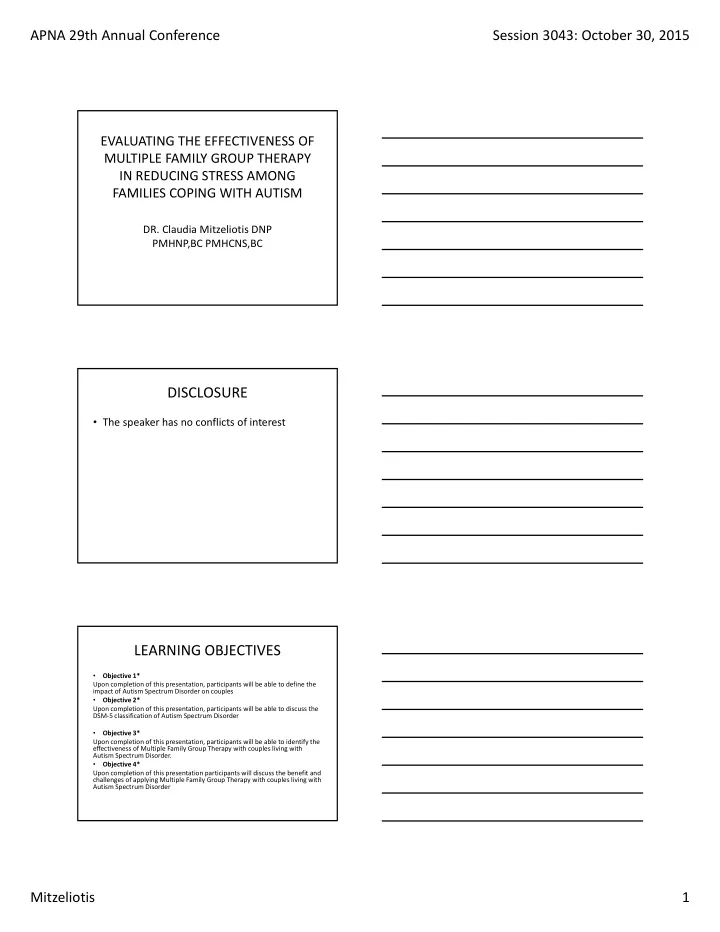
EVALUATING THE EFFECTIVENESS OF MULTIPLE FAMILY GROUP THERAPY IN REDUCING STRESS AMONG FAMILIES COPING WITH AUTISM

  • DR. Claudia Mitzeliotis DNP

PMHNP,BC PMHCNS,BC

DISCLOSURE

  • The speaker has no conflicts of interest

LEARNING OBJECTIVES

  • Objective 1*

Upon completion of this presentation, participants will be able to define the impact of Autism Spectrum Disorder on couples

  • Objective 2*

Upon completion of this presentation, participants will be able to discuss the DSM‐5 classification of Autism Spectrum Disorder

  • Objective 3*

Upon completion of this presentation, participants will be able to identify the effectiveness of Multiple Family Group Therapy with couples living with Autism Spectrum Disorder.

  • Objective 4*

Upon completion of this presentation participants will discuss the benefit and challenges of applying Multiple Family Group Therapy with couples living with Autism Spectrum Disorder

slide-2
SLIDE 2

APNA 29th Annual Conference Session 3043: October 30, 2015 Mitzeliotis 2

INTRODUCTION

 Illness has an impact on all family members.  Parents raising a child with Autism Spectrum Disorder (ASD) have higher levels of stress than other disabilities. (Estes,Munson,Dawson, Koehler,

Zhou & Abbott 2009; Davis & Carter 2008 ; Brost, Clopton, Hendrick .2009)

 Mothers raising a child with ASD reported less parenting competence, decrease in marital satisfaction difficulty adapting compared to mothers of children coping with Down’s Syndrome .

(Dunn, Burbine, Bowers .& Dunn‐Tantleff 2001.

 Parents tend to isolate themselves avoiding social contact with the

  • utside world. There are limited services available for parents.(Grey

1993)

BACKGROUND

 Autism Spectrum Disorder (ASD) has been on the rise and current statistics estimate that males are four times more likely to have ASD than females (Duchan 2012).  Duchan (2012) surveyed the epidemiology of ASD and the number has soared to 60 per 10,000 individuals.  The National Health Statistics Report, which was based on parent reporting, found a significant increase in ASD of 2.00% as of 2011‐2012. This was compared to 2007 where the rate was reported to be 1.16%.  CDC has reported that 1 in 68 children have been identified with ASD  The ratio of boys 5x more likely to have ASD compared to girls.  CDC report indicated diagnose delay may be related to validated tools to assess symptom severity lack of early assessment

AUTISM SPECTRUM DISORDER

Autism Spectrum Disorder – Merges Autism, Asperger’s disorder, and Pervasive Developmental Disorder–Not Otherwise Specified (PDD‐NOS) (Skuse 2012) Diagnostic Criteria has 2 components social communication deficits and repetitive behaviors and fixed interests (DSM‐5, 2013) 3 levels of severity level 1‐ requiring support 2‐ requiring substantial support 3‐ requiring very substantial support

(DSM‐5, 2013)

slide-3
SLIDE 3

APNA 29th Annual Conference Session 3043: October 30, 2015 Mitzeliotis 3

AUTISM SPECTRUM DISORDER

Severity Level Social Communication Restricted, Repetitive Behavior Level 3 Requiring very Substantial Support Severe deficits verbal and non‐verbal communication Severe impairment in ability to initiation social interactions

  • r to respond to social interactions

Inflexible behavior extreme difficulty coping with change/ restricted or repetitive behavior markedly interferes with functioning Severe distress unable to change focus Level 2 Requiring Substantial Support Marled deficits in verbal, non‐verbal communication and social impairment even with support in place. Inflexibility of behavior difficulty coping with change /restricted or repetitive appear frequently enough to be obvious to

  • bserver. Distress unable to change

focus Level 1 Requiring Support Without support in place deficits in social communication cause noticeable impairments Problems organizing and planning Inflexible behavior interferes with

  • functioning. (DSM‐5,2013)

IMPACT OF ASD ON PARENTS

 Parental stress has been identified as a significant component related to raising a child with ( Bilgin & Kucuk2010; Dabrowska & Pisula 2010; Davis &

Carter 2008; Dunn, Burbine, Bowers & Tantleff 2001).

 Parental stress has been correlated with many factors ranging from marital discord, child’s behavior, social support, ineffective coping and poor self‐ efficacy (Davis & Carter 2008; Neely, Eschevarria & Tannen 2012; Osborne,

McHugh, Saunders, & Reed, 2008).

 Lack of psychoeducation programs focusing on stress and emotions to assist parents to coping with ASD ( Cappe, Wolff, Bobet & Adren 2011).  Parents reported feeling supported when they had the opportunity to meet with other parents coping with ASD (Phelps 2009)  Families expressed an interested in attending support groups for autism (Luther 2005).

STATEMENT OF PROBLEM

  • There is lack of psychoeducation programs

focusing on stress and emotions to assist parents raising a child with ASD (Capote Wolff, Bobet &

Adren 2011).

  • Inquiry Question: What impact will a 4‐ week

Multiple Family Group Therapy intervention have on stress levels of parents raising a child with ASD?

slide-4
SLIDE 4

APNA 29th Annual Conference Session 3043: October 30, 2015 Mitzeliotis 4

Aspects of Parental Stress in Families Raising a Child with ASD

Theme One: Impact on Parent’s Relationship Parents coping with a child diagnosed with ASD have lower marital happiness (Higgins, Bailey,& Pearce, 2005). The demands of coping with with ASD impacts on parents interpersonal relationship (Tunali & Power 2002) The behavior of the child with ASD impacts on the parents more then the developmental delayed issues

(Hartley 2010).

Decrease in fathers’ involvement in child life creates greater stress in the relationship (Brobst, Clopton & Hendrick

2013).

Aspects of Parental Stress in Families Raising a Child with ASD

Theme Two: Parental Stress There are 3 factors causing parental stress, child’s behavior, lack of professional support and social attitudes directed at the child(Pisula 2011) The inability to manage the behavior of the child produced parental stress (Altiere & Von Kluge. 2009; Dabrowska &

Pisula . 2010).

Mothers reported that the lack of attachment children show have produced stress this was reinforced in the high scores on the PSI‐SF in area of Child Domain (Pisula

2011 )

Aspects of Parental Stress in Families Raising a Child with ASD

Theme Three: The Impact Stress Has on Parents Coping  Parents reported withdrawal, helplessness, worrying, and blaming behaviors’ produced a daily negative mood (Pottie and Ingram 2008). Coping does not improve with time (Hastings et al.

(2005),

Parents reported feeling sadness, depression, stress, and exhaustion raising a child with ASD

(Phelps, Hodgson, McCammon, & Lamson, 2009).

slide-5
SLIDE 5

APNA 29th Annual Conference Session 3043: October 30, 2015 Mitzeliotis 5

Aspects of Parental Stress in Families Raising a Child with ASD

Theme Four: Social Support  Parents reported parental stress and lower social support and relationship satisfaction compared to parents not experiencing ASD.

(Brobst, Clopton, and Hendrick 2008),

 The isolation parent’s feel raising a child with ASD is prominent (Altiere & Von Kluge, 2009; Dunn, Burbine, & Tantleff‐Dunn, 2001; Luther, Canham, & Young Cureton,

2005).

 Parents reported a decrease in social circles, feeling stigmatized and lack of motivation related to socializing. (Markoulakis, Fletcher, & Bryden, 2012)  Luther et. al. (2005) noted that families were interested in attending support groups for autism.  Parents reported feeling supported when they had the opportunity to meet with other parents coping with ASD (Phelps 2009)

APPLICATIONS OF PERRY’S STRESS MODEL

Perry designed model to be applied in research and clinical practice. Designed for families of ASD. (Perry,A.1990). The theoretical framework has been adopted in a number of studies (Perry, Harris & Flynn 2004;Bluth

2013).

THEORETICAL MODEL

Perry’s Stress Model

RESOURCES

SUPPORT

(Perry 1990) Couple Positive Outcome Child Characteristics Negative Outcome Mothers’ Perception of Child Fathers' Perception of Child Informal Formal Individual

slide-6
SLIDE 6

APNA 29th Annual Conference Session 3043: October 30, 2015 Mitzeliotis 6

MULTIPLE FAMILY GROUP THERAPY (MFGT)

Historical Background of Multiple Family Group Therapy Peter Lacquer in 1977 was the first to discuss the importance of providing education to parents on what initial topic Multiple Family Group Therapy served as the intervention. McFarlane expanded on his concept framework and designed Multiple Family Group Therapy (MFGT).

APPLICATIONS OF MFGT

MFGT is a psychoeducation model, which has been seen as the most effective evidence‐based practice in both clinical trials and community settings (Jewel, Downing

& McFarlane 2009; McFarlane & Lukens 2004;Fristad,Gavazzi, Soldano1999 ).

The model is flexible, incorporating both illness information and strategies for coping. McFarlane and Lukens (2004) found the MFGT model to be the most effective of the evidence‐based practice models in treating families coping with illnesses ranging from schizophrenia to cancer.

TRANSLATIONAL RESEARCH

  • Translational research involves utilizing or

applying basic and clinical research findings to new clinical and research tools, medications, and therapies.

slide-7
SLIDE 7

APNA 29th Annual Conference Session 3043: October 30, 2015 Mitzeliotis 7

– Phase 1: Parents raising a child with ASD experience high levels of stress – Phase 2: MFGT is effective in helping families cope with illness – Phase 3: Evaluating the application MFGT with parents raising a child with ASD. – Phase 4: Implementing MFGT with parents raising a child with ASD. – Phase 5: Evaluating the efficacy of MFGT in reducing stress in parents coping with ASD.

(National Collaborating Centre)

PHASES OF PROJECT DESIGN MEANS OF DATA ANALYSIS

Quantitative Data‐ SPSS demographic frequencies and t test. PSI‐SF focuses on percentiles in the data analysis.

 Parental Stress Index – Short Form

PSI‐SF measures parental stress in 3 domains

Parental Distress Parent Child Difficulty Interaction Difficult Child

Qualitative data

GROUP EVALUATION FORMS DEFINE THEMES

DEMOGRAPHIC DATA

Demographic Data Subjects Age Gender child age child’s gender 1 35.00F 6.00 Male 2 41.00F 2.00 Female 3 46.00F 7.00 Male 4 44.00F 4.00 Male 5 42.00F 12.00 Male 6 32.00F 5.00 Male 7 39.00M 5.00 Male 8 43.00 M 6.00 Male Total N 8 8 Mean 40.2500 5.8750 Median 41.5000 5.5000 Maximum 46.00 Male 12.00 Male Minimum 32.00 Female 2.00 Female

slide-8
SLIDE 8

APNA 29th Annual Conference Session 3043: October 30, 2015 Mitzeliotis 8

PARENTS TOTAL STRESS MEAN SCORES IN PERCENTILES

GENDER PRE –INTERVENTION POST‐INTERVENTION Female 99 98 Male 88 99 Female 99 99 Male 84 92 Female 94 76 Female 60 60 Female 84 99 Female 79 82

PARENTS TOTAL STRESS MEAN PERCENTILE SCORES

GENDER PRE –INTERVENTION POST‐INTERVENTION Female 99 98 Male 88 99 Female 99 99 Male 84 92 Female 94 76 Female 60 60 Female 84 99 Female 79 82

PARENT CHILD DYSFUNCTIONAL INTERACTION

GENDER PRE‐ INTERVENTIO POST‐INTERVENTION Female 98 76 Male 84 99 Female 99 99 Male 90 94 Female 80 58 Female 66 58 Female 96 94 Female 72 76

slide-9
SLIDE 9

APNA 29th Annual Conference Session 3043: October 30, 2015 Mitzeliotis 9

DIFFICULT CHILD PERCENTIAL SCORES

GENDER PRE‐ INTERVENTIO POST‐INTERVENTION Female 98 76 Male 84 99 Female 99 99 Male 90 94 Female 80 58 Female 66 58 Female 96 94 Female 72 76

FINDINGS QUALITATIVE DATA

Group responses placed in matrices and analyzed for common themes. Support Socialization Hope

COMMON THEME SUPPORT

“Connect with other parents.” “Connect and feel normal.” “Be a safe place to share in a safe environment .” “See that other people have the same problems that I have “

slide-10
SLIDE 10

APNA 29th Annual Conference Session 3043: October 30, 2015 Mitzeliotis 10

COMMON THEME SOCIALIZATION

“Understand there are people with the same problems.” “Talk free with another couple about child issues or family issues.” “Connect with other parents and talk about my feelings about having a son with autism.” “Sharing experience and hearing the experience of

  • thers.”

“Enjoy nowadays fighting autism step‐by‐step with my

  • son. I found a new step now and can play with our son

together.” “Connect and feel more normal.”

COMMON THEME OF HOPE

“Enjoy nowadays fighting with Autism step by step” “ Feel that not everything in our life has ended” “We can and must enjoy our life with hopes for the best future for our family”

CONCLUSION

Implications for Practice‐ MFGT applicable with families coping with ASD Implications for Research‐ the outcome of the study supports the next step a pilot study with a larger population.