Disclosure Disclosure Caries Management by Risk Caries Management - - PDF document

disclosure disclosure caries management by risk caries
SMART_READER_LITE
LIVE PREVIEW

Disclosure Disclosure Caries Management by Risk Caries Management - - PDF document

Disclosure Disclosure Caries Management by Risk Caries Management by Risk Assessment Assessment : I have no personal financial interest in any I have no personal financial interest in any The Caries Balance The Caries Balance company


slide-1
SLIDE 1

Caries Management by Risk Caries Management by Risk Assessment Assessment : The Caries Balance The Caries Balance

John D.B. Featherstone John D.B. Featherstone Professor and Dean Professor and Dean E-mail jdbf@ucsf.edu mail jdbf@ucsf.edu

School of Dentistry School of Dentistry

University of California San Francisco University of California San Francisco

Disclosure Disclosure

I have no personal financial interest in any I have no personal financial interest in any company relevant to this presentation. company relevant to this presentation. I consult for, have consulted for, or have I consult for, have consulted for, or have done research funded or supported by: done research funded or supported by: Arm and Hammer, Beecham, Cadbury, GSK, Arm and Hammer, Beecham, Cadbury, GSK, KaVo, Novamin, Omnii Oral Pharmaceuticals, KaVo, Novamin, Omnii Oral Pharmaceuticals, Oral B, Philips Oralcare, Procter and Gamble, Oral B, Philips Oralcare, Procter and Gamble, 3M ESPE Preventive Care, Wrigley, and the 3M ESPE Preventive Care, Wrigley, and the National Institutes of Health. National Institutes of Health.

Protective Factors

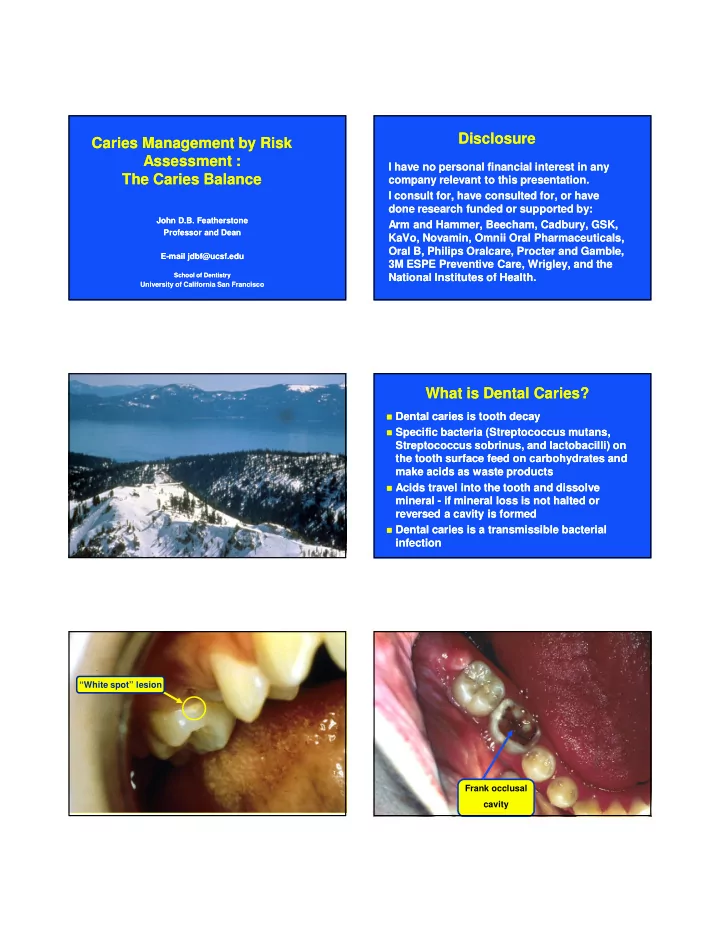
What is Dental Caries? What is Dental Caries?

Dental caries is tooth decay

Dental caries is tooth decay

Specific bacteria (Streptococcus mutans,

Specific bacteria (Streptococcus mutans, Streptococcus sobrinus, and lactobacilli) on Streptococcus sobrinus, and lactobacilli) on the tooth surface feed on carbohydrates and the tooth surface feed on carbohydrates and make acids as waste products make acids as waste products

Acids travel into the tooth and dissolve

Acids travel into the tooth and dissolve mineral mineral - if mineral loss is not halted or if mineral loss is not halted or reversed a cavity is formed reversed a cavity is formed

Dental caries is a transmissible bacterial

Dental caries is a transmissible bacterial infection infection

Protective Factors

“White spot” lesion

Protective Factors

Frank occlusal cavity

slide-2
SLIDE 2

Protective Factors

Childhood Caries

The Caries Balance The Caries Balance

Protective Factors

  • Saliva flow and components
  • Fluoride, Calcium, Phosphate:

remineralization

  • Antibacterials:-

chlorhexidine, xylitol, new?

No Caries Caries Pathological Factors

  • Acid-producing bacteria
  • Frequent eating/drinking of

fermentable carbohydrates

  • Sub-normal saliva flow and

function

Featherstone, Community Dent Oral Epidem, 1999

Protective Factors

Stay in balance to survive

Pathological Factors Pathological Factors

Cariogenic bacteria: mutans streptococci

Cariogenic bacteria: mutans streptococci (S. mutans and S. sobrinus)

  • S. mutans and S. sobrinus) and

and lactobacillus species lactobacillus species

Frequency of ingestion of fermentable

Frequency of ingestion of fermentable carbohydrates: sucrose, glucose, carbohydrates: sucrose, glucose, fructose, cooked starch fructose, cooked starch

Reduced salivary function (medication

Reduced salivary function (medication induced; radiation therapy; disease; induced; radiation therapy; disease; genetic) genetic) Protective Factors

Acid producing bacteria are usually less than 1 percent of the total flora in the plaque Scanning Electron Micrograph

  • f bacteria on

a tooth surface

slide-3
SLIDE 3

Streptococcus mutans culture showing active cell

  • division. S. sobrinus is similar. Sucrose leads to

extracellular polysaccharides that stick the plaque together

Mutans Streptococci Mutans Streptococci

This group of bacteria contains two primary species that appear in humans

Streptococcus mutans - almost universal Streptococcus sobrinus - virulent, high risk

Both species produce acids and can live in acid

Lactobacillus culture. Lactobacilli species produce predominantly lactic acid from fermentable carbohydrates

What about the clinical relevance?

Does drilling and filling really fix caries?

Clinical Study Results Clinical Study Results NIH/NIDCR Grant NIH/NIDCR Grant Caries Management By Risk Caries Management By Risk Assessment Assessment 1999 1999-2004 2004

Principal Investigator: Principal Investigator: John Featherstone John Featherstone Co Co-investigators: investigators: Chuck Hoover, Stuart Gansky, Marcia Rapozo Chuck Hoover, Stuart Gansky, Marcia Rapozo-Hilo, Kim Tran, Hilo, Kim Tran, Joel White, Jane Weintraub Joel White, Jane Weintraub

Caries Management Study Caries Management Study

S1 S3 S7 S2

Baseline Observations Saliva Sample MS, LB and F Radiographs DMFS 1-7 cavities

Control Intervention

Final Observations Radiographs DMFS

Randomization

Restorations +Anti-bacterial and Fluoride Treatment All Restorations Complete

S2 S4-S6

Conventional Treatment Plan Restorations

S3 S7

Final Observations Radiographs DMFS All Restorations Complete

S4-S6

high low

  • N=116

(CHX + F) N=115

slide-4
SLIDE 4
  • !

High Bacterial Challenge Baseline Bacterial Levels vs Decay Existing Cavity = High Risk

Mean (SE) logM S

1 2 3 4 5 6 7 1 2 3 4 5

Log MS Control Log MS Intervention Visit # - 6 month intervals

Chlorhexidine plus Fluoride Restorations

Patients With Frank cavities Patients With Frank cavities

One or more frank cavities indicates high

risk for future new carious lesions

Moderate to high levels of mutans

streptococci

Moderate to high levels of lactobacilli Patients have a high bacterial challenge that

most likely can not be completely overcome by fluoride alone

Placing restorations does not reduce the

Placing restorations does not reduce the bacterial loading in the rest of the mouth bacterial loading in the rest of the mouth ∆ ∆ ∆ ∆DMFS (SE) 24% reduction (p=0.02)

Control Intervention 1 2 3 4 5 Would you put a new roof on while the house is burning? Placing a restoration does not significantly reduce the bacterial loading in the remainder of the mouth.

Caries is a Transmissible Caries is a Transmissible Bacterial Infection Bacterial Infection

Time for a paradigm shift Children infected by mother, caregiver,

siblings

Fluoride is effective only up to a point High bacterial challenge can not be

completely overcome

Placing “fillings” has little effect on

cariogenic bacterial loading in the mouth

Need to deal with the infection

slide-5
SLIDE 5

First Colonizable Hard Surface. First Colonizable Hard Surface. Soft tissues can also be colonized Soft tissues can also be colonized before before teeth erupt. teeth erupt. Pathological Factors Pathological Factors

Cariogenic bacteria: mutans streptococci

Cariogenic bacteria: mutans streptococci (S. mutans and S. sobrinus)

  • S. mutans and S. sobrinus) and

and lactobacillus species lactobacillus species

Frequency of ingestion of fermentable

Frequency of ingestion of fermentable carbohydrates: sucrose, glucose, carbohydrates: sucrose, glucose, fructose, cooked starch fructose, cooked starch

Reduced salivary function (medication

Reduced salivary function (medication induced; radiation therapy; disease; induced; radiation therapy; disease; genetic) genetic)

+ Demineralization:- Step 1

Cariogenic Bacteria

  • S. Mutans
  • S. Sobrinus

Lactobacilli Fermentable Carbohydrates Sucrose Glucose Fructose Cooked starch Organic Acids Which penetrate enamel and dentin Dissolve tooth mineral

Protective Factors

Cariogenic foods contain fermentable carbohydrates such as sucrose, glucose, fructose and cooked starch

Non Non-cariogenic Sweeteners cariogenic Sweeteners

Sorbitol

Sorbitol

Aspartame

Aspartame

Saccharin

Saccharin

Sodium cyclamate

Sodium cyclamate

Xylitol

Xylitol

Pathological Factors Pathological Factors

Cariogenic bacteria: mutans streptococci

Cariogenic bacteria: mutans streptococci (S. mutans and S. sobrinus)

  • S. mutans and S. sobrinus) and

and lactobacillus species lactobacillus species

Frequency of ingestion of fermentable

Frequency of ingestion of fermentable carbohydrates: sucrose, glucose, carbohydrates: sucrose, glucose, fructose, cooked starch fructose, cooked starch

Reduced salivary function (medication

Reduced salivary function (medication induced; radiation therapy; disease; induced; radiation therapy; disease; genetic) genetic)

slide-6
SLIDE 6

Male, 55 years old, before radiation to the head and neck for cancer treatment. Causes saliva flow and function to be cut by at least 90% Same male, after radiation to the head and neck. Six months later, showing rampant decay and massive destruction of the teeth

Protective factors Protective factors

Salivary components and flow

Salivary components and flow

Fluoride, calcium and phosphate:

Fluoride, calcium and phosphate: remineralization remineralization

Antibacterials from extrinsic sources

Antibacterials from extrinsic sources

Saliva Contains Numerous Saliva Contains Numerous Important Components Important Components

Calcium, phosphate and fluoride

Calcium, phosphate and fluoride

Proteins and lipids that form the pellicle

Proteins and lipids that form the pellicle that protects the tooth surface that protects the tooth surface

Proteins that keep calcium in solution

Proteins that keep calcium in solution - they maintain supersaturation they maintain supersaturation

Buffers: bicarbonate, phosphate,

Buffers: bicarbonate, phosphate, peptides peptides

Antibacterial substances &

Antibacterial substances & immunoglobulins immunoglobulins

Protective factors Protective factors

Salivary components and flow

Salivary components and flow

Fluoride, calcium and phosphate:

Fluoride, calcium and phosphate: remineralization remineralization

Antibacterials from extrinsic sources

Antibacterials from extrinsic sources

+

Demineralization:- Step 2

If fluoride is present in the If fluoride is present in the solution between the solution between the crystals it inhibits mineral crystals it inhibits mineral loss loss

Organic Acids

Dental Mineral = Carbonated Hydroxyapatite Acid soluble

Demineralization Calcium and phosphate into solution

Protective Factors

Scanning Electron Microscope image of Normal Enamel Surface

slide-7
SLIDE 7

Protective Factors

SEM of enamel surface 60,000X, showing crystal ends Transmission Electron Microscope image of enamel cross-section at 60,000X showing individual crystals and the prism (rod) boundary

Protective Factors

Acid-damaged enamel crystals from a carious lesion at 3,000,000x showing rows of calcium atoms. Hexagonal white patches (arrows) are where acid has dissolved mineral from calcium deficient/carbonate rich regions. Dissolved regions Water amongst the crystals

  • Dr. Fluoride

protects against mineral loss

Water amongst the crystals

+

Remineralization/Tooth Repair

Fluoride speeds up remineralization -> less soluble mineral

Calcium in tooth water (from saliva) Phosphate in tooth water (from saliva) Remineralization Builds on existing crystal remnants New mineral less soluble Fluoride helps

  • Dr. Fluoride speeds

up remineralization and makes acid resistant mineral

Demineralized surface blocks need to be replaced with new calcium, phosphate and fluoride to make a more acid resistant surface on the crystal

slide-8
SLIDE 8

SEM in the body of a carious lesion (~ 30,000x) showing remaining crystal remnants awaiting remineralization Sound enamel crystal (3,000,000x) dissected from inner enamel showing carbonate rich acid soluble regions (white patches). Enamel crystal after remineralization with calcium, phosphate and fluoride, showing a well-formed, low solubility, fluorapatite-like veneer overlying the

  • riginal defective crystal

Calcium and phosphate are cemented in place by fluoride providing a new stable wall

Enamel/dentin crystal = Carbonated apatite Partly dissolved crystal Crystal nucleus ACID Acid resistant Acid resistant Ca Ca10

10 (PO

(PO4)6

6 (F)

(F)2 = = fluorapatite fluorapatite-like like coating on crystals coating on crystals

Remineralization

Calcium + Phosphate + Fluoride

Fluoride works primarily via Fluoride works primarily via topical mechanisms topical mechanisms

Fluoride inhibits demineralization by

Fluoride inhibits demineralization by adsorbing from solution onto tooth adsorbing from solution onto tooth mineral crystal surfaces mineral crystal surfaces

Fluoride enhances remineralization

Fluoride enhances remineralization by combining with calcium and by combining with calcium and phosphate to make a “fluorapatite phosphate to make a “fluorapatite-

  • like” remineralized veneer

like” remineralized veneer

slide-9
SLIDE 9

Protective Factors

H+ + F- HF HF H+ + F - Bacterial Cell pH 7 H+ + F - H F pH 4.5 H+ + F -

H F

Fluoride can not enter bacteria in its ionic form, but as the bacteria produce acid HF is formed, which diffuses readily into the cells Fluoride inhibits demineralization

Fluoride inhibits demineralization

Fluoride enhances remineralization

Fluoride enhances remineralization

Fluoride can inhibit plaque bacteria

Fluoride can inhibit plaque bacteria

Fluoride works primarily via Fluoride works primarily via topical (surface) mechanisms topical (surface) mechanisms

(Fluoride in water, foods, beverages, products) Protective Factors

Fluoride levels in the mouth are sufficient to enhance remineralization

Protective Factors

Numerous clinical trials showed ~30% reduction with fluoride dentifrice 1000-2800 ppm F. Curnow, Pine, et al, 2002 reported 56% reduction with supervised brushing twice daily

Orthodontic brackets attract cariogenic bacteria, leading to “white patch” decay Stannous Fluoride Stabilized Formula 2007

slide-10
SLIDE 10

Over the counter fluoride rinses (0.05% NaF) are very effective in high caries risk patients when used once or twice daily for one minute, plus a fluoride-containing dentifrice. O’Reilly and Featherstone, 1987

Office Office-Applied Fluoride Products Applied Fluoride Products Gel ( Gel (> > 5,000 ppm F) 5,000 ppm F) and Fluoride Varnish and Fluoride Varnish

Do not require continuing patient

Do not require continuing patient compliance compliance

Forms slowly soluble calcium fluoride

Forms slowly soluble calcium fluoride-

  • like

like deposits in lesions and the plaque deposits in lesions and the plaque

Gives slow release fluoride for several

Gives slow release fluoride for several weeks weeks

Three times a year for high risk patients

Three times a year for high risk patients Evidence-based Clinical Recommendations: Professionally Applied Topical Fluoride The Council on Scientific Affairs, American Dental Association May, 2006

Fluoride gel applied for 4 minutes or more is effective Fluoride varnish applied every 6 months is effective Two or more applications of fluoride varnish per year are effective in high caries risk individuals Office topical applications no added benefit for low risk individuals Protective Factors Weintraub et al, J Dent Res, 2006. Fluoride varnish in infants (approx 2 years old at start)

Caries Incidence Infants Over 2 years

1 2 3 5 10 15 20 25 30 35 40 45

Fluoride Varnish Applications

Fluoride Varnish for High Risk of All Ages White “Vanish” Varnish – 3M ESPE Prev Care

High fluoride concentration (5,000 High fluoride concentration (5,000 ppm F) toothpaste more effective ppm F) toothpaste more effective than 1100 ppm F in high risk than 1100 ppm F in high risk individuals individuals

Baysan A et al, Caries Res 2001. 5000 ppm F Baysan A et al, Caries Res 2001. 5000 ppm F toothpaste gave statistically significant extra toothpaste gave statistically significant extra reduction in root caries compared to 1100 reduction in root caries compared to 1100 ppm F toothpaste. ppm F toothpaste. However, caries progression still occurred in However, caries progression still occurred in many subjects even with high concentration many subjects even with high concentration fluoride use fluoride use

slide-11
SLIDE 11

High concentration fluoride products for high risk patients. Proven effective for root caries.

Conclusions Conclusions - Fluoride Fluoride

The anti

The anti-caries effects of fluoride are caries effects of fluoride are primarily topical (surface) in plaque primarily topical (surface) in plaque

The systemic benefits of fluoride are

The systemic benefits of fluoride are minimal minimal

Therapeutic levels of F can be achieved

Therapeutic levels of F can be achieved from drinking water and fluoride products from drinking water and fluoride products

Fluoride therapy may not overcome a high

Fluoride therapy may not overcome a high bacterial challenge bacterial challenge

Calcium Phosphopeptide: Calcium Phosphopeptide: CPP/ACP CPP/ACP Eric Reynolds Eric Reynolds - Australia Australia

Background and mechanism Laboratory studies: Three decades Clinical Studies: clinical evidence

Representation of a proposed Representation of a proposed CPP CPP-ACP complex ACP complex

Cross et al. 2007 Curr Pharm Des,

Conclusions Conclusions

Limited calcium and phosphate in

Limited calcium and phosphate in individuals with reduced salivary function individuals with reduced salivary function is a common problem is a common problem

Calcium and phosphate delivery can be

Calcium and phosphate delivery can be enhanced to improve remineralization enhanced to improve remineralization

Great need for novel improved

Great need for novel improved remineralization methods to better alter remineralization methods to better alter the “caries balance”, especially in the “caries balance”, especially in individuals with high bacterial challenge individuals with high bacterial challenge

MI paste, MI Paste Plus (with fluoride)

MI paste, MI Paste Plus (with fluoride)

slide-12
SLIDE 12

The Caries Balance The Caries Balance

Protective Factors

  • Saliva flow and components
  • Fluoride, calcium, phosphate:-

remineralization

  • Antibacterials:- chlorhexidine,

xylitol, new?

No Caries Caries Pathological Factors

  • Acid-producing bacteria
  • Frequent eating/drinking
  • f fermentable carbohydrates
  • Sub-normal saliva flow and

function

Protective factors Protective factors

Salivary components and flow

Salivary components and flow

Fluoride, calcium and phosphate:

Fluoride, calcium and phosphate: remineralization remineralization

Antibacterials from extrinsic sources

Antibacterials from extrinsic sources

Protective Factors

Biofilm Modification is necessary as part

  • f our therapy for high bacterial challenge
  • individuals. Caries is a transmissible

bacterial infection

Caries is a Transmissible Caries is a Transmissible Bacterial Infection Bacterial Infection

Multiple acid

Multiple acid-producing species of bacteria are producing species of bacteria are responsible responsible

Children are infected by mothers, care

Children are infected by mothers, care-givers, givers, siblings, playmates, through saliva transfer siblings, playmates, through saliva transfer

Babies and infants are most susceptible from birth

Babies and infants are most susceptible from birth to about 4 years of age to about 4 years of age

Children infected early have more cavities later in

Children infected early have more cavities later in life life

Need to break the chain of infection and deal with

Need to break the chain of infection and deal with the bacteria the bacteria

Similarity of bacteriocins of Similarity of bacteriocins of S. S. mutans mutans from mother and infant from mother and infant

R.J. Berkowitz and H.V. Jordan

  • Archs. Oral Biol. 20:725-730, 1975

Demonstrated the likelihood of Demonstrated the likelihood of transmission from mother to child transmission from mother to child

Oral colonization of S. mutans Oral colonization of S. mutans in Six in Six-month month-old Predentate

  • ld Predentate

Infants Infants

A.K.L. Wan, W.K. Seow, et al. J.Dent Res. 80:2060-2065,2001

Showed that S.mutans colonized even before teeth erupted

(50% of infants).

Related to high S. mutans in mothers, increased frequency

  • f sugar intake, breast feeding and habits with saliva

transfer from mother to child

slide-13
SLIDE 13

Chlorhexidine Gluconate 0.12%, 10 ml, daily for 1 week reduces MS markedly and LB somewhat after restorations completed. Repeat every month. Chlorhexidine was effective at reducing

Chlorhexidine was effective at reducing the bacterial challenge in high caries risk the bacterial challenge in high caries risk individuals even when compliance was individuals even when compliance was problematic problematic

Preferred regimen is once a day rinse for

Preferred regimen is once a day rinse for

  • ne week every month for a year
  • ne week every month for a year

Monitor success by bacterial testing

Monitor success by bacterial testing

Ideally we need a better antibacterial

Ideally we need a better antibacterial therapy therapy

Must combine with remin/fluoride

Must combine with remin/fluoride

What about What about toddlers/preschoolers? toddlers/preschoolers?

No good antibacterial vehicle available for

No good antibacterial vehicle available for toddlers toddlers - chlorhexidine has negatives chlorhexidine has negatives

Chewing xylitol gum inappropriate & mints

Chewing xylitol gum inappropriate & mints might be aspirated might be aspirated

Xylitol wipes?

Xylitol wipes? - Spiffies: Unpublished data Spiffies: Unpublished data show caries reduction over one year in infants show caries reduction over one year in infants

Enlist the mothers and caregivers

Enlist the mothers and caregivers

Xylitol Xylitol

Xylitol is a 5 carbon “sugar alcohol”

Xylitol is a 5 carbon “sugar alcohol”

It looks like sucrose and has about the same

It looks like sucrose and has about the same sweetness by weight sweetness by weight

It is used in some foods, chewing gum, candies,

It is used in some foods, chewing gum, candies, lozenges, and dental products as a sweetener lozenges, and dental products as a sweetener

Cariogenic (caries causing) bacteria can not feed

Cariogenic (caries causing) bacteria can not feed

  • n it
  • n it

Humans can feed on it and use it as an energy

Humans can feed on it and use it as an energy source source

It inhibits the transfer of bacteria from person to

It inhibits the transfer of bacteria from person to person by altering the way the bacteria stick to person by altering the way the bacteria stick to surfaces surfaces

Influence of maternal xylitol Influence of maternal xylitol consumption on acquisition of consumption on acquisition of mutans streptococci by infants mutans streptococci by infants

  • E. Soderling, P. Pienihakkinen, J. Tenovuo
  • J. Dent. Res. 79:882-887, 2000

Use of xylitol gum by mothers reduced Use of xylitol gum by mothers reduced colonization in infants. colonization in infants.

Xylitol was better than chlorhexidine varnish, which was better than fluoride varnish

Parallel study showed marked caries reductions Parallel study showed marked caries reductions after 5 years (10 year results still hold up) after 5 years (10 year results still hold up)

Treat the mother or Treat the mother or caregiver to reduce caries in caregiver to reduce caries in the child the child

Mother or caregiver with active

Mother or caregiver with active caries must be taken care of caries must be taken care of

Chlorhexidine rinses during 3rd

Chlorhexidine rinses during 3rd trimester continuing after birth trimester continuing after birth

Fluoride therapy to control the decay

Fluoride therapy to control the decay

4-5 g/day xylitol chewing gum for 5

5 g/day xylitol chewing gum for 5 minutes each time and/or mints. minutes each time and/or mints.

slide-14
SLIDE 14

Xylitol Xylitol

Xylitol chewing gum use enhances

Xylitol chewing gum use enhances remineralization remineralization

It inhibits the transfer of bacteria from

It inhibits the transfer of bacteria from person to person by altering the way the person to person by altering the way the bacteria stick to surfaces bacteria stick to surfaces

It inhibits future recolonization

It inhibits future recolonization

Xylitol Gum, Mints Xylitol Gum, Mints

Xylitol Xylitol

  • Noncariogenic sweetener

Noncariogenic sweetener Inhibits transfer of bacteria Inhibits transfer of bacteria from mother to child from mother to child Can reduce loading of Can reduce loading of cariogenic bacteria in the cariogenic bacteria in the mouth mouth

Xylitol Xylitol Peter Milgrom Peter Milgrom - University University

  • f Washington
  • f Washington

Caries response is dose dependent Gummy bears successful as a delivery vehicle

A Few Xylitol Gum Sources A Few Xylitol Gum Sources

  • Epic. http://www.epicdental.com/departments.asp
  • Epic. http://www.epicdental.com/departments.asp

You can buy gums and mints from this company, including You can buy gums and mints from this company, including dispensers. dispensers.

Omni Preventive Care 3M ESPE. Office and home care

Omni Preventive Care 3M ESPE. Office and home care products. products. http://solutions.3m.com/wps/portal/3M/en_US/preventive http://solutions.3m.com/wps/portal/3M/en_US/preventive- care/home/ care/home/

  • Zellies. Ellie has the full range plus educational materials.
  • Zellies. Ellie has the full range plus educational materials.

http://www.zellies.com http://www.zellies.com

Spry is another company that markets gum and mints to

Spry is another company that markets gum and mints to dental offices dental offices http://www.homesteadmarket.com/xylitol_mints.html http://www.homesteadmarket.com/xylitol_mints.html

Use The Caries Use The Caries Balance to Balance to Assess the Risk Assess the Risk

slide-15
SLIDE 15

The Caries Balance The Caries Balance

Protective Factors

  • Saliva flow and components
  • Fluoride, calcium, phosphate:

remineralization

  • Antibacterials:-

chlorhexidine, xylitol, new?

No Caries Caries Pathological Factors

  • Acid-producing bacteria
  • Frequent eating/drinking of

fermentable carbohydrates

  • Sub-normal saliva flow and

function

Sometimes there is a delicate balance

Caries Risk Assessment Caries Risk Assessment

An Actual Case An Actual Case -

  • 1

1

21 year old female referred by general dentist

(a) (a) First cavity of her life

First cavity of her life

(b) (b) Numerous interproximal lesions on radiographs,

Numerous interproximal lesions on radiographs, several into dentin several into dentin

(c) (c) Apparently good oral hygiene

Apparently good oral hygiene

(d) (d) College student living in an apartment

College student living in an apartment

(e) (e) White patches observed

White patches observed - Orthodontic treatment Orthodontic treatment completed three years before completed three years before

(f) (f) Did bacteria test

Did bacteria test – Ivoclar/Vivadent CRT Ivoclar/Vivadent CRT

Mixed saliva is added to the two sided selective media slide (mutans streptococci and lactobacilli) Incubate for 72 hours and read versus density scale

Vivadent Test Strips. An actual case. Used to measure mutans streptococci and lactobacilli

Caries Risk Assessment Caries Risk Assessment

An Actual Case An Actual Case -

  • 2

Pathological factors

(a) (a) Mutans streptococci and lactobacilli very high

Mutans streptococci and lactobacilli very high

(b) (b) Frequent (greater than 3 times) between meal

Frequent (greater than 3 times) between meal snacks of sugars/cooked starch snacks of sugars/cooked starch - college student college student not eating regular meals not eating regular meals

(c) (c) No saliva reducing factors: 1) medications, 2)

No saliva reducing factors: 1) medications, 2) radiation to the head and neck, 3) systemic radiation to the head and neck, 3) systemic reasons reasons

(d) (d) Saliva flow normal (approximately 2.0 ml/min)

Saliva flow normal (approximately 2.0 ml/min)

(e) (e) Previously appliances present

Previously appliances present - orthodontic

  • rthodontic

brackets brackets

slide-16
SLIDE 16

Caries Risk Assessment Caries Risk Assessment

An Actual Case An Actual Case -

  • 3

3

Protective factors Protective factors

(a) (a)

Use of fluoride toothpaste not regular Use of fluoride toothpaste not regular

(b) (b) Saliva normal and adequate

Saliva normal and adequate

(c) (c)

Insufficient to overcome the high and frequent acid Insufficient to overcome the high and frequent acid challenges challenges

(d) (d) Treatment regimen

Treatment regimen

(e) (e)

Chlorhexidine rinse daily one week each month Chlorhexidine rinse daily one week each month

(f) (f)

High concentration fluoride toothpaste daily High concentration fluoride toothpaste daily

(g) (g) Diet diary and modification of snacking. Add xylitol gum.

Diet diary and modification of snacking. Add xylitol gum. Motivated/intelligent individual. Motivated/intelligent individual.

(h) (h) Restore tooth with cavity. Monitor the remainder

Restore tooth with cavity. Monitor the remainder

(i) (i)

Caries controlled Caries controlled

Protective Factors

Orthodontic brackets attract cariogenic bacteria, leading to “white patch” decay

Risk Assessment Assessing the risk for caries in the future

Putting into practice Putting into practice the results of many the results of many years of research. years of research. “Caries Management “Caries Management by Risk Assessment” by Risk Assessment” based upon the based upon the “Caries Balance” “Caries Balance” CDA Journal CDA Journal Feb/March 2003 Feb/March 2003

http://www.cdafoundation.org/journal

Putting into practice Putting into practice the results of many the results of many years of research. years of research. “Caries Management “Caries Management by Risk Assessment” by Risk Assessment” October, November October, November

  • 2007. On line, free
  • 2007. On line, free

California Dental California Dental Association Journal Association Journal based upon the based upon the “Caries Balance” “Caries Balance”

http://www.cdafoundation.org/journal

The Caries Imbalance The Caries Imbalance

Protective Factors

  • Saliva
  • Fluoride, Ca, P
  • Antibacterials

No Caries Caries Progression Risk Factors

  • Acidogenic

bacteria

  • Frequent

carbohydrates

  • Sub-normal saliva

Disease Indicators

  • Cavities/dentin
  • Enamel lesions
  • Restorations < 3 yr
  • White spots

Featherstone, Young, Wolff, 2007

slide-17
SLIDE 17

Barriers to CAMBRA Implementation Barriers to CAMBRA Implementation

Up front cost to patients

Up front cost to patients

Lack of insurance coverage

Lack of insurance coverage

Practitioners and patients do not have

Practitioners and patients do not have therapeutic measures in their mind as part of therapeutic measures in their mind as part of the treatment plan the treatment plan

Insufficient training

Insufficient training

Lack of acceptance by traditionally trained

Lack of acceptance by traditionally trained clinicians clinicians - afraid of the unknown afraid of the unknown

Lack of willingness to make the change

Lack of willingness to make the change

Caries Risk assessment Caries Risk assessment

(Age 6 years and older/adult) (Age 6 years and older/adult) -

  • 1

1

  • 1. Disease Indicators = Clinical Observations
  • 1. Disease Indicators = Clinical Observations

(a) (a) Visible cavities present

Visible cavities present

(b) (b) Caries restored in last 3 years

Caries restored in last 3 years

(c) (c) Interproximal caries lesions/radiolucencies

Interproximal caries lesions/radiolucencies

(d) (d) White spots on enamel surfaces

White spots on enamel surfaces Any one of these signals a bacteria test for MS and Any one of these signals a bacteria test for MS and LB LB These are all clinical observations that tell us These are all clinical observations that tell us nothing about the cause of the disease nothing about the cause of the disease - they they indicate presence of disease indicate presence of disease

Caries Risk assessment Caries Risk assessment

(Age 6 years and older/adult) (Age 6 years and older/adult) -

  • 2
  • 2. Risk Factors (Biological determinants of caries risk)
  • 2. Risk Factors (Biological determinants of caries risk)

(a) (a)

MS and LB medium or high MS and LB medium or high - by culture by culture

(b) (b) Visible heavy plaque on teeth

Visible heavy plaque on teeth

(c) (c)

Frequent (greater than 3 times) between meal snacks of Frequent (greater than 3 times) between meal snacks of sugars/cooked starch sugars/cooked starch

(d) (d) Deep pits and fissures

Deep pits and fissures

(e) (e)

Recreational drug use Recreational drug use

(f) (f)

Inadequate saliva flow (less than 0.5 ml/min) Inadequate saliva flow (less than 0.5 ml/min)

(g) (g) Saliva reducing factors: 1) medications, 2) radiation to the

Saliva reducing factors: 1) medications, 2) radiation to the head and neck, 3) systemic reasons, e.g. Sjogren’s head and neck, 3) systemic reasons, e.g. Sjogren’s syndrome syndrome

(h) (h) Exposed tooth roots

Exposed tooth roots

(i) (i)

Orthodontic appliances present Orthodontic appliances present

Caries Risk assessment Caries Risk assessment

(Age 6 years and older/adult) (Age 6 years and older/adult) -

  • 3

3

  • 3. Protective Factors
  • 3. Protective Factors

(a) (a)

Lives/works/school in community with fluoridated water Lives/works/school in community with fluoridated water

(b) (b)

Uses fluoride toothpaste once daily Uses fluoride toothpaste once daily

(c) (c)

Use fluoride toothpaste at least twice daily Use fluoride toothpaste at least twice daily

(d) (d)

Uses fluoride rinse/gel daily Uses fluoride rinse/gel daily

(e) (e)

Uses 5000 ppm F toothpaste daily Uses 5000 ppm F toothpaste daily

(f) (f)

Fluoride varnish in last 6 months Fluoride varnish in last 6 months

(g) (g)

Office F topical in last 6 months Office F topical in last 6 months

(h) (h)

Chlorhexidine rinse prescribed/used daily for 1 week every Chlorhexidine rinse prescribed/used daily for 1 week every month last 6 months month last 6 months

(i) (i)

Xylitol gum/candies 4 times daily last 6 months Xylitol gum/candies 4 times daily last 6 months

(j) (j)

Calcium/phosphate paste last 6 months Calcium/phosphate paste last 6 months

(k) (k)

Saliva flow visibly adequate or > 1 ml/min by test Saliva flow visibly adequate or > 1 ml/min by test

Caries Risk Assessment Caries Risk Assessment (Age 6years (Age 6years -

  • adult)

adult)-

  • 5

5

  • 4. Bacterial test for high risk individual as a

baseline measure

  • 5. Count the yes’s. Assess caries risk and circle

risk as extreme, high, moderate or low

  • 6. Treatment Plan

Includes home care, office preventive treatments and restorative work

  • 7. Home Care Recommendations
  • 8. Recall and Re-assessment of Caries Risk
slide-18
SLIDE 18

Extreme Caries Risk Individuals Extreme Caries Risk Individuals

High Risk plus severe hyposalivation. Measure

High Risk plus severe hyposalivation. Measure saliva flow rate (less than 0.5 ml/minute) saliva flow rate (less than 0.5 ml/minute)

Same as for high risk individuals PLUS:

Same as for high risk individuals PLUS:

Baking soda rinse 4x daily (2 teaspoons in 8 ounces

Baking soda rinse 4x daily (2 teaspoons in 8 ounces water) water)

Consider fluoride trays for home use (1.1% neutral

Consider fluoride trays for home use (1.1% neutral sodium fluoride gel) daily sodium fluoride gel) daily

Consider calcium phosphate home use gel

Consider calcium phosphate home use gel

Recall 3 months and repeat F varnish etc.

Recall 3 months and repeat F varnish etc.

Caries Risk (Age 6 years Caries Risk (Age 6 years-Adult): Adult):- Patient Recommendations Patient Recommendations

Daily oral hygiene.

Daily oral hygiene. Fluoride Fluoride-containing toothpaste containing toothpaste

Diet

  • Diet. Limit between meal snacks, limit sodas.

. Limit between meal snacks, limit sodas.

Fluoride

  • Fluoride. Increase stepwise depending on risk level.

. Increase stepwise depending on risk level. (1) Toothpaste 2x daily, (2) F rinse (0.05% sodium fluoride) daily, (1) Toothpaste 2x daily, (2) F rinse (0.05% sodium fluoride) daily, (3) 5,000 ppm F dentifrice/gel nightly. Consider fluoride (3) 5,000 ppm F dentifrice/gel nightly. Consider fluoride varnish. varnish.

Sugar free gum/candy.

Sugar free gum/candy. Xylitol containing gum/candy, 4x daily. Xylitol containing gum/candy, 4x daily.

Antibacterial rinse

Antibacterial rinse. Chlorhexidine gluconate (0.12%) once . Chlorhexidine gluconate (0.12%) once daily for one week every month for 6 months. daily for one week every month for 6 months.

For Dry Mouth (EXTREME RISK)

For Dry Mouth (EXTREME RISK). Baking soda toothpaste with . Baking soda toothpaste with fluoride, xylitol gum, rinse frequently with baking soda fluoride, xylitol gum, rinse frequently with baking soda suspension in water (2 teaspoons/250 ml water). suspension in water (2 teaspoons/250 ml water).

Caries Risk assessment Caries Risk assessment

(Age 6 years and older/adult) (Age 6 years and older/adult)-

  • 4

4

  • Tests

Tests

(a) (a)

Stimulated Stimulated saliva flow rate saliva flow rate is measured by chewing is measured by chewing and spitting for 3 and spitting for 3-5 minutes (timed). Amount (in ml) 5 minutes (timed). Amount (in ml) divided by time = rate (ml/min). Less than 0.7 divided by time = rate (ml/min). Less than 0.7 ml/min is low and , less than 0.5 ml/min is dry. ml/min is low and , less than 0.5 ml/min is dry.

(b) (b) Bacteria testing by the CRT (Caries Risk Test, from

Bacteria testing by the CRT (Caries Risk Test, from Vivadent, Amherst, NY) or Dentocult Vivadent, Amherst, NY) or Dentocult (www.edgedental.com). Use selective media sticks (www.edgedental.com). Use selective media sticks for mutans streptococci and lactobacilli. Incubate for mutans streptococci and lactobacilli. Incubate 72 hours and read as low medium or high. 72 hours and read as low medium or high.

(c) (c)

Follow up with repeat tests at 3 Follow up with repeat tests at 3-6 months until 6 months until stable stable Vivadent Test Strips. Used to measure mutans streptococci and lactobacilli bacterial challenge level.

High Low

Mutans streptococci Lactobacilli

What is the Caries Risk of What is the Caries Risk of this Individual? this Individual? 15 year old female 15 year old female

No new caries lesions in the last 5 years

No new caries lesions in the last 5 years

No symptoms of salivary dysfunction

No symptoms of salivary dysfunction (dry mouth), no medications with (dry mouth), no medications with salivary side effects salivary side effects

Assume low cariogenic bacteria levels

Assume low cariogenic bacteria levels

Not a frequent snacker

Not a frequent snacker

slide-19
SLIDE 19

Low Risk Patient Low Risk Patient

Protective Factors

  • No new caries in 5 years
  • Saliva normal
  • Fluoride, calcium, phosphate
  • remineralization:-
  • 2 x daily F toothpaste
  • Antibacterials:- No need

No Caries Caries Pathological Factors

  • Low Acid-producing bacteria
  • Saliva normal
  • Carbohydrates o.k.

X

Therapy for Low Caries Risk Therapy for Low Caries Risk Individual Individual 15 year old female 15 year old female

Maintain 2 x daily fluoride toothpaste brushing

Maintain 2 x daily fluoride toothpaste brushing and other habits. and other habits.

Recall 12 months.

Recall 12 months.

The Caries Balance The Caries Balance

Protective Factors

  • Saliva flow and components
  • Remineralization:
  • Fluoride, calcium, phosphate
  • Antibacterials:-

chlorhexidine, xylitol, new?

No Caries Caries Pathological Factors

  • Acid-producing bacteria
  • Frequent eating/drinking of

fermentable carbohydrates

  • Sub-normal saliva flow and

function

What is the Caries Risk of this What is the Caries Risk of this Individual? Individual? 19 year old female 19 year old female

Several radiographic lesions into dentin

Several radiographic lesions into dentin

Symptoms of salivary dysfunction (dry

Symptoms of salivary dysfunction (dry mouth), taking anti mouth), taking anti-anxiety medication, and anxiety medication, and major analgesic daily for three years. major analgesic daily for three years.

Risk assessment signals to do a bacteria test

Risk assessment signals to do a bacteria test - medium LB and medium MS medium LB and medium MS

Admits to being a frequent snacker

Admits to being a frequent snacker

High/Extreme Risk High/Extreme Risk Patient Patient

Protective Factors

  • Fluoride - remineralization

F Toothpaste once daily only Minimal calcium, phosphate

  • Antibacterials:- none used

No Caries

Caries

X

slide-20
SLIDE 20

High Risk Patient High Risk Patient

Protective Factors

  • Office applied Topical Fluoride
  • Chlorhexidine 10 ml daily one

week a month for 6 months

  • Brush with high 5000 ppm F

toothpaste daily - enhance remineralization

  • Xylitol gum daily
  • Consider MI paste
  • Recall 3 or 6 months

No New Caries

Caries On Hold

Caries risk assessment procedures and treatments for children aged 0-5 years, can be accessed in the October 2007 CDA JournalRamos-Gomez et al., www.cdafoundation.org/journal

1.

  • 1. Modification of the oral flora

Modification of the oral flora 2.

  • 2. Patient education

Patient education 3.

  • 3. Remineralization of non

Remineralization of non-cavitated lesions of enamel cavitated lesions of enamel and dentin and dentin 4.

  • 4. Minimal operative intervention of cavitated lesions

Minimal operative intervention of cavitated lesions 5.

  • 5. Repair of defective restorations

Repair of defective restorations

FDI statement 2002 FDI statement 2002

Minimal Intervention in the Management of Minimal Intervention in the Management of Dental Caries Dental Caries

Minimally Invasive Dentistry Minimally Invasive Dentistry

The basic principle is to preserve as much of

the natural tooth structure as possible while at the same time encouraging remineralization of early lesions to inhibit further progression.

Maintaining a balance between caries

pathological and protective factors is the key to success and the oral health of the patient

Featherstone, April, 2004

slide-21
SLIDE 21

Conservative Caries Conservative Caries Management by the Dental Management by the Dental Team Team

Detect caries lesions early enough to

Detect caries lesions early enough to reverse or prevent progression reverse or prevent progression

Assess caries risk

Assess caries risk

Use fluoride and/or antibacterial

Use fluoride and/or antibacterial therapy based on observations therapy based on observations

Use minimally invasive restorative

Use minimally invasive restorative procedures to conserve tooth procedures to conserve tooth structure structure

It is an uphill struggle to get faculty, students and practitioners to accept the practical application of the “caries balance” and caries management by risk assessment, BUT it works and patients are grateful