DISASTER NEEDS FOR DISASTER NEEDS FOR FLOOD PREPARATION, RESPONSE, - - PDF document

disaster needs for disaster needs for flood preparation
SMART_READER_LITE
LIVE PREVIEW

DISASTER NEEDS FOR DISASTER NEEDS FOR FLOOD PREPARATION, RESPONSE, - - PDF document

7/30/2009 DISASTER NEEDS FOR DISASTER NEEDS FOR FLOOD PREPARATION, RESPONSE, AND RECOVERY Linn County Public Health Overview Preparation Training and Planning Community and Partnership Identification Response R


slide-1
SLIDE 1

7/30/2009 1

DISASTER NEEDS FOR DISASTER NEEDS FOR FLOOD PREPARATION, RESPONSE, AND RECOVERY

Linn County Public Health

Overview

Preparation Training and Planning Community and Partnership Identification

R

Response Implementation Recovery Monitoring Educating Managing and Evaluating

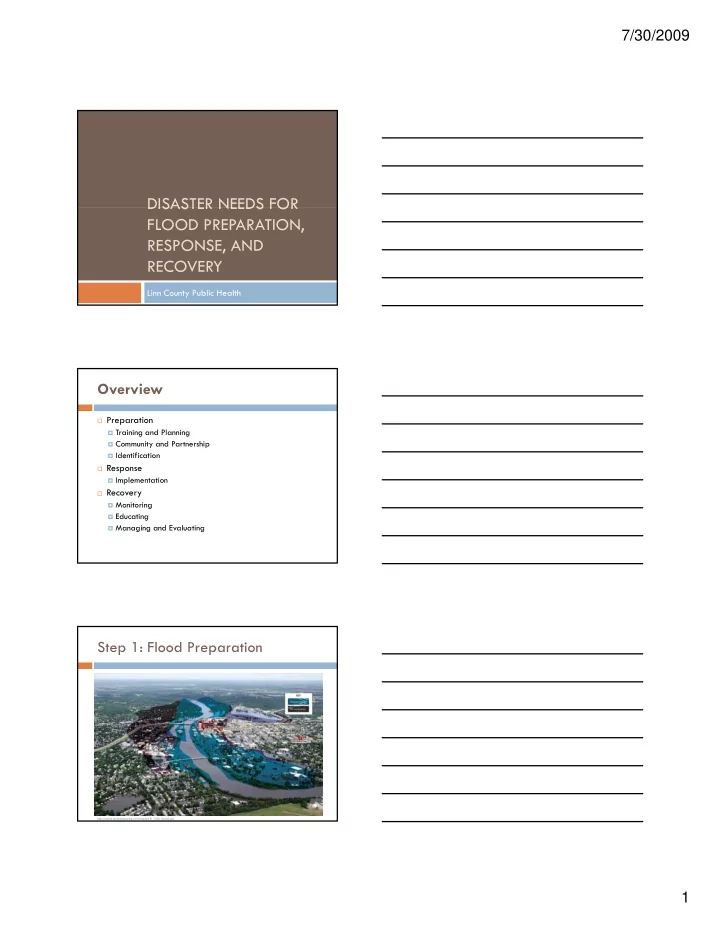
Step 1: Flood Preparation

http://media.buildingsmedia.com/images/B_1108_flood2.jpg

slide-2
SLIDE 2

7/30/2009 2

Cedar Rapids Water Quality Cedar Rapids Alternate H20 sources

Flood of 2008:

  • Lost 49 of 50 wells
  • Coast Guard and National Guard helped

in surveying damage to wells

  • Hiawatha and Marion provided water

Planning for the Future:

  • UV Disinfection and Plant Remodeling Project

March 2010 – estimated completion

  • Upgrade emergency contingency plans (2009)
  • Identify alternate source of water

Preparation: Training and Planning

  • Train and simulate

emergency shelters

  • Plan for emergency

child care facilities child care facilities

  • Plan for a practice

hospital surge protection

  • Plan for the special

needs population

http://images.acswebnetworks.com/1/573/EmergencyShelter.png http://www.arup.utah.edu/about/tour/images/Child-care.jpg

slide-3
SLIDE 3

7/30/2009 3

Preparation: Planning

Plan for Health Considerations during re-entry

  • Tetanus vaccination status
  • Respiratory protection
  • Shock hazard

identification

  • Personal protective

clothing

  • Age and health

restrictions

http://www.prisonplanet.com/images/april2009/280409top.jpg http://3.bp.blogspot.com/_ocdkAZH22b0/RzzjLU8HX1I/AAAAAAAAAHs/hi4isruaL48/s320/PPE.png

Preparation: Planning

Plan for mask procurement and distribution

  • Train public in the use

Train public in the use

  • f masks
  • Plan waste disposal
  • Look at vector activity

monitoring and control methods

  • Rodents
  • Flies/ mosquitoes
  • Feral cats

http://www.enquirer.com/editions/1997/03/12/12mask_400x521.jpg

Hydrograph at the Peak

Plan to check and repair instruments that can help the community know what actions they have to take.

slide-4
SLIDE 4

7/30/2009 4

Preparation: Planning

River stage Levels (NOAA) Note: These data are only intended for general information - they have NOT BEEN REVIEWED TO VALIDATE THEIR QUALITY During flood events users

  • QUALITY. During flood events, users

should consult local NWS forecast offices which provide the most current and accurate river observations, forecasts, watches and warnings. http://www.weather.gov/ahps/

Preparation: Community and Partnership

http://graphics8.nytimes.com/images/2008/06/13/us/13flood.span.jpg

Preparation: Community and Partnership

  • Communicate with industries

within the flood zone

  • Form a network between the

animal rescue operations with local animal control and rescue leagues leagues

  • Partner with mental health

service providers

  • Partner with Corps of

Engineers

  • Monitor river levels
  • Better know when to mobilize

http://www.abc.net.au/reslib/200806/r260976_1085474.jpg http://www.foxnews.com/images/379720/10_68_061208_cedar1.jpg

slide-5
SLIDE 5

7/30/2009 5

Preparation: Community and Partnership

Emergency Management Agency Emergency Operation Center FEMA Incident Command Center Handling of Volunteers MRC (Medical Reserve Core) Communication with community and

extra volunteers

http://xenophilius.files.wordpress.com/2008/06/fema.jpg

Tom Aldrich, EMA; and Mike Goldberg,

  • Admin. Services

Preparation: Identification Preparation: Identification

Identify best evacuation routes Identify l i alternative locations for affected businesses and municipal functions

http://images.google.com/imgres?imgurl=http://www.eyeoniowa.com/08flood/images/DSC_0105_low.jpg&imgrefurl=http://www.eyeoniowa.com/08flood/index.htm&u sg=__ynhV8FVY8eFMku6cRsZd6IpnItI=&h=950&w=1549&sz=1103&hl=en&start=26&um=1&tbnid=phzF_Ki6LDXmbM:&tbnh=92&tbnw=150&prev=/images%3Fq% 3Dcedar%2Brapids%2Bflood%2Bpictures%26ndsp%3D18%26hl%3Den%26safe%3Doff%26sa%3DN%26start%3D18%26um%3D1

slide-6
SLIDE 6

7/30/2009 6

Preparation: Identification

  • Identify a need for resources
  • Alternate drinking water sources and distribution sites
  • Adequate generators
  • Water pumps with adequate cords and intake hoses

O li t l kit f if ti

  • Online tool kits for uniform response preparation
  • Sources for reentry cleaning supplies
  • Warehouse and storage facilities for response supply

management

  • Food sanitation inspectors for shelters and relief food

distribution sites

  • Adequate portable toilet vendor agreement

Step 2: Flood Disaster Response

http://cache.daylife.com/imageserve/0cr4cwA9iReVA/340x.jpg http://www.redcross.org/

Flood Emergency Response

Have shelters available which include showers, kitchens,

bathrooms, and enough food and water (partner with Red Cross)

Flood affected people and pets Volunteers Order masks, gloves, and protective eyewear Take water samples to check for contaminants and track

flow to prevent drinking water contamination downstream

Have mobile rescue health stations set up to screen

rescued individuals for potential harm

slide-7
SLIDE 7

7/30/2009 7

Flood Emergency Response

Carbon Monoxide:

  • Install battery-operated CO

alarms or plug-in CO alarms with battery back-up in your home

  • Gas Powered Generators
  • Primary hazards to avoid when

using a generator are carbon monoxide (CO) poisoning from the toxic engine exhaust, electric shock

  • r electrocution, fire and burns

***Even if you do not smell exhaust fumes, you may still be exposed to CO

http://www.cpsc.gov/cpscpub/pubs/portgen.html

Step 3: Flood Disaster Recovery

http://www.hodr.org/wp-content/uploads/richsju.jpg http://www.hawkeyereview.com/.a/6a010536e43eda970c01156f2c9c82970c-800wi http://wpcontent.answers.com/wikipedia/commons/thumb/8/86/Cedar_Rapids_- _Mays_Island.jpg/180px-Cedar_Rapids_-_Mays_Island.jpg

Recovery

Neighborhood outdoor air

quality

Potential mold blooms

Offer seminars and

discussions of proper and safe ways to enter flood Educating Monitoring

High density air particulate

spaces

Solid waste entering land fills Screen for potential

recyclables

Hazardous chemicals Controlled substances

safe ways to enter flood affected structures and to remove and sort property and debris

Fortifies relations with

flood-relief organizations throughout the affected area

slide-8
SLIDE 8

7/30/2009 8

Indoor Air Quality Monitoring

Factors that can affect Health in Homes Monitor Moisture levels

High moisture in a wall means the wall or insulation is acting like a

sponge and creates an environment favorable for mold.

Ch k S P

Check Sump Pumps If open, elevated exposures to Radon, CO and CO2 can

  • ccur. Also, sump pumps can act as a source for humid air to

get inside the house.

Regulate Temperature/Relative Humidity If relative humidity is above 50% dust mites can form. If

above 60% spontaneous mold growth can occur.

Post Flood Pest Control

Without proper disposal of waste, post flood

conditions can be a perfect environment for pests

Need to control and monitor populations

  • f:

Mosquitoes Mosquitoes Larvicide/Removing standing water Surveillance of mosquitoes through trapping Rodents (Mice, Rats) Bait Traps, taking away garbage from

suspected area, sealing up cracks in housing foundation.

Feral Cats Stopping rodent problem source (garbage,

housing structure), stopping people from feeding them. Vaccinating after trapped so disease won’t spread.

http://sjmosquito.org/assets/images/pic-nj-light-trap.jpg

Recovery: Management and Evaluation

Survey the affected community for their concerns and

inputs

Manage displaced or lost household pet and animal

populations

Partnering with animal control to prevent feral populations

from spreading through neighborhoods

Treat and document Infections Allergic responses Negative conditions acquired during flood related work
slide-9
SLIDE 9

7/30/2009 9

All The People who Helped!

Credits

Power Point Made By: Ryan Landi Christina Michaud Presented By: Presented By: Tom Hart