Dippy on Tour: wildlife past and present Phil Stephens, Russell - - PowerPoint PPT Presentation

dippy on tour wildlife past and present
SMART_READER_LITE
LIVE PREVIEW

Dippy on Tour: wildlife past and present Phil Stephens, Russell - - PowerPoint PPT Presentation

Dippy on Tour: wildlife past and present Phil Stephens, Russell Hill, Sammy Mason and Sian Green Durham University > Outline > Background > What we do > Where you come in Outline Engaging school
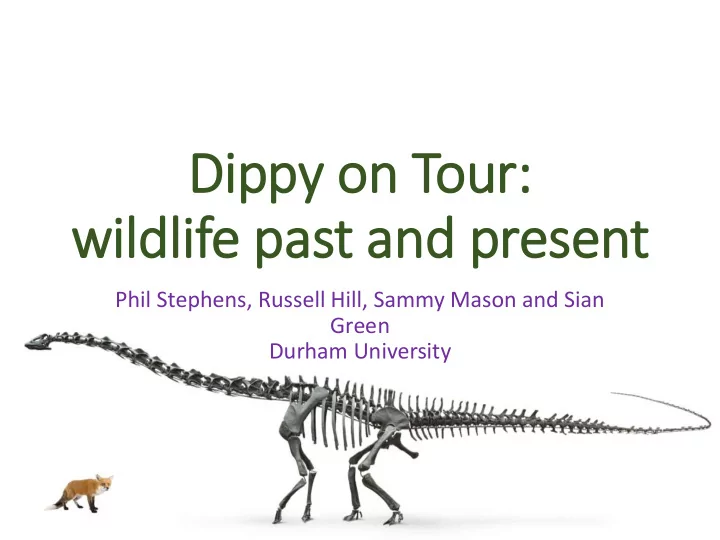

slide-1
SLIDE 1

Dippy on Tour: wildlife past and present

Phil Stephens, Russell Hill, Sammy Mason and Sian Green Durham University

slide-2
SLIDE 2

Outline

Engaging school pupils and museum visitors in an interactive effort to monitor local mammalian wildlife

  • Background
  • Monitoring
  • Policy and management
  • Engagement
  • What we do
  • MammalWeb
  • Engaging schools
  • MammalWeb at the GNM
  • How it will work

> Outline > Background > What we do > Where you come in

slide-3
SLIDE 3

Why monitor mammals?

  • Ecology
  • monitoring, explaining and predicting responses to

environmental change

> Outline > Background > What we do > Where you come in

slide-4
SLIDE 4

Why monitor mammals?

  • Ecology
  • monitoring, explaining and predicting responses to

environmental change

  • Policy and management
  • cultural value
  • conservation
  • control of pest species
  • invasive species
  • disease contingency

> Outline > Background > What we do > Where you come in

slide-5
SLIDE 5

Why monitor mammals?

  • Ecology
  • monitoring, explaining and predicting responses to

environmental change

  • Policy and management
  • cultural value
  • conservation
  • control of pest species
  • invasive species
  • disease contingency
  • Engagement and awareness

> Outline > Background > What we do > Where you come in

slide-6
SLIDE 6

Source: National Wildlife Management Centre

> Outline > Background > What we do > Where you come in

slide-7
SLIDE 7

MammalWeb

  • Recognises that mammals are scarce and hard to

spot

  • “Camera traps” overcome that
  • hard to deploy in sufficient numbers
  • yield huge numbers of images to classify

https://vimeo.com/237771257

> Outline > Background > What we do > Where you come in

slide-8
SLIDE 8

MammalWeb

> Outline > Background > What we do > Where you come in

slide-9
SLIDE 9

i) encouraging families to explore nature on their doorstep; ii) encouraging young people to connect with the natural world; iii) build partnerships between regional cultural, scientific and wildlife organisations.

AIMS:

slide-10
SLIDE 10

MammalWeb & Dippy: plans

  • Natural Northumbria exhibit

> Outline > Background > What we do > Where you come in

slide-11
SLIDE 11

MammalWeb & Dippy: plans

  • Natural Northumbria exhibit
  • Profiles different habitats
  • Upland
  • Lowland
  • Woodland
  • Seas & Coasts
  • Introducing Urban

> Outline > Background > What we do > Where you come in

slide-12
SLIDE 12

MammalWeb & Dippy: plans

  • School project

> Outline > Background > What we do > Where you come in

slide-13
SLIDE 13

MammalWeb & Dippy: plans

  • School project

> Outline > Background > What we do > Where you come in

slide-14
SLIDE 14

MammalWeb & Dippy: plans

  • School project

> Outline > Background > What we do > Where you come in

slide-15
SLIDE 15

MammalWeb & Dippy: plans

  • Natural Northumbria exhibit
  • Museum visitors (during Dippy’s visit)
  • touch screens by each habitat
  • classify images from that habitat captured by schools

> Outline > Background > What we do > Where you come in

slide-16
SLIDE 16

i) encouraging families to explore nature on their doorstep; ii) encouraging young people to connect with the natural world; iii) build partnerships between regional cultural, scientific and wildlife organisations.

AIMS:

slide-17
SLIDE 17

Questions?