Dinner Program 18:30 Dinner Opening & Introductions Hilko - - PowerPoint PPT Presentation

dinner program
SMART_READER_LITE
LIVE PREVIEW

Dinner Program 18:30 Dinner Opening & Introductions Hilko - - PowerPoint PPT Presentation

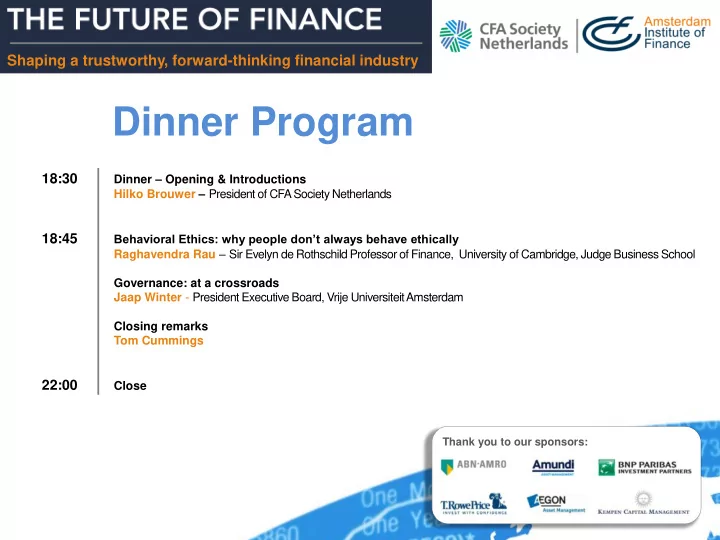
Shaping a trustworthy, forward-thinking financial industry Dinner Program 18:30 Dinner Opening & Introductions Hilko Brouwer President of CFA Society Netherlands 18:45 Behavioral Ethics: why people dont always behave ethically


slide-1
SLIDE 1

Shaping a trustworthy, forward-thinking financial industry

18:30

Dinner – Opening & Introductions Hilko Brouwer – President of CFA Society Netherlands

18:45

Behavioral Ethics: why people don’t always behave ethically Raghavendra Rau – Sir Evelyn de Rothschild Professor of Finance, University of Cambridge, Judge Business School Governance: at a crossroads Jaap Winter - President Executive Board, Vrije Universiteit Amsterdam Closing remarks Tom Cummings

22:00

Close

Thank you to our sponsors:

Dinner Program

slide-2
SLIDE 2

GOVERNANCE AT THE CROSS-ROADS

slide-3
SLIDE 3

THREE THEMES

  • Persistent governance themes for public companies
  • Shareholders and (lack of) engagement
  • Board performance
  • Regaining trust

3

slide-4
SLIDE 4

SHAREHOLDERS DID NOT DISCIPLINE MANAGEMENT

  • Walker Review UK, European Commission: Lack of

disciplining by shareholders contributed to excessive risk taking

  • More engagement needed
  • Really?
  • Shareholders push risk taking, believing they can hedge by

diversifying

  • Company cannot hedge in same way
  • Recent proposal Shareholder Rights Directive to stimulate

engagement,voting, disclosure of asset management arrangements

4

slide-5
SLIDE 5

WHY ENGAGEMENT BY INSTITUTIONAL INVESTORS IS A MYTH

  • Excessive diversification (way beyond level relevant for

reducing risk)

  • Prudent person: no concentration
  • Follow the market
  • Solvency rules, debt over equity
  • Excessive focus on liquidity
  • Mark to market of liabilities
  • Cognitive bias
  • Intermediation separates owners from assets
  • Fiduciary duty: don’t underperform
  • Better conventionally wrong than unconventionally right
  • No interest in engagement, unless cheap and effortless (OECD)
  • Forcing engagement useless (proxy voting)

5

slide-6
SLIDE 6

UNDERSTANDING BOARD PERFORMANCE

  • Dominant paradigm agency theory
  • Shareholders principals, managers agents
  • Non-executives’ key role is to monitor agents
  • Independence
  • Expertise
  • Diversity
  • Nr of board seats
  • Incomplete grasp of board performance
  • Understanding uncertainty
  • Navigate
  • Direct and adapt
  • Key issue on boards in US (Lorsch) and EU (Van de

Loo/Winter): roles of non-executives not clear

6

slide-7
SLIDE 7

BOARD PERFORMANCE: INSIDE THE BLACK BOX

  • Clarifying roles through organisational role analysis, incl

revealing (unconscious) perceptions

  • Focus on interaction between executives and non-executives
  • Board Reality Questionnaire
  • Group Dynamics
  • Biases
  • Group think
  • Personal traits
  • Looking good
  • Generating sense of responsibility, in action
  • Way beyond grasp of regulation

7

slide-8
SLIDE 8

REGAINING TRUST

  • Knee-jerk response post crisis: regulate more
  • More and more rules make us less and less responsible
  • Barry Schwarz: more and more rules chip away our moral

skills (and more and more incentives destroy our moral will)

  • Absolute horror: EBA and ESMA to develop technical

standards for honesty and integrity (CRD IV)

  • What then?
  • Need to develop (learn again) conversations that reinforce

personal access to morality, judgement and responsibility

8

slide-9
SLIDE 9

TWO CONCEPTS GENERATING REAL CONVERSATIONS AND JUDGEMENTS

  • Virtue ethics
  • Aristotle
  • MacIntyre (After Virtue)
  • Virtues: acquired human qualities needed to achieve

internal goods of a human practice and protect against domination of external goods

  • Requires reflection and judgement, not routinely following

rules

  • Integrity honour your word, also when you will not keep it
  • Not normative, but about effectiveness, how to make our

word work

  • Requires reflection: what is my word? What does it require

now? Conversation without attack and defence

9

slide-10
SLIDE 10

IT’S ALL ABOUT PRACTICE

  • Aristotle
  • Practicing virtues
  • Thomas Aquinas
  • Practicing prayer
  • Peter Sloterdijk
  • Anthropotechnik

Denn da ist keine Stelle, die dich nicht

  • sieht. Du musst dein Leben Ändern (Rilke)

10