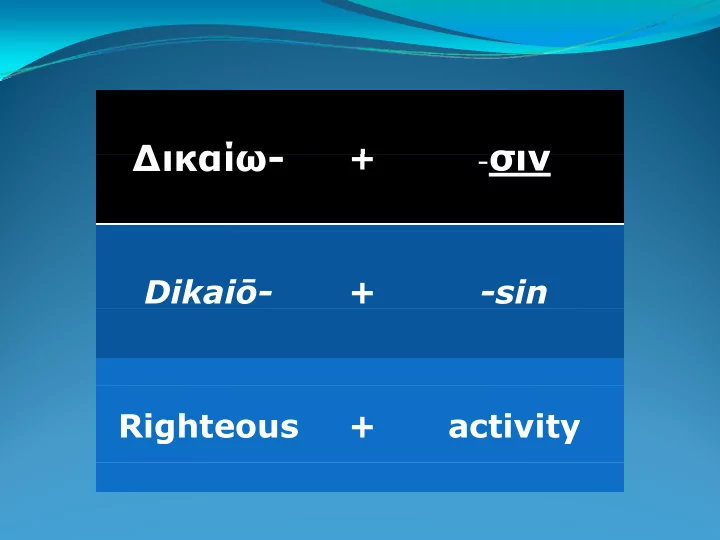
- + + Dikai - + -sin Righteous + activity 1 - - PowerPoint PPT Presentation

dikai sin righteous activity 1 timothy 5 6
SMART_READER_LITE
LIVE PREVIEW

- + + Dikai - + -sin Righteous + activity 1 - - PowerPoint PPT Presentation

- + + Dikai - + -sin Righteous + activity 1 Timothy 5:6 She who lives in pleasure is dead while she lives. Ch Characteristics of Life t i ti f Lif Safety Understanding


slide-1
SLIDE 1

Δικαίω

+

σιν Δικαίω-

+ ‐σιν Dikaiō- +

  • sin

Righteous + activity

slide-2
SLIDE 2

1 Timothy 5:6

She who lives in pleasure is dead while she lives.

slide-3
SLIDE 3

Ch t i ti f “Lif ” Characteristics of “Life”

Safety Understanding Confidence Stability Humility Honor Stability Protection Honor Satisfaction

slide-4
SLIDE 4

Paul’s Indicatives

  • 5 19

“will be made”

  • 5:19,

“will be made”

  • 5:20,

“grace abounded” 6 “ di d”

  • 6:2,

“we died”

  • 6:3,

“were baptized” (2x)

  • 6:4,

“we were buried”

  • 6:5a,

“we have been united”

  • 6:5b

“we shall be”

  • 6:6,

“was crucified”

  • 6:7,

“has been freed”

  • 6:8a,

“we died”

  • 6:8b

“we shall live”

slide-5
SLIDE 5

Summary of 5 Implications

( ) D t ti i i i d

 (1) Do not continue in sin, period!  (2) We are a “dead to sin kind of  (2) We are a

dead-to-sin-kind-of- people” making continuance in sin b d absurd.

 (3) By a work of God we have been  (3) By a work of God, we have been

liberated from the tyranny of sin.

Next slide…………….

slide-6
SLIDE 6

Summary of 5 Implications continued

  • -continued--

 (4) Not only have we been identified with  (4) Not only have we been identified with

Christ’s death, but also with His resurrection life so that we may “live with Him,” y , participating now in “newness of life.”

 (5) Because God destroyed the reign of sin

and offers newness of life, each Christian is id hi lf d d h i f (a) to consider himself dead to the reign of sin and alive to God, and (b) to put himself at the Lord’s disposal not yielding to at the Lord s disposal not yielding to temptation, but to righteous living.

slide-7
SLIDE 7

Conclusion #1 Conclusion #1

Th d t i l d i i f

  • The

doctrinal underpinning

  • f

experiential sanctification begins here: know (6:3) knowing (6:6) knowing (6:9) know (6:3), knowing (6:6), knowing (6:9), know (6:16), and form of doctrine (6:17).

Apart from revelation in one’s soul of the great work God has done to enable experiential sanctification crucified the

  • ld

man and sanctification—crucified the

  • ld

man and raised believers to newness of life—there will be little, if any, experiential sanctification. be little, if any, experiential sanctification.

slide-8
SLIDE 8

Conclusion #2

  • What we learn in Romans 6 requires each

Christian’s personal application which we Christian s personal application, which we can summarize in three words: * Reckoning, * Refusing, Refusing, * Presenting.

slide-9
SLIDE 9

Conclusion #3

  • Walking in newness of life is not a given for

those born again God has provided those born again. God has provided enablement to walk in newness of life, but honors the volition He created in each honors the volition He created in each person, who may or may not obey “from the heart that form of doctrine to which [he heart that form of doctrine to which [he was] delivered” (Romans 6:17).

See next slide………….

slide-10
SLIDE 10

Subjunctives at 5:21 (“might reign”); 6:4 Subjunctives at 5:21 ( might reign ); 6:4

(“should walk”); 6:6 (“might be rendered inoperative”); cf. 7:4 (“should bear fruit to God”).

Imperatives at 6:11 (“consider”); 6:12 (“not

let reign”); 6:13 (“present ” 2x); 6:19 let reign ); 6:13 ( present, 2x); 6:19 (“present”).

Infinitives at 6:6 (“should no longer be

t ves at 6 6 ( s ou d

  • ge

be slaves”); 6:12 (“should

  • bey”);

cf. 7:6 (“should serve”).

slide-11
SLIDE 11

l i Conclusion #4

Th t t f h t 6 th h f d ti l i

  • The content of chapter 6, though foundational, is

incomplete, leaving a believer frustrated: O wretched man that I am! Who will deliver me from this body of man that I am! Who will deliver me from this body of death (Romans 7:24)?

  • This in no way minimizes the importance, even

This in no way minimizes the importance, even absolute necessity, of knowing and reckoning what God has done to enable us to advance in experiential sanctification. But chapter 6 is not stand‐alone doctrine; we must wed it to chapters 7 and especially 8.

slide-12
SLIDE 12

l i Conclusion #5

Ch t 6 & f P l’ “ li h ” i h 8

  • Chapters 6 & 7 prepare for Paul’s “clincher” in chp 8

the matter of sanctification, which is the on‐going work of the Spirit in each believer’s life There he work of the Spirit in each believer s life. There he builds on knowing God’s enablement (chp 6), the inadequacy of energy of the flesh (chp 7), then shows q y gy p that by walking by means of the Spirit experiential sanctification will happen. The result?‐‐the righteous requirement of the law might be fulfilled in us who do not walk according to the flesh but according to the Spirit (Romans 8:4).