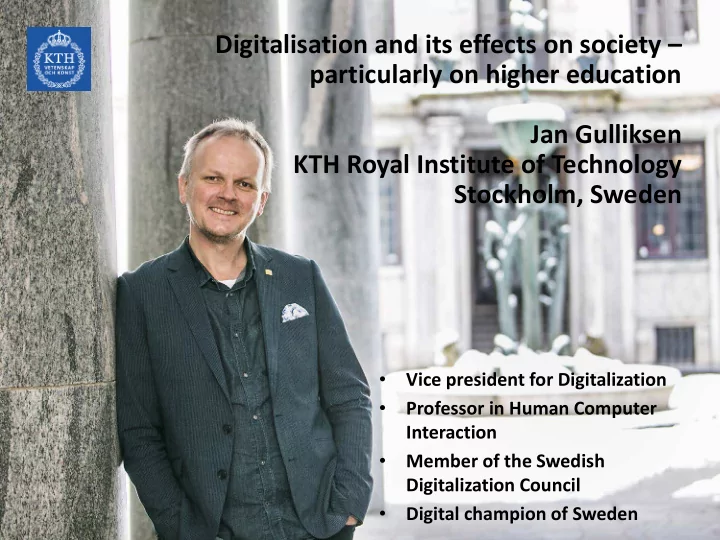
SLIDE 1
- Vice president for Digitalization
- Professor in Human Computer
Interaction
Digitalization Council
- Digital champion of Sweden
Digitalisation and its effects on society – particularly on higher education Jan Gulliksen KTH Royal Institute of Technology Stockholm, Sweden
SLIDE 2
Traditional office environments 20 years of development – Do you see the development?
SLIDE 3 Two types of digitalization
Information digitalization (English: digitization) a process in which information is transformed from analogue to digital, making the information structurable, searchable and accessible through the digital channels. Social digitization (English: digitalization) is the change of society, working life, business, technology use and the new business conditions that arise from the opportunities offered by the technology. Digital technology allows us to do things in completely different ways than we could before, but it also gives us the
- pportunity to do brand new things..
”The social and human-revolving process that gradually becomes increasingly difficult to distinguish at all from any part of life. This means that individuals and organizations can communicate and exchange information with other people, organizations and their environment in new ways. Digitalization and the use of ICT-based solutions can help to increase the accessibility and efficiency of both the business and public administration.” (SOU 2014:13, SOU 2015:91)
SLIDE 4
150 years of digitalization of the music industry
SLIDE 5
Digitalization – digital transformation
SLIDE 6
Digitalization of education 20 years of development – Do you see the development?
SLIDE 8
The future pedagogy
SLIDE 9
Blooms taxonomy and Flipped Classroom
Remembering Understanding Applying Analyzing Evaluating Creating
Traditional classrooms Flipped classrooms
SLIDE 10
SLIDE 11 The Swedish digitalization strategy
Vision: A sustainable digital Sweden. General goal: Sweden shall be the best country in the world when it comes to using the opportunities for digitalization Sub goals:
- digital competence,
- digital security,
- digital innovation,
- digital leadership and
- digital infrastructure.
The Governments overarching goals: Sweden shall have Europe’s lowest unimployment 2020
http://www.regeringen.se/49adea/contentassets/5429e024be6847fc907b786ab954228f/digitaliseringsstrategin_slutlig_170518-2.pdf
SLIDE 12 What will the future labour market look like?
Digitalization Automatization Robotization Globalization Urbanization Individualization
Fölster, S. (2014). Vartannat jobb automatiseras inom 20 år – utmaningar för Sverige.
SLIDE 13 “The future of employment: how susceptible are jobs to computerisation?” by Carl Benedikt Frey and Michael A. Osborne, September 17, 2013
Nearly half of US jobs could be at risk of computerization
Creative and social intelligence skills are required
SLIDE 14 The job context of the ”hour-glass economy”
For every 10 middle-skilled jobs that disappeared between 1996-2008 in: UK: 4.5 replacement jobs were high-skilled and 5.5 low-skilled Ireland: 8 replacement jobs were high-skilled and 2 low-skilled France: 7 replacement jobs were high-skilled and 3 low-skilled Germany: 7 replacement jobs were high-skilled and 3 low-skilled Portugal: 0 replacement jobs were high-skilled and 10 low-skilled
Reference: Holmes C. & Mayhew K. (2012) The changing shape of the UK job market and its implications for the bottom half earners. Resolution foundation commission on living standards and S. O’Connor: UK economy shows shift to low skilled jobs, research finds, financial times 19 January 2015
SLIDE 15 Source: LinkedIn Source: LinkedIn
SLIDE 16 Source: LinkedIn
SLIDE 17
The ICT world is not enough
Companies can't find ICT specialists Young people can't find jobs
SLIDE 18
Skills for the Digital Society
SLIDE 19
Software Development Academy
SLIDE 20
Multi-, Inter-, Transdisciplinarity
SLIDE 21
What is a Digital Work Environment?
”The work environment, with its problems and possibilities of physical, psycho- social as well as cognitive nature tht is the result of the digitalization of the tools and support systems.”
SLIDE 22
Thanks
Jan Gulliksen
gulliksen@kth.se @jangulliksen jangulliksen.com