Digital Training of Land Forces in 2019 Leveraging Commercial - - PowerPoint PPT Presentation

digital training of land forces in 2019
SMART_READER_LITE
LIVE PREVIEW

Digital Training of Land Forces in 2019 Leveraging Commercial - - PowerPoint PPT Presentation

Digital Training of Land Forces in 2019 Leveraging Commercial Capabilities for a Changing Technical Landscape Ryan McAlinden Institute for Creative Technologies US Army University Affiliated Research Center 1 The work depicted here was


slide-1
SLIDE 1

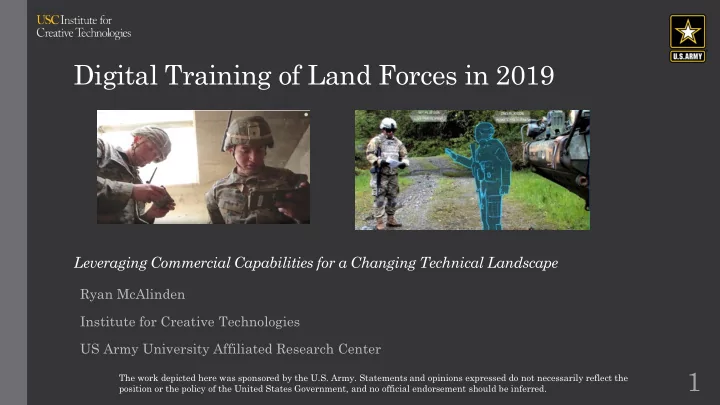
Digital Training of Land Forces in 2019

Leveraging Commercial Capabilities for a Changing Technical Landscape

Ryan McAlinden Institute for Creative Technologies US Army University Affiliated Research Center

1

The work depicted here was sponsored by the U.S. Army. Statements and opinions expressed do not necessarily reflect the position or the policy of the United States Government, and no official endorsement should be inferred.

slide-2
SLIDE 2

Overview

  • How technology is changing, and

how the US DoD has tried to keep up

  • The short life-spans of technology

today

  • The acquisition model associated

with technology

  • Institutionalizing technological

change within the Force

 Generational comfort

  • US Army’s Synthetic Training

Environment (STE)

  • Working with the Commercial

Sector

2

slide-3
SLIDE 3

Technology Development: 1995 – Present

  • Modern technology platforms

 <1995: Software primarily built by small teams  1995 – 2015: Too expensive/risky, so big companies sprung up offering technology. Teams and budgets grew exponentially (>100 people; $10sM+)  >2015: shift back to smaller teams

 Resulting from cheaper access to development tools

  • US DoD’s use of technology for training:

 Traditional

 Constructive simulations: OneSAF, JSAF  Virtual training: VBS, CCTT  Mission Command systems  Instrumented systems

 Non-Traditional: First-person shooters

 America’s Army  Call of Duty

3

slide-4
SLIDE 4

Use of Modeling & Simulation to Train Land Forces

  • Traditional kinetic: Offense, Defense
  • Non-kinetic: stability, peacekeeping,

disaster relief

  • Collective training tasks
  • Combined arms training tasks

 Multi-domain battle  Full-spectrum operations

  • Analysis, Experimentation, Testing
  • Situational Awareness, mission planning,

rehearsal

4

50% 5% 10% 5% 20% 10% Investment

slide-5
SLIDE 5

US Army Synthetic Training Environment (STE)

  • What is it?

 STE is a collective, multi-echelon training and mission rehearsal capability  It brings together the virtual, constructive and gaming training environments into a single environment  The capability will train all Warfighting Functions and the human dimension across Joint and Unified Action Partners in the context

  • f Unified Land Operations.
  • Specifics:

 Training and mission rehearsal capability  Interfaces with operational networks, Mission Command, and live training instrumentation  Leverages commercial off-the-shelf (COTS) and government off-the-shelf (GOTS) hardware.

5

slide-6
SLIDE 6

Example: One World Terrain

  • An organic, small-unit capability (data, tools, services) for producing and

sharing up-to-date 3D geospatial information for current and next- generation simulation and training systems

6

Application

  • Shared Foundation
  • Loading and rendering

terrain in M&S Systems

  • Innovative use of AR and

VR

Distribution

  • Making Global Data

Available to Point of Need

  • Network Infrastructure
  • Access Control and Security

Storage

  • Online / Cloud Storage
  • Databases
  • Physical Storage
  • High Availability
  • Mechanisms to Update and

Version

Processing

  • Sophisticated Algorithms

to Automate Classification & Segmentation

  • Generation of Usable

M&S Assets

Collection

  • GOTS
  • Open Source
  • COTS
  • Organic Collection
  • sUAS / Drone Collect
slide-7
SLIDE 7

Example: USMC Tactical Decision Kit (TDK)

7

slide-8
SLIDE 8

Simulation & Training Technologies Today

  • Penetration of technology by

generation

  • Fewer and fewer custom-developed

solutions

  • Reliance on cloud and other

commercial infrastructure

  • Technology has shelf-life of a few

years

8

slide-9
SLIDE 9

DoD vs Commercial Technology Dev

Identify Requirement

  • TRADOC
  • 3-6 months

Concept Design

  • S&T Org
  • 12 months

Prototype

  • S&T Org
  • 6-12

months

Production

  • Materiel

Developer

  • 18 - 24

months

User Testing

  • ATEC
  • 6 months

Transition

  • Materiel

Developer

  • 3 months

Sustainment

  • Materiel

Developer

  • 1s, 10s

years

9

Concept Design

  • Studio
  • 3 months

Prototype

  • Studio
  • 6 months

Production

  • Studio
  • 12-18

months

User Testing

  • Studio
  • 3 months

Go To Market

Total Time: 5+ years # of Orgs: 4 Total Time: 2 years # of Orgs: 1

slide-10
SLIDE 10

Technology Procurement Challenges

  • Use of other contract vehicles –

Other Transaction Authorities (OTA)

  • Modifying the lifecycle for off-the-

shelf technologies

  • Relaxing restriction for use of off-

the-shelf technologies

  • Use of Personal Devices and

computing facilities

10

slide-11
SLIDE 11

Challenges of Working with Commercial Entities

  • Profit-driven
  • Origin of technology stacks
  • Despite rigid acquisition process, DoD M&S
  • ften suffers from scope creep
  • IP issues: DoD wants full source-code and
  • wnership
  • Security/networking limitations

 Access over military networks  Outdated hardware

11

slide-12
SLIDE 12

How Do We Measure Effectiveness of Digital Training Solutions?

  • Quantitative

 Task completion/success %  Baselining against other training

  • Analog vs Digital

 E.g. cognitive vs tactical

  • Cost of developing & employing technology

vs traditional training mediums

  • Qualitative

 Surveys, feedback

12

slide-13
SLIDE 13

Institutionalizing the Use of Technology

  • Promoting avenues for both

technological and creative advancement

 Reduce barriers to implementation  Foster creativity  Accepting failure

  • Streamlined acquisition models

 Use of non-traditional contractors

  • Use of perishable technologies
  • Accepting or changing origins of

technology solutions

  • Know our ‘customer’ – ie the Soldier

13

slide-14
SLIDE 14

Questions

14