Digital Signs and Billboards: Crafting and Enforcing Local - - PowerPoint PPT Presentation

digital signs and billboards crafting and enforcing local
SMART_READER_LITE
LIVE PREVIEW

Digital Signs and Billboards: Crafting and Enforcing Local - - PowerPoint PPT Presentation

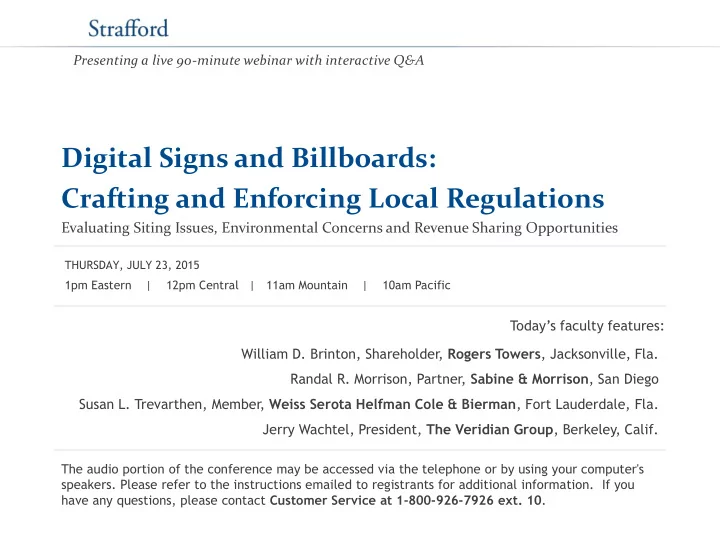
Presenting a live 90-minute webinar with interactive Q&A Digital Signs and Billboards: Crafting and Enforcing Local Regulations Evaluating Siting Issues, Environmental Concerns and Revenue Sharing Opportunities THURSDAY, JULY 23, 2015 1pm


slide-1
SLIDE 1

The audio portion of the conference may be accessed via the telephone or by using your computer's

  • speakers. Please refer to the instructions emailed to registrants for additional information. If you

have any questions, please contact Customer Service at 1-800-926-7926 ext. 10.

Presenting a live 90-minute webinar with interactive Q&A

Digital Signs and Billboards: Crafting and Enforcing Local Regulations

Evaluating Siting Issues, Environmental Concerns and Revenue Sharing Opportunities

Today’s faculty features:

THURSDAY, JULY 23, 2015

William D. Brinton, Shareholder, Rogers Towers, Jacksonville, Fla. Randal R. Morrison, Partner, Sabine & Morrison, San Diego Susan L. Trevarthen, Member, Weiss Serota Helfman Cole & Bierman, Fort Lauderdale, Fla. Jerry Wachtel, President, The Veridian Group, Berkeley, Calif.

1pm Eastern | 12pm Central | 11am Mountain | 10am Pacific

slide-2
SLIDE 2

Tips for Optimal Quality

Sound Quality If you are listening via your computer speakers, please note that the quality

  • f your sound will vary depending on the speed and quality of your internet

connection. If the sound quality is not satisfactory, you may listen via the phone: dial 1-866-871-8924 and enter your PIN when prompted. Otherwise, please send us a chat or e-mail sound@straffordpub.com immediately so we can address the problem. If you dialed in and have any difficulties during the call, press *0 for assistance. Viewing Quality To maximize your screen, press the F11 key on your keyboard. To exit full screen, press the F11 key again.

FOR LIVE EVENT ONLY

slide-3
SLIDE 3

Continuing Education Credits

In order for us to process your continuing education credit, you must confirm your participation in this webinar by completing and submitting the Attendance Affirmation/Evaluation after the webinar. A link to the Attendance Affirmation/Evaluation will be in the thank you email that you will receive immediately following the program. For additional information about CLE credit processing call us at 1-800-926-7926

  • ext. 35.

FOR LIVE EVENT ONLY

slide-4
SLIDE 4

Program Materials

If you have not printed the conference materials for this program, please complete the following steps:

  • Click on the ^ symbol next to “Conference Materials” in the middle of the left-

hand column on your screen.

  • Click on the tab labeled “Handouts” that appears, and there you will see a

PDF of the slides for today's program.

  • Double click on the PDF and a separate page will open.
  • Print the slides by clicking on the printer icon.

FOR LIVE EVENT ONLY

slide-5
SLIDE 5

Digital Signs and Billboards: Crafting and Enforcing Defensible Local Regulations Susan L. Trevarthen, Esq., A.I.C.P.

Weiss Serota Helfman Cole & Bierman, P.L.

  • Ft. Lauderdale, FL * 954-763-4242 * @SusanTrevarthen

STrevarthen@wsh-law.com * www.wsh-law.com

William D. Brinton, Esq.

Rogers Towers, P.A. * Jacksonville, FL * 904-398-3911 wbrinton@rtlaw.com * www.rtlaw.com

Randal R. Morrison, Esq.

Sabine & Morrison * PO Box 531518 San Diego CA * 92153-1518 * 619-234-2864 www.signlaw.com * rrmsignlaw@gmail.com

Jerry Wachtel, C.P.E.

The Veridian Group, Inc. * Berkeley, CA * 510-848-0250 jerry@veridiangroup.com * www.veridiangroup.com

slide-6
SLIDE 6

6

Constitutional Basics of Sign Regulation The big idea: sign display is a form of free speech protected by the First Amendment.

slide-7
SLIDE 7

7

Types of Speech

Ideological / “noncommercial speech”: Debate in the marketplace of

  • ideas. May or may not contain facts, and

may or may not be accurate, but protected because “integrally related to the exposition of thought . . . that may shape our concepts of the whole universe of man.”

slide-8
SLIDE 8

Types of Speech

Commercial speech: Debate in the marketplace

  • f goods and services; regular advertising. No

protection until mid 1970’s. Now protected at “lower level” on a utilitarian basis, because the information is of potential interest in making purchasing decisions, and is not related to “any direct contribution to the interchange of ideas.” Virginia State Bd of Pharmacy v. Virginia Citizens Consumer Council, Inc., 425 U.S. 748 (1976) (Stewart, J., concurring).

8

slide-9
SLIDE 9

Central Hudson Analysis: For Commercial Speech

 Central Hudson v. PSC, 447 U.S. 557 (1980)  Four steps:

 Is product or service illegal, or message deceptive? If

yes: no protection, case over.

 Serve a substantial governmental interest?  Directly advance the asserted interest?  More extensive than necessary – is there a

reasonable fit?

 Lorillard Tobacco v. Reilly, 533 U.S. 525 (2001) – no

tobacco ad signs within 1,000 feet of schools, playgrounds – goes too far, unconstitutional

9

slide-10
SLIDE 10

Protected Speech, Expressive Conduct Lower Level Protection Not Protected

Flag desecration Racist/sexist

comments

Political Religious  Social commentary  “God Hates Fags”  Blasphemy/heresy Commercial

Speech

Erotic or Adult

Entertainment that does not meet the legal definition of “obscene”

Defamation Obscenity or child

pornography

Perjury Fighting words Criminal

conspiracies

Threatening life of

President or VP

Violent or

destructive acts

Deceptive

commercial speech

10

slide-11
SLIDE 11

11

Content Neutrality Summary

 A regulation that is “content-based” will be

subject to strict scrutiny: compelling governmental interest, least restrictive means, and narrow tailoring

 A regulation that is “content-neutral” will be

subject to intermediate scrutiny: significant/important governmental interest unrelated to suppression of speech, substantially related means, narrow tailoring, and ample alternative channels for communication

 Regulations of commercial speech are subject to

the Central Hudson intermediate scrutiny test

slide-12
SLIDE 12

Police Dept. of Chicago v. Mosley

 408 U.S. 92 (1972) – case decided when

commercial speech had no protection

 Chicago ordinance prohibited picketing of

schools, but excepted peaceful picketing of a school involved in a labor dispute

 Unconstitutional: The government may not

choose the message, the messenger, or the topic of debate

12

slide-13
SLIDE 13

13

Other Content Neutrality Cases

Ward v. Rock Against Racism, 491 U.S. 781 (1989)

City regulation of concerts at a public bandshell, which required use of City amplifiers and City sound technician (who deferred to artist on appropriate mix of sound), was held to be constitutional:

 Regulation must promote a substantial governmental interest

that would be achieved less effectively without it, and the means chosen must not be substantially broader than necessary to achieve that interest; if so, then courts should defer to government's reasonable determination.

 “The principal inquiry in determining content neutrality, in

speech cases generally and in time, place, or manner cases in particular, is whether the government has adopted a regulation of speech because of disagreement with the message it conveys.”

slide-14
SLIDE 14

14

Other Content Neutrality Cases

Metromedia, Inc. v. City of San Diego, 453 U.S. 490 (1981). The ordinance:

– Ban on all off-premise advertising signs. Exceptions to the ban: on-premises signs and certain other types of signs (political signs, real estate signs, religious signs, etc.) – Substantial City interests: traffic safety and city aesthetics – Commercial off-site billboards can be banned, but government cannot favor commercial over noncommercial speech – Regulations of noncommercial speech must be content neutral: “With respect to noncommercial speech, the city may not choose the appropriate subjects for public discourse: ‘To allow a government the choice of permissible subjects for public debate would be to allow that government control over the search for political truth.’”

slide-15
SLIDE 15

15

Medium and Message

Billboards, then, like other media of

communication, combine communicative and noncommunicative aspects. As with

  • ther media, the government has legitimate

interests in controlling the noncommunic- ative aspects of the medium, but the First and Fourteenth Amendments foreclose a similar interest in controlling the communic- ative aspects. Metromedia v. San Diego, 453 US 490 (1981)

slide-16
SLIDE 16

Message Substitution

 An easy way to avoid accidental violation of

Metromedia Rule 2 (no favoring of commercial)

 Anywhere any legal sign displays any legal

message, the message can be changed to any kind of protected noncommercial speech

 No permitting or approval required  Every sign ordinance should include message

substitution

16

slide-17
SLIDE 17

17

Other Content Neutrality Cases

City of Ladue v. Gilleo, 512 U.S. 43 (1994): the one Supreme Court sign code case cited by Justice Thomas in Reed

 Ordinance prohibited signs on residential property, with

exceptions including identification signs, warning signs, and “for sale” signs Court assumed, without deciding, that it was content neutral.

 Because there were not ample adequate alternatives to this

paper window sign – a cheap, convenient medium of expression, the unanimous Court struck the ban as applied to residential political/protest window and yard signs.

 See also Linmark Assocs., Inc. v. Township of Willingboro,

431 U.S. 85 (1977): City cannot ban Real Estate For Sale signs – onsite residential – some states expand this

slide-18
SLIDE 18

18

slide-19
SLIDE 19

19

slide-20
SLIDE 20

20

Reed v. Town of Gilbert

June 18, 2015

 US Supreme Court case  Gilbert, Arizona Sign Code categories

were used for exceptions to permitting requirement and different standards (size, locations, display time):

  • Political Signs
  • Ideological Signs
  • Temporary Directional Signs for Qualifying

Special Events

slide-21
SLIDE 21

Reed v. Gilbert

 Small congregation,with no

meeting place of its own, rents meeting places in varying locations

 Put up temp directional signs

Saturday afternoon, take down Sunday after services

 Effective and economical way to

inform public of events

 Code enforced for placement

  • utside of the allowed times

Source: Azcentral.com

21

slide-22
SLIDE 22

22

Reed v. Gilbert

June 18, 2015

As depicted by Reed’s attorney in the briefs:

slide-23
SLIDE 23

Reed v. Gilbert - Thomas (Thomas/Scalia/Roberts)

 Alito & Thomas: Alito/Kennedy/Sotomayor  On its face, is the rule based on message

content?

 Messages, topic, subject, function  If YES >>> Strict Scrutiny  1) Does the rule serve a compelling gov’t

interest?

 2) Narrowly tailored to serve that interest?

23

slide-24
SLIDE 24

Example of Strict Scrutiny: Election Signs

Burson v. Freeman, 504 U.S. 191(1992)

 State law: no signs or politicking within 100 feet

  • f polls on election day

 Valid – justified by interest in preventing voter

fraud and intimidation

 Narrowly tailored  Rare example of content-based rule concerning

noncommercial speech which was sufficiently justified to survive strict scrutiny

 Some states have codified this rule

24

slide-25
SLIDE 25

Reed v. Gilbert – Thomas

 Town’s code is content based on its face. Therefore,

presumptively unconstitutional and strict scrutiny.

 Ward? If cannot justify without reference to content,

gov’t justifications, motives or purposes for enactment don’t matter. Viewpoint neutral and equal treatment within the category? Doesn’t matter

 Bad motive (censorial purpose) or good motive is

irrelevant.

 Speaker or event-based regulation? Ok if content

neutral.

 Regulating by function or purpose? Facially content-

based.

25

slide-26
SLIDE 26

Reed v. Gilbert – Thomas

 Compelling gov’t interest?  Assumed for sake of argument that

aesthetic appeal and traffic safety were compelling governmental interests

 Most cases have concluded that these

are substantial and important governmental interests, meeting intermediate scrutiny

 Invites a showing that traffic safety

meets strict scrutiny – here, Town failed to justify

26

slide-27
SLIDE 27

Reed v. Gilbert - Thomas

 Acceptable factors for sign regs  Size  Building materials  Lighting  Moving parts  Portability

27

slide-28
SLIDE 28

Types of Speech

Third category of speech?: Another category for functional information or speech that informs, but is not debate? Stop signs, speed limits, etc. Most courts dodge this issue. Makes sense for it to be approached differently, because there is no motive to censor and no chance of running afoul of the policy concerns of the First Amendment.

28

slide-29
SLIDE 29

Reed: Alito concurrence examples

 Locations (freestanding v. attached)  Fixed messages vs changing electronic  Private property vs Public Property  Commercial vs Residential property  On premise vs Off premise  Limit on number per mile  Time limits for one time events akin to noise regs –

Contradicts Thomas?

 Gov’t speech on signs (Summum case)  Directionals  Safety rules (speed limits, etc.)  Historic and scenic

29

slide-30
SLIDE 30

Alito’s Event-based rule?

Additional temporary signage rights related to the date of elections? GK Ltd. Travel v. Lake Oswego, 436 F.3d 1064 (9th Cir. 2006)

Display right based on event (election), not message content – okay

30

slide-31
SLIDE 31

Reed: Kagan concurrence

 Concur in result only of Reed  Majority rule will either lead to a watering down

  • f strict scrutiny review, or lead to the Court

acting as a “veritable Supreme Board of Sign Review” invalidating many perfectly reasonable, democratically adopted regulations.

 Dilemma: repeal useful exemptions or open the

doors to sign clutter

 Serious reservations about application to other

situations

 Blind pedestrian

* Hidden Driveway

 Highway Beautification Act - Special allowances for

scenic and historic sites, free coffee

31

slide-32
SLIDE 32

Reed: Kagan concurrence

 The reasons for First Amendment protection

are simply not present in most subject matter exemptions in sign codes – e.g., directional or identification signs.

 The Court has repeatedly upheld such content-

based distinctions in cases not overruled—or even cited—by the Reed majority.

 As in Ladue, all justices agree that Gilbert’s

regulation fails intermediate scrutiny – and the “laugh test,” so the majority’s whole discussion

  • f strict scrutiny is unnecessary dicta.

32

slide-33
SLIDE 33

Reed: Breyer concurrence

 Concur in result only of Reed  Content categories are not enough to solve this

legal problem. They are analytical tools that should be used as rules of thumb rather than triggers for invalidation

 All kinds of government activities involve

regulation of speech with content

  • discrimination. If that triggers strict scrutiny, the

court has written “a recipe for judicial management of ordinary government regulatory activity.”

33

slide-34
SLIDE 34

Reactions to Reed

 Counsel and train permit and code enforcement

staff NOW

 Examine your sign code, and likely amend it  Temporary signs  Substitution: noncommercial to noncommercial  Limit categories  Severability  Limit exceptions  Beef up your purpose and findings in support of any

arguably content-based restrictions – consider planning studies

 Know that threshold defenses remain strong

34

slide-35
SLIDE 35

Litigating the Sign Case

 Usually in federal court  Civil rights case  When challenger wins, often large

attorney fee awards

 Money damages possible  Burden of justification is on the gov’t  Sign regulation is a source of

considerable legal risk – be careful!

35

slide-36
SLIDE 36

In Regulating Signs, Discretion = Legal Risk

 In the typical land use case, courts usually

defer to local government’s discretion and policy choices

 In First Amendment land uses (signs,

billboards, adult uses, newsracks, religious facilities) – discretion is limited, and discretion in permitting creates real legal risk

 Courts want “narrow, objective rules,” not tied

to message, that are consistently enforced

36

slide-37
SLIDE 37

Sign Regulator’s Mantra

 The medium is NOT the message.  We regulate the medium, not the

message.

 Time, Place and Manner (TPM) rules

 Apply without regard to message  Size, height, setback, illumination,

separation, location, display method

 If you follow the mantra, most courts

approve the sign rules

37

slide-38
SLIDE 38

38

Issues In Regulating Signs

 Content Neutral Regulation

Rule is not based on message – Example: Regulate “temporary signs”, not “political signs” or “campaign signs.”

Functional View vs. Literal View (directional signs, time/temperature signs)

 Viewpoint Neutral Regulation is

required

Rule applies equally to all speakers within the defined class, does not vary by message – Example: Use “A flag is a noncommercial symbol,” not “A flag is a symbol of a government.”

slide-39
SLIDE 39

Issues in Regulating Signs

 No governmental review or

discrimination against message content

 Rule not based on message content  Focus: regulate time, place and manner  Graphic design rules (fonts, colors,

logos) – can be risky – need careful drafting

 Sign programs – rarely litigated,

generally approved

39

slide-40
SLIDE 40

40

Issues in Regulating Signs

 The governmental purpose is paramount

in determining whether the regulation will be upheld.

 Controlling impacts of the sign,

presenting compelling – or at least important and substantial - governmental interests? Yes.

 Suppressing free speech? No.

slide-41
SLIDE 41

41

Issues in Regulating Signs

 No “one-size-fits-all” solution exists  Strategies and desired outcome

need to be tailored to the circumstances, local needs

 Many (most?) codes have legal

issues, so borrowing can be problematic

 Governing law is very fact-sensitive,

evolving over time, and can be unpredictable

slide-42
SLIDE 42

Issues in Regulating Signs: Banning Signs in Traditional Public Forum Areas

 Traditional Public Forum – surfaces of streets, parks,

sidewalks, area around city hall

 Government speech is not regulated by First Amendment  Complete ban on private inanimate (posted, “left behind”)

signs on Traditional Public Fora, regardless of message type – many courts approve: Sussli v. San Mateo, 120 Cal.App.3d 1 (1981)

 Generally, government does not have to allow private signs in

Traditional Public Fora

 But, if commercial speech is allowed, then noncommercial

must be allowed – the “no favoring of commercial” rule applies

 If any noncommercial speech is allowed, door is (usually) open

to all types of noncommercial

42

slide-43
SLIDE 43

Banning Mobile Billboards

 Bans on mobile billboards (sign trucks) on city streets

have been approved many times

 Key issue: using the road for transportation purposes or

turning it into an advertising theater?

 Fifth Ave Coach v. NYC, 211 U.S. 467 (1911)  Railway Express Agency v. People of New York, 336 U.S.

106 (1949)

 Showing Animals Respect and Kindness v. West

Hollywood, 166 Cal.App.4th 816 (2008)

 BUT – beware of possible pre-emption under state law

(any licensed and registered vehicle can use the public roads and streets)

43

slide-44
SLIDE 44

44

What is a Digital Sign?

 Physical method of image presentation  Electronic display uses LCD, LED, plasma, or

projected images

 Much finer detail than traditional freeway info

signs or sports stadium scoreboards

 Full color, digital effects  Images easily changed – slide show or full

motion, even interactive – giant TV

slide-45
SLIDE 45

45

 More expensive to install, but generate much

more revenue

 Much more expensive to remove – road

widening, redevelopment, private property rights statutes

 Consider cumulative impact on aesthetics and

safety

slide-46
SLIDE 46

46

Digital Signs: the New Frontier in On and Off Premise Signs

 Fast-moving technological developments leading

to sophisticated signs that are economically feasible to deploy

 Can display full motion video, with sound and

special effects like smoke or odors

 Safety and status under the Highway

Beautification Act to be addressed by Bill and Jerry

 Costs coming down because of economies of

scale and competition

 Factors in regulation include whether to allow

animation or motion, length of delay in change of static advertising messages, standards for illumination

slide-47
SLIDE 47

Digital Signs and the Highway Beautification Act

Controls billboards along freeways and interstates

slide-48
SLIDE 48

“DIGITAL” BILLBOARDS AND THE HIGHWAY BEAUTIFICATION ACT (HBA): PENDING FEDERAL LITIGATION

 Most “digital” billboards now operating in the United States are

located along federal interstates and federal-aid primary highways, and are subject to the federal HBA (known as the “Lady Bird Act”).

 Scenic America, Inc. v. United States Department of Transportation,

et al., Case No. 1:13-cv-00093-JEB, in the United States District Court for the District of Columbia. Suit filed on January 23, 2013.

 Lawsuit challenges a Federal Highway Administration “Guidance

Memorandum” dated September 25, 2007.

 Core issue: whether “digital” billboards that display commercial

messages by utilizing LEDs, changing every 4-10 seconds, violate the HBA’s mandatory “customary use” standards as implemented through Federal State Agreements.

 The history of the HBA and the implementation of its restrictions on

size, lighting, and spacing-to what was then customary use-is critical to an understanding of the legal issue framed in the suit.

48

slide-49
SLIDE 49

HIGHWAY BEAUTIFICATION ACT TIMELINE RE: BANNING INTERMITTENT LIGHTING

 1965 – October 22, 1965: HBA enacted. Limits size,

lighting, and spacing on interstates and federal-aid primary highways in commercial and industrial zoned areas to what was then “Customary Use.”

 1966 – March-May. Public hearings in every state. Six

committees established. General Counsel’s Report

  • released. Intermittent lighting only to display Public

Service Information (time, date, temperature).

 1967 – First State-Federal Agreement (Vermont).  1968 – HBA Amendment. Only 12 Agreements in place.

Five more years to complete the process.

 1973 – Last State-Federal Agreement (South Dakota).

49

slide-50
SLIDE 50

HBA TIMELINE (2)

 1978 HBA Amendment - House-Senate Conference

Committee rejects House proposal to allow Commercial Electronic Variable Message Signs (CEVMS) for off-site signs under the HBA. Note: “Public Service Information” is not commercial speech.

 1990 - FHWA: CEVMS/Billboards are Illegal.  1996 - FHWA: intermittent lighting signs not allowed.  2007 - FHWA internal controversy over letter and spirit of

the HBA. Guidance Memo issued on September 25,

  • 2007. FOIA request by Scenic America led to disclosure
  • f internal fight over agency action. No internal discussion
  • f (1) the 1966 Public Hearings or (2) the 1978 rejection
  • f a change to the HBA to allow CEVMS.

50

slide-51
SLIDE 51

HBA TIMELINE (3)

 2007 – FHWA Guidance Memo states that every 4

seconds would not be deemed intermittent. This would mean that message changes 21,800 times per day would not be deemed “intermittent.”

 2009 – Scenic America consults with Georgetown

Law Center’s Institute for Public Representation (IPR).

 2010 – Scenic America (through IPR) files petition

for rulemaking. FHWA promises to address it

  • ASAP. Rulemaking petition then ignored for three
  • years. Digital billboards proliferate based upon the

2007 FHWA Guidance Memo.

51

slide-52
SLIDE 52

HBA TIMELINE (4)

 2012 - Scenic Arizona victory in state appellate court. Digital

billboards that change every 8 seconds are deemed intermittent and illegal. Scenic Arizona, Inc. v. City of Phoenix Board of Adjustment, et al., 228 Ariz. 419, 268 P.3d 370 (Ariz.Ct.App. 2012).

 2012 - Rutgers Law Review Article. Digital Billboards Violate

Letter and Spirit of the HBA.

 2013 (January 23, 2013) – Scenic America files lawsuit

against USDOT and FHWA. Outdoor Advertising Association of America (OAAA) intervenes.

 2013 (October 23, 2013) – District Court denies USDOT’s,

FHWA’s and OAAA’s motions to dismiss.

52

slide-53
SLIDE 53

HBA TIMELINE (5)

 2014 (June 20, 2014) – District Court Memorandum

  • Opinion. District Court grants motions for summary

judgment filed by USDOT, FHWA, and intervenor OAAA, and denies motion for summary judgment filed by Scenic

  • America. District Court dismisses with prejudice all three of

Scenic America’s challenges to the 2007 Guidance.

 2014 (August 11, 2014) – Scenic America files notice of

appeal with the U.S. Court of Appeals for the District of Columbia.

 2014 (December 22, 2014) – Scenic America files

Appellant Brief with federal appeals court.

53

slide-54
SLIDE 54

HBA TIMELINE (6)

 2014 (December 30, 2014) – The American Planning

Association, The Garden Club of America, Sierra Club, Inc., and International Dark-Sky Association, Inc. files Amicus Brief with federal appeals court.

 2015 (February 20, 2015) – USDOT/FHWA and OAAA file

Appellee Briefs with federal appeals court.

 2015 (March 11, 2015) – USDOT/FHWA and OAAA file

letters advising of additional authority: The Supreme Court decision in Perez v. Mortgage Bankers Association, No. 13- 1041 (March 9, 2015).

 2015 (March 20, 2015) – Scenic America files Reply Brief

with federal appeals court.

54

slide-55
SLIDE 55

HBA TIMELINE (7)

 2015 (May 12, 2015, May 13, 2015, and May 22, 2015) –

Appellant and Appellees file letters advising of additional authority: Association of Flight Attendants-CWA, AFL-CIO

  • v. Huerta, No. 13-1316 (D.C. Cir. May 8, 2015).

 2015 (June 18, 2015) – Clerk’s Order scheduling oral

argument for Friday, September 25, 2015.

 Friday, September 25, 2015, 9:30 a.m. – Date and Time

for Oral Argument before the United States Circuit Court of Appeals. September 2015 Term.

55

slide-56
SLIDE 56

President Johnson Signs HBA February 8, 1965

  • Association with beauty can enlarge man’s

imagination and revive his spirit.

  • Ugliness can demean the people who live among

it.

  • What a citizen sees every day is his America.
  • If it is attractive, it adds to the quality of his life.
  • If it is ugly, it can degrade his existence.

56

slide-57
SLIDE 57

HBA: The Lady Bird Act Enacted on October 22, 1965

57

slide-58
SLIDE 58

The “Customary Use” Provision Added to the HBA (as underscored) During Its Consideration in the House

 In order to promote the reasonable, orderly

and effective display of outdoor advertising while remaining consistent with the purposes of this section, signs, displays, and devices whose size, lighting and spacing, consistent with customary use is to be determined by agreement between the several States and the Secretary, may be erected and maintained…

58

slide-59
SLIDE 59

The 1966 Hearings

 Section 303 of the federal HBA, as enacted on October

22, 1965, required public hearings in each state.

 Hearings took place in March-April-May, 1966,

commencing less than 5 months after passage.

 8,000+ attended. 2,000+ testified.  For what purpose?  … for the purpose of gathering all relevant

information on which to base such standards, criteria, and rules and regulations.

 … report to Congress not later than January 10, 1967

all standards to be applied.

59

slide-60
SLIDE 60

1966 Hearings; Six Committees

 Six committees established to review the relevant

information.

 One committee evaluated the criteria for size,

lighting and spacing of signs permitted in commercial or industrial zones; evaluation of customary use for size, lighting and spacing.

 Report of the Bureau of Public Roads’ General

Counsel Lowell Anders was made on July 12, 1966 at the Workshop on Highway Law in Boulder, Colorado.

 Report attached to Circular Memorandum distributed

by Deputy Director of the Bureau of Public Roads on July 19, 1966.

60

slide-61
SLIDE 61

General Counsel Ander’s Report --July 12, 1966

 Our first lighting requirement would prohibit

flashing, intermittent or moving lights except those giving public service information such as time, date, temperature, weather or similar information.

 Note: No exception for intermittent

commercial messages.

61

slide-62
SLIDE 62

General Counsel Ander’s Report -- July 12, 1966 (cont’d)

  • During the [1966] public hearings testimony

from Industry spokesmen made it clear that it is customary in outdoor advertising to provide public service information on signs, by the use of intermittent or moving lights.

62

slide-63
SLIDE 63

Typical Federal State Agreement --1968 (California)

February 15, 1968 - California Federal State Agreement (7th agreement). Typical agreement identifying “customary” use for “Lighting” as follows: Lighting: Signs . . . shall not include . . . flashing, intermittent or moving lights (except that part necessary to give public service information such as time, date, temperature, weather or similar information);

63

slide-64
SLIDE 64

South Dakota – 1973 -- Last Federal State Agreement

LIGHTING Signs may be illuminated, subject to the following restrictions: Signs which contain, include, or are illuminated by any flashing, intermit- tent, or moving light or lights are prohibited, except those giving public service information such as time, date, temperature, weather, or similar information.

64

slide-65
SLIDE 65

August 18, 1978 Discussion on Floor of U.S. Senate 124 Cong. Rec. S26,917-18

 Mr. JACKSON. . . . Purely and simply, what this amendment will

allow is the use of electronic signs on the premises of businesses adjacent to interstate highways. It does not extend beyond this as some have advocated to off-premise commercial and industrially zoned properties. That is an entirely different

  • matter. . . .

 Mr. STAFFORD. Mr. President, I do, indeed, share the same

concern as the distinguished manager of the bill on the majority side, with respect to further electronic signs beyond those which might be under this amendment authorized on premise for activities carried on premise. . . . I have examined the existing law and the amendment of the distinguished Senator from Washington (Mr. Jackson). . . . Mr. President I want to register my concern over any proliferation of these electronic signs

  • ff premise. My concern is that these signs, if sanctioned
  • ff premise, may be a threat to highway safety.

65

slide-66
SLIDE 66

August 18, 1978 Discussion on Floor of U.S. Senate 124 Cong. Rec. S26,917-18 (cont’d)

 Mr. STAFFORD: . . . As I understand the

distinguished Senator’s amendment it removes any Federal barrier only to electronic signs which provide public service information or advertise activities on the property on which they are located. This does not change Federal regulations forbidding* these signs in commercial or industrial areas, where the signs are not on premise. Is that correct?

[*The “customary use” limit effectively forbade electronic off premise signs that intermittently display commercial messages.]

 Mr. JACKSON. That is correct.

66

slide-67
SLIDE 67

The 1978 Amendment to the HBA Surface Transportation Assistance Act

  • f 1978 (November 6, 1978)
  • The House version would have allowed

“commercial” electronic variable message signs (CEVMS) under the HBA.

  • The House version failed in Conference

Committee on Oct. 14, 1978.

  • The Senate version, advocated by Senator

Jackson, was adopted in lieu of House version.

  • This issue (limiting electronic commercial signs

to on premise) was the topic of the colloquy on the Senate floor on August 18, 1978 (quoted above).

67

slide-68
SLIDE 68

FHWA Memo Jan. 19, 1990 Director of Right-of-Way

 We have received several inquiries concerning the off-

premise advertising use of commercial electronic variable message signs (CEVMS) which change their advertising messages by electronic process or remote control. These

  • utdoor advertising signs use various types of evolving

technology such as lights, glow cubes, rotating slats, moving reflective disks, etc.

 FHWA has interpreted the Federal law as implemented

under individual state/federal agreements to prohibit

  • ff-premise variable message signs, irrespective of

the method used to display the changing message. The prohibited CEVMS must be considered to be illegal.

68

slide-69
SLIDE 69

FHWA Memo July 17, 1996 Director of Right of Way

 In nearly all States, these signs may still not

contain flashing, intermittent or moving lights.

 Note: The 1996 FHWA memo does not refer to

“commercial” electronic variable message signs, but refers merely to “changeable” message signs. The available record does not indicate whether the change in this CEVMS terminology was deliberate or merely inadvertent.

69

slide-70
SLIDE 70

FHWA CHANGES ITS POSITION September 25, 2007 - Guidance Memorandum Signed by Associate Administrator

 FHWA purportedly changed its longstanding interpretation of the HBA

  • n September 25, 2007 re: intermittent lighting. Scenic America

argues that FHWA went far beyond a mere interpretative change.

 FHWA advised that a range of acceptability was between 4-10

seconds and recommended 8 seconds for the frequency of a changeable message sign utilizing lights. FHWA again omitted the term “commercial” in describing the variable message signs and made no reference whatsoever to the public service information exceptions set forth in the FSAs.

 In 2013 U.S. District Judge Boasberg described it this way: “In 2007,

the Federal Highway Administration issued a ‘Guidance’ that paved the way for the construction of digital billboards along the nation’s

  • highways. . . . Historically, the FHWA believed that digital

billboards violated key language in federal-state agreements related to the Interstate Highway System.’ (Emphasis added.)

70

slide-71
SLIDE 71

US Dist. Ct. Summarizes Scenic America’s Position

 “First, it is a legislative rule promulgated without the

notice-and-comment procedure required by the APA. See 5 U.S.C. § 553.”

 “Second, it creates new lighting standards for billboards

without "agreement between the several States and the Secretary [of Transportation]," as required by the HBA. See 23 U.S.C. § 131(d).”

 “[Third], it establishes lighting standards for

billboards that are inconsistent with "customary use," another violation of the HBA. See id.”

71

slide-72
SLIDE 72

Court Opinion re: Scenic America’s Standing and Injury

 “Prior to the Guidance, most States did not allow

digital billboards because they did not believe that the language of their FSAs [Federal State Agreements]

  • r the decision makers at the FHWA would permit

such proposals.”

 “After the Guidance, States may now successfully

petition the FHWA to amend their regulations to allow the construction of such billboards because the agency has made clear its position that doing so does not violate their FSAs.”

72

slide-73
SLIDE 73

District Court Rejects Claim that the Guidance Was Not Final Agency Action

 “Nothing else in the document suggests that the

FHWA’s conclusion on this point is ‘tentative, open to further consideration, or conditional on future agency action.’ City of Dania Beach, Fla. v. FAA, 485 F.3d 1181, 1188 (D.C. Cir. 2007).”

 “The 2007 Guidance does not just announce

the FHWA’s vision of the law – that digital billboards are not ‘flashing,’ ‘intermittent,’ or ‘moving’ lights; it also commands Division Offices to turn that vision into reality.”

73

slide-74
SLIDE 74

Recap – Scenic Arizona Decision in 2012

“Because the combination of LEDs used to display each brightly lit image on the billboard changes every eight seconds, the billboard’s lighting necessarily is intermittent under the plain meaning

  • f the statute. Thus, we are not persuaded by

American Outdoor’s attempt to exempt its billboard from the bar on intermittent lighting.” “The billboard uses multiple arrangements of lighting to display images that stop and start at regular intervals, which means it uses intermittent lighting.” Scenic Arizona, Inc. v. City of Phoenix Board of Adjustment, et al., 268 P.3d 370, 378 (Ariz.App.

  • Div. 1 2012).

74

slide-75
SLIDE 75

Recap – Rutgers Law Review in 2012

 “A court need not consult a dictionary to know that

digital signs violate the letter and spirit of the HBA, and the failure of the FHWA to do its part "to promote the safety and recreational value of public travel, and to preserve natural beauty" has created an imbalance of power that leaves the general public at a loss.”

  • Quote from Between Beauty and Beer Signs: Why

Digital Billboards Violate the Letter and Spirit of the Highway Beautification Act of 1965, Susan C. Sharpe, Rutgers Law Review, Vol. 64, Issue 2, (Winter 2012), at pp. 325-326

75

slide-76
SLIDE 76

Recap – 1966 Post- Hearings Report; Pre-FSA

  • Our first lighting requirement would

prohibit flashing, intermittent or moving lights except those giving public service information such as time, date, temperature, weather or similar information.

  • During the [1966] public hearings testimony

from Industry spokesmen made it clear that it is customary in outdoor advertising to provide public service information on signs, by the use of intermittent or moving lights

76

slide-77
SLIDE 77

 The District Court’s Memorandum Opinion

now on appeal begins with the following statement:

 “This administrative-law dispute involves

a conundrum that has long bedeviled the federal courts: How should rules written in the past apply to new and unforeseen circumstances in the present?”

77

District Court June 20, 2014 Memorandum Opinion

slide-78
SLIDE 78

District Court June 20, 2014 Memorandum Opinion

 The District Court’s opening statement about past

and present goes directly to the heart of the now pending appeal.

 Did Congress in October 1965 mean what it said

when it came to only allowing the erection and maintenance of signs whose lighting was consistent with what was then “customary use”?

 And what was the purpose of the mandated hearings

across America, March to May 1966, when it came to determining what was then customary use?

78

slide-79
SLIDE 79

Safety Concerns of Digital Signs

And How to Deal with Them

slide-80
SLIDE 80

Safety Concerns Not New

 Research on safety issues of roadside

billboards since the 1930s

 First study on effects of digital signs (CEVMS)

by FHWA in 1980

 Early studies inconsistent, but  More rigorous studies found concerns  Found 15 impacts of CEVMS on traffic safety and

visual environment

 Recommended further research (not begun for 30

years)

The Veridian Group, Inc.

80

slide-81
SLIDE 81

Visual Distraction

 Many definitions, but this is typical:  Diversion of the driver’s visual

attention away from the road and traffic towards a competing activity or

  • bject that is irrelevant to the driving

task.

The Veridian Group, Inc.

81

slide-82
SLIDE 82

How Are Digital Billboards Different than Traditional?

 Human eye is drawn to the brightest objects in

the scene and those that show motion/apparent motion

 This is called phototaxis or phototropism

  • Sometimes called the “moth effect”

 Research (e.g. Theeuwes) shows that this response is

both is automatic and unavoidable

 DBBs use these features to capture attention  In the US, DBBs typically change message every

6-8 seconds

The Veridian Group, Inc.

82

slide-83
SLIDE 83

More Differences

 Size potential – almost limitless

 A 1000 square foot sign has been proposed for

South San Francisco

 Compelling high definition imagery  Intermittency and image change at will  Potential for message sequencing  Potential for interactivity with driver

The Veridian Group, Inc.

83

slide-84
SLIDE 84

Worldwide, Much Research in the Past 15 years

  • Industry reports claim no safety issues.

– But these reports are misleading, contradicted by

their own data.

  • Nearly all independent research in the past 15

years shows safety issues with CEVMS.

  • A 2011 Canadian study found a causal relationship

between video billboards and crashes when a lead vehicle braked hard.

  • Long awaited FHWA study was released in

December 2013 – fatally flawed as described in a 50 page peer-reviewed critique.

The Veridian Group, Inc.

84

slide-85
SLIDE 85

The Research Is Clear

 More recent research  stronger findings  Provides a basis to understand the problem

 Drivers’ eyes off road for 2 sec or longer  substantially

higher crash risk (2.8x)

  • NHTSA/VTTI “100 car study”

 Digital signs take drivers’ eyes off road for longer than 2 sec

3x more often than conventional billboards.

  • Found in industry study – but result unreported

The Veridian Group, Inc.

85

slide-86
SLIDE 86

Recent Research

The Veridian Group, Inc.

86

slide-87
SLIDE 87

8 New Studies 2012-15

 US (University of Massachusetts)  Sweden  Israel  Denmark  US (Federal Highway Administration)  US (University of South Dakota)  US (Albion College – Michigan)  Canada (Transportation Association of Canada)

All but FHWA shed new light on safety concerns

The Veridian Group, Inc.

87

slide-88
SLIDE 88

Denmark

 On-road instrumented vehicle – 2013

 Excellent summary of other recent research  Camera system to track eye movements  GPS to record speed behavior  Laser scanner to measure distance to other vehicles

  • Significant improvement to prior studies since it measures actual in-

traffic situations.

  • Calculated a “safety buffer” – time available to driver to respond to a

sudden action of the vehicle ahead after turning visual attention back to the road after viewing a billboard

 Used the empirically derived algorithm for measuring

distraction developed by VTTI.

  • Any 2 seconds with a 6-second sliding window (odds ratio ~2)

The Veridian Group, Inc.

88

slide-89
SLIDE 89

 Results:

 109 drives; 233 glances; 16 billboards  Duration of successive glances per billboard:

  • 22% >2.0 seconds
  • 10% > 3.0 seconds

 Safety buffer

  • ~25% of glances occurred with TTC < 2 seconds to vehicle ahead
  • ~20% of glances occurred with TTC < 1.5 seconds to vehicle ahead

 For every sixth drive, visual distraction occurs  Visual distraction occurs to substantial part of all road

users; not limited to a single category of driver

The Veridian Group, Inc.

Denmark contd.

89

slide-90
SLIDE 90

The Danish study is valuable, not only because it is rigorous, but because this research is very difficult to get right.

Here are some of the variables that need to be addressed:

Sign size, setback from road, height above grade

Proximity to decision points – exits, entrances, merges, lane drops

Luminance (brightness) levels at night

Frequency of message change (dwell time)

Message transition time, transition effects

Colors and contrast of figures and background

Number of words/characters

Font/letter size

Proximity to other advertising signs, official traffic signs

Traffic speeds, volumes; sight distance to sign

Sight distance to sign

The Veridian Group, Inc.

Getting the Research Right

90

slide-91
SLIDE 91

Human Factors Research Findings

 The evidence from recent human factors

studies shows the adverse impacts of digital billboards.

 Drivers are less able to maintain lane control –

they drift while looking at the billboard, and then make a sudden steering reversal after returning their eyes to the road ahead.

 Drivers tend to look at billboards while leaving

insufficient following distance to the vehicle ahead.

The Veridian Group, Inc.

91

slide-92
SLIDE 92

Federal Highway Administration

 Spent 4 years, over $500K  Measured driver eye glances in instrumented car  Peer reviewers of draft report found eye glance data to

be unrealistically brief, not reasonable.

 Took 9 months to revise the report  No explanation for errors; not again subjected to peer

review.

 Final report unnumbered; fatal errors in

assumptions, measurements, design, analysis.

 Report intended to form basis for policy– but no

longer reasonable to do so.

 Conclusions indefensible.

The Veridian Group, Inc.

92

slide-93
SLIDE 93

Transportation Association of Canada

 A thoughtful, comprehensive study - 2015

 Literature review  Applies human factors and traffic engineering principles  Interviewed sign developers/owners/operators

 Product: Guidelines available for implementation by

Provincial and local government agencies.

 Key recommendation: Digital advertising signs should

be regulated such that they emulate static signs.

 Several provocative statements, unsupported

guidelines, and inconsistent recommendations.

The Veridian Group, Inc.

93

slide-94
SLIDE 94

TAC contd.

 “By permitting (DBBs), jurisdictions

are willingly and knowingly accepting an increase in collision frequency.” (p. 18).

 “… (DBB dwell times) of 20 seconds

  • r longer can limit increases in

collisions due to distraction of these signs to less than five percent.” (p. 73)

The Veridian Group, Inc.

94

slide-95
SLIDE 95

Albion College - Michigan

 A simple before-and-after comparison of

crashes in the vicinity of digital billboards compared with overall crashes:

2004 2012 All limited access primary road crashes 30106 27392 ≤0.50 mi from digital billboards 2489 2545 ≤0.25 mi from digital billboards 1202 1286 ≤0.10 mi from digital billboards 402 431

The Veridian Group, Inc.

95

slide-96
SLIDE 96

Albion College – contd.

 The actual change in the number and percent of crashes from

2004 to 2012 was as shown below.

 The proportions of digital billboard-proximal traffic crashes on

Michigan freeways are significantly higher “after” than “before” the digital billboards were installed.

Number Rate, % All limited access primary road crashes

  • 2714
  • 9.01

≤0.50 mi from digital billboards 56 2.25 ≤0.25 mi from digital billboards 84 6.99 ≤0.10 mi from digital billboards 29 7.21

The Veridian Group, Inc.

96

slide-97
SLIDE 97

Albion College – contd.

 The authors knew that their methods

were simplistic, and proposed:

 An independent assessment of their

results, and

 A “credible and widely recognized

sponsor” to reevaluate their methods and data, and publish the results.

 Billboard industry heavily criticized

their report.

The Veridian Group, Inc.

97

slide-98
SLIDE 98

Albion College – contd.

 So what happened?  Funding was found for a follow-up study  A contract was awarded to UMTRI to redo the

study

 The billboard industry used its influence to

have the funding pulled and stop the study before it began.

The Veridian Group, Inc.

98

slide-99
SLIDE 99

What are the Safety Concerns?

The Veridian Group, Inc.

slide-100
SLIDE 100

Principal Safety Concerns

 Time, place and manner of operations and

use:

 Display (dwell) time too brief

  • The image change captures the drivers’ attention
  • Message duration often too brief to read
  • Driver looks in anticipation of next message
  • (Zeigarnik effect – long used in advertising)

 Excessive nighttime brightness

  • Industry guidelines, adopted by many States, enable

DBBs to be up to 10 times brighter than appropriate

The Veridian Group, Inc.

100

slide-101
SLIDE 101

The Veridian Group, Inc.

101

slide-102
SLIDE 102

Safety Concerns, contd.

Messages that are Too Long or Difficult to Read

The Veridian Group, Inc.

102

slide-103
SLIDE 103

Safety Concerns, contd.

Proximity to demanding driver decision points

The Veridian Group, Inc.

103

slide-104
SLIDE 104

Safety Concerns, Contd.

Personalization and Interactivity

This billboard sends a personalized message to the approaching driver This one suggests that the driver scan the QR code for more info And this one advises the driver to text for current waiting times

The Veridian Group, Inc.

104

slide-105
SLIDE 105

Safety Concerns, Contd.

Message Sequencing

 The advertising industry has long used “message

sequencing” to deliver only parts of a complete ad at a time – teasing the viewer to keep looking.

Burma Shave signs were the original sequenced advertising on public roads.

The Veridian Group, Inc.

105

slide-106
SLIDE 106

Message Sequencing, contd.

 With digital billboards, complete messages can be divided across

two signs, as seen below, or the message can be revealed on a single sign by presenting only segments of it at a time. In either case, the result is taking the drivers’ eyes off the road for a longer period of time.

The Veridian Group, Inc.

106

slide-107
SLIDE 107

The Newest Threats to Safety

The Veridian Group, Inc.

slide-108
SLIDE 108

Newest Threats – Worse Than the Old Threats

 Full motion video  Every modern CEVMS can display high

definition, full-motion video

 Prohibited on off-premise signs by HBA

  • Although there are increasing violations

 No restrictions for on-premise signs

  • Can be very large, close to the road, very bright

 All research shows serious cases of visual

distraction

The Veridian Group, Inc.

108

slide-109
SLIDE 109

Still More Threats

 Billboards, including full motion video,

  • n trucks moving in traffic.

 Several jurisdictions have successfully

banned these mobile ads.

 Automated license plate readers allow

those who “opt in” to receive location and time-specific messages.

The Veridian Group, Inc.

109

slide-110
SLIDE 110

Examples:

This is a promotion for an advertiser using ALPR technology This big rig displays full motion video while driving in traffic

The Veridian Group, Inc.

110

slide-111
SLIDE 111

What can be done?

The Veridian Group, Inc.

slide-112
SLIDE 112

Steps we can take

 Set upper limits on nighttime luminance

 Require “fail safe” in case of system failure

 Set minimum dwell time

 So that drivers see maximum of two messages

 Place upper limit on the amount of information that

can be displayed per screen

 Define and enforce roadway decision points where

billboards cannot be located.

 Prohibit sequencing, interactivity, personalization  Prohibit moving vehicles whose sole purpose is

advertising.

The Veridian Group, Inc.

112

slide-113
SLIDE 113

Traffic Safety Bottom Line

 We cannot prohibit digital billboards

just because they are digital

 Digital is simply the next evolution in

billboard display technology

 But we can restrict those aspects of

location and operation that take the drivers’ eyes off the road for excessive periods of time

The Veridian Group, Inc.

113

slide-114
SLIDE 114

Thanks for your attention

jerry@veridiangroup.com

The Veridian Group, Inc.

114

slide-115
SLIDE 115

Making Deals and Living With Digitals

slide-116
SLIDE 116

116

Areas Defined by Signage

 Las Vegas, Times Square

slide-117
SLIDE 117

117

Best Practices

 Require sign to go dark if malfunction  Shutoff during emergencies, energy brownouts  Brightness  Impact, and regulatory approach will vary

depending on the type of surrounding activity

  • residential vs. non-residential

 Automatic brightness adjustment tied to ambient

light levels

 Provide brightness measurement  Control visual clutter and proliferation  Have all stores in the shopping center share time

  • n one digital sign
slide-118
SLIDE 118

118

Best Practices (2)

 Motion

 Static  Animated  Intermittent  Full video  Prohibit flashing, strobing, racing,

images/colors that could be confused with traffic safety lights and signs

La Tour v. City of Fayetteville, Ark., 442 F.3d 1094 (8th Cir. 2006) (prohibition of flashing, blinking and animated signs is not content based restriction, and is therefore constitutional)

slide-119
SLIDE 119

119

Best Practices (3)

 Okay to ban digitals, but watch out for

exceptions that undermine the

  • prohibition. Naser Jewelers v. City of

Concord New Hampshire, 513 F.3d 27 (1st

  • Cir. 2008); Carlsons Chrysler v. Concord (NH

Supreme Ct); Metromedia, Inc. v. City of San Diego, 453 U.S. 490 (1981)

 If not a complete ban, regulate where

and when they are allowed

slide-120
SLIDE 120

120

Two Sign Industries

Outdoor Advertising

* Billboards

  • General advertising for

hire; usually “off-site”

  • New name: “Out of

Home Advertising”

  • Sign itself is a

separate business, profit center

Sign Shops

 Make and install

custom signs for stores

 Traditionally: one

permanent image (usually a logo)

 Past – no

association with OA

slide-121
SLIDE 121

121

Convergence

 Now, with digital, the image on a store

sign can be easily changed

 Some “on-site” signage is now “time

sharing” or “hybrid” use

 Sign can be both onsite and offsite  Sign becomes a separate profit center  Co-operative advertising

slide-122
SLIDE 122

122

Policy Considerations

 Signs on private property  Apply Metromedia rules  Regulate based on impacts, not content  Some impacts may be acceptable in one

area, while not acceptable in another. Okay to differentiate by location, zoning district, lot size, nature of land use.

 Have specific definitions and rules for digital

signs – do not rely on old rules about “flashing, blinking, intermittent light”

slide-123
SLIDE 123

123

Regulating Digital Signs (1)

 Separation

 Distance between digital signs

  • Can create haves and have-nots
  • First come, first entitled

 Distance from residential or other

negatively impacted uses

 Visibility of one or more signs at a time

 Okay onsite, but not offsite?  On-site definition – not limited to “same

parcel”

slide-124
SLIDE 124

124

Regulating Digital Signs (2)

 Government interest findings in ordinance  OTR Media Group, Inc. v. City of New York, 83

A.D.3d 451(N.Y.A.D. 1 Dept., 2011) (regulations for billboards facing arterials directly advanced the stated governmental interests of promoting traffic safety and preserving aesthetics, and were narrowly tailored to achieve those interests.)

 Prohibit or regulate  Sizes: Digital sign; Portion of sign face  Regulate placement, orientation, spacing  Limit flashing, animation, video  Provide dwell times, transition times  Cap brightness and require automatic controls

slide-125
SLIDE 125

125

Regulating Digital Signs (3)

 Goals:  Be as clear, unambiguous, non-discretionary

 Act promptly  Regulate in the most even-handed way possible  Watch for possible inadvertent discrimination  Always focus on the impact or other neutral

justification, not the content of the speech

 What works today may be invalid next year –

check for latest developments in the law

 Get expert assistance

slide-126
SLIDE 126

Bargaining For Digital Rights

 Billboard companies see digital as the key to

their financial future

 Potentially huge increases in revenue  Offers for digital rights

 Take down old signs in sensitive areas  Amber alerts, emergency messages  TPM rules

 Special permit fees for digital = auctioning the

First Amendment?

126

slide-127
SLIDE 127

City As Billboard Landlord

 If city owns land near a freeway,

expect a “partnership offer”

 Under lease, OA companies will agree

to content restrictions (alcohol, tobacco, adult, etc.)

 Up front signing bonus, % rent  Impressive cash flow predictions  New revenue that is not tax

127

slide-128
SLIDE 128

City as Billboard Landlord

(2)

 Percentage rent – “15% is industry

standard”

 True only for naïve landlords  Market rate for percentage rent is

based on value of location, not an arbitrary standard rate

 Premium locations can draw 30-35%

rent, super premiums even more

128

slide-129
SLIDE 129

City As Billboard Landlord

 Possible deal points  City can have one slide out of 8 for its

  • wn messages

 Technical rules on brightness, energy

consumption, dwell, transitions, etc.

 Pre-emption or co-operation for

emergency message

 Open for competitive bidding  PSAs required

129

slide-130
SLIDE 130

Sacramento California

 City is landlord to four billboard

locations, total seven faces

 Signing bonus: $330,000  Monthly rent fixed for 5 years:

$60,000 per month

 After 5 years, possible rent increase

based on formula in place at the beginning

130

slide-131
SLIDE 131

City as Billboard Owner

 If City uses the sign exclusively for its own

message, presumably okay

 If the sign is a hybrid of government speech

and paid advertising, many unanswered legal questions

 Does City have staff with skill set to sell

advertising?

 City property only? Metro Lights v. LA, 551 F.3d

898 (9th Cir. 2010) – advertising on street furniture, no obligation to allow private parties to do the same

131

slide-132
SLIDE 132

Development Agreements

 New trend–legal frontier–many qns  OA company granted right to install

new digital billboards on private land

 OA company removes old signs  OA states intention to refrain from

alcohol, tobacco, SOBs etc.

 Consistent with current law?

132

slide-133
SLIDE 133

Development Agreements

(2)

 Substantial processing fee, annual

maintenance fees

 Annual fees targeted to mitigating

impacts

 Result: money to city from signs on

private land

133

slide-134
SLIDE 134

Development Agreements

(3)

 Precedent: if city says YES to one

proposal, and NO to another – then what?

 Competitive bidding? Exclusive

negotiation period?

 “Auction off the First Amendment”

argument

134

slide-135
SLIDE 135

Large Scale Developments

 New shopping centers / malls / sports

/ convention / tourists facilities

 Developer demands signage rights  No distinction between onsite / offsite  Deal “won’t pencil out” without broad

signage rights

 If digital signs are allowed on new

developments, why not elsewhere?

135

slide-136
SLIDE 136

More Resources

 Newsletter: Sign Regulation and Public Forum

Bulletin – free, national

 Distributed only by email; Requests to:

rrmsignlaw@gmail.com

 Website: www.signlaw.com; Lots of basic info,

cases

 Safety issues and research requests:

jerry@veridiangroup.com

 Land use newsletters and links to First

Amendment materials: strevarthen@wsh- law.com; www.wsh-law.com

 Wbrinton@rtlaw.com

136