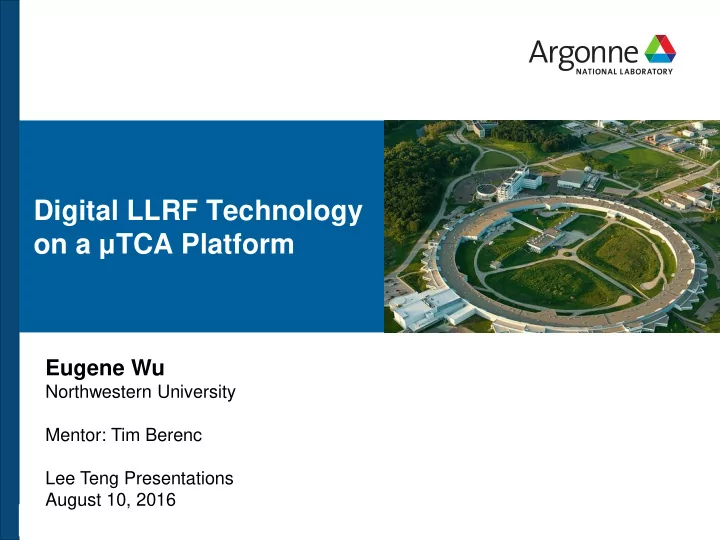
Digital LLRF Technology on a TCA Platform Eugene Wu Northwestern - - PowerPoint PPT Presentation

digital llrf technology
SMART_READER_LITE
LIVE PREVIEW

Digital LLRF Technology on a TCA Platform Eugene Wu Northwestern - - PowerPoint PPT Presentation

Digital LLRF Technology on a TCA Platform Eugene Wu Northwestern University Mentor: Tim Berenc Lee Teng Presentations August 10, 2016 Motivation Low-level RF systems regulate the amplitude and phase of an RF cavity Present APS LLRF


slide-1
SLIDE 1

Digital LLRF Technology

  • n a μTCA Platform

Eugene Wu

Northwestern University Mentor: Tim Berenc Lee Teng Presentations August 10, 2016

slide-2
SLIDE 2

2 Eugene Wu - Lee Teng Presentations - August 2016

Cavity

PA

FWD REV

Digital Signal Processing

  • Field Control
  • Fast Tuner Algorithm
  • Slow Tuner Algorithm
  • Calibration & Tune-Up
  • etc.

Power Amplifier

Cavity System

IF LO CLK

LLRF Controller

Up-Converter

DAC ADC FWD REV CAV Reference

Down-Converters

ADC ADC ADC IF CAV ADC ADC Slow ADCs Fast ADCs DAC DAC Slow DACs RF LO i.e., Slow & Fast Tuners i.e., vibration sensors

beam

Motivation

  • Low-level RF systems regulate the amplitude and phase of an RF cavity
  • Present APS LLRF systems use analog hardware
  • Long-term plans to upgrade to digital LLRF technology
  • Goal of project: evaluate microTCA based hardware for digital applications
slide-3
SLIDE 3

3 Eugene Wu - Lee Teng Presentations - August 2016

  • micro Telecommunications Computing Architecture (μTCA)

– Specifications-based hardware platform – Offers an ecosystem of various modules from multiple vendors – Used in high energy physics, digital LLRF, military, and telecommunications

slide-4
SLIDE 4

4 Eugene Wu - Lee Teng Presentations - August 2016

Hardware Components

  • Vadatech AMC502 FPGA Carrier w/ Kintex-7 FPGA

– 2 FPGA Mezzanine Card (FMC) Slots

  • D-TACQ ACQ420 Analog-to-Digital (ADC) FMC

– 16-bit, Four-channel, 2 Mega-samples per second (MSPS)

  • D-TACQ AO400 Digital-to-Analog (DAC) FMC

– 18-bit, Four-channel, 1 MSPS

slide-5
SLIDE 5

5 Eugene Wu - Lee Teng Presentations - August 2016

FPGA FMC1 FMC0 CPU GbE microTCA Backplane

slide-6
SLIDE 6

6 Eugene Wu - Lee Teng Presentations - August 2016

FPGA Design

Signal Processing will go here

First Goal: Get ADC’s and DAC’s working

slide-7
SLIDE 7

7 Eugene Wu - Lee Teng Presentations - August 2016

ADC serial interface DAC serial interface

ADC and DAC Timing Diagrams

slide-8
SLIDE 8

8 Eugene Wu - Lee Teng Presentations - August 2016

VHDL Design

  • Acquired reference designs from Vadatech and D-TACQ
  • Modified to match hardware, wrote new DAC code

– e.g., 160 FMC pins x 2, DAC serial interface

  • ~3600 lines of code
  • Synthesize design and debug
  • Use FPGA Integrated Logic Analyzer (ILA) to read internal

signals and debug

ModelSim simulation of DAC testbench

VHDL testbench for simulation/debugging

slide-9
SLIDE 9

9 Eugene Wu - Lee Teng Presentations - August 2016

Lab Setup

μTCA chassis Function generator and oscilloscope for testing FMC Front panel connector breakout Full view of lab

slide-10
SLIDE 10

Real-time Data from FPGA

10 Eugene Wu - Lee Teng Presentations - August 2016

Integrated Logic Analyzer Output

slide-11
SLIDE 11

11 Eugene Wu - Lee Teng Presentations - August 2016

ADC Data

32K Point FFT 10 kHz full-scale input

  • n channel 1

𝑂𝑝𝑗𝑡𝑓 = 𝑂𝐺 ∗ 𝐶𝑋 ≅ 223 𝜈𝑊𝑆𝑁𝑇 Noise floor ~ -130 dBV2/Hz 𝑇𝑂𝑆 = 93 𝑒𝐶 Harmonics were found to be due to signal source

slide-12
SLIDE 12

12 Eugene Wu - Lee Teng Presentations - August 2016

DAC Output

ADC Input DAC Output FFT of DAC Output

(Stanford Research Systems SR785)

slide-13
SLIDE 13

Summary

13 Eugene Wu - Lee Teng Presentations - August 2016

  • Successfully demonstrated use of ADC and DAC modules
  • n a microTCA FMC carrier for baseband signal acquisition
  • Future work

– Past application of baseband signal processing was for AM/PM noise suppression in APS storage ring RF systems (previous Lee Teng project using proprietary National Instruments hardware) – Intent is to migrate noise suppression algorithm to microTCA – Possibly start on signal processing next week – Ultimately need to transition into intermediate frequency signals for full digital LLRF