SLIDE 1
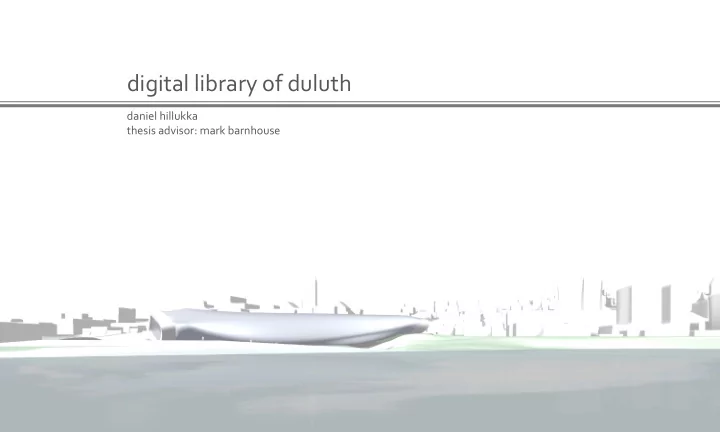
digital library of duluth
daniel hillukka thesis advisor: mark barnhouse
SLIDE 2
problem statement:
How do the use of advanced computing techniques infmuence the design of the built environment?
SLIDE 3
premises:
Software being used by architectural fjrms, is directly linked to traditional ways of developing archi- tectural documentation, further restricting design opportunities. With advanced methods such as the use of parameters, simulations, and 3d models, process should change to refmect such uses and abilities of technology. Particularly with the use of parameters, architecture has the ability to simulate changes a building could phase through, providing an avenue directly into a dynamic architecture.
SLIDE 4
theoretical premise/unifying idea
By taking a critical look at available technologies, ourselves as architects, and our processes, we should come to the realization that outdated methods of design are severely hampering the results of our work.
SLIDE 5
History of Architectural documentation/Architectural tools
SLIDE 6
History of documentation of Architectural information/Architectural tools
Middle Ages
Architects historically known as “master masons” derived from their having mastered the techniques of harvesting rock and forming it into specifjed objects. This evolved to becoming “master builders” as the pallet of materials broadened and construction techniques became more elaborate, allowing for more trades and requiring more complex production processes. The medium of architectural documentation was limited during this time, with the “master builder” being required on site and orating how the process must proceed for the successful construction of the building.
SLIDE 7 Renaissance
Documentation shifted from the oral medium toward paper documentation, and the art
- f perspectives. This shift was a direct result of artists skill evolving into the inclusion
- f depth in their paintings, which allowed architects vision to be more aptly described
through the painting medium. The shift of the architect from on site, into a studio resulted in the introduction of ortho- graphic drawings for builders to use on site as information directing the construction of the project.
History of documentation of Architectural information/Architectural tools
SLIDE 8
Mid-19th Century
The gap between the construction and design of the building widened signifjcantly when construction documents became contract documents.
History of documentation of Architectural information/Architectural tools
SLIDE 9 Today
Tools, more directly computing tools, have allowed for a new type of documentation
- f buildings. The parametric link between buildings and 2d documentation has further
shifted the architects approach from close to the construction site to further away. 3d Modeling Simulations Parmeticism
History of documentation of Architectural information/Architectural tools
SLIDE 10
3d Models
production tools
History of documentation of Architectural information/Architectural tools
SLIDE 11
3d Models
parametrics
History of documentation of Architectural information/Architectural tools
SLIDE 12
3d Models
simulations
History of documentation of Architectural information/Architectural tools
SLIDE 13
History of Libraries
SLIDE 14
Library of Alexandria
300 BC The establishment of the fjrst known library in the world, known today as the library of Alexandria.
History of Libraries
SLIDE 15
Presently
University of Texas Engineering Library has removed all physical books from its building, all information is accessed via the internet.
History of Libraries
SLIDE 16
Materials
SLIDE 17
“GAPS” diet- Natasha Campbell-McBride, MD
“All diseases begin in the gut.” Hippocrates
Materials
SLIDE 18
Materials
Nano materials
Nano materials are constructed at the molecular level. Inherently stronger, lighter, and more durable.
SLIDE 19
Structural skin
Consists of cabon nanotube aerogel composite sheets. Can operate in a range from below -196 c to 1538 c. Can elongate 10 times more than natural muscles, and at rate of 1000 times faster. Natural muscles contract at 30% per second, while these contract at 30,000% per second.
SLIDE 20
Entry Glass
Consists of Flexible Glass Currently being developed for consumer products which have a need for being fmexible. Extremely thin, very malleable.
SLIDE 21
Entry Structure
Consists of Transparent Aluminum. ALONtm A ceramic compound of high compressive strength and durability. The replacement for transparent amour in the armed forces. Can with stand high impact forces from bullets. Cost$ 10 to 15 per square inch.
SLIDE 22
Site
SLIDE 23
Site
SLIDE 24
Site
SLIDE 25
Site
SLIDE 26
Site
SLIDE 27
Site
SLIDE 28
SLIDE 29
SLIDE 30
SLIDE 31
SLIDE 32
SLIDE 33
SLIDE 34
SLIDE 35
SLIDE 36
SLIDE 37
SLIDE 38
SLIDE 39
SLIDE 40
SLIDE 41