Different approaches to Talk based on the work made in collaboration - - PowerPoint PPT Presentation

different approaches to
SMART_READER_LITE
LIVE PREVIEW

Different approaches to Talk based on the work made in collaboration - - PowerPoint PPT Presentation

Different approaches to Talk based on the work made in collaboration with: the global periodicity problem Anna Cima (UAB), Armengol Gasull V ctor Ma nosa (UPC), Francesc Ma nosas (UAB), UAB ICDEA 2012, Barcelona Armengol Gasull


slide-1
SLIDE 1

Different approaches to the global periodicity problem

Armengol Gasull

UAB

ICDEA 2012, Barcelona

Armengol Gasull (UAB) Global periodicity problem 1 / 39

Talk based on the work made in collaboration with: Anna Cima (UAB), V´ ıctor Ma˜ nosa (UPC), Francesc Ma˜ nosas (UAB),

Armengol Gasull (UAB) Global periodicity problem 2 / 39

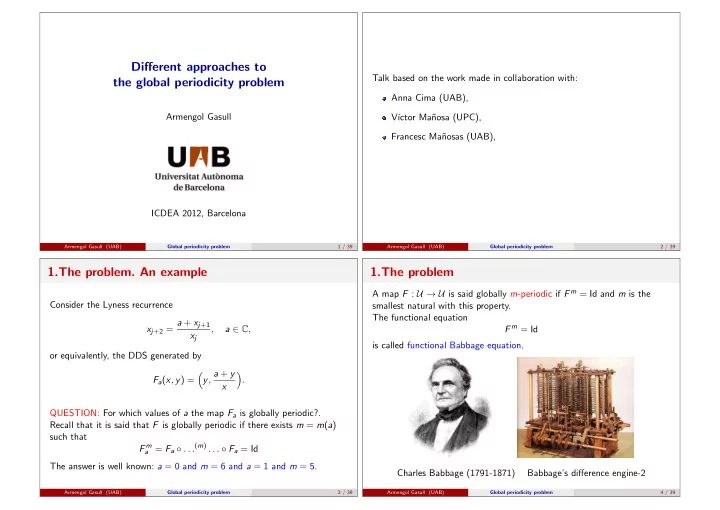
1.The problem. An example

Consider the Lyness recurrence xj+2 = a + xj+1 xj , a ∈ C,

  • r equivalently, the DDS generated by

Fa(x, y) =

  • y, a + y

x

  • .

QUESTION: For which values of a the map Fa is globally periodic?. Recall that it is said that F is globally periodic if there exists m = m(a) such that F m

a = Fa ◦ . . .(m) . . . ◦ Fa = Id

The answer is well known: a = 0 and m = 6 and a = 1 and m = 5.

Armengol Gasull (UAB) Global periodicity problem 3 / 39

1.The problem

A map F : U → U is said globally m-periodic if F m = Id and m is the smallest natural with this property. The functional equation F m = Id is called functional Babbage equation. Charles Babbage (1791-1871) Babbage’s difference engine-2

Armengol Gasull (UAB) Global periodicity problem 4 / 39

slide-2
SLIDE 2
  • 1. The problem

Given a class of maps F, we want to find and characterize the globally periodic cases. Recall that the difference equation xj+n = f (xj, xj+1, . . . , xj+n−1) can be studied considering the DDS given by the map F(x1, . . . , xn) = (x2, . . . , xn−1, f (x1, . . . , xn)). The goal of this talk is to present some of the techniques that we are using to approach the above problem and some of our results.

Armengol Gasull (UAB) Global periodicity problem 5 / 39

  • 2. Techniques for studying global periodicity

Find special properties of the dynamical system induced by F. The local linearization given by the Montgomery-Bochner Theorem. Theory of normal forms. Properties of the so called vanishing sums. These are polynomial identities with integer coefficients involving only roots of the unity.

Armengol Gasull (UAB) Global periodicity problem 6 / 39

  • 3. Properties of the globally periodic maps-I

First we present some classical results when U = Rn: Recall that a map F defined on an open set U, Ck- linearizes if there exists a Ck-homeomorphism, ψ : U → ψ(U) ⊂ Rn, for which ψ ◦ F ◦ ψ−1 is the restriction of a linear map to ψ(U). The map ψ is called a linearization of F on U. Any continuous globally periodic map on R2, C0-linearizes. (Ker´ ekj´ art´

  • , 1919 and 1920)

For n ≥ 3 there are globally periodic continuous maps on Rn that do not linearize. (Bing, 1952 and 1964) For n ≥ 7 there are globally periodic differentiable maps on Rn without fixed points. (Kister, 1969)

Armengol Gasull (UAB) Global periodicity problem 7 / 39

  • 3. Properties of the globally periodic maps-II

MONTGOMERY-BOCHNER THEOREM If x is a fixed of a Ck (k ≥ 1) m-periodic map F, then F Ck-linearizes in a neighborhood of x. The linearization ψ is explicitly given by ψ = 1 m

m−1

  • i=0

((DF)x)−i F i = Id + · · · Montgomery and L. Zippin, 1955. IDEA OF THE PROOF: It is easy to see that ψ ◦ F = L ◦ ψ where L is the linear map L(y) = (DF)xy, because F m = Lm = Id.

Armengol Gasull (UAB) Global periodicity problem 8 / 39

slide-3
SLIDE 3
  • 3. Properties of the globally periodic maps-III

We use the following well-known properties for globally periodic maps: If a map F is m-periodic then F k, for any integer k is also periodic. If a map F : U → U is periodic then it has to be bijective in U. If a rational map is periodic of period m in open subset of Rn then it has to be periodic –also of period m– in the whole real or complex space, except at the points where F or its iterates are not well defined. If F : U → U is a periodic map of period m and x ∈ U is a fix point

  • f F then ((DF)x)m = Id.

The eigenvalues of (DF)x have to be m roots of the unity. The matrix (DF)x diagonalices. The fixed points of a periodic map can not be neither attractor nor repeller. They have zero algebraic entropy.

Armengol Gasull (UAB) Global periodicity problem 9 / 39

  • 3. Properties of the globally periodic maps-IV

An easy, but useful, consequence of the Mongomery-Bochner Theorem is:

Proposition

Let F be a differentiable map having a fixed point x0. Assume that F is m-periodic and let k be the minimum positive k such that ((DF)x0))k = Id. Then k = m. For instance a simple corollary is:

Corollary

If a smooth map F(x, y) = (−x + ..., −y + ...) is m-periodic then it is an involution (m = 2).

Armengol Gasull (UAB) Global periodicity problem 10 / 39

  • 3. Properties of the globally periodic maps-V

We also have proved the following “more dynamical properties” when the map F is m-periodic: If it is C1 then the DDS generated by F has an absolutely continuous invariant measure ν, that is there exists an integrable map g such that ν(A) =

  • A

g(x) dx, and ν(F −1(A)) = ν(A). The map DDS generated by F, defined on a subset of Rn, has n functionally independent first integrals. Moreover if the map is bijective this property ”essentially” characterizes the globally periodic maps. Recall that a non-constant function H is called a first integral or invariant

  • f the DDS generated by F if

H(F(x)) = H(x). Notice that the level sets of H are invariant by F

Armengol Gasull (UAB) Global periodicity problem 11 / 39

  • 4. “Equivalence”between global periodicity and

existence of n first integrals

When and why a planar map with two functionally independent first integrals is periodic? The set of intersection points is invariant by F. We need that the number of intersections is bounded.

Armengol Gasull (UAB) Global periodicity problem 12 / 39

slide-4
SLIDE 4
  • 4. “Equivalence”between global periodicity and

existence of n first integrals-II

  • Example. The map

F(x, y) = (x + 2π, y) has the two functionally independent first integrals H1(x, y) = y − sin(x), H2(x, y) = y. and is clearly non periodic.

Armengol Gasull (UAB) Global periodicity problem 13 / 39

  • 4. “Equivalence”between global periodicity and

existence of n first integrals-III

For instance the Lyness map F(x, y) = (y, a + y x ) has for all a ∈ C the first integral H1(x, y) = (x + 1)(y + 1)(x + y + a) xy and when a = 0 it has also the first integral H2(x, y) = x4y2 + x2y4 + y4 + y2 + x2 + x4 x2y2 and when a = 1, H2(x, y) =

y4x+(x3+x2+2x+1)y3+(x3+5x2+3x+2)y2+(x4+2x3+3x2+3x+1)y+x3+2x2+x x2y2

.

Armengol Gasull (UAB) Global periodicity problem 14 / 39

  • 4. “Equivalence”between global periodicity and

existence of n first integrals-IV

How to construct the n independent first integrals for any globally periodic map?

Proposition

Let F : U ⊂ Rn → U be a globally m–periodic map on U. Let Φ : Um =

m

  • U × U × · · · × U −

→ K be a symmetric function. Then, whenever it is not a constant function, Hφ(x) = Φ(x, F(x), . . . , F m−1(x)) is a first integral of the DDS generated by F.

Armengol Gasull (UAB) Global periodicity problem 15 / 39

  • 4. “Equivalence”between global periodicity and

existence of n first integrals-V

  • Example. Consider the map

F(x, y) = (y, c xy ). corresponding to the difference equation xn+2 = c xnxn+1 . It holds (x, y) → (y, c xy ) → ( c xy , x) → (x, y), so it is 3-periodic. So n = 2 and m = 3. The first integrals are constructed using two suitable symmetric functions

  • f the orbit.

Armengol Gasull (UAB) Global periodicity problem 16 / 39

slide-5
SLIDE 5
  • 4. “Equivalence”between global periodicity and

existence of n first integrals-VI

Recall that (x, y) → (y, c xy ) → ( c xy , x) → (x, y), Taking σ1(a, b, c, d, e, f ) = a + b + c + d + e + f we get: H1(x, y) = 2

  • x + y + c

xy

  • .

Taking σ2(a, b, c, d, e, f ) = a2 + b2 + c2 + d2 + e2 + f 2, H2(x, y) = 2

  • x2 + y2 +

c2 x2y2

  • .

Note that the symmetric function σ3(a, b, c, d, e, f ) = abcdef gives a constant function and is not a first integral.

Armengol Gasull (UAB) Global periodicity problem 17 / 39

  • 5. Applications of the given tools

Consider the n−th order rational difference equation xj+n = A1xj + A2xj+1 + · · · + Anxj+n−1 + A0 B1xj + B2xj+1 + · · · + Bnjj+n−1 + B0 , with initial condition (x1, x2, . . . , xn) ∈ (0, ∞)n, and n

i=0 Ai > 0,

n

i=0 Bi > 0, Ai ≥ 0, Bi ≥ 0, and A2 1 + B2 1 = 0.

The following globally periodic difference equations are well known: xj+2 = xj+1 xj , xj+2 = xj+1 + 1 xj , xj+3 = xj+1 + xj+2 + 1 xj xj+1 = xj, xj+1 = 1 xj (trivial cases).

Armengol Gasull (UAB) Global periodicity problem 18 / 39

  • 5. Applications of the given tools-II

Each m−periodic k-th order difference equation produces in a natural way periodic difference equation of higher order. For instance the ones of order 2 given in the previous slide xj+2 = xj+1 xj , xj+2 = xj+1 + 1 xj , (1) produce the following ones xj+2ℓ = xj+ℓ xj , xj+2ℓ = xj+ℓ + 1 xj , for any positive integer ℓ, which are also periodic. Moreover taking xn = αyn, α = 0 they can be written as yj+2ℓ = αyj+ℓ yj , yj+2ℓ = αyj+ℓ + α2 yj . We will say that they are equivalent to (1).

Armengol Gasull (UAB) Global periodicity problem 19 / 39

  • 5. Applications of the given tools-III

Theorem

Consider the n−th order rational difference equation xj+n = A1xj + A2xj+1 + · · · + Anxj+n−1 + A0 B1xj + B2xj+1 + · · · + Bnjj+n−1 + B0 , with the above hypotheses. Then for n ∈ {1, 2, 3, 4, 5, 7, 9, 11} all the globally periodic cases are equivalent the 5 ones given in the previous slides (3 of the Lyness type and the 2 trivial ones).

Open Question

Is the above result true for any n?

Remark

When Aj and Bj are no more non-negative there are globally periodic maps of all periods: the M¨

  • bius maps.

Armengol Gasull (UAB) Global periodicity problem 20 / 39

slide-6
SLIDE 6
  • 5. Applications of the given tools-IV

Theorem

Any (n + 1)-periodic recurrence of class Ck defined in an open connected subset of Rn can be Ck-linearized. The proof consists in showing that the Montgomery-Bochner linearization is in this case globally invertible. For other globally m-periodic difference equations the same idea works. Unfortunately, recently we have proved that there are simple explicit involutions (m = 2) (not coming from a difference equation) for which the linearization given by the Montgomery-Bochner Theorem is not globally invertible.

Armengol Gasull (UAB) Global periodicity problem 21 / 39

  • 5. Applications of the given tools-V

Proposition

Let F : R2 − → R2 be given by F(x, y) =

  • x + 4xy + f (x, y), −y + 2(x2 + y2) − f (x, y)
  • ,

(2) where f (x, y) = 4(x + y)2(y − x) − 4(x + y)4. Then F is an involution, has (0, 0) as a fixed point and its associated Montgomery-Bochner linearization ψ = 1

2

  • Id + (DF)−1

(0,0) ◦ F

  • is not a global diffeomorphism.

Open Question

Is the Montgomery-Bochner linearization associated to a globally periodic C1 difference equation with a fixed point globally invertible?

Open Question

Is any C1 globally periodic map with a fixed point globally linearizable?

Armengol Gasull (UAB) Global periodicity problem 22 / 39

  • 6. A concrete case: the Coxeter recurrence

For any n ≥ 1, the map Fn(x1, . . . , xn) = (x2, . . . , xn, 1 − xn 1 − xn−1 1 − xn−2 1 − · · · x2 1 − x1 ) is associated to the Coxeter recurrence which is (n + 3)-periodic. It holds:

Theorem

The Coxeter maps have exactly n+2

2

  • fixed points, all them with positive
  • coordinates. Moreover at each of these fixed points Fn is locally

conjugated to a different linear map. We do not know how to prove that these conjugations are global (in the corresponding open sets).

Armengol Gasull (UAB) Global periodicity problem 23 / 39

  • 6. A warning!

For many globally periodic real difference equations, including the linear

  • nes,

xj+n = f (xj, xj+1, . . . , xj+n−1), given its associated map F(x1, . . . , xn) = (x2, . . . , xn, f (x1, . . . , xn)), the following properties hold: P1: For each fixed y ∈ R and w ∈ R the map fy(w) := f (w, y, . . . , y) is an involution. P2: The map σ ◦ F is an involution, where σ : Rn → Rn is σ(x1, x2, . . . , xn−1, xn) = (xn, xn−1, . . . , x2, x1). It can be seen that for n = 2 both properties are equivalent.

Armengol Gasull (UAB) Global periodicity problem 24 / 39

slide-7
SLIDE 7
  • 6. A warning!-II

For instance for the globally 8-periodic Lyness recurrence, f (x, y, z) = 1+y+z

x

, both P1 and P2 hold: fy(w) := f (w, y, y) = 1 + 2y w is an involution. The map σ ◦ F(x, y, z) = (1 + y + z x , z, y) is also an involution. We prove that this is not always the case.

Armengol Gasull (UAB) Global periodicity problem 25 / 39

  • 6. A warning!-III

Proposition

None of the properties P1 and P2 is a necessary condition for global periodicity of real difference equations. Proof: Consider F = Φ ◦ L ◦ Φ−1, where Φ(x, y) = (x + g(y), y + g(−x − y)) with g(z) = −z − z2 − z3 and L(x, y) = (y, −x − y). It can be seen that F writes as F(x, y) = (y, f (x, y)), for a suitable f .

Armengol Gasull (UAB) Global periodicity problem 26 / 39

  • 6. A warning!-IV

Nevertheless for the map F = Φ ◦ L ◦ Φ−1 given in the previous slide if we consider σ := Φ ◦ σ ◦ Φ−1 it holds that

  • σ is an involution

The map σ ◦ F is also an involution

Open Question

Is property P2 always true, changing σ by a suitable involution?

Armengol Gasull (UAB) Global periodicity problem 27 / 39

  • 7. Normal form theory

Given a ordinary differential equation ˙ x = F(x) or a DDS xj+1 = F(xj) in Rn or Cn the Normal Form Theory provides a method to remove the unessential parameters in F. This theory goes back to Poincar´ e and Lyapunov. For instance given a planar analytic differential equation (˙ x, ˙ y) = (−y + f2(x, y) + f3(x, y) + · · · , x + g2(x, y) + g3(x, y) + · · · ), is well known that the origin is either a center or a focus. In this later case its stability is given by the sign of the first non-null number of a list of polynomial expressions, called the Lyapunov quantities V3, V5, . . . obtained from the coefficients of fj and gj. In particular the first one V3 = V3(f2, f3, g2, g3)

Armengol Gasull (UAB) Global periodicity problem 28 / 39

slide-8
SLIDE 8
  • 7. Normal form theory-II

It turns out that the normal form of the differential equation (˙ x, ˙ y) = (−y + f2(x, y) + f3(x, y) + · · · , x + g2(x, y) + g3(x, y) + · · · ), is (˙ x, ˙ y) = (−y −(x2+y2)(V3y +T2x)+· · · , x +(x2+y2)(V3x −T2y)+· · · ). So only V3 (that gives the stability) and T2 (that gives information about the “period” of the orbits) remain. Following the same idea, since by the Montgomery-Bochner Theorem says that globally periodic maps with a fixed point locally linearize we can apply the normal form theory for DDS to obtain the obstructions to be linearized. As far as we know this approach is new. We will call these obstructions global periodicity conditions although they are also linerizability conditions.

Armengol Gasull (UAB) Global periodicity problem 29 / 39

  • 7. Normal form theory-III

Theorem

Consider a smooth complex map of the form F(x, y) =  αx +

  • i+j≥2

fi,jxiyj, 1 α y +

  • i+j≥2

gi,jxiyj   , (3) where α is a primitive m-root of unity, m ≥ 5. Then the conditions P1(F) = P2(F) = 0 are necessary for F to be m-periodic, where P1(F) := (f2,1 + f1,1g1,1) α4 − f1,1 (2f2,0 − g1,1) α3 + (2g2,0f0,2 − f1,1f2,0 + f1,1g1,1) α2 − (f2,1 + f1,1f2,0) α + f1,1f2,0, P2(F) :=g0,2g1,1α4 − (g1,2 + g0,2g1,1) α3 + (f1,1g1,1 + 2g2,0f0,2 − g0,2g1,1) α2 + g1,1 (−2g0,2 + f1,1) α + f1,1g1,1 + g1,2.

Armengol Gasull (UAB) Global periodicity problem 30 / 39

  • 7. Normal form theory-IV

As an application of the theorem applications we study the global periodicity for the 2-periodic Lyness recurrence xj+2 = aj + xj+1 xj , where aj = a for j = 2ℓ + 1, b for j = 2ℓ, (4) and a, b ∈ C.

Theorem

The only globally periodic recurrences in (4) are: (i) The cases a = b = 0 (6-periodic) and a = b = 1 (5-periodic). (ii) The cases a = (−1 ± i √ 3)/2 and b = a = 1/a, 10-periodic.

Armengol Gasull (UAB) Global periodicity problem 31 / 39

  • 7. Normal form theory-V

Main steps of the proof: I) The sequence {xj} can be reobtained as (x1, x2) Ga − → (x2, x3)

Gb

− → (x3, x4) Ga − → (x4, x5)

Gb

− → (x5, x6) Ga − → · · · where Gα(x, y) = (y, (α + y)/x), with α ∈ {a, b}. So the behavior of (4) is given by the dynamical system generated by the map: Gb,a(x, y) := Gb ◦ Ga(x, y) = a + y x , a + bx + y xy

  • Armengol Gasull (UAB)

Global periodicity problem 32 / 39

slide-9
SLIDE 9
  • 7. Normal form theory-VI

II) Given the family of maps Gb,a(x, y) := Gb ◦ Ga(x, y) = a + y x , a + bx + y xy

  • ,

if we introduce the new parameters a = B3 λ2 + 1

  • + λ
  • 2 B3 − 1
  • B (λ + 1)2

, b = −B + (B2 − a)2, with B(λ + 1) = 0 and λ = 0, (5) it holds: We cover all the values of a and b in C. The fixed point is (B, B2 − a), where a is given above. The eigenvalues of Gb,a at this point are λ and 1/λ.

Armengol Gasull (UAB) Global periodicity problem 33 / 39

  • 7. Normal form theory-VII

III) The cases m = 1, 2, 3 and 4 are trivial. For m ≥ 5, translating the fixed point to the origin and making a linear change we can apply our Normal form Theorem to the new map FB,λ. All the coefficients of this map are rational functions of B and λ. From both conditions Pi(FB,λ) = 0, i = 1, 2, we obtain the same periodicity condition C1(B, λ) = 0, where C1(B, λ) is B6λ10 + 9B6λ9 + 35B6λ8 + 80B6λ7 + 124B6λ6+2B3λ9+142B6λ5+8B3λ8 + 124B6λ4 + 18B3λ7 + 80B6λ3 + 32B3λ6 + 35B6λ2 + 40B3λ5 + 9B6λ + 32B3λ4 + λ7 + B6 + 18B3λ3 + 3λ6 + 8B3λ2 + 2λ5 + 2B3λ + 3λ4 + λ3.

Armengol Gasull (UAB) Global periodicity problem 34 / 39

  • 7. Normal form theory-VIII

Computing similarly the condition P3(FB,λ) = 0, we obtain a new periodicity condition C2(B, λ) = 0, where C2(B, λ) is huge polynomial of degree 37 in B and λ. To study the solutions of C1(B, λ) = 0, C2(B, λ) = 0, we compute R(λ) := Res(C1(B, λ), C2(B, λ); B) where Res is the resultant of both polynomials. We get R(λ) = λ36 (λ − 1)24 (λ + 1)72 λ2 + 1 6 λ2 + λ + 1 24 S6(λ) T 6(λ), where S(λ) = λ4 + λ3 + λ2 + λ + 1 and T(λ) = 3λ4 + 15λ3 + 20λ2 + 15λ + 3

Armengol Gasull (UAB) Global periodicity problem 35 / 39

  • 7. Normal form theory-IX

Then a necessary condition for for FB,λ to be m-periodic, for m ≥ 5, is λ36 (λ − 1)24 (λ + 1)72 λ2 + 1 6 λ2 + λ + 1 24 S6(λ) T 6(λ) = 0, where S(λ) = λ4 + λ3 + λ2 + λ + 1 and T(λ) = 3λ4 + 15λ3 + 20λ2 + 15λ + 3, where λ is also a primitive m-th of the unity is that either S(λ) = 0 or T(λ) = 0. It can be seen that T(λ) has no roots which are roots of the unity. On the other hand the roots of S(λ) are 5-th roots of the unity and give rise to a FB,λ which is globally 5-periodic. They correspond to the 5 and 10 periodic Lyness recurrences.

Armengol Gasull (UAB) Global periodicity problem 36 / 39

slide-10
SLIDE 10
  • 8. Vanishing sums-I

This is an ongoing project, also in collaboration with V. Ma˜ nosas(UPC) and X. Xarles(UAB). We want to apply the properties of the so called vanishing sums to detect globally periodic cases. To fix the ideas here we will center our attention to a family of maps already studied by Bedford F(x, y) = (y, a + y b + x ), a, b ∈ C It is known that the only periods appearing are m ∈ {5, 6, 8, 12, 18, 30}. We will approach to this problem with this new tool.

Armengol Gasull (UAB) Global periodicity problem 37 / 39

  • 8. Vanishing sums-II

As in the study of the 2-periodic Lyness difference equation we introduce a rational change of parameters: a = U(λ, µ), b = V (λ, µ). The map has generically two fixed points. With these new parameters the eigenvalues of DF at one of the fixed points are λ, µ. The eigenvalues s at the other fixed point satisfy the equation (λµ − λ − µ)s2 + (λ + µ)s + 1 − λ − µ = 0. Since all λ, µ and s have to be roots of the unity we have got what is called a vanishing sum.They are subject of classical interest and classified by Conway and Jones (1967).

Armengol Gasull (UAB) Global periodicity problem 38 / 39

  • A. Cima, A. Gasull and V. Ma˜
  • nosa. Global periodicity and complete

integrability of discrete dynamical systems, J. Difference Equ. Appl. 2006.

  • A. Cima, A. Gasull and V. Ma˜
  • nosa. Global periodicity conditions for

maps and recurrences via normal forms. Preprint May 2012.

  • A. Cima, A. Gasull and F. Ma˜

nosas On periodicity rational difference equations of order k, J. Difference Equ. Appl. 2004.

  • A. Cima, A. Gasull and F. Ma˜
  • nosas. Global linearization of periodic

difference equations, Discrete Contin. Dyn. Syst. 2012.

  • A. Cima, A. Gasull and F. Ma˜
  • nosas. New periodic recurrences with

applications, J. Math. Anal. Appl. 2012.

  • A. Cima, A. Gasull and F. Ma˜
  • nosas. Simple examples of planar

involutions with non-global montgomery-Bochner linearizations. To appear in Appl. Math. Lett.

  • A. Gasull, V. Ma˜

nosa and X. Xarles. Vanishing sums and globally periodic recurrences. In preparation.

Armengol Gasull (UAB) Global periodicity problem 39 / 39