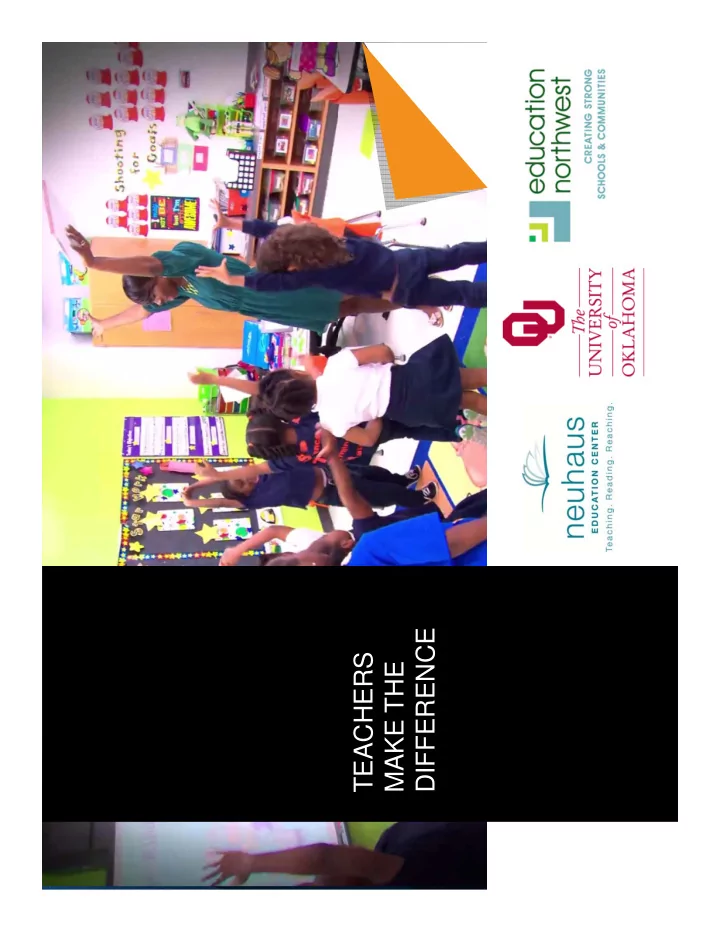
DIFFERENCE TEACHERS MAKE THE ROLES Steve Underwood, Ed.D. - - PDF document

difference teachers make the roles
SMART_READER_LITE
LIVE PREVIEW

DIFFERENCE TEACHERS MAKE THE ROLES Steve Underwood, Ed.D. - - PDF document

DIFFERENCE TEACHERS MAKE THE ROLES Steve Underwood, Ed.D. Marybeth Flachbart, Ed.D. Education Northwest | Manager in Neuhaus Education Center, the Center for Strengthening President/CEO Education Systems mflachbart@neuhaus.org


slide-1
SLIDE 1

TEACHERS MAKE THE DIFFERENCE

slide-2
SLIDE 2

ROLES

Steve Underwood, Ed.D. Education Northwest | Manager in the Center for Strengthening Education Systems

steve.underwood@educationnorthwest.org

Regina Boulware-Gooden, Ph.D. Neuhaus Education Center, VP School Improvement & Research

rgooden@neuhaus.org

Marybeth Flachbart, Ed.D. Neuhaus Education Center, President/CEO

mflachbart@neuhaus.org

Vanessa Grant, M.S. Neuhaus Education, Center Coaching Coordinator

sgrant@neuhaus.org

slide-3
SLIDE 3

3

The William Stamps Farish Fund

slide-4
SLIDE 4

CONTEXT OF THE PROJECT

slide-5
SLIDE 5

QUESTION: DOES A SYSTEMIC AND STRUCTURED APPROACH TO LITERACY INSTRUCTION IMPROVE OUTCOMES FOR PRE-K STUDENTS LIVING IN POVERTY?

slide-6
SLIDE 6

TEACHERS MAKE THE DIFFERENCE

http://createmediaservices.com/clients/mal

  • sky/neuhaus/PreK/
slide-7
SLIDE 7

SYSTEMS THINKING

A systemic approach to large-scale educational improvement accounts for all the parts and all of the people, and intentionally integrates them so that they move forward collectively and

  • coherently. It ensures that efforts are

not fragmented, for when they are fragmented, they do not produce adequate results.

Image: Shannon & Bylsma (2007). The nine characteristics of high-performing schools.

slide-8
SLIDE 8

USING A THEORY OF CHANGE

slide-9
SLIDE 9
slide-10
SLIDE 10

THANK YOU TO OUR PARTNERS

10

slide-11
SLIDE 11

OUTPUT 1: WORKSHOPS PLUS COACHING

Training Components Knowledge

% of teachers who understand concept

Skill Implementation

% of teachers who apply concept

Classroom Application

% of teachers who transfer concept into their repertoire

Theory (e.g., presenter

explains the concept)

10% 5% 0%

Plus Demonstration

(e.g., presenter models the concept)

30% 20% 0%

Plus Practice (e.g.,

participants practice the concept during the training)

60% 60% 5%

Plus Peer Coaching

(e.g., participants receive

  • ngoing feedback about their

practices of the concept in a real setting)

95% 95% 95%

Joyce, B., & Showers, B. (2002). Student achievement through staff development (3rd ed.). Alexandria, VA: Association for Supervision and Curriculum Development.

slide-12
SLIDE 12

OUTPUT 2: RESOURCES AND TOOLS

12

slide-13
SLIDE 13

OUTCOMES

Teacher Knowledge Teacher Practice Student Knowledge

13

Phonemic Awareness Letter Recognition Phoneme/ Grapheme Knowledge Oral Language

slide-14
SLIDE 14

COMPONENTS OF PROFESSIONAL DEVELOPMENT AND EMBEDDED COACHING

  • Concepts of Print
  • Phonological Awareness
  • Letter Recognition
  • Oral Language

14

slide-15
SLIDE 15

A SIMPLE VIEW OF READING

reading comprehension (RC) decoding (D) language comprehension (LC)

RC = D x LC

(Gough & Tunmer, 1986)

goal of reading

slide-16
SLIDE 16

READING

Comprehension Decoding

  • 1. Instant word recognition
  • 2. Sound/symbol
  • 3. Structural analysis
  • 4. Context
  • 1. Oral language
  • 2. World Knowledge
  • 3. Strategic Thinking
  • 4. Inference Making

F L U E N C Y

slide-17
SLIDE 17

CONCEPTS OF PRINT

  • Book knowledge
  • Title
  • Author
  • Front/end
  • How print works
  • How spoken words relate to printed words
  • Where words are found on the page
  • Where one word ends and another word

begins

slide-18
SLIDE 18

PHONOLOGICAL AWARENESS

  • Rhyming and Alliteration
  • Counting Words in Sentences
  • Counting and Blending Syllables
  • Identifying Sounds
  • Phoneme segmentation and blending
slide-19
SLIDE 19

INSTANT LETTER RECOGNITION CHART 1

A B C D E F B F D C A E D F E C B A C A B E F D F C A B D E

slide-20
SLIDE 20

ORAL LANGUAGE

  • Oral language – the words children can

understand and can use when listening and speaking

  • Oral language comes from:
  • singing songs
  • telling nursery rhymes
  • reading and looking at books
  • playing word games
  • talking, talking, talking
slide-21
SLIDE 21

INTRODUCTION TO COACHING LOGS

  • Coaching logs were developed for each component.
  • Coaches completed logs after each coaching session.
  • Data from logs was shared with coaches monthly.
  • Instruction was adjusted according to data.

21

slide-22
SLIDE 22

OVERVIEW OF PROFESSIONAL DEVELOPMENT FOR TEACHERS AND COACHING

  • Pre-K teachers and coaches attended five days of

professional development sessions, with a final day of collaboration with Kindergarten teachers.

  • Teachers were given a pre- and post- Literacy

Knowledge Survey on first and last days of workshops.

  • Topics covered included Concepts of Print, Phonological

Awareness, Letter Recognition, Oral Language, and Motivation to Read.

22

slide-23
SLIDE 23
slide-24
SLIDE 24
slide-25
SLIDE 25

volume 3 volume 3

slide-26
SLIDE 26

volume 4 volumen cuatro

slide-27
SLIDE 27

COACHING

  • Coaches were certified current and former teachers.
  • Role of the coach was to support, model,

collaborate.

  • Received training for coaching through the

University of Oklahoma and Neuhaus Education Center .

27

slide-28
SLIDE 28

COACHING

  • Coaches met with teachers either weekly or

monthly throughout the school year, using four techniques from the University of Oklahoma (Observation, Demonstration, Side-by-Side, and Shadow coaching.

  • Reviewed ELQA data and set goals with

teachers to improve literacy instruction.

28

slide-29
SLIDE 29

BEGINNING AND END OF YEAR RESULTS

29

slide-30
SLIDE 30

30

GREATER THAN EXPECTED DIFFERENCES

slide-31
SLIDE 31

CHANGES IN STUDENT AND TEACHER KNOWLEDGE

  • Teacher literacy knowledge increased

significantly.

  • Teachers became more familiar with ELQA data

analysis through coaching activities about using data to drive classroom instruction.

  • Teachers reported that external coaches helped

them improve their instructional practices.

31

slide-32
SLIDE 32

LESSONS LEARNED

  • Early intervention is important
  • Plan in advance for evaluation
  • Make data collection simple
  • You can make a difference!

32

slide-33
SLIDE 33

QUESTIONS