DEVELOPMENT OF THE HUMAN ZYGOTE OCCURS IN STAGES Human prenatal - - PowerPoint PPT Presentation

development of the human zygote occurs in stages
SMART_READER_LITE
LIVE PREVIEW

DEVELOPMENT OF THE HUMAN ZYGOTE OCCURS IN STAGES Human prenatal - - PowerPoint PPT Presentation

DEVELOPMENT OF THE HUMAN ZYGOTE OCCURS IN STAGES Human prenatal (before birth) development begins when fertilization occurs Within 30 hours: Zygote divides by mitosis Cell division continues rapidly Mass of dividing cells travels and


slide-1
SLIDE 1

DEVELOPMENT OF THE HUMAN ZYGOTE OCCURS IN STAGES

Human prenatal (before birth) development begins when fertilization occurs

  • Within 30 hours: Zygote divides by mitosis
  • Cell division continues rapidly
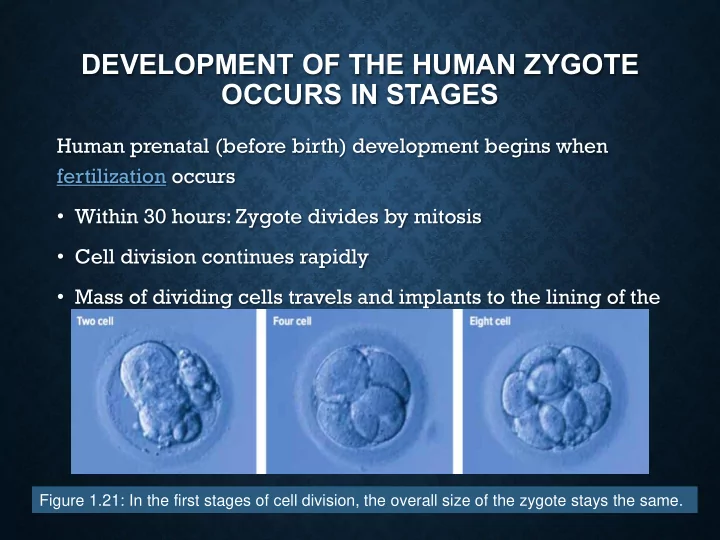
  • Mass of dividing cells travels and implants to the lining of the

uterus

Figure 1.21: In the first stages of cell division, the overall size of the zygote stays the same.

slide-2
SLIDE 2

HUMAN PRENATAL DEVELOPMENT: EMBRYONIC AND FETAL STAGES

  • Embryonic stage: 8 weeks
  • Fetal stage: 30 weeks
  • Total: 38 weeks from fertilization to birth

Figure 1.22: Human development from fertilized egg to newborn is divided into two main stages: embryonic and fetal.

slide-3
SLIDE 3

HUMAN PRENATAL DEVELOPMENT

  • Complete chart and draw a diagram of what you think each

stage looks like.

slide-4
SLIDE 4

HUMAN PRENATAL DEVELOPMENT: SUMMARY

slide-5
SLIDE 5

SEXUAL REPRODUCTION TAKES MANY FORMS.

Sexual reproduction can vary based on:

  • Reproductive behaviors
  • Methods of fertilization (internal/external)
  • Ways that offspring develop (internal/external)
slide-6
SLIDE 6

REPRODUCTIVE BEHAVIOURS

  • Organisms may have complex mating rituals

which involve effort and energy expenditure.

  • Moonwalk
  • Dancing for your life?
  • Dancing Spider
  • Courtship
  • Puffer fish
slide-7
SLIDE 7

SEXUAL REPRODUCTION FEATURES: MAMMALS

  • Development from fertilized

egg to offspring occurs inside the female

  • Female is also source of

nourishment

slide-8
SLIDE 8

INSECTS

  • Reproduction in insects is usually

sexual

  • Some insects (bees) develop

without fertilization:

  • Unfertilized eggs

become males

  • Fertilized eggs

become females

slide-9
SLIDE 9

FUNGI

  • Fungi (yeasts, moulds)

reproduce sexually and asexually

  • Sexually (produce

haploid spores)

slide-10
SLIDE 10

FISH, FROGS, AND BIRDS

  • Fertilized eggs develop
  • ffspring outside the

female’s body

  • Offspring are released when

eggs hatch

slide-11
SLIDE 11

PLANTS

  • Plants the grow

from seeds require pollination for fertilization

  • Pollen can be

transferred by the wind or by animals (bees, birds)

slide-12
SLIDE 12

REPRODUCTIVE TECHNOLOGIES

  • What if a couple cannot have a child naturally?
  • Options that involve technology exist
  • In vitro fertilization