Development of an Active Regeneration System Based On Catalytic - - PowerPoint PPT Presentation
Development of an Active Regeneration System Based On Catalytic Combustion Active regeneration Based on secondary fuel injection and catalytic combustion Soot oxidation rate 400 60 Soot Oxidation Rate (g/hr) 350 4.8 g/L 50 Soot
Active regeneration
Based on secondary fuel injection and catalytic combustion
10 20 30 40 50 60 150 200 250 300 350 400 450 Inlet Temperature (°C) Soot Oxidation Rate (g/hr) 4.8 g/L 2.4 g/L 0.6 g/L
Soot oxidation rate
50 100 150 200 250 300 350 400 600 620 640 660 680 DPF Inlet Temperature (°C) Soot Oxidation Rate (g/hr)
NO2 Regeneration 2NO2+C => 2NO +CO2 O2 Regeneration O2+C => CO2
Active regeneration
Based on secondary fuel injection and catalytic combustion Fuel consumption
100 200 300 400 500 25 50 75 100 125
Power output (kW)
Expected Temp Increase (°C)
150 kg/hr 700 kg/hr 1200 kg/hr
30 60 90 120 150 50 100 150 200 250
Fuel Injection Rate (cm3/min)
Power output (kW)
Active regeneration system
System description
- Based on secondary fuel injection
- Catalytic combustion
- Controlled Regeneration
- Ensures required Soot
- xidation Rates.
Active regeneration system
Main components
- Fuel supply
- Injection manifold
- Electronic control unit
Control Algorithm
Regeneration start parameters
- Max soot loading is reached.
- And/or min. regeneration time interval reached.
- Acceptable exhaust temperature
Control Algorithm
Regeneration stop parameters
- Injection time has elapsed.
- Engine switched off.
- Temperature after catalyst under low limit over time.
- Temperature after catalyst over high limit.
- System error.
Active regeneration system
Field trial
System description
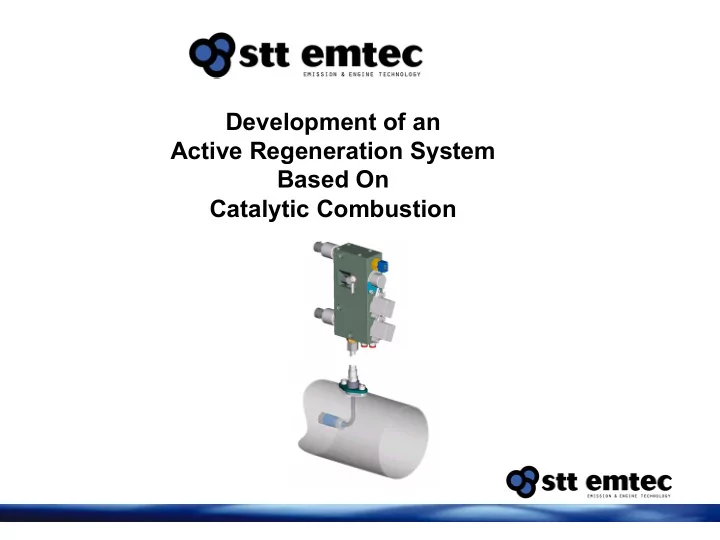
Injection manifold / Dosing unit Combustion catalyst Fuel delivery system DPF
Field trial results
Example of regeneration event
Engine speed Engine load Fuel pressure Air pressure After catalyst Before DPF Exhaust pipe Before catalyst After DPF
Field trial results
Example with regeneration triggered by exhaust back pressure
Exhaust back pressure Temperatures After catalyst Before catalyst 140 mbar
Field trial results
DPF performance
- Low temperature application
- High PM application
- Controlled regeneration
- Succesful regeneration
- Clean tailpipe
Safety features
Control system safety functions
- Injection, air pressure and fuel pressure stop at system error.
- System error at high catalyst outlet temp
- System error at hi/lo Fuel and air pressure.
- System error at Injection (PWM) feed back error.
- System error at EGR error (if used)
- Fuel pressure only in injection mode