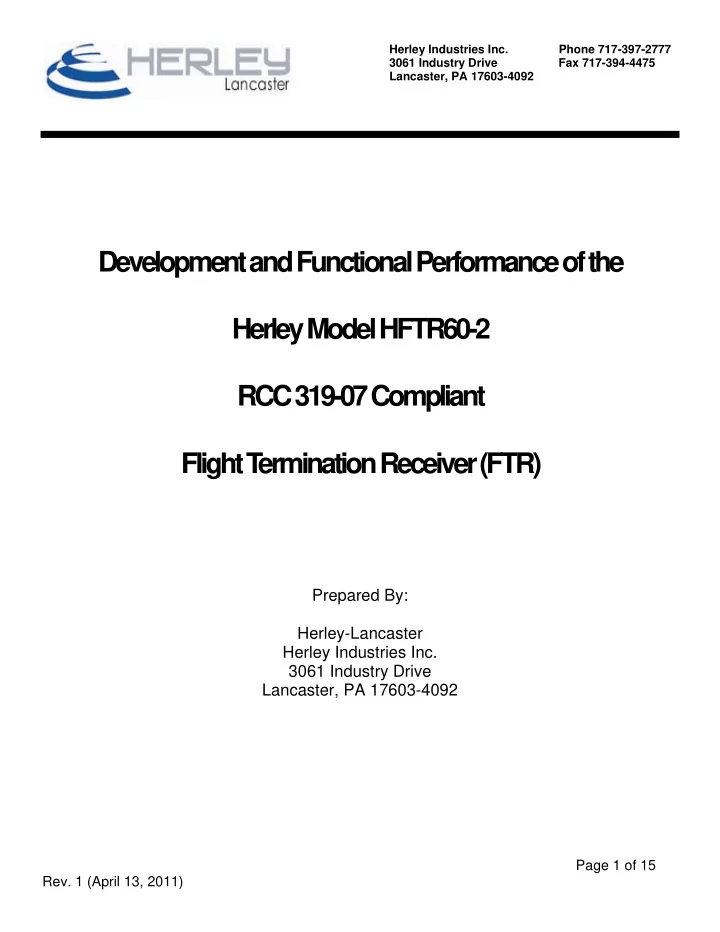
Development and Functional Performance of the Herley Model HFTR60-2 - - PDF document

development and functional performance of the herley
SMART_READER_LITE
LIVE PREVIEW

Development and Functional Performance of the Herley Model HFTR60-2 - - PDF document

Herley Industries Inc. Phone 717-397-2777 3061 Industry Drive Fax 717-394-4475 Lancaster, PA 17603-4092 Development and Functional Performance of the Herley Model HFTR60-2 RCC 319-07 Compliant Flight T ermination Receiver (FTR)


slide-1
SLIDE 1

Herley Industries Inc. Phone 717-397-2777 3061 Industry Drive Fax 717-394-4475 Lancaster, PA 17603-4092

Page 1 of 15

  • Rev. 1 (April 13, 2011)

Development and Functional Performance of the Herley Model HFTR60-2 RCC 319-07 Compliant Flight T ermination Receiver (FTR)

Prepared By: Herley-Lancaster Herley Industries Inc. 3061 Industry Drive Lancaster, PA 17603-4092

slide-2
SLIDE 2

Herley Industries Inc. Phone 717-397-2777 3061 Industry Drive Fax 717-394-4475 Lancaster, PA 17603-4092

Page 2 of 15

  • Rev. 1 (April 13, 2011)

TABLE of CONTENTS

1.0 INTRODUCTION.......................................................................................................................................................................3 1.1 FLIGHT TERMINATION RECEIVER OPERATION .......................................................................................................................3 2.0 HFTR60-1 AND HFTR60-2 DESIGN COMPARISON ........................................................................................................4 2.1 HFTR60 ELECTRICAL DESIGN: .............................................................................................................................................4 2.2 HFTR60-2 MECHANICAL DESIGN:.......................................................................................................................................10 2.3 HFTR60-2 ENVIRONMENTAL DESIGN: ................................................................................................................................11 3.0 CONCLUSION ........................................................................................................................................................................15

LIST OF FIGURES

FIGURE 1: HFTR60-2 RF ASSEMBLY FUNCTIONAL BLOCK DIAGRAM ......................................................................................................8 FIGURE 2: HFTR60-2 TONE DECODER FUNCTIONAL BLOCK DIAGRAM ...................................................................................................9 FIGURE 3: HFTR60-2 COMMAND OUTPUT STRUCTURE.........................................................................................................................10 FIGURE 4: HERLEY MODEL HFTR60-1 FLIGHT TERMINATION RECEIVER............................................................................................12 FIGURE 5: HERLEY MODEL HFTR60-2 FLIGHT TERMINATION RECEIVER............................................................................................12 FIGURE 6: HFTR60-2 OUTLINE DIMENSIONS AND PIN OUT.................................................................................................................13 FIGURE 7: GENERAL MECHANICAL DESIGN FOR HFTR60-1 & HFTR60-2.........................................................................................14

slide-3
SLIDE 3

Herley Industries Inc. Phone 717-397-2777 3061 Industry Drive Fax 717-394-4475 Lancaster, PA 17603-4092

Page 3 of 15

  • Rev. 1 (April 13, 2011)

1.0 Introduction This Technical Brief provides a description of the design principles and performance functions of the Herley Model HFTR60-2 Flight Termination Receiver (FTR) with respect to meeting the requirements of Range Commanders Council FTS Range Safety Commonality Standard RCC 319-07. All HFTR60-2 performance characteristic design updates which have been incorporated to meet the requirements of RCC 319-07 are made with reference to the existing performance characteristics of the Herley HFTR60-1 which is an RCC319-99 compliant receiver. 1.1 Flight Termination Receiver Operation The Model HFTR60-2 Flight Termination Receiver/Decoder is an airborne flight unit designed for Range Safety flight termination purposes in missile, rocket, and target

  • applications. Under normal operation, the unit receives the UHF/RF carrier frequency

modulated with up to 4 simultaneous IRIG tone frequencies, and decodes uplink commands from ground based transmitters for unmanned vehicle flight termination and/or control

  • functions. The UHF carrier frequency and the four (4) individual tone decoder channel

frequencies are factory set by selecting discrete fixed chip resistors and chip capacitors for the required tone center frequency, detection bandwidth, and deviation threshold required for each tone channel. The HFTR60-2 is a superheterodyne type receiver which utilizes a 3- pole solid ceramic coaxial filter with low pass and notch filtering to ensure adequate rejection of spurious, image, L.O. leakage, out-of-band, and harmonic signals. A mixer with a synthesized local oscillator is used to downconvert the received RF to an IF frequency of 21.4 MHz. The design incorporates four active filters and associated phase-locked loop tone decoders, each of which can be set to any one of the RCC standard tone frequencies. RCC standard three (3) tone logic provides 4 Command Outputs, and an optional direct fourth tone provides a Check Channel telemetry monitor output. Telemetry outputs are provided for the received signal strength (SSTO) and individual tone monitor signals for telemetry status monitoring and/or vehicle control functions. The transmitted uplink UHF tone-modulated RF signal is received and processed, and baseband audio signals are sent to the tone decoder

  • section. The FM demodulated tones are detected, and the appropriate Command Outputs,

ARM, MONITOR, OPTIONAL, and TERMINATE are activated when the internal logic circuitry identifies the correct applied tone sequences. The HFTR60-2 also provides failsafe circuitry which generates latched ARM and TERMINATE commands immediately for the loss

  • f input dc power or after a factory-set time period for loss of the RF carrier or Tone A.
slide-4
SLIDE 4

Herley Industries Inc. Phone 717-397-2777 3061 Industry Drive Fax 717-394-4475 Lancaster, PA 17603-4092

Page 4 of 15

  • Rev. 1 (April 13, 2011)

2.0 HFTR60-1 and HFTR60-2 Design Comparison The Herley HFTR60-2 Flight Termination Receiver is an updated version of the HFTR60-1 which is a mature existing design qualified to RCC 319-99 with an extensive and successful qualification test and flight pedigree. A summary of the enhanced features of the HFTR60-2 design are as follows:

  • Updated version of the HFTR60-1
  • Designed to meet RCC 319-07
  • Updated Failsafe Circuitry

Latching Arm and Terminate Commands on Failsafe events Low Voltage Sense Input Pin (Available Option- Low Voltage Telemetry Output for

backward compatibility with the HFTR60-1)

Commanded Failsafe Tone Logic per 319-07 (Available Option-HFTR60-1 Failsafe

Disable Command Logic, Tones B-D)

Cross-strap Operational Logic per 319-07

  • Return to Last Commanded State after a 50 ms Input Power Interruption
  • Output Monitor ±45 V Protection
  • Reduced Overall Input Power Consumption
  • Reduced Command Output Voltage Drop
  • High Power RF Front End Protection (Available Option)
  • No Pure Tin Chassis & Covers
  • High Control BOM - No Pure Tin Component Terminations (Available Option)

2.1 HFTR60 Electrical Design: The HFTR60-2 is an update to the existing HFTR60-1 design to meet the Range Safety Standard Logic FTR requirements of RCC 319-07. The necessary design updates are generally driven by the RCC 319-07 FTR design and test requirements that were undefined in the previous versions of RCC 319. In addition, the HFTR60-2 design addresses the existing part obsolescence issues associated with the greater than 10 year old HFTR60-1 design. From an overall electrical design standpoint, the differences between the HFTR60-1 and HFTR60-2 are minor, as for the most part the proven signal processing and circuit technology and functions of the HFTR60-1 are common to the HFTR60-2 design. To fully meet all RCC 319-07 performance requirements, the existing HFTR60-1 design required updates in the failsafe circuitry, failsafe cross-strapping logic, and the addition of transient loss of power

  • peration circuitry and TM monitor output overvoltage protection. The HFTR60-1 failsafe

digital logic was updated in the HFTR60-2 to operate per the RCC 319-07 defined

  • requirements. Functional Block Diagrams comparing the HFTR60-1 and the HFTR60-2

designs are shown in Figures 1 and 2.

slide-5
SLIDE 5

Herley Industries Inc. Phone 717-397-2777 3061 Industry Drive Fax 717-394-4475 Lancaster, PA 17603-4092

Page 5 of 15

  • Rev. 1 (April 13, 2011)

The most significant design updates in the HFTR60-2 are in the failsafe circuitry. The HFTR60-2 provides both latched ARM and TERMINATE commands during failsafe conditions, uses the RCC 319-07 defined tone pairs for the commanded failsafe functions, and meets the RCC 319-07 defined redundant failsafe cross-strap operational logic. A significant new RCC 319-07 performance requirement incorporates a need for a state recovery function of the FTR following a 50 millisecond interruption of DC input power. Where prior RCC 319 documents required the FTR to only “withstand and operate after” a 50 ms interruption of input power (typically only associated with external to internal power source switching), RCC 319-07 now requires the FTR to “withstand and return to its last commanded state”. The FTR must return to a latched ARM command as well as maintain a Failsafe Enabled state upon a power transient recovery if the FTR was in either of these states prior to the power dropout. The Herley HFTR60-2 meets this requirement through added low current- draw under-voltage monitor state-retention circuitry and energy storage that is adequate to restore the ARM Command and the Failsafe Enable function states upon power recovery following a power loss of up to 50 milliseconds. The following is a simplified summary list of the HFTR60-2 primary electrical circuit design changes made in reference to the existing HFTR60-1 design:

  • With a minor change to the digital decoder circuitry logic for a detected failsafe condition,

the failsafe enabled HFTR60-2 circuitry now provides both latched Terminate and Arm command outputs per RCC 319-07 following either a loss of Tone A or low voltage failsafe

  • condition. The prior HFTR60-1 enabled failsafe circuitry only generated an unlatched

Terminate command output for an input failsafe condition. Note: During testing, the HFTR60-2 must have power removed for 2 seconds to reset the latched Failsafe generated output commands.

  • With a minor change to the digital decoder circuitry logic, the HFTR60-2 failsafe cross-

strapping interconnection operational logic now operates per the RCC 319-07 defined redundant failsafe cross-strap logic.

  • With a minor change to the digital decoder circuitry logic, the HFTR60-2 Commanded

Failsafe Disable logic function operates with the application of Tones C and D which is compliant to the RCC 319-07 requirement. The Commanded Failsafe Enable logic of the HFTR60-2 and HFTR60-1 operate with the application of Tones A and D. The HFTR60-1 Commanded Failsafe Disable function operates with the application of Tones B and D.

  • Low current-draw under-voltage monitor state-retention circuitry along with adequate

energy storage was added to the digital decoder circuitry to restore a latched ARM Command (A-C “ON”, C “OFF”) and the Failsafe Enable state upon a power recovery which follows a DC power loss of up to 50 milliseconds to meet the RCC 319-07

  • requirement. In a cross strap configuration of two (2) HFTR60-2 receivers, state recovery
  • nly occurs if one of the two receivers experienced the less than 50 millisecond power
  • transient. If both receivers in a cross strapped configuration experience a simultaneous
slide-6
SLIDE 6

Herley Industries Inc. Phone 717-397-2777 3061 Industry Drive Fax 717-394-4475 Lancaster, PA 17603-4092

Page 6 of 15

  • Rev. 1 (April 13, 2011)

power transient, a low voltage failsafe condition has occurred and an immediate latched ARM and TERMINATE Command is generated.

  • The identical switching power supply and transformer circuitry are used, however the

isolated secondary operating voltages are reduced from 12V in the HFTR60-1 to 6V in the HFTR60-2 through a simple power supply primary side component value adjustment.

  • The HFTR60-2 RF Receiver and Tone Decoder circuitry are now powered by 6V versus

12V used in the prior HFTR60-1 design. The lower operating voltage reduces the overall required FTR operating dc input current draw from 210 mA max for the HFTR60-1 to a 125 mA max for the HFTR60-2. The typical power dissipation of the HFTR60-2 is less than 2.5 Watts.

  • Reverse polarity protection on the dc power lines in the HFTR60-1 was provided by a

single series reverse polarity diode which has an associated forward voltage drop. The series voltage drop experienced in the HFTR60-2 is reduced through the use of a series MOSFET with a low Rds on for reverse polarity protection of the dc inputs. This along with the use of lower Rds on MOSFETs for the command outputs results in a much lower

  • verall voltage drop from the input dc voltage to the activated command output voltages.
  • The “Low Voltage Sense Output” (J2 pin 11) of the prior HFTR60-1 was a telemetry
  • utput that has now been configured in the HFTR60-2 as a “Low Voltage Sense Input”.

This input pin can now be used to monitor the dc voltage (at the unit or elsewhere) so that when the voltage on the input sense pin drops to the specified threshold voltage, a failsafe enabled HFTR60-2 will immediately initiate the latched failsafe Terminate and Arm commands. Prior HFTR60-1 use of this pin as a telemetry output did not provide any additional information regarding a loss of input dc power condition since the FTS battery voltages and all other FTR telemetry outputs are generally monitored and will provide a clear indication of a power loss condition. The HFTR60-2 “Low Voltage Sense Input” (J2 pin 11) is isolated from the FTR DC input and therefore is not subject to the potential fluctuations of the FTR’s DC input voltage under high current Command

  • loads. Note: The “Low Voltage Sense Input” must be tied to the DC input voltage pins

(J2 1 and 14) if not used as an isolated DC sense input.

  • Recoverable protection circuitry was added to all HFTR60-2 telemetry monitor (TM)
  • utputs (including SSTO) to provide protection from damage during applied overvoltage

conditions (up to ±45V) across any telemetry monitor output and its return. The prior HFTR60-1 met this overvoltage condition only when the over voltage condition is applied across any telemetry monitor output and chassis.

  • In the HFTR60-2 the consistency and overall stability of the SSTO telemetry output signal
  • ver temperature will be improved by the use of an added logarithmic amplifier IC with

stable and repeatable internal temperature compensation.

slide-7
SLIDE 7

Herley Industries Inc. Phone 717-397-2777 3061 Industry Drive Fax 717-394-4475 Lancaster, PA 17603-4092

Page 7 of 15

  • Rev. 1 (April 13, 2011)
  • Like the HFTR60-1, the HFTR60-2 provides dual redundant series output MOSFETS on

the ARM and TERMINATE Range Safety command outputs. Unlike the HFTR60-1, the HFTR60-2 does not utilize dual redundant series output MOSFETS on the MONITOR and OPTIONAL command outputs (see Figure 3). The elimination of the redundant Monitor and Optional output circuitry was necessary to allow room to add circuitry needed to meet

  • ther defined RCC 319-07 functions.
  • Baseband audio signal isolation in the HFTR60-1 was provided through the use of an

audio isolation coupling transformer which as a mechanical assembly which suffers from dimensional tolerance, wire winding, ferrite core material, and epoxy variations that not always provided unit-to-unit and environmental performance consistency. In the HFTR60-2 design, baseband audio signal isolation will be vastly stabilized and consistent through the use of single ended-to-differential and differential-to-single ended semiconductor isolation amplifier devices.

  • Factory adjustment and setting of the receiver Local Oscillator (LO) frequency in the

HFTR60-1 is accomplished through physical circuit trace cuts and jumpers on an installed PLL Synthesizer IC. LO frequency adjustment and setting in the HFTR60-2 is accomplished through a programmed microcontroller CPU with the LO settings stored in flash memory and sent to an integrated Synthesizer & VCO IC.

  • The HFTR60-2 receiver RF substrate layout accommodates an available option which

allows additional limiter components to be installed (or not installed as in the standard unit) to provide severe high power RF signal input protection (up to +52 dBm in-band and up to +57 dBm out-of-band).

slide-8
SLIDE 8

Herley Industries Inc. Phone 717-397-2777 3061 Industry Drive Fax 717-394-4475 Lancaster, PA 17603-4092

Page 8 of 15

  • Rev. 1 (April 13, 2011)

`

Mixer Crystal BPF IF Receiver Subsytem

1st IF Amp 2nd IF Amp Single Ended to Differential Audio Amp

RF Input LO PLL

Signal Strength Output

BPF

RF Amp

ATTEN LPF TEMP COMP ATTEN ATTEN BPF LPF ATTEN Logarithmic Amplifier

Audio + Audio -

High Power Signal Protection ATTEN Functionally equivalent to HFTR60-1 HFTR60-2 Available Option

Figure 1: HFTR60-2 RF Assembly Functional Block Diagram

slide-9
SLIDE 9

Herley Industries Inc. Phone 717-397-2777 3061 Industry Drive Fax 717-394-4475 Lancaster, PA 17603-4092

Page 9 of 15

  • Rev. 1 (April 13, 2011)

Active Filter

A Tone Decoder B Tone Decoder C Tone Decoder

Active Filter Active Filter SSTO Isolation Amplifier Signal Strength Output Audio Buffer Audio Output Tone C Monitor

Decoder / Failsafe Logic (includes 50 mSec dropout protection)

Tone B Monitor Tone A Monitor Fail Safe Cross- Link Output Fail Safe Telemetry

High Current Switch High Current Switch High Current Switch High Current Switch

Fail Safe Enable Input Fail Safe Cross-Link Input Terminate Arm Optional Monitor

D Tone Decoder

Active Filter Diff to Single Ended Amp

Audio + Audio -

Tone D Monitor SSTO from RF

Switching Power Supply

+28 VDC Input +6V RF +5.8V TD +6V ISO

Functionally equivalent to HFTR60-1

Command Outputs Low Voltage Sense Input Telemetry Outputs Audio from RF +28 VDC Input

Figure 2: HFTR60-2 Tone Decoder Functional Block Diagram

slide-10
SLIDE 10

Herley Industries Inc. Phone 717-397-2777 3061 Industry Drive Fax 717-394-4475 Lancaster, PA 17603-4092

Page 10 of 15

  • Rev. 1 (April 13, 2011)

Decoder/ Logic Circuitry J2-23 ARM Command Output J2-1 J2-14 28V DC Input J2-10 OPTIONAL Command Output J2-22 MONITOR Command Output J2-8 J2-20 TERMINATE Command Output J2-2, 3, 4, 5, or 18 28V Return J2-2, 3, 4, 5, or 18 28V Return J2-2, 3, 4, 5, or 18 28V Return J2-2, 3, 4, 5, or 18 28V Return J2-2, 3, 4, 5, or 18 28V Return Tone A Tone B Tone C Decoder/ Logic Circuitry

Figure 3: HFTR60-2 Command Output Structure 2.2 HFTR60-2 Mechanical Design: Both the HFTR60-1 and HFTR60-2 mechanical designs (see Figures 4 through 7) are fit, form, and interface interchangeable (not operationally for the J2 pin 11 low voltage sense,

slide-11
SLIDE 11

Herley Industries Inc. Phone 717-397-2777 3061 Industry Drive Fax 717-394-4475 Lancaster, PA 17603-4092

Page 11 of 15

  • Rev. 1 (April 13, 2011)

and J2 pins 7 and 19 cross-strap interconnections and commanded failsafe tone pairs). Both provide a fully-contained environmentally & electromagnetically sealed chassis design with conductive gasket-sealed top and bottom covers that enclose and protect all internal

  • circuitry. Both designs consist of a single RF substrate directly solder attached to the

chassis on one side, and a single Power Supply/Tone Decoder CCA PWB mounted by fastener hardware to the chassis on the other side. To achieve all the required electrical functions in the HFTR60-2, some parts were reduced to 0402 in size and have insignificant mass (0603 was the smallest part size in the prior HFTR60-1). All assemblies and components are adequately mounted along with epoxy staking and damping techniques and materials that are employed to negate the effects of the dynamic forces applied during acceleration, shock, and vibration environments. The unit chassis and covers are machined from light weight high-conductivity 6061-T6 aluminum alloy. Mechanical design improvements implemented in the HFTR60-2 over the existing HFTR60-1 include reinforced covers with interlocking metal-to-metal contact, additional cover attachment screws, thickened chassis side and internal circuitry isolation walls, EMI feed-thru filters are used in place of prior routed discrete wiring and the elimination of pure tin plating on the unit chassis and covers. The aluminum chassis and covers of the HFTR60-2 are thick multi-layer nickel plated to provide a uniform corrosion-resistant durable finish with excellent electrical and thermal conductivity. 2.3 HFTR60-2 Environmental Design: The HFTR60-2 design is based on the proven performance of the HFTR60-1 Flight Termination Receiver. The HFTR60-1 is a mature Range Certified design. Since its original qualification and subsequent WSMR JAMI qualification, the HFTR60-1 has successfully completed many Delta-qualification test programs to the requirements of individual airborne vehicle programs. Each qualification test program was performed to meet RCC Range Safety requirements while operating under extreme environmental levels all with applied margins over actual flight levels. The prior HFTR60-1 has demonstrated significant dynamic margin by successfully passing more than 20 different qualification operating random vibration profiles (hard-mounted in all 3 axes) at extreme levels and durations of up to 34.4 grms applied for 45 minutes/axis. The HFTR60-1 has proven itself to be rugged, reliable, and robust with margin over the most severe environmental conditions associated with many varied airborne vehicle platforms. Due to its design similarities, the RCC 319-07 compliant HFTR60-2 will provide identical, if not greatly improved environmental capabilities over the presently manufactured HFTR60-1.

slide-12
SLIDE 12

Herley Industries Inc. Phone 717-397-2777 3061 Industry Drive Fax 717-394-4475 Lancaster, PA 17603-4092

Page 12 of 15

  • Rev. 1 (April 13, 2011)

Figure 4: Herley Model HFTR60-1 Flight Termination Receiver Figure 5: Herley Model HFTR60-2 Flight Termination Receiver

slide-13
SLIDE 13

Herley Industries Inc. Phone 717-397-2777 3061 Industry Drive Fax 717-394-4475 Lancaster, PA 17603-4092

Page 13 of 15

  • Rev. 1 (April 13, 2011)

Figure 6: HFTR60-2 Outline Dimensions and Pin Out

slide-14
SLIDE 14

Herley Industries Inc. Phone 717-397-2777 3061 Industry Drive Fax 717-394-4475 Lancaster, PA 17603-4092

Page 14 of 15

  • Rev. 1 (April 13, 2011)

Figure 7: General Mechanical Design for HFTR60-1 & HFTR60-2

slide-15
SLIDE 15

Herley Industries Inc. Phone 717-397-2777 3061 Industry Drive Fax 717-394-4475 Lancaster, PA 17603-4092

Page 15 of 15

  • Rev. 1 (April 13, 2011)

3.0 Conclusion The Herley HFTR60-2 design is a low risk design providing a qualified Flight Termination Receiver meeting the electrical, mechanical and environmental performance requirements of RCC 319-07 and RCC 319-10.