Developing Future Pharmacy Leaders: An Interdisciplinary Approach - - PDF document

developing future pharmacy leaders an interdisciplinary
SMART_READER_LITE
LIVE PREVIEW

Developing Future Pharmacy Leaders: An Interdisciplinary Approach - - PDF document

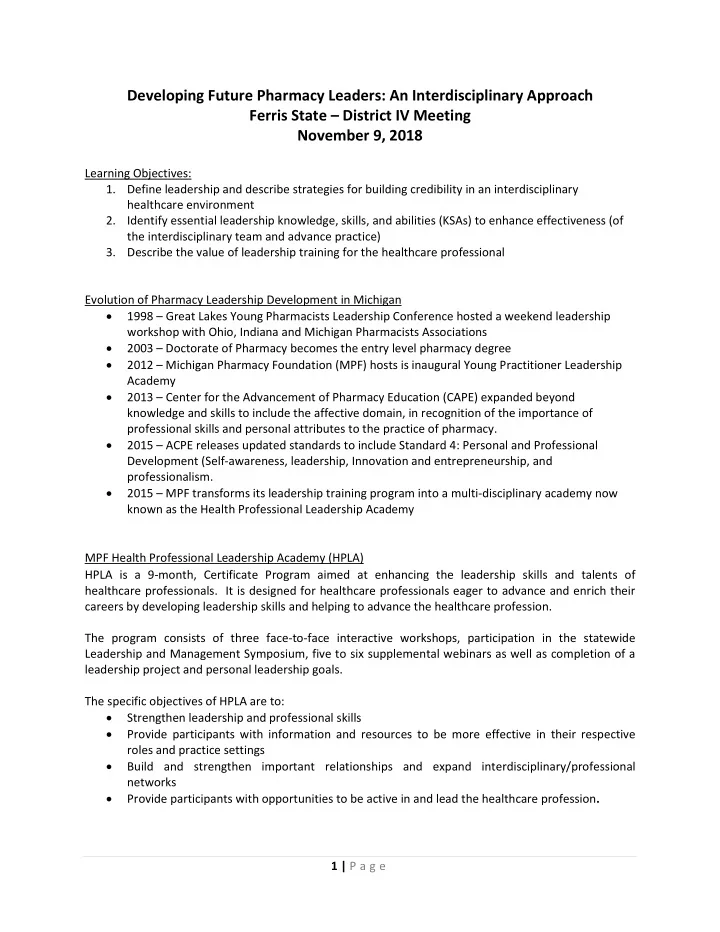
Developing Future Pharmacy Leaders: An Interdisciplinary Approach Ferris State District IV Meeting November 9, 2018 Learning Objectives: 1. Define leadership and describe strategies for building credibility in an interdisciplinary healthcare


slide-1
SLIDE 1

Developing Future Pharmacy Leaders: An Interdisciplinary Approach Ferris State – District IV Meeting November 9, 2018

Learning Objectives:

  • 1. Define leadership and describe strategies for building credibility in an interdisciplinary

healthcare environment

  • 2. Identify essential leadership knowledge, skills, and abilities (KSAs) to enhance effectiveness (of

the interdisciplinary team and advance practice)

  • 3. Describe the value of leadership training for the healthcare professional

Evolution of Pharmacy Leadership Development in Michigan

  • 1998 – Great Lakes Young Pharmacists Leadership Conference hosted a weekend leadership

workshop with Ohio, Indiana and Michigan Pharmacists Associations

  • 2003 – Doctorate of Pharmacy becomes the entry level pharmacy degree
  • 2012 – Michigan Pharmacy Foundation (MPF) hosts is inaugural Young Practitioner Leadership

Academy

  • 2013 – Center for the Advancement of Pharmacy Education (CAPE) expanded beyond

knowledge and skills to include the affective domain, in recognition of the importance of professional skills and personal attributes to the practice of pharmacy.

  • 2015 – ACPE releases updated standards to include Standard 4: Personal and Professional

Development (Self-awareness, leadership, Innovation and entrepreneurship, and professionalism.

  • 2015 – MPF transforms its leadership training program into a multi-disciplinary academy now

known as the Health Professional Leadership Academy MPF Health Professional Leadership Academy (HPLA) HPLA is a 9-month, Certificate Program aimed at enhancing the leadership skills and talents of healthcare professionals. It is designed for healthcare professionals eager to advance and enrich their careers by developing leadership skills and helping to advance the healthcare profession. The program consists of three face-to-face interactive workshops, participation in the statewide Leadership and Management Symposium, five to six supplemental webinars as well as completion of a leadership project and personal leadership goals. The specific objectives of HPLA are to:

  • Strengthen leadership and professional skills
  • Provide participants with information and resources to be more effective in their respective

roles and practice settings

  • Build and strengthen important relationships and expand interdisciplinary/professional

networks

  • Provide participants with opportunities to be active in and lead the healthcare profession.

1 | P a g e

slide-2
SLIDE 2

HPLA Leadership Domains and Curriculum Leadership and Leader Defined:

  • Leadership: a process of influencing others to excel and achieve common goals.
  • A leader: anyone who inspires and influences others to do their best and achieve goals.
  • Enhancing your role as leader: Leveraging and/or balancing position and personal power.

Attributes “followers” most look for and admire in leaders:

  • Individual assessment/analysis
  • Most trusted professions, according to Gallup
  • Discussion: Strategies for building credibility
  • Debrief

Leadership Skills to Thrive in Today’s Environment

  • Leadership Challenges
  • Key leadership skills: healthcare profession
  • Discussion: Strengthening the Interdisciplinary Team and Advancing the Profession
  • Debrief

Coaching Pharmacy Leaders and Healthcare Professionals

  • Career Limiting/Derailment Behaviors (see diagram below)
  • Discussion

2 | P a g e

slide-3
SLIDE 3

and extraordinary results.”

Sources: Center for Creative Leadership (2 – 6) and Conference Board (7 -10).

Leadership Academy Success:

  • Participants have included pharmacists, certified pharmacy technicians, nurses, physician

assistant, medical-related managers

  • 95 Applicants in the first five years
  • 89 Successfully graduated
  • Year 5 has 12 applicants who began the program in October.
  • Surveys have been conducted to continue improvements to the Academy

3 | P a g e

Career Limiting/ Derailment Behaviors 1. Lack of self- awareness 2. Problems w/ Interpersonal Relationships (lack of SEI) 3. Difficulty Leading and Working in Teams 4. Difficulty Changing or Adapting 5. Failure to Achieve Business Objectives 6. Too Narrow of a Functional Orientation 7. Hesitancy to Take Necessary Business Risks 8. Personal Arrogance & Insensitivity 9. Controlling Leadership Style 10. Reluctance to Handle Tough People Issues

slide-4
SLIDE 4

References

  • 1. Accreditation Standards and Guidelines for the Professional Program in Pharmacy Leading to the

Doctor of Pharmacy Degree. Accreditation Council for Pharmacy Education. Chicago; 2006.

  • 2. https://www.acpe-accredit.org/pdf/Standards2016FINAL.pdf
  • 3. https://www.aacp.org/sites/default/files/2017-10/CAPEoutcomes2013%20%281%29.pdf

4 | P a g e