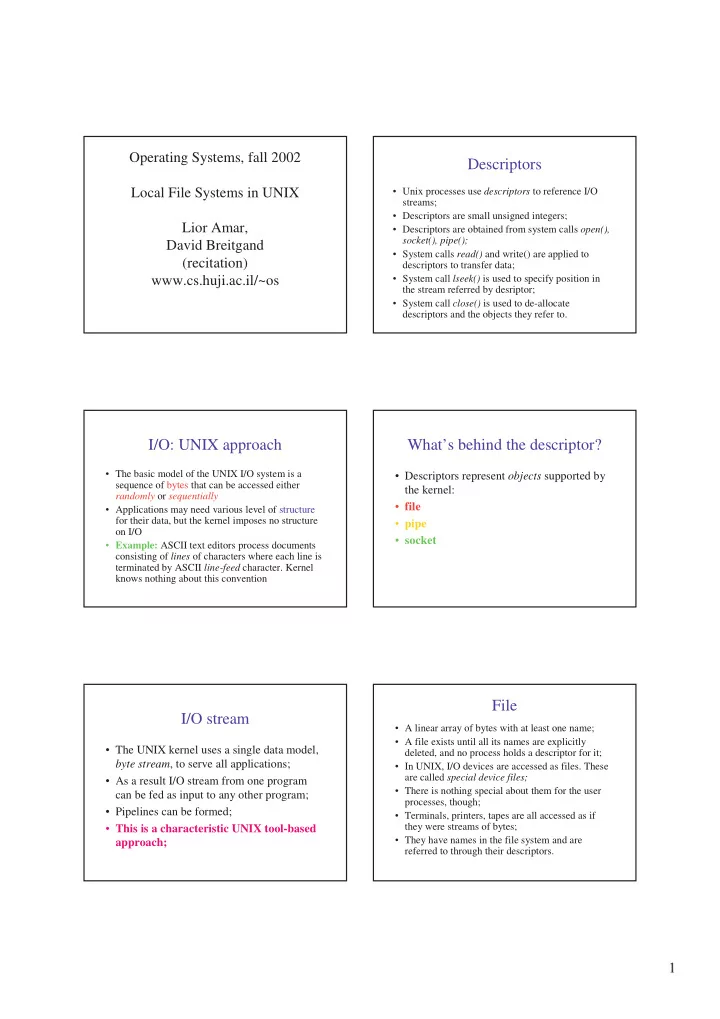

SLIDE 1
- Operating Systems, fall 2002
Local File Systems in UNIX Lior Amar, David Breitgand (recitation) www.cs.huji.ac.il/~os
I/O: UNIX approach
- The basic model of the UNIX I/O system is a
sequence of bytes that can be accessed either randomly or sequentially
- Applications may need various level of structure
for their data, but the kernel imposes no structure
- n I/O
- Example: ASCII text editors process documents
consisting of lines of characters where each line is terminated by ASCII line-feed character. Kernel knows nothing about this convention
I/O stream
- The UNIX kernel uses a single data model,
byte stream, to serve all applications;
- As a result I/O stream from one program
can be fed as input to any other program;
- Pipelines can be formed;
- This is a characteristic UNIX tool-based
approach;
Descriptors
- Unix processes use descriptors to reference I/O
streams;
- Descriptors are small unsigned integers;
- Descriptors are obtained from system calls open(),
socket(), pipe();
- System calls read() and write() are applied to
descriptors to transfer data;
- System call lseek() is used to specify position in
the stream referred by desriptor;
- System call close() is used to de-allocate
descriptors and the objects they refer to.
What’s behind the descriptor?
- Descriptors represent objects supported by
the kernel:
- file
- pipe
- socket
File
- A linear array of bytes with at least one name;
- A file exists until all its names are explicitly
deleted, and no process holds a descriptor for it;
- In UNIX, I/O devices are accessed as files. These
are called special device files;
- There is nothing special about them for the user
processes, though;
- Terminals, printers, tapes are all accessed as if
they were streams of bytes;
- They have names in the file system and are