Denver Moves: Transit Task Force Meeting #6 June 1, 2017 1. Welcome - - PowerPoint PPT Presentation

denver moves transit task force
SMART_READER_LITE
LIVE PREVIEW

Denver Moves: Transit Task Force Meeting #6 June 1, 2017 1. Welcome - - PowerPoint PPT Presentation

Insert transit picture Denver Moves: Transit Task Force Meeting #6 June 1, 2017 1. Welcome & Introductions Opening remarks and housekeeping Task Force and audience introductions 2 6/1/2017 2. Project Updates Recent Denver


slide-1
SLIDE 1

Insert transit picture
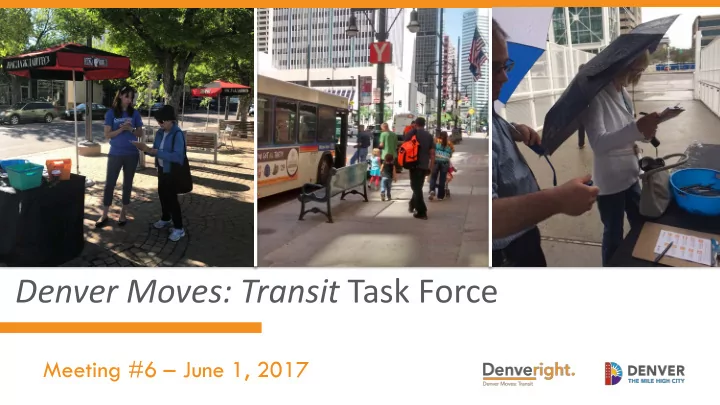
Denver Moves: Transit Task Force

Meeting #6 – June 1, 2017

slide-2
SLIDE 2
  • 1. Welcome & Introductions
  • Opening remarks and housekeeping
  • Task Force and audience introductions

6/1/2017 2

slide-3
SLIDE 3
  • 2. Project Updates
  • Recent Denver Moves: Transit Plan work
  • Early Transit Plan Action: Denver Moves:

Broadway

6/1/2017 3

slide-4
SLIDE 4

Recent Denver Moves: Transit Plan Work

4 6/1/2017

slide-5
SLIDE 5

Neighborhood Drop-In Workshops

  • Southwest Rec Center (SW)
  • Montbello Denver Broncos Boys & Girls Club

(Far NE)

  • Cake Crumbs Bakery (NE)
  • Corkey Gonzalez Branch Library (NW)
  • Dazbog Coffee (E. Central)
  • Colorado Light Rail Station at I-25 (SE)
  • Denver Public Library Central Branch (W.

Central)

6/1/2017 5

slide-6
SLIDE 6

Denveright.

0envet- Moves.: Triinsit

Neighborhood Drop-In Workshops

6/1/2017 6

slide-7
SLIDE 7

Workshop & Event Feedback

Participants indicated these priorities:

  • Higher frequency and enhanced bus service
  • Earlier/later and more weekend service
  • More fare pass programs
  • More amenities at stops and stations
  • More high capacity transit service

6/1/2017 7

slide-8
SLIDE 8

Build Your Own Transit System

  • Launched mid-April
  • Closing June 30
  • 872 responses

– 870 English, 2 Spanish

  • Distributed via:

– Denver.gov – Neighborhood workshops – Youth Stakeholder Group – Other community outlets

6/1/2017 8

slide-9
SLIDE 9

Build Your Own Transit System

Respondents…

  • Live in Capitol Hill (5.9%)
  • Identified as:

− White (81.3%) − Hispanic/Latino/Latina (4.5%) − Black or African American (2.5%)

  • Make between $100,000 to

$149,999 (23.7%)

  • Are between the ages of 25

to 34 (41.8%)

Focus Area Number Percent

Northwest 235 37.5% West Central 157 25.0% Southwest 13 2.1% Northeast 50 8.0% East Central 111 17.7% Southeast 48 7.7% Far Northeast 13 2.1%

As of 5/28/2017; there were a total of 627 responses for this question.

6/1/2017 9

slide-10
SLIDE 10

Build Your Own Transit System

Highest Priorities Responses Higher frequency bus service 542 More rail (e.g., light rail or commuter rail) in Denver 507 Improved access to transit stops and stations 467 Lowest Priorities More outreach and education about transit services/programs 173 Access to more car share options near transit 145 On-demand bus (e.g., Access-A-Ride) 72

As of 5/28/2017

6/1/2017 10

slide-11
SLIDE 11

Youth Stakeholder Group

6/1/2017 11

slide-12
SLIDE 12

Denveright Community Think Tank

  • Held special meeting on

May 31

  • Played Blueprint Denver

growth game

  • Had opportunity to

meet 1-on-1 with city project managers

6/1/2017 12

slide-13
SLIDE 13

Early Transit Plan Action:

Denver Moves: Broadway Broadway/Lincoln Transit Study

6/1/2017 13

slide-14
SLIDE 14

NACTO Transit Program Accelerator

  • New initiative to share best practices,

develop strategies, and advance implementation to create great transit streets

  • Implement concepts of the NACTO Transit

Street Design Guide

  • Broadway/Lincoln identified as candidate

transit corridors for near-term study and implementation readiness

14 6/1/2017

slide-15
SLIDE 15

Broadway/Lincoln Transit Study

  • Study area:

– Broadway (17th to I-25/Broadway Station) – Lincoln (5th to Colfax)

  • Proposed study improvements:

– 24-hour transit-only lane

Red pavement treatment in Seattle

– Red pavement treatments for enforcement – Coordination with RTD bus stop consolidation

  • Study anticipated to start 3Q 2017

Source: NACTO/Seattle DOT

6/1/2017 15

slide-16
SLIDE 16

Broadway/Lincoln Transit Study

  • Study will evaluate:

– Transit service and operational improvements (e.g., travel time savings) – Transit-only lane compliance (vehicle violations) – Other metrics (in development)

6/1/2017 16

slide-17
SLIDE 17
  • 3. Tools for Decision Making: Project

Evaluation Framework

  • Task Force role in prioritization and decision

making

  • Developing a meaningful evaluation and

investment framework

6/1/2017 17

slide-18
SLIDE 18

Transit S<..,eriot Priority

START

m2011

Comdors

I

JUN 2017

Acc..M, Connection•. &Pn>gr.-ns

Pro;.ct Cosb,

Funding, & Implementation

  • cr

2C17

I

Drllft Pfan

DE<" 2011

  • Goalt&

H

I

Succen

Framew«k

.~

)C

V\

Menuresof

Evaluation ~ FA

.:

>~

) ~

~ ~

7

I TO ~

~

~

T+~

TOPICS

~

TOPICS

  • Why Denver Move~:

Transit?

  • Values & Vision

Elements

  • Goals & Measures
  • f

Success KEY QUESTIONS II luive abQut th•

VISIOn and

vision efel'lents? What goal& should we

Ht

for Llt-t1w1 Mo''

11.11 •.t?

liow w1 I we know If we have accomplished thow

~?

TOPICS

  • Draft Goals &

Objectives

  • Decision-M;iking &

Evaluation Tools

  • Evaluation

Framework: Setting Priorities KEY QUESTIONS

  • b1ectives ht

the mark?

How should we evaluate

  • ptions and set pt"iorlties

as part of I

}()fl / M•we:s.

lnro :l TOPICS

  • Preliminary

Blueprint Scenarios

  • Adding Transit to

th"' Mix

  • Approach to

Priorizing Corridors KEY QUESTIONS qu .. '

'lS -

have about the Elwpnrrt

SCinar;os?

How 5hould trensit be 1ncorporat.,i into theH scenarios? Do you h~e feedback on .,ur '1Wluation alld pnont1z.ot on epp1oech?

  • Potential Transr

t Priority Corridors

  • Exploring the

Analysis

  • Creating Complete

Corridors KEY QUESTIONS proortty comdors align wll h your ''"P"ctatrons? Ar;,

thwre additional or replacement ciJmdon that should be

con:5idored7 What should be uded

in

a compliite corridor"? TOPICS

,

  • Improving Access

& Connections

  • Identifying

Multimodal Hubs

  • Policy & Program

Toolbox KEY QUESTIONS community stop prionties

for 1mprovtng trnnsit access?

Whore are multirnodal hubi """ded?

Wh~

should they 1ndude? What polu:1es ;ind programs can support transit in !)Qnv"r?

  • Project Costs

,--I

,

  • Funding Options

I

  • Implementation &

Phasing

W • Draft Plan

Engagement KEY QUESTIONS Wh I havo about funding

  • ptioons that ghoi.ld be

COll$tdered? How should ! r•de-offs be mad;i to support imp'9rrwntation? How can we be:.t engago ttie pubric

;,.. reV'!!W ng the

draft plan? TOPICS

  • Draft DenvQr Movos:

1i·;mslt Plan

  • Bringing it all

Togathar

  • Next Steps

KEY QUESTIONS

II

  • n tho draft p1an7

I av;i What w I you to do

  • ncourago ott!Qrs to provide

fudh:ll:k on the plan?

How can you support "mp!.mentation of the plan?

Task Force Roadmap

11/16/2016 18

slide-19
SLIDE 19

Denver’s Evaluation Framework

  • Build on vision and goals
  • Balance priorities
  • Integrate with Blueprint

Denver and coordinate with other plans and processes

19 6/1/2017

slide-20
SLIDE 20

Sample Evaluation Criteria

ENHANCE CONNECT

  • Transit average speed
  • Land use access and density
  • Transit mode share
  • Locally significant destinations

SIMPLIFY

  • Stops with shelters
  • Participants in travel training

SUSTAIN

  • Cost effectiveness
  • Productivity

THRIVE

  • Access for seniors
  • Reduction in GHG emissions

20 6/1/2017

slide-21
SLIDE 21

ENHANCE

@

SUSTAIN

Denver Moves: Transit

GOALS

SIMPLIFY FREQUENT TRANSIT NETWORK eeee TRANSIT CORRIDOR CAPITAL IMPROVEMENTS eee

lntermed.ate-to-high capacity transit

  • Bus pr:ority corridors

J

TRANSIT CORRIDOR TOOLBOX ee

  • Corridor typologies
  • Design standards
  • --- PLACES DESIGN BOOK eeee

, Station/stop standards

  • Mobility hub concepts

LAND USE COORDINATION ee

  • Recommendation to/from Blueprint Denver

TRANSIT-SUPPORTIVE PROGRAMS eeee Information Education

  • Partnerships

IMPLEMENTATION e

  • Funding strategies
  • Governance

Transit policies

Using the Evaluation Framework

6/1/2017 21

slide-22
SLIDE 22

~ m1111 L

1

11 :

. . . : :

.

: - . II • .

. ::o

ew

I •

ltllliO cf lftw'ltit 10 01>10 tl"a.-61 litn6

I • I •

  • Nvmber
  • f
people portiC:ipoting in trov.1 ff"Oining progromi. (3)

Acceu for no-vehicle ho1J-.ehold• [I ] "'"9.ifor,0111h (I] A«i6uforu11ior'J (l]

  • A«tu
t or people "'"" diJOlbilitiet [ 1

J

  • J..c:auform;noriti•.s(I]
  • Commute po" erns to key job
au·ttio,.,, or lob cen.ter ~"
  • Pt oduaMty (e.g,.
Ml'm'~ l\oourJ per rider') City budget d1tdic.otod lo 1r-
  • r00 proWeo.s [3]
11.lueprlnl Scenorios
  • TH1r11ltPt'A11t

eonu

..

511ppoftl'n, C-rid DI'

EvoluotiOft: 5tr1111'°'filiet1 & '""oluallon: Corridor Peffonno nce fniticil Saeenin9 l"'rioritizotion Meo1wc1
  • II
2 4

"'

Denveright.

0envet- Moves.: Triinsit

Proposed Evaluation Criteria

6/1/2017 22

slide-23
SLIDE 23

Lessons from Columbus

  • Values-driven

process shaped preliminary corridor evaluation

  • Issues of equity

and growth at the forefront of the evaluation

23 6/1/2017

slide-24
SLIDE 24

zyxwvutsrqponmlkjihgfedcbaZYXWVUTSRQPONMLKJIHGFEDCBA

Lessons from Salt Lake City

  • Evaluation framework supported

idea that frequent network could leverage strong street grid in eastern SLC

  • Alternative strategies used to extend

transit to some areas

  • Various land use densities better

accommodate different transit modes

Source: Salt Lake City Draft Transit Master Plan, October 2016

24 6/1/2017

slide-25
SLIDE 25

Lessons from Orange County

  • Transit investment framework articulates how decisions are made for both

service and capital investments

  • Based on stated vision and goals and supported by detailed evaluation

criteria

25 6/1/2017

slide-26
SLIDE 26

Lessons from Nashville

  • Guiding principles shaped

scenarios

  • Evaluation criteria—ridership,

access to jobs, and equity— informed selection of 5 high capacity transit lines

  • Mayor recently announced plan to

advance design of first light rail corridor

6/1/2017 26

slide-27
SLIDE 27

Lessons from Seattle

  • Investment framework shaped

all aspects of plan recommendations

  • Corridor selection and

evaluation based on “multiple account” evaluation

  • Policy and program

recommendations flow from same goals

27 6/1/2017

slide-28
SLIDE 28
  • 5. Short Break

6/1/2017 28

slide-29
SLIDE 29
  • 4. Identifying and Evaluating Priority

Transit Corridors

  • Approach to corridor identification and evaluation
  • Mapping key criteria along corridors
  • Report out and discussion

6/1/2017 29

slide-30
SLIDE 30

Using the Evaluation Framework

6/1/2017 30

slide-31
SLIDE 31

Sample Corridor Analysis: Seattle

Comprehensive Set of Initial Corridor Screening Corridors for Prioritization Final Plan Corridors Corridors

6/1/2017 31

slide-32
SLIDE 32

Using the Evaluation Framework

6/1/2017 32

slide-33
SLIDE 33

Comprehensive Set of Corridors

  • Blueprint Denver

(2002)

  • Existing frequent

service

  • RTD network

analysis

  • Project team input
  • Task Force input
  • Agency Team input

6/1/2017 33

slide-34
SLIDE 34

Comprehensive Set of Corridors

  • Blueprint Denver

(2002)

  • Existing frequent

service

  • RTD network

analysis

  • Project team input
  • Task Force input
  • Agency Team input

6/1/2017 34

slide-35
SLIDE 35

Comprehensive Set of Corridors

  • Blueprint Denver

(2002)

  • Existing frequent

service

  • RTD network

analysis

  • Project team input
  • Task Force input
  • Agency Team input

6/1/2017 35

slide-36
SLIDE 36

Comprehensive Set of Corridors

  • Blueprint Denver

(2002)

  • Existing frequent

service

  • RTD network

analysis

  • Project team input
  • Task Force input
  • Agency Team input

6/1/2017 36

slide-37
SLIDE 37

Comprehensive Set of Corridors

  • Blueprint Denver

(2002)

  • Existing frequent

service

  • RTD network

analysis

  • Project team input
  • Task Force input
  • Agency Team input

6/1/2017 37

slide-38
SLIDE 38

Comprehensive Set of Corridors

  • Blueprint Denver

(2002)

  • Existing frequent

service

  • RTD network

analysis

  • Project team input
  • Task Force input
  • Agency Team input

6/1/2017 38

slide-39
SLIDE 39

Denveright.

Comprehensive Set of Corridors

6/1/2017 39

slide-40
SLIDE 40

Our Final Corridors

6/1/2017 40

slide-41
SLIDE 41

Using the Evaluation Framework

6/1/2017 41

slide-42
SLIDE 42

Segments for Screening

  • Break at logical points

to capture changes in land use or corridor character

  • Work with smaller

segments to support fine-grained results and ability to stitch pieces together

6/1/2017 42

slide-43
SLIDE 43

Initial Screening Criteria

  • Density
  • Demographics
  • Demand and

Accessibility

6/1/2017 43

slide-44
SLIDE 44
  • l
  • ..
Littleton

2015 Population & Employment Density

within 1/4 mile of Corridors

  • 6

SI"

..... -

,.,_1

A.Ip>'!

J J

Aur01"_,

2015 Population and Employment (pe<SOns

and jobs per acre)

1.4 ·8.0

8.1. 12.0 12.1. 20.0 20.1. 35.0

35.1. 111-3 Segment break

· ~d.l ~ h-~-i.d.d "°1lflf<«roO'N,-;~ "-1
  • w

....

...,...:i .... '-'*1-

G ' O.-..i.tgr,...T,_:l'>d• 11>"'fl
  • .-...

~

Q.Kji01.-:fSDl<Oli,ColortdrOD01,0pe<'J(oltr~do,. lS.I ~!.N\'._!

N

~:.".'.~!
  • AJVada
  • """""

~ 1

  • ...

,... 4

,,,.

,..

J """

"

Lakewood

M-*"!

f

!

.;

~ ... " l.\<0# ~- I
  • ........

Englewood

\

  • ·

Littleton

...

..::::: '

~ ..

.,

I ..

j

  • ~

,..

.. ,

""'

_ 1"'1~

"""'

Aurora

6

Population earning less

...

1han 1 50%

  • flhe

6 poverty level

(ppl/aue)

0.0- 4.0

....

& ~
  • 41 - 80

'

"

  • s.1-12.0
  • 12.1-16.0
  • 16.1 · 20.0

Segment breOlk Gr

..

nwood Villag;lil

· ~&uluoboetl
  • eluded

"-...

c-.w

~l;
  • .:--

lr_ ..............

tf>M.t1 • i.r.~ QfO.-~ T<_\.,..,aprl;q/
  • -..
~eow-

_______

  • ..1H..S.u•1 ORCOl'a
, CdoudoOr . Opt-nc.tw.cS.,ES•l,201S,_.A1rkMl(-1MlJ~

.....

  • -..<.

Low-Income Population Density

within 1/4 mile of Corridors

Denveright.

Denvet- Moves.: Transit

D

~:!.l.!

N

=:
  • L
~

Preliminary Results

6/1/2017 44

slide-45
SLIDE 45

Your Turn

  • Spend ~15 min at each station

reviewing the analysis and maps

  • Discuss the following questions:

– How well do the criteria tell the “story”

  • f a corridor?

– Is anything missing? What additional information would be valuable? – What is the relative importance of different criteria?

45 6/1/2017

slide-46
SLIDE 46

Small Group Report Out

4/6/2017 46

slide-47
SLIDE 47
  • 7. Upcoming Outreach and Engagement
  • Youth Stakeholder Group video release
  • Wrapping up the Build Your Own Transit System
  • utreach phase
  • Preliminary plans for summer engagement

47 6/1/2017

slide-48
SLIDE 48

Summer & Fall Engagement

  • Partner with Denveright
  • Target August and early

September initially

  • Gather feedback on priority

corridors

  • Keep it simple

– Maptionnaire survey – In-person at local/regional fairs and festivals

6/1/2017 48

slide-49
SLIDE 49
  • 8. Next Steps
  • Next Task Force participation opportunity

– Share and promote the Build Your Own Transit System survey (closing June 30) – Say hi at summer outreach events in your neighborhood – Publicize the youth video

  • Task Force Meeting #7: August 3 (let’

s discuss)

49 6/1/2017

slide-50
SLIDE 50
  • 9. Questions and Comments

www.denvergov.org/denveright

6/1/2017 50