
Technology Overview Current Status
To achieve step-change performance with Li-S chemistry, it is imperative to operate at very high sulfur concentrations. Accordingly, we have accomplished the following: 1. Polysulfide electrodes can be reversibly cycled at extremely high sulfur concentrations ( up to 16 MS) in water-based electrolyte. Reversible capacity ranges from 10 to 20 mAh/cm2. 2. PolyPlus has worked with several suppliers to successfully develop a hydrophilic carbon matrix for aqueous sulfur electrodes. 3. Projected performance based on laboratory lithium-sulfur cell testing is ~ 400 Wh/kg and 650 Wh/l
A Revolutionary Approach to High-Energy Density, Low-Cost Lithium-Sulfur Batteries
PolyPlus Battery Company, Berkeley, CA OPEN 2012
- Dr. Steven J. Visco, CEO and CTO
510-841-7242 svisco@polyplus.com Presenter: Dr. Hannah L. Ray
Project Statistics
Award Amount $4.5M Award Timeline February 2013 - February 2016 Next Stage Target 400 mAh Li-S prototype cell at 400Wh/kg, 650 Wh/L Collaborations Sought Strategic Partners, Manufacturing expertise, System Integration.
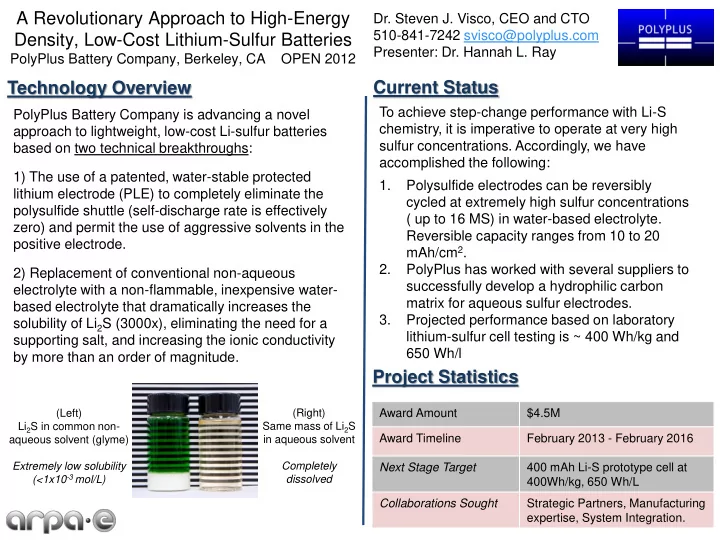
PolyPlus Battery Company is advancing a novel approach to lightweight, low-cost Li-sulfur batteries based on two technical breakthroughs: 1) The use of a patented, water-stable protected lithium electrode (PLE) to completely eliminate the polysulfide shuttle (self-discharge rate is effectively zero) and permit the use of aggressive solvents in the positive electrode. 2) Replacement of conventional non-aqueous electrolyte with a non-flammable, inexpensive water- based electrolyte that dramatically increases the solubility of Li2S (3000x), eliminating the need for a supporting salt, and increasing the ionic conductivity by more than an order of magnitude.
(Left) Li2S in common non- aqueous solvent (glyme) Extremely low solubility (<1x10⁻³ mol/L) (Right) Same mass of Li2S in aqueous solvent Completely dissolved