Deinking chemistry performance: from laboratory flotation tests to - - PowerPoint PPT Presentation

deinking chemistry performance
SMART_READER_LITE
LIVE PREVIEW

Deinking chemistry performance: from laboratory flotation tests to - - PowerPoint PPT Presentation

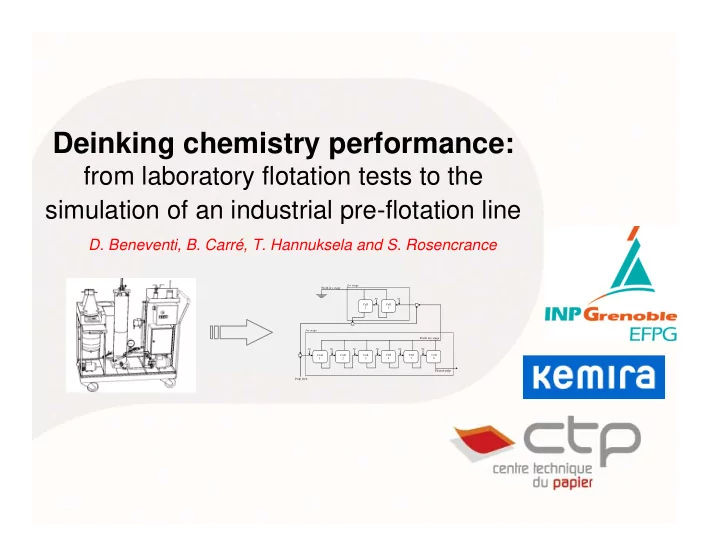
Deinking chemistry performance: from laboratory flotation tests to the simulation of an industrial pre-flotation line D. Beneventi, B. Carr, T. Hannuksela and S. Rosencrance 2ry stage Froth 2ry stage Air Air


slide-1
SLIDE 1

Deinking chemistry performance:

from laboratory flotation tests to the simulation of an industrial pre-flotation line

  • D. Beneventi, B. Carré, T. Hannuksela and S. Rosencrance
Air Air Air Air Air Air Air Air Froth 1ry stage Froth 2ry stage Cell 1 Cell 2 Cell 3 Cell 4 Cell 5 Cell 6 Cell 1 Cell 2 Floated pulp Pulp feed 2ry stage 1ry stage
slide-2
SLIDE 2

2

DB– September, 2007

Guideline

Motivations and objectives Materials and methods

  • Laboratory flotation test procedure
  • Data analysis and process simulation

Results

  • Laboratory flotation tests
  • Process simulation

Conclusions

slide-3
SLIDE 3

3

DB– September, 2007

Extrapolation of laboratory flotation tests to the industrial scale difficult/misleading Absence of a laboratory test/data analysis procedure to interpret and simulate the action of deinking chemicals at lab and industrial scale

Motivations and objectives

To develop a lab test procedure and a simulation tool to predict the influence of process chemistry

  • n deinking selectivity in industrial lines

Lab benchmark test Data analysis and process simulation Selectivity in industrial lines

slide-4
SLIDE 4

4

DB– September, 2007

Guideline

Motivations and objectives Materials and methods

  • Laboratory flotation test procedure
  • Data analysis and process simulation

Results

  • Laboratory flotation tests
  • Process simulation

Conclusions

slide-5
SLIDE 5

5

DB– September, 2007

Materials and methods

Laboratory flotation test procedure

High consistency pulping

  • Furnish:

50% OMG/50%ONP

  • Consistency: 13%
  • Temperature: 45°C
  • Pulping time: 15 min
  • Ca2+: 150 mg/L
slide-6
SLIDE 6

6

DB– September, 2007

Materials and methods

Laboratory flotation test procedure

High consistency pulping

  • Furnish:

50% OMG/50%ONP

  • Consistency: 13%
  • Temperature: 45°C
  • Pulping time: 15 min
  • Ca2+: 150 mg/L

Re-pulping chemistry NaOH (%) Silicate (%) Peroxide (%) Collector (%) Soap, 2% silicate 0.7 2 0.7 0.45 Soap, 1% silicate 0.7 1 0.7 0.45 Blend, 2% silicate 0.7 2 0.7 0.15 Blend, 1% silicate 0.7 1 0.7 0.15

Re-pulping chemistries tested in this study

Re-pulping chemistry NaOH (%) Silicate (%) Peroxide (%) Collector (%) Soap, 2% silicate 0.7 2 0.7 0.45 Soap, 1% silicate 0.7 1 0.7 0.45 Blend, 2% silicate 0.7 2 0.7 0.15 Blend, 1% silicate 0.7 1 0.7 0.15

Re-pulping chemistries tested in this study

slide-7
SLIDE 7

7

DB– September, 2007

Materials and methods

Laboratory flotation test procedure

Air Pulp chest Floated pulp Froth collection To vacuum pump Adjustable froth removal

Pulp aeration line

High consistency pulping

  • Furnish:

50% OMG/50%ONP

  • Consistency: 13%
  • Temperature: 45°C
  • Pulping time: 15 min
  • Ca2+: 150 mg/L

Laboratory continuous flotation

  • Consistency: 0.8%
  • Temperature: ~40°C
  • Ca2+: 150 mg/L
slide-8
SLIDE 8

8

DB– September, 2007

Materials and methods

Laboratory flotation test procedure

Air Pulp chest Floated pulp Froth collection To vacuum pump Adjustable froth removal

Pulp aeration line

High consistency pulping

  • Furnish:

50% OMG/50%ONP

  • Consistency: 13%
  • Temperature: 45°C
  • Pulping time: 15 min
  • Ca2+: 150 mg/L

Laboratory continuous flotation

  • Consistency: 0.8%
  • Temperature: ~40°C
  • Ca2+: 150 mg/L
  • Pulp feed flow: 2 L/min
slide-9
SLIDE 9

9

DB– September, 2007

Materials and methods

Laboratory flotation test procedure

Air Pulp chest Floated pulp Froth collection To vacuum pump Adjustable froth removal

Pulp aeration line

High consistency pulping

  • Furnish:

50% OMG/50%ONP

  • Consistency: 13%
  • Temperature: 45°C
  • Pulping time: 15 min
  • Ca2+: 150 mg/L

Laboratory continuous flotation

  • Consistency: 0.8%
  • Temperature: ~40°C
  • Ca2+: 150 mg/L
  • Pulp feed flow: 2 L/min
  • Air flow: 4 L/min
slide-10
SLIDE 10

10

DB– September, 2007

Materials and methods

Laboratory flotation test procedure

High consistency pulping

  • Furnish:

50% OMG/50%ONP

  • Consistency: 13%
  • Temperature: 45°C
  • Pulping time: 15 min
  • Ca2+: 150 mg/L

Laboratory continuous flotation

  • Consistency: 0.8%
  • Temperature: ~40°C
  • Ca2+: 150 mg/L
  • Pulp feed flow: 2 L/min
  • Air flow: 4 L/min
  • Cell volume: 14.5 L

Air Pulp chest Floated pulp Froth collection To vacuum pump Adjustable froth removal

Pulp aeration line

slide-11
SLIDE 11

11

DB– September, 2007

Materials and methods

Laboratory flotation test procedure

High consistency pulping

  • Furnish:

50% OMG/50%ONP

  • Consistency: 13%
  • Temperature: 45°C
  • Pulping time: 15 min
  • Ca2+: 150 mg/L

Laboratory continuous flotation

  • Consistency: 0.8%
  • Temperature: ~40°C
  • Ca2+: 150 mg/L
  • Pulp feed flow: 2 L/min
  • Froth removal thickness: 1, 2, 3, 5 cm
  • Air flow: 4 L/min
  • Cell volume: 14.5 L

Air Pulp chest Floated pulp Froth collection To vacuum pump Adjustable froth removal

Pulp aeration line

slide-12
SLIDE 12

12

DB– September, 2007

Materials and methods

Laboratory flotation test procedure

High consistency pulping

  • Furnish:

50% OMG/50%ONP

  • Consistency: 13%
  • Temperature: 45°C
  • Pulping time: 15 min
  • Ca2+: 150 mg/L

Laboratory continuous flotation

Pulp characterization

  • ERIC, Brightness
  • Ash content (475°C), fibre content
  • Mass flow

Air Pulp chest Floated pulp Froth collection To vacuum pump Adjustable froth removal

Pulp aeration line

slide-13
SLIDE 13

13

DB– September, 2007

Motivations and objectives Materials and methods

  • Laboratory flotation test procedure
  • Data analysis and process simulation

Results

  • Laboratory flotation tests
  • Process simulation

Conclusions

Guideline

slide-14
SLIDE 14

14

DB– September, 2007

Materials and methods

Data analysis and process simulation

Flotation de-inking modelling

n g n n

c S Q K dt dc

α

− =

S Q K k

g n n α

⋅ =

Air Pulp chest d Adjustable froth removal

Pulp aeration line

S cell cross section Qg air flow cn particle concentration Kn experimental flotation rate

Flotation

slide-15
SLIDE 15

15

DB– September, 2007

Materials and methods

Data analysis and process simulation

n f n

c V Q dt dc ⋅ − = φ

Air Pulp chest d Adjustable froth removal

Pulp aeration line

V cell volume Qf

0 water upstream flow

cn particle concentration φ entrainment coefficient

Flotation de-inking modelling Entrainment

slide-16
SLIDE 16

16

DB– September, 2007

Materials and methods

Data analysis and process simulation

g f f

Q Q Q + = ε

FRT Ld

e

⋅ −

⋅ = ε ε

Air Pulp chest d Adjustable froth removal

Pulp aeration line

Flotation de-inking modelling Frothing

ε water holdup ε0 water holdup at the froth/pulp interface Qf water upstream flow Qg gas flow FRT froth retention time Ld water drainage coefficient

slide-17
SLIDE 17

17

DB– September, 2007

Materials and methods

Data analysis and process simulation

d nf f

Q c dt dM ⋅ ⋅ − = δ

Air Pulp chest d Adjustable froth removal

Pulp aeration line

Flotation de-inking modelling Drainage

dMf /dt particle drainage rate δ particle drainage coefficient cnf particle concentration in the froth Qd water drainage flow

slide-18
SLIDE 18

18

DB– September, 2007

Materials and methods

Data analysis and process simulation

Air Pulp chest d Adjustable froth removal

Pulp aeration line

Flotation de-inking modelling

Laboratory flotation tests Experimental data fitting with model equations Extraction of transport coefficients Process scale-up and design using model equations

Industrial line simulation

slide-19
SLIDE 19

19

DB– September, 2007

Materials and methods

Data analysis and process simulation

Industrial pre-flotation line

Cell volume (L) Cell cross section area (m

2)

Pre-flotation feed flow (L/min) Cell nominal flow (L/min) Gas flow (L/min) Number of 1ry cells Number of 2ry cells Recirculation rate

  • n 2ry cells (%)

24000 12 30000 40000 20000 6 2 71

Parameters used to simulate an industrial pre-flotation unit

slide-20
SLIDE 20

20

DB– September, 2007

Materials and methods

Data analysis and process simulation

Industrial pre-flotation line

Air Air Air Air Air Air Air Air

Froth 1ry stage Froth 2ry stage Cell 1 Cell 2 Cell 3 Cell 4 Cell 5 Cell 6 Cell 1 Cell 2 Floated pulp Pulp feed 2ry stage 1ry stage

Cell volume (L) Cell cross section area (m

2)

Pre-flotation feed flow (L/min) Cell nominal flow (L/min) Gas flow (L/min) Number of 1ry cells Number of 2ry cells Recirculation rate

  • n 2ry cells (%)

24000 12 30000 40000 20000 6 2 71

Parameters used to simulate an industrial pre-flotation unit

slide-21
SLIDE 21

21

DB– September, 2007

Guideline

Motivations and objectives Materials and methods

  • Laboratory flotation test procedure
  • Data analysis and process simulation

Results

  • Laboratory flotation tests
  • Process simulation

Conclusions

slide-22
SLIDE 22

22

DB– September, 2007

Comparison of fatty acid soap and fatty acid-surfactant blend

100 200 300 400 500 600 700 800 900 1000 10 20 30 40 50 Time (min) ERIC (ppm) Soap, 1% silicate Blend, 1% silicate 2 cm 1cm 3 cm 5 cm

b)

0.0 0.5 1.0 1.5 2.0 2.5 3.0 3.5 4.0 4.5 5.0 10 20 30 40 50 Time (min) Fibre consistency (g/L) Soap, 1% silicate Blend, 1% silicate 2 cm 1cm 3 cm 5 cm

ERIC of floated pulp Fibre consistency in the froth

Results

Laboratory flotation tests

slide-23
SLIDE 23

23

DB– September, 2007

)

1 2 3 4 5 6 7 8 9 10 20 30 40 50 Time (min) Ash consistency (g/L) Soap, 1% silicate Blend, 1% silicate 2 cm 1cm 3 cm 5 cm

b)

0.0 0.5 1.0 1.5 2.0 2.5 3.0 3.5 4.0 4.5 5.0 5.5 6.0 10 20 30 40 50 Time (min) Fines consistency (g/L) Soap, 1% silicate Blend, 1% silicate 2 cm 1cm 3 cm 5 cm

Comparison of fatty acid soap and fatty acid-surfactant blend

Fines consistency in the froth Ash consistency in the froth

Results

Laboratory flotation tests

slide-24
SLIDE 24

24

DB– September, 2007 5 10 15 20 25 30 35 1 2 3 4 5 6 Froth thickness (cm) Water loss (%) Soap, 2% silicate Soap, 1% silicate Blend, 2% silicate Blend, 1% silicate

b)

0.02 0.04 0.06 0.08 0.1 0.12 0.14 0.16 2 4 6 8 10 12 14 16 18 Retention time (s) Water holdup (%) Soap, 2% silicate Soap, 1% silicate Blend, 2% silicate Blend, 1% silicate

Comparison of fatty acid soap and fatty acid-surfactant blend

Water loss vs. froth removal thickness Water holdup in the froth vs. FRT

Results

Laboratory flotation tests

slide-25
SLIDE 25

25

DB– September, 2007

Flotation yield of tested deinking chemicals

a)

5 10 15 20 25 1 2 3 4 5 6 Froth thickness (cm) Fibre loss (%) Soap, 2% silicate Soap, 1% silicate Blend, 2% silicate Blend, 1% silicate

b)

5 10 15 20 25 30 35 40 1 2 3 4 5 6 Froth thickness (cm) Fines loss (%) Soap, 2% silicate Soap, 1% silicate Blend, 2% silicate Blend, 1% silicate

c)

10 20 30 40 50 60 70 1 2 3 4 5 6 Froth thickness (cm) Ash loss (%) Soap, 2% silicate Soap, 1% silicate Blend, 2% silicate Blend, 1% silicate

d)

5 10 15 20 25 30 35 40 1 2 3 4 5 6 Froth thickness (cm) Total loss (%) Soap, 2% Silicate Soap, 1% silicate Blend, 2% silicate Blend, 1% silicate

slide-26
SLIDE 26

26

DB– September, 2007

Ink removal efficiency

62 64 66 68 70 72 74 76 78 1 2 3 4 5 6 Froth thickness (cm) Ink removal (%) Soap, 2% silicate Soap, 1% silicate Blend, 2% silicate Blend, 1% silicate

Results

Laboratory flotation tests

slide-27
SLIDE 27

27

DB– September, 2007

Guideline

Motivations and objectives Materials and methods

  • Laboratory flotation test procedure
  • Data analysis and process simulation

Results

  • Laboratory flotation tests
  • Process simulation

Conclusions

slide-28
SLIDE 28

28

DB– September, 2007

Process yield

Results

Process simulation

Air Air Air Air Air Air Air Air

Froth 1ry stage Froth 2ry stage Cell 1 Cell 2 Cell 3 Cell 4 Cell 5 Cell 6 Cell 1 Cell 2 Floated pulp Pulp feed 2ry stage 1ry stage

36.4 44.3 33.8 41.4 7.8 13.1 7.6 12.2 2.6 4.2 1.1 15.2 35.6 20.3 36.3 5.9 5.8 5.5 5.4 6.6 3.2 3.1 7.5 2.9

5 10 15 20 25 30 35 40 45 50 Soap, 2% silicate Soap, 1% silicate Blend, 2% silicate Blend, 1% silicate Loss (%) Total loss 1ry Total loss 2ry Fibre loss Ash loss Fines loss Water loss

slide-29
SLIDE 29

29

DB– September, 2007

Laboratory and pre-flotation line flotation selectivity

Results

Process simulation

60 63 66 69 72 75 78 81 84 87 5 10 15 20 25 30 35 Total loss (%) Ink removal (%) Soap, 2% silicate Soap, 1% silicate Blend, 2% silicate Blend, 1% silicate

Soap, 2% silicate Soap, 1% silicate Blend, 1% silicate Blend, 2% silicate

Air Air Air Air Air Air Air Air

Froth 1ry stage Froth 2ry stage Cell 1 Cell 2 Cell 3 Cell 4 Cell 5 Cell 6 Cell 1 Cell 2 Floated pulp Pulp feed 2ry stage 1ry stage

Air Pulp chest d Adjustable froth removal

Pulp aeration line

Lab flotation column Industrial pre-flotation line

slide-30
SLIDE 30

30

DB– September, 2007

Guideline

Motivations and objectives Materials and methods

  • Laboratory flotation test procedure
  • Data analysis and process simulation

Results

  • Laboratory flotation tests
  • Process simulation

Conclusions

slide-31
SLIDE 31

31

DB– September, 2007

Conclusions

Laboratory flotation tests

Silicate decreases fibre loss by depressing fibre entrainment and promoting fibre drainage in the froth A decrease in ink removal due to more intense ink drainage in the froth was also observed when increasing silicate dosage from 1 to 2%. The fatty acid-surfactant blend gave a higher ink removal selectivity than that obtained with fatty acid soap

Air Pulp chest Floated pulp Froth collection To vacuum pump Adjustable froth removal

Pulp aeration line

slide-32
SLIDE 32

32

DB– September, 2007

Conclusions

Process simulation

The performance scale determined during laboratory trials was respected and further emphasized by the layout of the simulated line The presence of a secondary stage in modern deinking lines boosts the ink removal selectivity The fatty acid-surfactant blend used with 2% silicate demonstrated the most favourable deinking performance

Air Air Air Air Air Air Air Air

Froth 1ry stage Froth 2ry stage Cell 1 Cell 2 Cell 3 Cell 4 Cell 5 Cell 6 Cell 1 Cell 2 Floated pulp Pulp feed 2ry stage 1ry stage