Definitions Boolean set: B 0 , 1 Boolean constants: 0, 1 - - PDF document

definitions
SMART_READER_LITE
LIVE PREVIEW

Definitions Boolean set: B 0 , 1 Boolean constants: 0, 1 - - PDF document

Computer Architecture applied computer science 03.01 Boolean algebra urbino worldwide campus 03 Logic networks 03.01 Boolean algebra Definitions Boolean


slide-1
SLIDE 1

urbino worldwide campus applied computer science

Computer Architecture

alessandro bogliolo isti information science and technology institute 1/12

03.01 Boolean algebra

03 Logic networks

03.01 Boolean algebra

  • Definitions
  • Boolean functions
  • Properties
  • Canonical forms
  • Synthesis and minimization

urbino worldwide campus applied computer science

Computer Architecture

alessandro bogliolo isti information science and technology institute 2/12

03.01 Boolean algebra

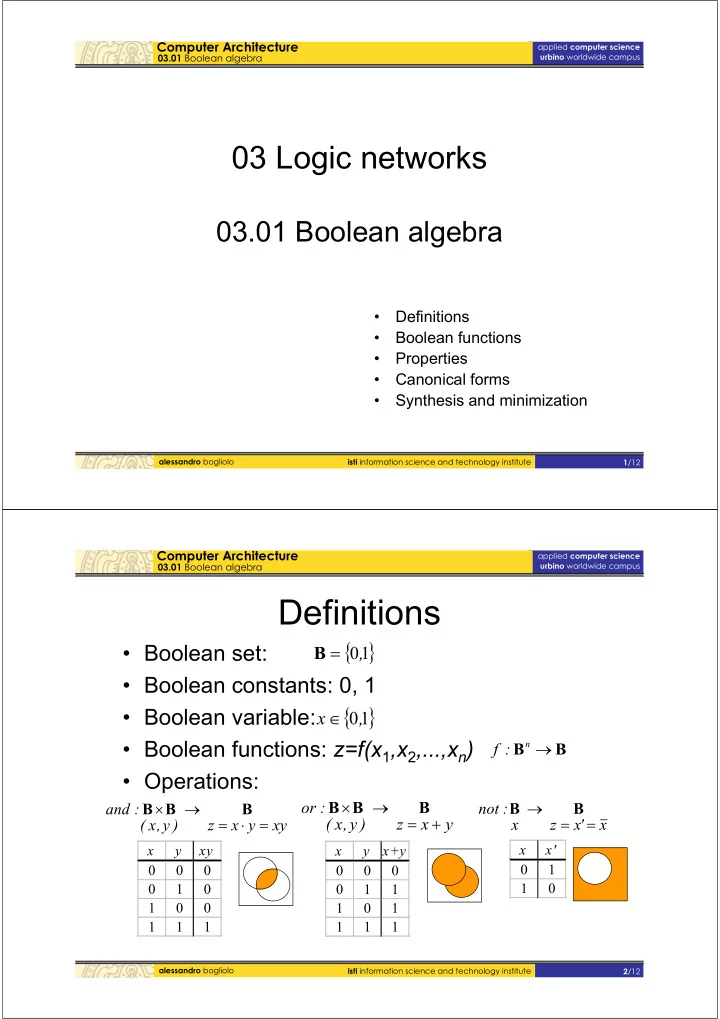
Definitions

  • Boolean set:
  • Boolean constants: 0, 1
  • Boolean variable:
  • Boolean functions: z=f(x1,x2,...,xn)
  • Operations:

1 0,

  • B

xy y x z ) y , x ( : and

  • B

B B

y x z ) y , x ( :

  • r
  • B

B B

x ' x z x : not

  • B

B

1 0, x

x y xy 1 1 1 1 1 x y x+y 1 1 1 1 1 1 1 x x' 1 1

B B

n

: f

slide-2
SLIDE 2

urbino worldwide campus applied computer science

Computer Architecture

alessandro bogliolo isti information science and technology institute 3/12

03.01 Boolean algebra

Boolean functions

  • Truth table:

Table of 2n rows that associates a Boolean value to each configuration

  • f n independent variables

There are 22n different functions of n variables

  • Boolean expression:

Expression of Boolean variables, Boolean constants and operators

c ) ab ( c ab ' c b a f

  • B

B

n

: f

a b c f 1 1 1 1 1 1 1 1 1 1 1 1 1 1 1 1 1

urbino worldwide campus applied computer science

Computer Architecture

alessandro bogliolo isti information science and technology institute 4/12

03.01 Boolean algebra

Properties

x x x

  • x

x x

  • )

z x ( ) y x ( ) z y ( x

  • )

z x ( ) y x ( ) z y ( x

  • z

) xy ( ) yz ( x xyz

  • z

) y x ( ) z y ( x z y x

  • x

y y x

  • yx

xy x x 1 x x

  • x

1 1

  • x
  • '

x x 1

  • '

x x x xy x

  • x

) y x ( x

  • '

y ' x )' xy (

  • '

y ' x )' y x (

  • Idempotent laws

Distributive laws Associative laws Commutative laws Identity elements Null laws (forcing elements) Complement laws Absorption laws De Morgan’s laws (duality principle)

slide-3
SLIDE 3

urbino worldwide campus applied computer science

Computer Architecture

alessandro bogliolo isti information science and technology institute 5/12

03.01 Boolean algebra

Idempotent laws

x x x

  • x

x x

  • Idempotent laws

x y xy 1 1 1 1 1 x x*x 0*0 1 1*1 1 x y x+y 1 1 1 1 1 x x+x 0+0 1 1+1 1

By perfect induction:

urbino worldwide campus applied computer science

Computer Architecture

alessandro bogliolo isti information science and technology institute 6/12

03.01 Boolean algebra

x xy x

  • x

) y x ( x

  • Absorption laws

Absorption laws

x x ) y ( x y x x

  • 1

1

x y x x y x x x ) y x ( x

  • By Boolean manipulation:
slide-4
SLIDE 4

urbino worldwide campus applied computer science

Computer Architecture

alessandro bogliolo isti information science and technology institute 7/12

03.01 Boolean algebra

' y ' x )' xy (

  • '

y ' x )' y x (

  • De Morgan’s laws

De Morgan’s laws

By perfect induction: x=0, y=0

  • (00)’=0’=1

0’+0’=1+1=1 x=0, y=1

  • (01)’=0’=1

0’+1’=1+0=1 x=1, y=0

  • (10)’=0’=1

1’+0’=0+1=1 x=1, y=1

  • (11)’=1’=0

1’+1’=0+0=0 x=0, y=0

  • (0+0)’=0’=1

0’0’=11=1 x=0, y=1

  • (0+1)’=1’=0

0’1’=10=0 x=1, y=0

  • (1+0)’=1’=0

1’0’=01=0 x=1, y=1

  • (1+1)’=1’=0

1’1’=00=0

urbino worldwide campus applied computer science

Computer Architecture

alessandro bogliolo isti information science and technology institute 8/12

03.01 Boolean algebra

Canonical forms

  • There are infinite equivalent Boolean expressions.
  • The equivalence (i.e., identity) between two

expressions can be demonstrated:

1. By perfect induction 2. By Boolean manipulation

  • Canonical forms associate unique expressions to

each function

  • Checking the equivalence between two functions

reduces to a comparison of their canonical representations

slide-5
SLIDE 5

urbino worldwide campus applied computer science

Computer Architecture

alessandro bogliolo isti information science and technology institute 9/12

03.01 Boolean algebra

Canonical forms (Sum of Products)

  • Literal: independent variable taken either in true or

complemented form (e.g., x, x’)

  • Minterm: Product of all independent variables taken

either in true or complemented form

– A minterm represents a Boolean function that takes value 1 corresponding to a unique configuration of input variables (e.g., f(a,b,c)=ab’c takes vale 1 for abc=101) – A Boolean function that takes value 1 for M different configurations (that has M 1’s in the truth table) can be expressed as the sum of the M minterms associated with the M 1’s

  • Any Boolean function can be expressed as a sum of

products

  • A sum of minterms, with fixed variable order, is a

canonical form

urbino worldwide campus applied computer science

Computer Architecture

alessandro bogliolo isti information science and technology institute 10/12

03.01 Boolean algebra

From truth tables to SoPs

a b c f 1 1 1 1 1 1 1 1 1 1 1 1 1 1 1 1 1

f = a’b’c’ + a’bc’ + ab’c’ + abc’ + abc

1 1 1 1 1

= + + + +

slide-6
SLIDE 6

urbino worldwide campus applied computer science

Computer Architecture

alessandro bogliolo isti information science and technology institute 11/12

03.01 Boolean algebra

Boolean minimization

Given a Boolean function, find a Boolean expression that represents the function using a minimum number of literals

  • In general, this is not an easy task
  • There is a closed-form solution for 2-level SoP

expressions

  • There is no closed-form solution for general multi-level

expressions.

  • Heuristic solutions found by Boolean manipulation

f = a’b’c’ + a’bc’ + ab’c’ + abc’ + abc 15 literals f = a’c’ + ab’c’ + ab 7 literals f = a’c’ + ab’c’ + abc’ + abc 11 literals

urbino worldwide campus applied computer science

Computer Architecture

alessandro bogliolo isti information science and technology institute 12/12

03.01 Boolean algebra

Boolean minimization (example)

f = a’b’c’ + a’bc’ + ab’c’ + abc’ + abc 15 literals (SoP) = a’c’(b’ + b) + ab’c’ + ab (c’ + c) 11 literals (distributive) = a’c’ + ab’c’ + ab 7 literals (complement) = a’c’ + a (b’c’ + b) 6 literals (distributive) = a’c’ + a (b’c’ + b c’ + b) 8 literals (absorption) = a’c’ + a ((b’+b) c’ + b’) 7 literals (distributive) = a’c’ + a (c’ + b) 5 literals (complement) = a’c’ + a c’ + ab 6 literals (distributive) = (a’ + a) c’ + ab 5 literals (distributive) = c’ + ab 3 literals (complement) Remark: the number of literals doesn’t decrease at every step. This makes the process non trivial