Definition of Immunity Protection against disease, usually - - PDF document

definition of immunity
SMART_READER_LITE
LIVE PREVIEW

Definition of Immunity Protection against disease, usually - - PDF document

Definition of Immunity Protection against disease, usually Introduction to Immunology infectious disease, mediated by a collection BIOS 486A/586A of molecules, cells, and tissues collectively called the immune system . In a broader


slide-1
SLIDE 1

1

Introduction to Immunology BIOS 486A/586A

Kenneth J. Goodrum,Ph.D. Department of Biomedical Sciences Ohio University 2005

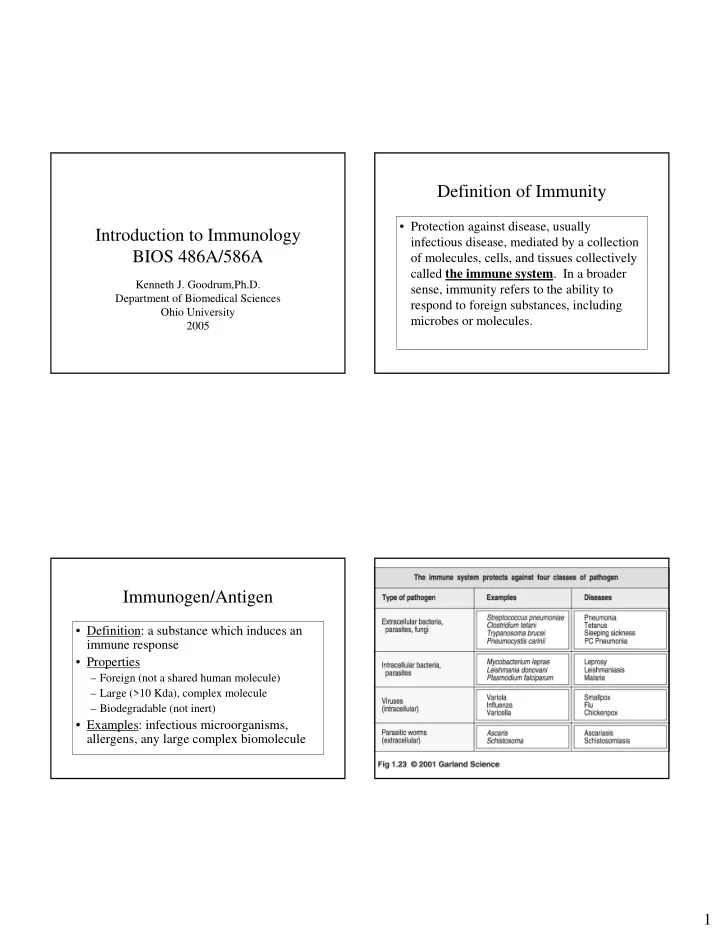
Definition of Immunity

  • Protection against disease, usually

infectious disease, mediated by a collection

  • f molecules, cells, and tissues collectively

called the immune system. In a broader sense, immunity refers to the ability to respond to foreign substances, including microbes or molecules.

Immunogen/Antigen

  • Definition: a substance which induces an

immune response

  • Properties

– Foreign (not a shared human molecule) – Large (>10 Kda), complex molecule – Biodegradable (not inert)

  • Examples: infectious microorganisms,

allergens, any large complex biomolecule

slide-2
SLIDE 2

2

Cells of the Immune System

  • White Blood Cells (derived from precursor

cells in the bone marrow)

– phagocytes (granulocytes, monocytes/macrophages) – lymphocytes (B and T) – natural killer cells

Immune Cells Immune cells Immune Cells

slide-3
SLIDE 3

3

Fig 1.5

Left: Light photomicrograph of a lymphocyte in a stained smear of peripheral blood. Right: Electron micrograph

Immune System-Lymphoid tissues

  • Lymphocytes mature in the primary

lymphoid organs

– bone marrow or thymus

  • Secondary lymphoid organs trap antigen to

allow initiation of immune responses and sustain recirculating lymphocytes

– bone marrow, thymus, spleen, lymph nodes, mucosal-associated lymphoid tissue

Fig 1.7 Foreign substances in tissue fluids (lymph) or in blood are carried via lymphatic or blood vessels to lymphoid organs for interaction with lymphocytes

slide-4
SLIDE 4

4

Lymphocytes circulate between blood and lymph and between various lymphoid organs to insure that the appropriate immune cell contacts an immunogen regardless of where it enters the body.

Lymph nodes filter immunogens from the lymph, and the resident lymphocytes proliferate in response to immunogens.

Principles of Immunity

  • Each lymphocyte generates a unique antigen

receptor by DNA rearrangement of its receptor genes – B cell antigen receptor = antibody – T cell antigen receptor = T cell receptor

  • Lymphocytes proliferate in response to antigen in

secondary lymphoid tissues generating effector cells and memory – Clonal expansion [clone = single cell]

Fig 1.14

slide-5
SLIDE 5

5

  • Fig. 1.15

I mmune Response

Bone marrow stem cells Thymus Β lymphocytes T lymphocytes immunogen Clonal selection, expansion (proliferation), differentiation in lymphoid organs Antibody production (immunogen specific) plus Memory B cells Cytotoxic function expressed (immunogen-specific)and cytokines produced(immunoregulatory factors) plus memory T cells Elimination of immunogen and long term immunity

Principles of Immunity

  • Activation of specialized antigen-presenting

cells is a necessary first step for induction

  • f adaptive immunity

– Dendritic cells

  • Lymphocytes activated by antigen give rise

to clones of antigen-specific cells that mediate adaptive immunity

– Clonal selection

T cells are activated by foreign peptides trapped and displayed by dendritic cells in lymph nodes. B cells directly bind immunogens and proliferate with the help of T cell-derived growth factors.

slide-6
SLIDE 6

6

Each lymphocyte has a single antigen-specificity mediated by a cell surface antigen

  • receptor. Amino

acid variability (variable structural regions) in the actual antigen binding sites explains the different antigen binding specificities between any 2 different B cells. Fig 1.20 On first contact with a new immunogen, immune responses are delayed, small, and short-lived. (Primary responses are therapeutic). On secondary contact with the same immunogen (boost), responses are rapid, large, and long-lived (Secondary responses are prophylactic). Protective mechanisms

  • f antibodies. B cells

secrete their antigen receptor as a soluble molecule (antibody). Antibody recognizes and binds the immunogen resulting in direct neutralization

  • f toxicity or

infectivity; promotes phagocytosis and digestion of the antigen directly or via serum complement activation.

  • Fig. 1.24

Fig 1.25 Protective mechanism of T

  • cells. Cytotoxic T

cells recognize foreign antigens on self cells (such as

  • n virus-infected or

tumor cells) and mediate direct lysis and cell death of the altered self cells.

slide-7
SLIDE 7

7

Fig 1.26 Protective mechanisms of T

  • cells. Activated T

helper cells secrete soluble protein factors (cytokines) that enhance the innate antimicrobial functions of phagocytes allowing an infected phagocyte to more easily kill an intracellular microbe.

Effect of immunizations

  • n incidence of

infectious diseases.

Consequences of normal or deficient immune responses.