Physician Peer Review: Ensuring Immunity, Confidentiality and - - PowerPoint PPT Presentation

physician peer review ensuring immunity confidentiality
SMART_READER_LITE
LIVE PREVIEW

Physician Peer Review: Ensuring Immunity, Confidentiality and - - PowerPoint PPT Presentation

Presenting a live 90-minute webinar with interactive Q&A Physician Peer Review: Ensuring Immunity, Confidentiality and Compliance Preserving Immunity or Leveraging Exceptions, Shielding Documentation, Complying With Statutory and JHACO


slide-1
SLIDE 1

The audio portion of the conference may be accessed via the telephone or by using your computer's

  • speakers. Please refer to the instructions emailed to registrants for additional information. If you

have any questions, please contact Customer Service at 1-800-926-7926 ext. 10.

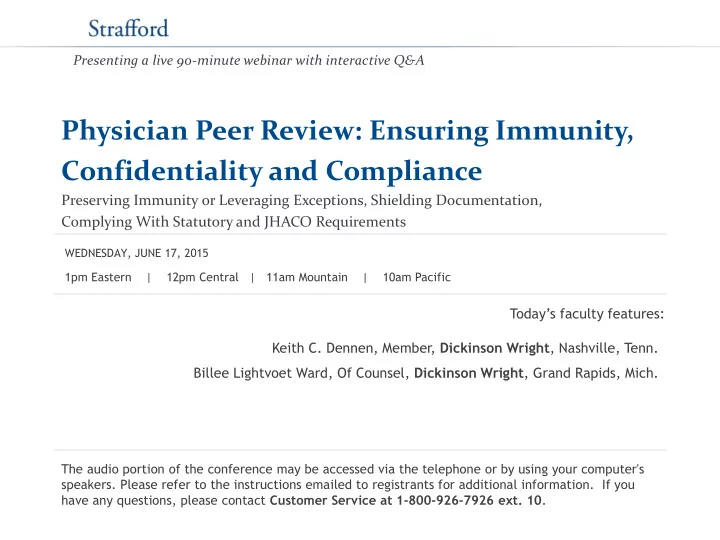
Presenting a live 90-minute webinar with interactive Q&A

Physician Peer Review: Ensuring Immunity, Confidentiality and Compliance

Preserving Immunity or Leveraging Exceptions, Shielding Documentation, Complying With Statutory and JHACO Requirements

Today’s faculty features:

1pm Eastern | 12pm Central | 11am Mountain | 10am Pacific WEDNESDAY, JUNE 17, 2015

Keith C. Dennen, Member, Dickinson Wright, Nashville, Tenn. Billee Lightvoet Ward, Of Counsel, Dickinson Wright, Grand Rapids, Mich.

slide-2
SLIDE 2

Tips for Optimal Quality

Sound Quality If you are listening via your computer speakers, please note that the quality

  • f your sound will vary depending on the speed and quality of your internet

connection. If the sound quality is not satisfactory, you may listen via the phone: dial 1-866-927-5568 and enter your PIN when prompted. Otherwise, please send us a chat or e-mail sound@straffordpub.com immediately so we can address the problem. If you dialed in and have any difficulties during the call, press *0 for assistance. Viewing Quality To maximize your screen, press the F11 key on your keyboard. To exit full screen, press the F11 key again.

FOR LIVE EVENT ONLY

slide-3
SLIDE 3

Continuing Education Credits

In order for us to process your continuing education credit, you must confirm your participation in this webinar by completing and submitting the Attendance Affirmation/Evaluation after the webinar. A link to the Attendance Affirmation/Evaluation will be in the thank you email that you will receive immediately following the program. For additional information about CLE credit processing call us at 1-800-926-7926

  • ext. 35.

FOR LIVE EVENT ONLY

slide-4
SLIDE 4

Program Materials

If you have not printed the conference materials for this program, please complete the following steps:

  • Click on the ^ symbol next to “Conference Materials” in the middle of the left-

hand column on your screen.

  • Click on the tab labeled “Handouts” that appears, and there you will see a

PDF of the slides for today's program.

  • Double click on the PDF and a separate page will open.
  • Print the slides by clicking on the printer icon.

FOR LIVE EVENT ONLY

slide-5
SLIDE 5

5

Physician Peer Review:

Ensuring Immunity, Confidentiality and Compliance

Keith C. Dennen, Esq.

kdennen@dickinsonwright.com

Billee Lightvoet Ward, Esq.

bward@dickinsonwright.com

slide-6
SLIDE 6

6

Disclaimer

The information presented is for informational purposes only, is not intended to create an attorney-client relationship, and should not be relied upon as legal advice. You should consult with qualified legal counsel on your specific situation before acting on the basis of any information provided during this presentation.

slide-7
SLIDE 7

7

Setting the Stage

  • Prior to 1986, there was no federal law that provided

legal protections to those participating in peer review

  • Anti-trust lawsuits were being filed by aggrieved

physicians against their reviewers

  • Increases in incidents of medical malpractice

Congress’ answer:

  • Healthcare Quality Improvement Act of 1986

(“HCQIA”) – 42 U.S.C. § 11101 et seq

slide-8
SLIDE 8

8

Federal HCQIA

Enacted to address identified national needs:

  • Improve quality of care on a national scale
  • Restrict the ability of physicians to move across states

and institutions without disclosing past performance issues

  • Protect the peer review process and its participants
  • Incentivize physicians to engage in effective peer

review

slide-9
SLIDE 9

9

Federal HCQIA

  • Legal Protections

– Immunity – Confidentiality

  • Reporting Requirements

– Medical Malpractice Payments – Licensure Actions – Professional Review Actions

  • Hospital Duty to Query
slide-10
SLIDE 10

10

Professional Review under HCQIA

  • “Professional Review Action”

– Action or recommendation (or decision not to act) of professional review body – Taken or made in the conduct of a professional review activity, which is based on the competence or professional conduct of an individual physician

  • Which conduct affects or could adversely affect the health or

welfare of a patient or patients

– And which adversely affects/may adversely affect the physician’s clinical privileges, or membership in a professional society

slide-11
SLIDE 11

11

Professional Review under HCQIA

  • A Professional Review Action is not based on

professional competence or conduct if it is primarily based on employment; association with a professional society; fees, advertising or competitive acts, or certain other activities

  • “Professional Review Activity”

– An activity of a health care entity with respect to an individual physician’s privileges or membership

  • Granting or denying, placing conditions on, or modifying privileges
slide-12
SLIDE 12

12

Professional Review under HCQIA

  • “Professional Review Body”

– A health care entity

  • A licensed hospital
  • An entity that provides health care services and follows

a peer review process for the purpose of furthering quality health care

  • A professional society of physician or other licensed

health care practitioners that follows a formal peer review process for the purpose of furthering quality health care

slide-13
SLIDE 13

13

Professional Review under HCQIA

  • “Professional Review Body” cont.

– Governing body of the health care entity – Any committee of the health care entity which conducts professional review activity – Any committee of the medical staff when assisting the governing body in a professional review activity

slide-14
SLIDE 14

14

Immunity Under HCQIA

  • General Rule: If the professional review action meets

specified standards, participants will be immune from certain liabilities.

  • The HCQIA standards must be met in order for

HCQIA immunity to apply

– Regardless of compliance with applicable state law, bylaws or other internal procedures

  • There is a rebuttable presumption that the action

meets the Reasonableness Standards

  • Not guaranteed, not absolute
slide-15
SLIDE 15

15

Immunity under HCQIA

  • Reasonableness Standards: the professional review

action must be taken:

– In the reasonable belief it was in furtherance of quality health care; – After a reasonable effort to obtain the facts; – After adequate notice and hearing procedures or “such

  • ther procedures as are fair to the physician under the

circumstances” are afforded; and – In the reasonable belief the action was warranted by the facts after compliance with (2) and (3)

slide-16
SLIDE 16

16

Immunity under HCQIA

  • Who is protected?

– The professional review body – Any person acting as a member or staff to the body – Any person under formal agreement or contract with the body – Any person who participates with or assists the body with respect to the action – Any person providing information to the body regarding the competence or professional conduct of the physician

slide-17
SLIDE 17

17

Immunity under HCQIA

  • Qualified Immunity

– Must comport with HCQIA definitions and requirements – Immunity from damages under state or federal law “with respect to the action”

  • Not from equitable or declaratory relief
  • Not from civil rights claims
  • Not from U.S. or state Attorney General actions

– Greater protections for individuals who provide information to a professional review body

  • Exception for knowingly providing false information
slide-18
SLIDE 18

18

Peer Review Under State Law

“Except as specifically provided in this part, nothing in this part shall be construed as . . . preempting or

  • verriding any State law which provides incentives,

immunities, or protection for those engaged in a professional review action that is in addition to or greater than that provided by this part.” 42 U.S.C. 11115 (emphasis added)

slide-19
SLIDE 19

19

Peer Review Under State Law

  • State peer review statutes generally cover activities

similar to those defined in the HCQIA

– Variation in who is covered – Variation in procedural requirements – HCQIA = floor; states can offer greater protections

  • Malice or bad faith are common exceptions to state

statutory immunity

– “The immunity from liability provided under subsection (3) does not apply to a person, organization, or entity that acts with malice.” Mich.

  • Comp. Laws § 331.531(4)
slide-20
SLIDE 20

20

Privilege and Confidentiality

  • State statutes offer varying degrees of protection for

documents and information generated in connection with the peer review process

– “The records, data, and knowledge collected for or by individuals or committees assigned a professional review function in a health facility or agency, or an institution of higher education in this state that has colleges of

  • steopathic and human medicine, are confidential, shall be used only for the

purposes provided in this article, are not public records, and are not subject to court subpoena.” MCL § 333.20175(8) – “The records, data, and knowledge collected for or by individuals or committees assigned a review function described in this article are confidential and shall be used only for the purposes provided in this article, shall not be public records, and shall not be available for court subpoena.” MCL § 333.21515

slide-21
SLIDE 21

21

Privilege and Confidentiality

  • Current Events:
  • Krusac v. Covenant Medical Center, No.

34,286 (N.M. Feb. 19, 2015)

– “[W]e hold that §§ 20175(8) and 21515 make privileged all records, data, and knowledge collected for or by a peer review committee in furtherance of its statutorily mandated purpose of reducing morbidity and mortality and improving patient care. This includes objective facts gathered contemporaneously with an event contained in an otherwise privileged incident report.”

slide-22
SLIDE 22

22

Krusac v. Covenant Medical Center

  • Overturned lower court decision distinguishing

between “factual information objectively reporting contemporaneous observations or findings and ‘records, data, and knowledge’ gathered to permit an effective review[.]” See Harrison v. Munson Healthcare, Inc., 304 Mich. App. 1; 851 NW2nd 549 (2014).

  • Criticized lower court for its reliance on caselaw from

foreign jurisdictions

slide-23
SLIDE 23

23

Privilege and Confidentiality

Current Events: Yedidag v. Roswell Clinic Corp, No. 34,286 (N.M.

  • Feb. 19, 2015)

– Employed physician participating in peer review of another employed physician – Reviewing physician terminated for unprofessional conduct in the course of review process – Reviewing physician filed suit against hospital for utilizing peer review information to justify his termination

slide-24
SLIDE 24

24

Yedidag v. Roswell Clinic Corp.

  • NM Review Organization Immunity Act (41-9-1 to 41-9-7 NMSA 1978)

– “review organization[s] . . . organized to gather and review information relating to the care and treatments of patients for the purposes of:

  • Evaluating and improving the quality of health care services rendered in the area or by a health care

provider;

  • Reducing morbidity or mortality;
  • Obtaining and disseminating statistics and information relative to the treatment and prevention of diseases,

illnesses and injuries;

  • Developing and publishing guidelines showing the norms of health care services in the area or by health care

providers;

  • Developing and publishing guidelines designed to keep within reasonable bounds the cost of health care

services;

  • Reviewing the nature, quality or cost of health care services provided to enrollees of health maintenance
  • rganizations and nonprofit health care plans;
  • Acting as a professional standards review organization pursuant to 42 U.S.C., Section 1320c-1, et seq.; or
  • Determining whether a health care provider shall be granted authority to provide health care services using

the heath care provider’s facilities or whether a health care provider’s privileges should be limited, suspended or revoked.” § 41-9-2(E)

slide-25
SLIDE 25

25

Yedidag v. Roswell Clinic Corp.

  • Holding: § 41-9-5 (A) creates a private cause of action

– “[a]ll data and information acquired by a peer review organization in the exercise of its duties and functions shall be held in confidence and shall not be disclosed to anyone except to the extent necessary to carry out one or more of the purposes of the review organization or in a judicial appeal from the action

  • f the review organization.” § 41-9-5(A) (emphasis added)

– “Section § 41-9-5(A) expressly guarantees the confidentiality of what ‘transpired’ during peer review meetings.” – “Dual regulatory system” provides different avenues for discipline, “albeit not by hospital administrators who are not privy to what transpires during peer review meetings.”

  • Holding: § 41-9-5(A) is a mandatory rule of law incorporated into

physician employment contracts and prevents the hospital from using peer review information for personnel decisions

slide-26
SLIDE 26

26

Yedidag v. Roswell Clinic Corp.

Practical issues impacting the Court’s decision:

  • Noted flaws in peer review process

– Peer review information was incomplete and, ultimately, leaked – Peer review information was used inappropriately

  • Internal competition

– Competition between peer reviewers (and hospital) – History of poor relations between hospital and Dr. Yedidag

  • Public policy: upholding peer review integrity

– Statutory criminal penalties didn’t satisfy the Court – Fear of retaliation from many sources, including employers, undermines the process

  • Respective purposes of medical staff v. administration

– Conflicting evidence of whether Yedidag’s behavior was inappropriate – Prior incidents of disruptive conduct outside peer review process

slide-27
SLIDE 27

27

Privilege and Confidentiality

  • HCQIA does not address privilege or

confidentiality of documents and information generated in connection with the peer review process

  • Confidentiality under the HCQIA is limited to

information reported to the NPDB

slide-28
SLIDE 28

28

Reporting under HCQIA

  • HCQIA requires health care entities to report certain

professional review actions . . .

– Professional review actions that adversely affect the physician’s privileges for more than 30 days – Acceptance of the surrender of privileges while the physician is under investigation or in return for not conducting an investigation – Professional review actions by a professional society that adversely affects the physician’s membership in the society

  • Permissive reporting for non-physician practitioners
slide-29
SLIDE 29

29

Reporting under HCQIA

  • Reports of professional review actions must be

submitted to:

– National Practitioner Data Bank (“NPDB”) – Applicable State Board of Medical Examiners

  • NPDB (45 CFR Part 60)

– Information clearinghouse established pursuant to HCQIA to collect and release information relating to professional competence and conduct of physicians, dentists and other healthcare practitioners – Expanded by subsequent laws to include certain state licensure actions and final adverse actions by state and federal agencies and health plans

slide-30
SLIDE 30

30

NPDB Guidebook

2015 NPDB Guidebook

– Significantly expanded and replaced 2001 Guidebook – Incorporates changes resulting from merger of NPDB and Healthcare Integrity and Protection Data Bank – Useful resources:

  • Tables
  • Examples
  • Q & A
slide-31
SLIDE 31

31

Bylaws

  • Establish the Peer Review Process
  • Identify Peer Review Agents
  • Ensure Fairness
  • Consistent with Other Constituent

Documents

slide-32
SLIDE 32

32

Bylaws

  • Define

– Peer Review Activity – Peer Review Actors

slide-33
SLIDE 33

33

Bylaws

  • Establish the Peer Review Process

– Routine – Investigative

slide-34
SLIDE 34

34

Bylaws

  • Initiation of Peer Review Process

– Medical Executive Committee – Chief Medical Officer – Chief of Staff – Individual Complainants – Staff Complaints

slide-35
SLIDE 35

35

Bylaws

  • Conduct of Investigation

– Internal v. External – Role of Hospital Staff – Physician Committee – Participation by Parties – Ensuring all Relevant Documentation

slide-36
SLIDE 36

36

Bylaws

  • Prosecution Decision

– Who Makes Decision

  • Physician Committee v. Medical Executive Committee
  • Outside Parties

– Conflicts of Interest – Party Participation

  • Attorneys
  • Witnesses
  • Standard of Proof
slide-37
SLIDE 37

37

Bylaws

  • Hearing

– Appointment of Hearing Committee – Members of Hearing Committee – Hearing Officer – Hearing Schedule

slide-38
SLIDE 38

38

Bylaws

  • Hearing

– Hearing Date/Schedule – Attorneys – Witnesses/Evidence – Role of Outside Consultants – Standard of Proof

slide-39
SLIDE 39

39

Bylaws

  • Internal Appeal

– Appeal Authority – Trial v. Argument – Standard on Appeal – New Evidence/Record

slide-40
SLIDE 40

40

Bylaws

  • External Appeal

– Judicial/Non-Judicial

slide-41
SLIDE 41

41

Bylaws

  • Establish Fairness

– Conflicts of Interest

  • Economic/Non-Economic

– Discrimination

  • Protected Classes – Race, Religion, National Origin,

Age, Disability, Sex, Genetic, Veterans Status

  • Whistleblowers

– Fundamental Fairness

slide-42
SLIDE 42

42

Bylaws

  • Consistent with Other Constituent

Documents

– Charter/Articles of Incorporation – Corporation Bylaws – Tax-Exempt Mission – Legislative Enactment – General Law

slide-43
SLIDE 43

43

Bylaws

  • Approved by All Constituent Groups

– Board of Trustees – Board of Directors – Medical Executive Committee – Medical Staff – Any Other Required Constituent Group

slide-44
SLIDE 44

44

Bylaws

  • Amendments

– Beware of Policy – Medical Staff Bylaw amendments – Resolutions

slide-45
SLIDE 45

45

Antitrust Concerns

North Carolina State Board of Dental Examiners

  • v. Federal Trade Commission, 574 U.S. ____

(Feb. 25, 2015).

– Because a controlling number of the Board’s decisionmakers are active market participants in the occupation the Board regulates, the Board can invoke the state action immunity only if it was subject to active supervision by the State.

slide-46
SLIDE 46

46

Antitrust Concerns

North Carolina State Board of Dental Examiners

  • v. Federal Trade Commission, 574 U.S. ____

(Feb. 25, 2015).

– When a State empowers a group of active market participates to decide who can participate in its markets and on what terms, the need for supervision is manifest.

slide-47
SLIDE 47

47

Antitrust Concerns

FTC v. Phoebe Putney Health System, Inc., 133 S.

  • Ct. 1003 (2013).

– State action immunity is disfavored. – Governmental Entity status does not automatically bestow state action immunity.

slide-48
SLIDE 48

48

Pitfalls and Practical Tips

  • Immunity is neither guaranteed nor absolute

– The 5 “Ws” matter, to varying degrees

  • Make no assumptions

– Not all information may be protected

  • An ever-changing landscape

– State-to-state variation – Fluctuations in judicial interpretation

slide-49
SLIDE 49

49

Pitfalls and Practical Tips

  • Documentation

– Implement written procedures

  • follow them
  • re-examine them as caselaw shifts

– Delegate and document who performs a peer review function – Document compliance efforts – Marking documents as peer review material can help, but is not a guarantee of protection

slide-50
SLIDE 50

50

THANK YOU