Defining, Transforming, and Exchanging High-Level Schemas My - - PDF document

defining transforming and exchanging high level schemas
SMART_READER_LITE
LIVE PREVIEW

Defining, Transforming, and Exchanging High-Level Schemas My - - PDF document

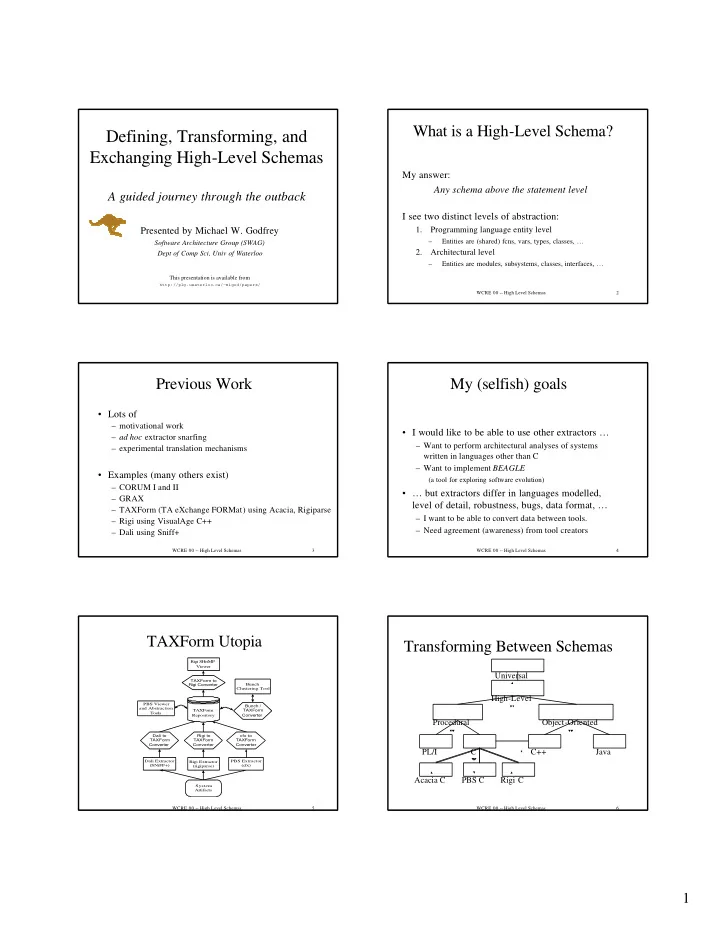
What is a High-Level Schema? Defining, Transforming, and Exchanging High-Level Schemas My answer: Any schema above the statement level A guided journey through the outback I see two distinct levels of abstraction: Presented by Michael W.


slide-1
SLIDE 1

1

Defining, Transforming, and Exchanging High-Level Schemas

A guided journey through the outback

Presented by Michael W. Godfrey

Software Architecture Group (SWAG) Dept of Comp Sci, Univ of Waterloo

This presentation is available from

http://plg.uwaterloo.ca/~migod/papers/

WCRE 00 -- High Level Schemas 2

What is a High-Level Schema?

My answer: Any schema above the statement level I see two distinct levels of abstraction:

1. Programming language entity level

– Entities are (shared) fcns, vars, types, classes, …

2. Architectural level

– Entities are modules, subsystems, classes, interfaces, …

WCRE 00 -- High Level Schemas 3

Previous Work

  • Lots of

– motivational work – ad hoc extractor snarfing – experimental translation mechanisms

  • Examples (many others exist)

– CORUM I and II – GRAX – TAXForm (TA eXchange FORMat) using Acacia, Rigiparse – Rigi using VisualAge C++ – Dali using Sniff+

WCRE 00 -- High Level Schemas 4

My (selfish) goals

  • I would like to be able to use other extractors …

– Want to perform architectural analyses of systems written in languages other than C – Want to implement BEAGLE

(a tool for exploring software evolution)

  • … but extractors differ in languages modelled,

level of detail, robustness, bugs, data format, …

– I want to be able to convert data between tools. – Need agreement (awareness) from tool creators

WCRE 00 -- High Level Schemas 5

TAXForm Utopia

PBS Extractor (cfx) Rigi Extractor (rigiparse) Dali Extractor (SNiFF+) TAXForm Repository PBS Viewer and Abstraction Tools System Artifacts Bunch Clustering Tool Rigi SHriMP Viewer Dali to TAXForm Converter Rigi to TAXForm Converter cfx to TAXForm Converter Bunch / TAXForm Converter TAXForm to Rigi Converter WCRE 00 -- High Level Schemas 6

Transforming Between Schemas

Universal High-Level Procedural PL/I C Object-Oriented C++ Java Acacia C Rigi C PBS C

slide-2
SLIDE 2

2

WCRE 00 -- High Level Schemas 7

TAXForm — Procedural schema

Source File uses file Data Type defines Procedure Data defines defines uses type uses data defines defines uses procedure uses type

WCRE 00 -- High Level Schemas 8

TAXForm — High level schema

Module depends-on Subsystem contains contains

WCRE 00 -- High Level Schemas 9

Back to my (selfish) goals

  • Would like to concentrate on procedural and OO

languages.

– Others are interested in COBOL, JCL etc.

  • I am interested in high-level info (f calls g)

– but not in ASGs, code-level metrics

  • Need to agree on

– Syntax – Level of granularity and detail – What to do in case of X e.g., X = “missing files”

WCRE 00 -- High Level Schemas 10

My schema wish list

[influenced by Acacia’s C and C++ data models]

Top-level programming language entities:

– functions, variables, constants, type definitions (procedural languages) – methods, class member data, static methods and member data (object-oriented languages)

Entity containers:

– files, modules, classes, packages

WCRE 00 -- High Level Schemas 11

My schema wish list

Entity attributes:

– Name, unique identifier (UID -- see next section) – UID of container, UID of containing file (if container is not a file) – Signature/data type – Line number information (see below) – Declared scope/visibility, static or not, final or not – Definition or declaration (see below)

Entity container attributes:

– name, UID – relative path (if a file) – version identifier (if provided) – UID of container (if not a file), UID of containing file (if not a file)

WCRE 00 -- High Level Schemas 12

My schema wish list

Relationships:

– Function calls, variable uses – Line number information (see below) – Container use/inclusion (by other containers) – Inheritance (various kinds) – “Friendship”, various template relationships

Relationship attributes:

– Line number information (see below) – Scope/permission of inheritance

slide-3
SLIDE 3

3

WCRE 00 -- High Level Schemas 13

Problems

Some technical problems:

– UID generation? (name-mangling?) – Line numbering (ranges)? – Incomplete information?

  • ill-formed code, gcc/K&R-isms
  • missing header files
  • resolving entity use to dfn/dcl

(esp. with polymorphism, overloading)

– Pre or post preprocessing?

WCRE 00 -- High Level Schemas 14

Problems

We’ve had these conversations before …

“Getting academics to agree on anything is like herding cats.”

WCRE 00 -- High Level Schemas 15

Example Extractors/Systems

Included here:

  • PBS

[UWloo]

  • Acacia

[AT&T]

  • cxref, ctags,

cscope

  • TA++

[UOttawa]

  • BAUHAUS [UStuttgart]
  • GUPRO

[UKoblenz]

Others:

  • Rigi

[UVictoria]

  • SPOOL

[UMontréal]

  • Datrix

[Bell Canada]

  • MOOSE

[UBern]

  • SHORE

[SD&M]

  • Neuhold

[UVienna]

  • VisualAge C++

[IBM]

  • … [many others]

WCRE 00 -- High Level Schemas 16

Dimensions of Variation

  • Intended use

– Level of schema (entity level, architectural level, or mixed) – Amount of detail

  • Languages modelled

– Multi-lingual – Common super schemas – Explicit model “cross-overs” (e.g., JCL, embedded SQL)

  • Hidden assumptions

– Known limitations

  • Notation/approach to store factbase

– Support for translations and transformations

  • What’s particularly novel and noteworthy

WCRE 00 -- High Level Schemas 17

PBS [Holt et al. @ UWaterloo]

  • Portable Bookshelf is a reverse engineering tool for

creating software architecture models of large systems:

– Guinea pigs: Mozilla, Linux, Apache, VIM, Mitel, TOBEY, …

  • Consists of fact extractor, fact manipulation engine

(“grok”), and visualization tool (“landscape”)

source code cfx grok landscape viewer entity-level facts architectural facts

WCRE 00 -- High Level Schemas 18

PBS C Language Entities

slide-4
SLIDE 4

4

WCRE 00 -- High Level Schemas 19

PBS C Language E/R View

WCRE 00 -- High Level Schemas 20

PBS Architectural Schema

WCRE 00 -- High Level Schemas 21

Acacia [Chen, Gansner et al. @ AT&T]

  • History:

– CIA → CIAO → Acacia

  • Consists of

– C and C++ extractors – SQL-like query engine – visualization with auto-layout

WCRE 00 -- High Level Schemas 22

Acacia C++/C Schemas

  • Entity attributes:

– Hex UID, name, kind (file, function, type, var, macro), filename, datatype (string), typeclass (enum, struct, etc.), linenum info for def/dec, def/dec/undef, param list, template info, scope, storage spec (static,

const, inline, inline virtual, etc.), signature

  • Relationship attributes:

– Linenum info, rel. kind (refers, contains, inherits, instantiates, typedef, etc.), relationship scope

WCRE 00 -- High Level Schemas 23

Acacia Queries

  • SQL-like queries for entities and relationships

produces “;” delimited textual output:

% ksh cdef -u fu closeTagFile 26f53ece;closeTagFile;function;entry.h;void;regular;83;0;83; dec;00000000;(const boolean);;extern;;;; 76e7ae31;closeTagFile;function;entry.c;void;regular;551;553; 563;def;00000000;(const boolean);;extern;;;; % ksh cref –u - - m - file2=‘osdeps.h’ <all entity1 attrs> ; <all entity2 attrs > ; <rel attrs>

WCRE 00 -- High Level Schemas 24

ctags, cxref, cscope

  • These are “open source” Unix tools that perform

extractions:

– ctags extracts only entity info

  • e.g., file, name, line num, kind, etc
  • works with C, C++, Eiffel, Fortran, and Java.
  • Used for fast context switching while editing source code with

vim/emacs

– cxref generates cross-reference table for C systems.

  • Often used for webifying source code (e.g., Linux, Mozilla).

– cscope used for program comprehension of C systems (e.g., who calls f, who uses v)

  • Older commercial Unix tool, recently open sourced.
slide-5
SLIDE 5

5

WCRE 00 -- High Level Schemas 25

TA++ [Lethbridge et al. @ UOttawa]

  • TKSee aids programming comprehension

– i.e., what programmers do all day – TA++ is the data modelling language

  • Want “full story” from the source code:

– Want pre-preprocessing view of code for all platforms and environments (text editor’s view) – … but most extractors use a compiler front end and preprocess toward a particular target and option set

  • Some extractors keep some macro info

WCRE 00 -- High Level Schemas 26

TA++ Entities

WCRE 00 -- High Level Schemas 27

TA++ Relationships

WCRE 00 -- High Level Schemas 28

TA++ Combined E/R Model

WCRE 00 -- High Level Schemas 29

BAUHAUS [Koschke et al. @ UStuttgart]

  • Software architecture recovery system

– Parse code, look for hidden/decayed abstractions, then redesign – Uses various heuristics to perform “clustering” – Works both at entity level and subsystem level

  • Built from many tools …

– … including Rigi viewer and a customized C parser/extractor that (optionally) dumps RSF

  • Example WoSEF problem:

– Cannot derive full includes hierarchy from Bauhaus extracted facts; this was a design decision, as the researchers were not interested in this information

WCRE 00 -- High Level Schemas 30

BAUHAUS Entities

slide-6
SLIDE 6

6

WCRE 00 -- High Level Schemas 31

BAUHAUS Relationships

WCRE 00 -- High Level Schemas 32

BAUHAUS Combined E/R

WCRE 00 -- High Level Schemas 33

GUPRO [Ebert, Kullbach, Winter et al. @ UKoblenz]

  • GUPRO supports simultaneous modelling of inter-

related systems written in different programming languages

– In particular, concerned with the COBOL/MVS/JCL mainframe world

  • GUPRO is notable because:

– Simultaneously multilingual – Explicitly models “boundary crossings” (!) – Looks at (very real) problems of the mainframe world

  • COBOL, JCL, database migration

WCRE 00 -- High Level Schemas 34

GUPRO

  • Candidate system is modelled in an object-based

repository using a graph-based approach:

EER (modelling language)

+

GRAL (constraint language)

  • GReQL mechanism supports structured queries on

the repository via restricted first-order logic

WCRE 00 -- High Level Schemas 35

GUPRO

JCL schema COBOL schema

WCRE 00 -- High Level Schemas 36

GUPRO

Integrated schemas for JCL and COBOL

slide-7
SLIDE 7

7

WCRE 00 -- High Level Schemas 37

GUPRO Multi-Language Model

WCRE 00 -- High Level Schemas 38

Summary — High-Level Schemas

  • Lots of sticky issues at the prog. lang. level:

– To pre- or not to pre-process – Entity resolution often not done (e.g., Datrix) – What is a function: def, dec, polymorphism,

  • verloading, templates, …

– How to deal with missing libraries, incremental extractions, versioned extractions, non-ANSI-isms, …

  • Conceptual gaps:

– COBOL/JCL world very different from C/C++/Java world – “I didn’t know you wanted full includes info…”

WCRE 00 -- High Level Schemas 39

Summary — Good News

  • Many of us seem to be doing similar kinds of
  • extractions. It seems like that:

– Many extractors can be used within other tools – Some form of common interchange format is feasible, tho it may not please everyone.

  • Challenges:

– May want to use multiple tools together

  • I have been working on a standalone cxref-based hack to add

full includes information to a BAUHAUS converter

– Can we take advantage of the web to set up some sort

  • f distributed fact extraction/conversion factory? [Holt]

Q: Ar e you game?