Defining climate modeling user needs what is actually required to - - PowerPoint PPT Presentation

defining climate modeling user
SMART_READER_LITE
LIVE PREVIEW

Defining climate modeling user needs what is actually required to - - PowerPoint PPT Presentation

Defining climate modeling user needs what is actually required to support impact analysis and adaptation policy development? Rob Swart (Alterra, Netherlands) and Christian Pag (CERFACS, France) AGU meeting Session on Climate modelling in


slide-1
SLIDE 1

Defining climate modeling user needs

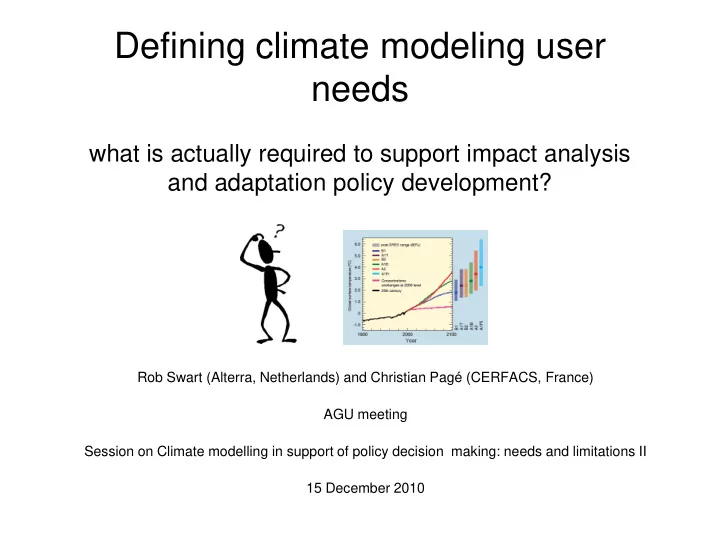
what is actually required to support impact analysis and adaptation policy development?

Rob Swart (Alterra, Netherlands) and Christian Pagé (CERFACS, France) AGU meeting Session on Climate modelling in support of policy decision making: needs and limitations II 15 December 2010

slide-2
SLIDE 2

Background

  • IS-ENES: Infrastructure for the European

Network for Earth System Modelling

  • Effort to better connect climate and

impacts communities since late 90s - with mixed success

  • Questionnaire to users in Europe in

summer 2010 and workshop in January 2011

  • Results support new strategy European

climate modelling groups for coming years

slide-3
SLIDE 3

Global climate modelling Statistical/dynamic downscaling The biophysical impact researchers??? The socio-economic researchers? Practitioners, public/ private decision makers?

Who are the users?

  • Water management;
  • Agriculture and forests;
  • Biodiversity/nature protection

(terrestrial, freshwater);

  • Coastal areas;
  • Marine (biodiversity) and

fisheries;

  • Health (human, animal, plant);
  • Infrastructure (transport, energy,
  • ther);
  • Financial instruments and

insurance;

  • Urban and other types of spatial

planning;

  • Disaster risk reduction.
slide-4
SLIDE 4

Two levels of users?

Many non-specialized users – need guidance? Many specialized users – need tailoring?

slide-5
SLIDE 5

Specify climate data users

  • Account for a diverse group of users, in terms
  • f

– types of sectoral impacts and – roles/functions (from impact modelers to private sector decision makers) – regions with a very different level of knowledge

  • Distinguish between non-specialized and

specialized, niche users, in terms of

– data volume – guidance and support provided.

slide-6
SLIDE 6

Kind of information required by impacts community

  • Derived climate indices, notably indices on extreme events
  • Highest resolution possible, but then how to deal with

uncertainties?

  • Full range of scenarios, including outer ends of ranges (worst or

best case)

  • Probabilistic scenarios - these advantages but also serious

constraints I terms of their interpretation: to avoid over-interpretation present with caution and proper guidance

  • Simple post-processing tools, e.g. for simple statistics, data

conversions, or visualization

1500 2000 2500 3000 3500 4000

2050 2100 4-5 years? Rotterdam?

slide-7
SLIDE 7

Not just data

  • Guidance on how to use and interpret the information

with proper account of uncertainties

  • Better integration/harmonization of data sources at

different geographic level

  • Specific tailor-made information is required for many

specialist applications that cannot be meaningfully addressed in a generic way

2000 4000 6000 8000 10000 12000 14000 16000 18000 26-1 27-1 28-1 29-1 30-1 31-1 1-2 2-2 3-2 4-2 5-2

???

slide-8
SLIDE 8

Easy access

  • Impact researchers and adaptation

practitioners are not climate modelers:

– Interface: design user friendly interfaces – Format: offer a variety of data formats – Barriers: remove institutional or financial constraints – Guidance: provide simple guidance

slide-9
SLIDE 9

The broader context

  • Connect communities: the climate modeling

and impacts communities should jointly work on developing guidance for impact researchers and practitioners on how to select and interpret climate scenario output in a way that best matches their needs.

  • Link with other scenarios: coordination with

the provision or development of socio-economic scenarios required for IVA analysis is important.