Defining a new class Defining some methods Example: 3-D Points - - PDF document

defining a new class defining some methods
SMART_READER_LITE
LIVE PREVIEW

Defining a new class Defining some methods Example: 3-D Points - - PDF document

Defining a new class Defining some methods Example: 3-D Points instance methods: + anotherPoint | result | class definition: result := Point3D new. Object subclass: #Point3D result x: x + anotherPoint x. instanceVariableNames: x y z


slide-1
SLIDE 1

Craig Chambers 111 CSE 341

Defining a new class

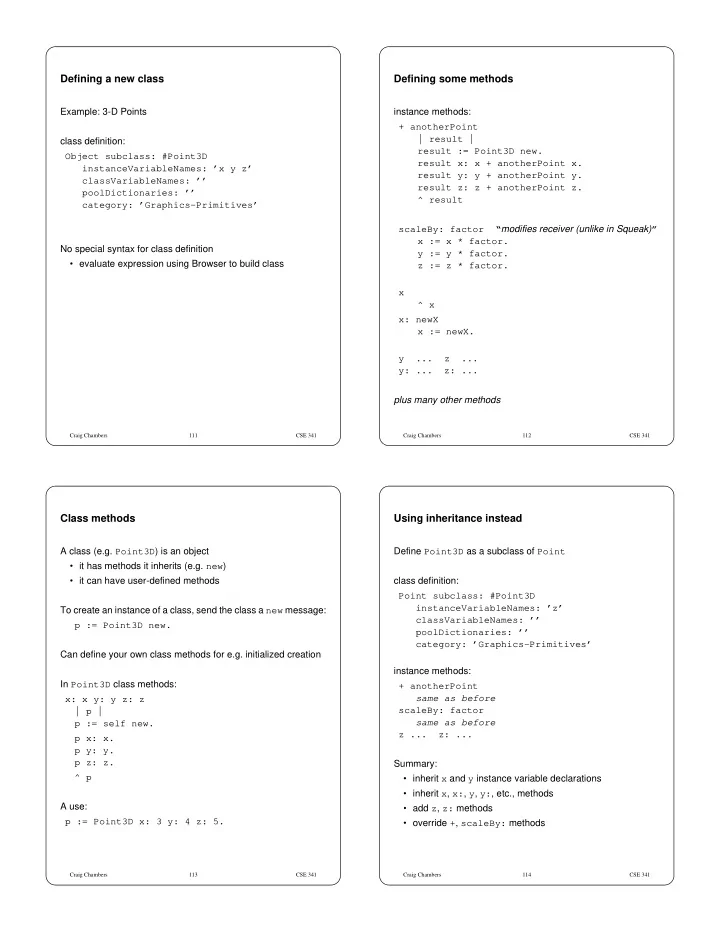
Example: 3-D Points class definition: Object subclass: #Point3D instanceVariableNames: ’x y z’ classVariableNames: ’’ poolDictionaries: ’’ category: ’Graphics-Primitives’ No special syntax for class definition

  • evaluate expression using Browser to build class

Craig Chambers 112 CSE 341

Defining some methods

instance methods: + anotherPoint | result | result := Point3D new. result x: x + anotherPoint x. result y: y + anotherPoint y. result z: z + anotherPoint z. ^ result scaleBy: factor “modifies receiver (unlike in Squeak)” x := x * factor. y := y * factor. z := z * factor. x ^ x x: newX x := newX. y ... z ... y: ... z: ... plus many other methods

Craig Chambers 113 CSE 341

Class methods

A class (e.g. Point3D) is an object

  • it has methods it inherits (e.g. new)
  • it can have user-defined methods

To create an instance of a class, send the class a new message: p := Point3D new. Can define your own class methods for e.g. initialized creation In Point3D class methods: x: x y: y z: z | p | p := self new. p x: x. p y: y. p z: z. ^ p A use: p := Point3D x: 3 y: 4 z: 5.

Craig Chambers 114 CSE 341

Using inheritance instead

Define Point3D as a subclass of Point class definition: Point subclass: #Point3D instanceVariableNames: ’z’ classVariableNames: ’’ poolDictionaries: ’’ category: ’Graphics-Primitives’ instance methods: + anotherPoint same as before scaleBy: factor same as before z ... z: ... Summary:

  • inherit x and y instance variable declarations
  • inherit x, x:, y, y:, etc., methods
  • add z, z: methods
  • override +, scaleBy: methods
slide-2
SLIDE 2

Craig Chambers 115 CSE 341

Sends to self

If a message is sent to self, then method lookup starts at the object that self refers to, not the current class Example: In Point: double ^ self + self This behavior is crucial to object-oriented programming

Craig Chambers 116 CSE 341

Differential programming for methods

There’s redundancy in current implementation In Point: scaleBy: factor x := x * factor. y := y * factor. In Point3D: scaleBy: factor x := x * factor. y := y * factor. z := z * factor.

Craig Chambers 117 CSE 341

Super sends

Can use super send to avoid code duplication: In Point3D: scaleBy: factor super scaleBy: factor. z := z * factor. Send to super is just like send to self, except method lookup starts in superclass

  • super can only appear as a message receiver

Craig Chambers 118 CSE 341

A pitfall

In Point: + anotherPoint | result | result := Point new. result x: x + anotherPoint x. result y: y + anotherPoint y. ^ result Current Point3D: + anotherPoint | result | result := Point3D new. result x: x + anotherPoint x. result y: y + anotherPoint y. result z: z + anotherPoint z. ^ result “Better” Point3D: + anotherPoint | result | result := super + anotherPoint. result z: z + anotherPoint z. ^ result

slide-3
SLIDE 3

Craig Chambers 119 CSE 341

Inserting sends to self

Increase reusability of Point + method by replacing hard-wired constant with send to self In Point: + anotherPoint | result | result := self pointClass new. result x: x + anotherPoint x. result y: y + anotherPoint y. ^ result pointClass ^ Point In Point3D: + anotherPoint | result | result := super + anotherPoint. result z: z + anotherPoint z. ^ result pointClass ^ Point3D

Craig Chambers 120 CSE 341

Another example of inheritance: PolarPoint

Goal: define a 2-D point that represents values using polar coordinates (rho and theta) Idea: implement by subclassing existing cartesian Point class class definition: Point subclass: #PolarPoint instanceVariableNames: ’rho theta’ classVariableNames: ’’ poolDictionaries: ’’ category: ’Graphics-Primitives’ instance methods: rho ... theta ... rho: ... theta: ... x ^ rho * theta cos y ^ rho * theta sin x: ... y: ...

Craig Chambers 121 CSE 341

A problem

Example: | p1 p2 | p1 := PolarPoint new. p1 rho: 1. p1 theta: 60. p2 := PolarPoint new. p2 rho: 1.5. p2 theta: 170. p1 + p2 produces a message-not-understood error: sending + to an instance of UndefinedObject (i.e., nil) Why?

Craig Chambers 122 CSE 341

A solution

Old: + anotherPoint | result | result := self class new. result x: x + anotherPoint x. result y: y + anotherPoint y. ^ result New: + anotherPoint | result | result := self class new. result x: self x + anotherPoint x. result y: self y + anotherPoint y. ^ result Theme: adding sends to self increases flexibility later

slide-4
SLIDE 4

Craig Chambers 123 CSE 341

Abstract vs. concrete classes

Point defines both an interface and an implementation For better flexibility, split these two components apart

  • abstract superclass containing methods

but no instance variables

  • concrete subclass providing the instance variables and

some accessor methods Abstract classes represent interfaces; can’t be instantiated Concrete classes flesh out abstract classes with full implementations

Craig Chambers 124 CSE 341

The interface

class definition: Object subclass: #Point instanceVariableNames: ’’ ... instance methods: + anotherPoint | result | result := self class new. result x: self x + anotherPoint x. result y: self y + anotherPoint y. result z: self z + anotherPoint z. ^ result scaleBy: factor self x: self x * factor. self y: self y * factor. self z: self z * factor. x self subclassResponsibility x: newX self subclassResponsibility y ... y: ...

Craig Chambers 125 CSE 341

The implementation

class definition: Point subclass: #CartesianPoint instanceVariableNames: ’x y’ ... instance methods: x ... y ... x: ... y: ...

Craig Chambers 126 CSE 341

Another implementation

class definition: Point subclass: #PolarPoint instanceVariableNames: ’rho theta’ ... instance methods: rho ... theta ... rho: ... theta: ... x ^ rho * theta cos y ^ rho * theta sin x: newValue ... y: newValue ...