Defined as a violently rotating column of air extending from a - - PowerPoint PPT Presentation

defined as a violently rotating column of air extending
SMART_READER_LITE
LIVE PREVIEW

Defined as a violently rotating column of air extending from a - - PowerPoint PPT Presentation

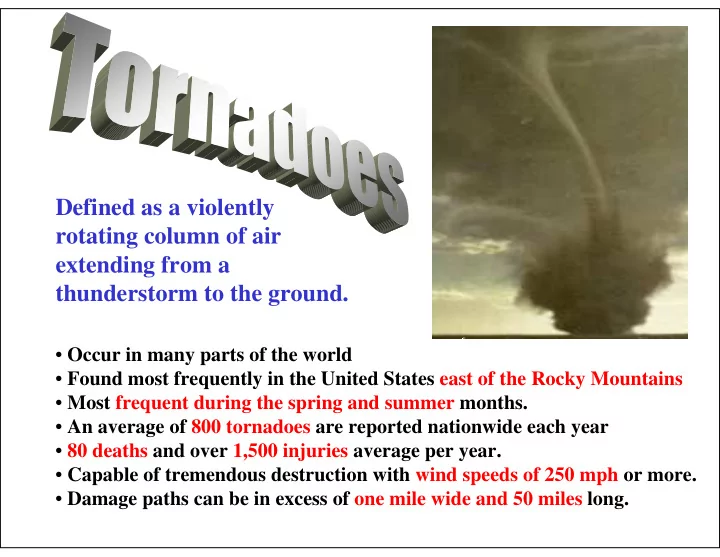
Defined as a violently rotating column of air extending from a thunderstorm to the ground. Occur in many parts of the world Found most frequently in the United States east of the Rocky Mountains Most frequent during the spring and


slide-1
SLIDE 1
  • Occur in many parts of the world
  • Found most frequently in the United States east of the Rocky Mountains
  • Most frequent during the spring and summer months.
  • An average of 800 tornadoes are reported nationwide each year
  • 80 deaths and over 1,500 injuries average per year.
  • Capable of tremendous destruction with wind speeds of 250 mph or more.
  • Damage paths can be in excess of one mile wide and 50 miles long.

Defined as a violently rotating column of air extending from a thunderstorm to the ground.

slide-2
SLIDE 2
  • Some tornadoes may form

during the early stages of rapidly developing thunderstorms.

  • Occasionally, two or more

tornadoes may occur at the same time.

  • Tornadoes may appear

nearly transparent until dust and debris are picked up.

  • Waterspouts are weak tornadoes

that form over warm water.

slide-3
SLIDE 3
slide-4
SLIDE 4

A lower cloud base in the center of the photograph identifies an area of rotation known as a rotating wall cloud. This area is often nearly rain-free. Note rain in the background. Moments later a strong tornado develops in this area. Softball-size hail and damaging "straight-line" winds can occur with this storm. Look out for: Look out for:

  • Dark, often greenish sky
  • Wall cloud
  • Large hail
  • Loud roar; similar to a

freight train

slide-5
SLIDE 5
  • Tornadoes hide in many ways -- under cover of

darkness, heavy rain, landscape.

  • They usually develop in areas in which a severe

thunderstorm watch or warning is in effect. Remain alert to signs of an approaching tornado and seek shelter if threatening conditions exist

slide-6
SLIDE 6

MYTH: Areas near rivers, lakes, and mountains are safe from tornadoes. FACT: No place is safe from tornadoes. In the late 1980's, a tornado swept through Yellowstone National Park leaving a path of destruction up and down a 10,000 ft. mountain. MYTH: The low pressure with a tornado causes buildings to "explode" as the tornado passes overhead. FACT: Violent winds and debris slamming into buildings cause most structural damage. MYTH: Windows should be opened before a tornado approaches to equalize pressure and minimize damage. FACT: Opening windows allows damaging winds to enter the structure. Leave the windows alone; instead, immediately go to a safe place.

slide-7
SLIDE 7
  • In a home or building, move to a pre-

designated shelter, such as a basement.

  • Stay away from windows
  • If an underground shelter is not available,

move to an interior room or hallway on the lowest floor and get under a sturdy piece of furniture.

Interior bathroom was all that was left standing of this house:

  • Mobile homes, even if tied down,
  • ffer little protection from tornadoes

and should be abandoned.

slide-8
SLIDE 8
  • Get out of automobiles.
  • Do not try to outrun a tornado in your

car; instead, leave it immediately.

slide-9
SLIDE 9
  • Go to an inside hallway at the lowest level (central 1st floor

hallway).

  • Stay inside
  • 1st floor aisle side cubicles under work surface
  • Rooms (restrooms, etc. adjoining 1st floor aisle
  • Avoid places with wide-span roofs areas
  • Move away from exterior walls and windows
  • Get under a piece of sturdy furniture such as a cubicle

work surface or heavy table or desk and hold on to it. (Several of the people that survived the Jarrell tornado lived because they had gotten into a bathtub).

  • Use arms to protect head and neck.