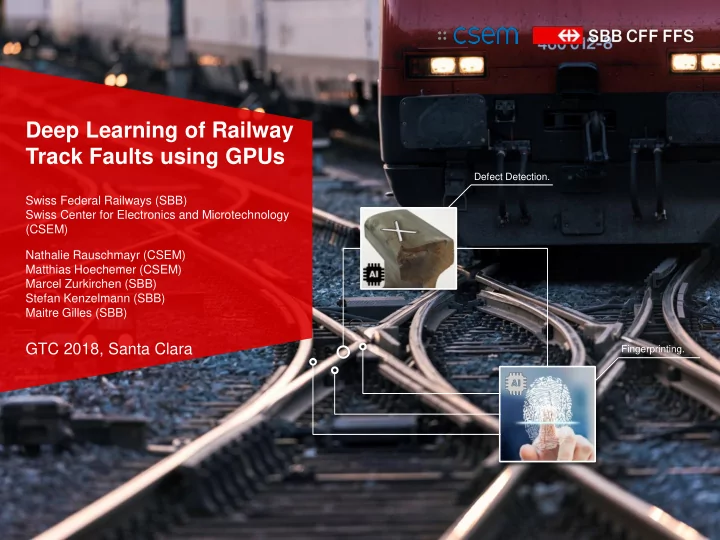
Deep Learning of Railway Track Faults using GPUs Defect Detection. - - PowerPoint PPT Presentation

deep learning of railway track faults using gpus
SMART_READER_LITE
LIVE PREVIEW

Deep Learning of Railway Track Faults using GPUs Defect Detection. - - PowerPoint PPT Presentation

Deep Learning of Railway Track Faults using GPUs Defect Detection. Swiss Federal Railways (SBB) Swiss Center for Electronics and Microtechnology (CSEM) Nathalie Rauschmayr (CSEM) Matthias Hoechemer (CSEM) Marcel Zurkirchen (SBB) Stefan


slide-1
SLIDE 1

Deep Learning of Railway Track Faults using GPUs

Swiss Federal Railways (SBB) Swiss Center for Electronics and Microtechnology (CSEM) Nathalie Rauschmayr (CSEM) Matthias Hoechemer (CSEM) Marcel Zurkirchen (SBB) Stefan Kenzelmann (SBB) Maitre Gilles (SBB)

GTC 2018, Santa Clara

Defect Detection. Fingerprinting.

slide-2
SLIDE 2

Monitoring the conditions of the Swiss rail network.

 Need for automation

Manual inspection is infeasible

Ever increasing traffic leads to faster attrition

New train types (Cargo, High Speed and Tilting Trains…)

cause the development of railway faults that have not been observable 10 years ago

 Multiple specially equipped trains «Diagnosis Trains»

Travelling up to 100 mph

Multiple high resolution cameras and other sensors Big Data

Deep Learning of Railway Track Faults using GPUs 2

Some Statistics

  • 15k trains per day
  • 1.2 million rides per day
  • Size of rail network: 4000 miles
slide-3
SLIDE 3

Monitoring the conditions of the Swiss rail network.

Deep Learning of Railway Track Faults using GPUs 3

Diagnosis train operates since 2007, BUT

Software generates too many false positives/negatives

Railway experts have to filter all of them by hand System has not been of much use until now

slide-4
SLIDE 4

Railcheck project.

Deep Learning of Railway Track Faults using GPUs 4

Our Project Goals: Use Deep Learning to:

 reduce the time for onsite visual inspections to a minimum  minimize the time experts spend on false positives  increase network safety

Human Being / Business Machine Learning Diagnosis train

Supervised Learning Unsupervised Learning Coniditon monitoring DFZ since 2006 IBN gDFZ 2018

slide-5
SLIDE 5

Railcheck project.

Deep Learning of Railway Track Faults using GPUs 5

Joint project between Swiss Center for Electronics and Microtechnology (CSEM) and Swiss Federal Railways (SBB)

 CSEM: Swiss R&D Lab specialized in microtechnology, system engineering, robotics,

automation and computer vision mainly doing applied R&D for industry (www.csem.ch)

slide-6
SLIDE 6

The Input Data.

Deep Learning of Railway Track Faults using GPUs 6

 Challenges:

Changing weather conditions: rain, snow, ice

Artefacts: leaves, dirt

Different forms and shapes

Small artefacts Rain Turnouts In the street Snow

slide-7
SLIDE 7

Preprocessing.

Deep Learning of Railway Track Faults using GPUs 7

 Tensorflow Object Detection API  Transfer Learning on faster R-CNN inception resnet in order to segment railway

surfaces and clamps

slide-8
SLIDE 8

Anomaly Detection.

Deep Learning of Railway Track Faults using GPUs 8

 Next Step: Clustering of railway components  Anomaly: components that do not fit to any cluster  Clustering with Generative Adversarial Networks (GAN):

Generator Discriminator Random Noise Fake Data Training Data

slide-9
SLIDE 9

Anomaly Detection.

Deep Learning of Railway Track Faults using GPUs 9

 Generator and Discriminator learn the underlying structure of the data  Search for similar images (Clustering) – Example:

Input Output: most similar images

slide-10
SLIDE 10

Anomaly Detection.

Deep Learning of Railway Track Faults using GPUs 10

 Pre-Clustering of normal railway components  Train Convolutional Autoencoder per Cluster

Input Image Reconstructed Difference Anomaly

slide-11
SLIDE 11

Fault Classification.

Deep Learning of Railway Track Faults using GPUs 11

 Major Problem:

Very little training data < 100

Tricky to define fault category: in principal 20 categories

Was simplified to 6 categories and later on to 4

A lot of variation

Welding Joint Surface Defect

slide-12
SLIDE 12

Fault Classification.

Deep Learning of Railway Track Faults using GPUs 12

 Major Problem:

Very little training data < 100

Tricky to define fault category: in principal 20 categories

Was simplified to 6 categories and later on to 4

A lot of variation

Wheel Slip Squat Not Defect

slide-13
SLIDE 13

Fault Classification.

Deep Learning of Railway Track Faults using GPUs 13

 Labelling faults: Tedious,

railway surface does mostly not contain any fault (luckily)

faults can be easily overlooked

 Speed the labelling process up  Increased training data for faults by a factor 100 within a month

Transfer Learning & Inference Inspect & Correct Output Add to Training Data

slide-14
SLIDE 14

Fault Classification.

Deep Learning of Railway Track Faults using GPUs 14

 Major Problem: bias, wrong categories, different expert opinions  The worst faults are sometimes the ones that are nearly invisible (e.g. squats)

Squat Surface Defect Surface Defect

slide-15
SLIDE 15

Fault Classification.

Deep Learning of Railway Track Faults using GPUs 15

 Solution: Crowd Decision Making  Experts can view output of neural network via a website and give feedback

Add to Training Data Transfer Learning & Inference Inspect & Correct Output

Statistical Analysis

Railway Experts

Surface Defect

slide-16
SLIDE 16

Fault Classification.

Deep Learning of Railway Track Faults using GPUs 16

 Even with little training data network achieves astonishing results

Detection rates:

Joint 99%, Welding 57%, Surface Defect 65%

No training data: Squat, Wheel Slip

Surface Defect Surface Defect Welding Tiny surface defect

slide-17
SLIDE 17

Fingerprinting.

Deep Learning of Railway Track Faults using GPUs 17

 «Diagnosis trains» go routes multiple times per year

Which fault is new?

Which fault is already recorded in DB?

 Challenge:

Faults change over time

Environmental conditions can be different

Faults << GPS accuracy

slide-18
SLIDE 18

Fingerprinting.

Deep Learning of Railway Track Faults using GPUs 18

Input faulty image into pretrained model Reduce size of feature vector

Locality Sensitive Hashing

Check for images within GPS Range and compares hashes

2016 2017

Are these surface defects identical?

slide-19
SLIDE 19

Fingerprinting.

Deep Learning of Railway Track Faults using GPUs 19

 Recording faults over time helps to understand

How do they develop

How to prevent them

November 2016 February 2017 April 2017 May 2017 June 2017 August 2017

slide-20
SLIDE 20

Summary.

Deep Learning of Railway Track Faults using GPUs 20

slide-21
SLIDE 21

Summary.

Deep Learning of Railway Track Faults using GPUs 21

 Highly parallel problem:

Create more instances of Fault- and Anomaly-Detectors depending on available GPUs

Ideally: real-time processing (120-160 km/h)  HPC

slide-22
SLIDE 22

www.csem.ch www.sbb.ch