Dedicated to Paul Epstein Friends or Foes? Pim Martens Maastricht - - PDF document

dedicated to paul epstein
SMART_READER_LITE
LIVE PREVIEW

Dedicated to Paul Epstein Friends or Foes? Pim Martens Maastricht - - PDF document

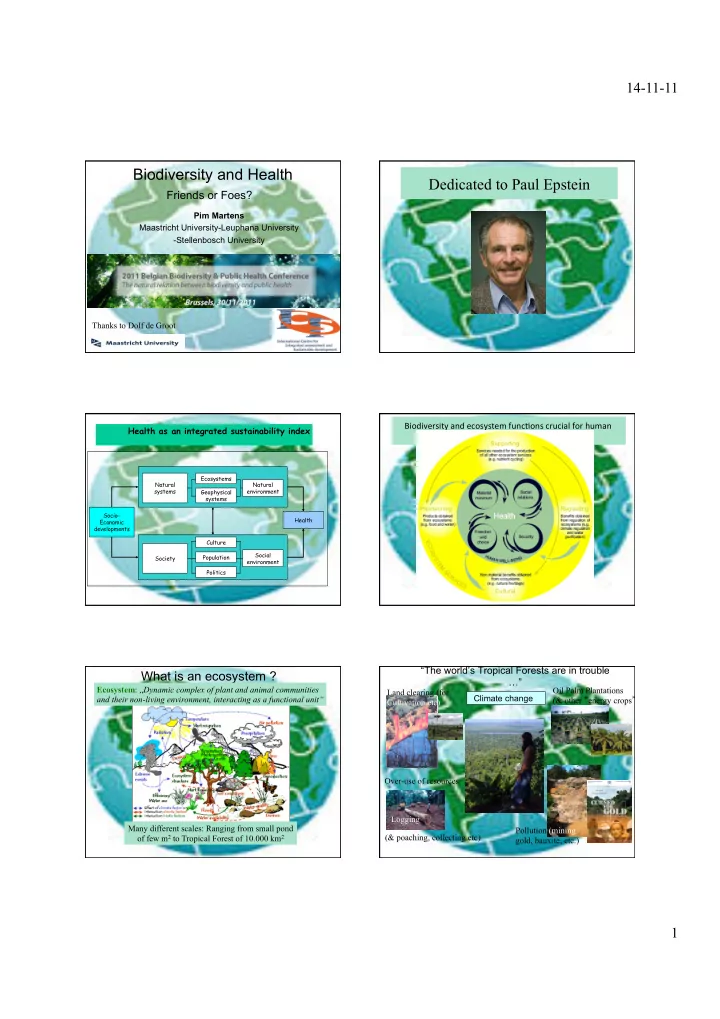
14-11-11 Biodiversity and Health Dedicated to Paul Epstein Friends or Foes? Pim Martens Maastricht University-Leuphana University -Stellenbosch University Thanks to Dolf de Groot Biodiversity and ecosystem func2ons crucial


slide-1
SLIDE 1

14-11-11 1

Pim Martens Maastricht University-Leuphana University

  • Stellenbosch University

Biodiversity and Health

Friends or Foes?

Thanks to Dolf de Groot

Dedicated to Paul Epstein

Health

Health as an integrated sustainability index

Socio- Economic developments Ecosystems Natural systems Society Geophysical systems Culture Population Politics Natural environment Social environment

Biodiversity ¡and ¡ecosystem ¡func2ons ¡crucial ¡for ¡human ¡ health ¡

What is an ecosystem ?

Ecosystem: „Dynamic complex of plant and animal communities and their non-living environment, interacting as a functional unit“ Many different scales: Ranging from small pond

  • f few m2 to Tropical Forest of 10.000 km2

“The world’s Tropical Forests are in trouble …”

Climate change Oil Palm Plantations (& other “energy crops” Logging (& poaching, collecting etc) Over-use of resources Land clearing (for Cultivation etc) Pollution (mining gold, bauxite, etc.)

slide-2
SLIDE 2

14-11-11 2

Lepers et al. 2003, based on data from Archard et al. 2002, De Fries et al. 2002 and Landsat Pathfinder

Hot spots of tropical deforestation, and the causitive patterns of tropical deforestation from 1850 to 1997, showing the proximate and underlying drivers of change

“The world’s Oceans are in trouble …”

Pollution Climate change Over-fishing Transport

species-shifts/bio-invasions

Habitat & species loss..

Year of Peak Fish Harvest

Harvest peak Pre-peak Post-peak

Source: Millennium Ecosystem Assessment and Sea Around Us project

The Global Loss of Biodiversity

The total biodiversity loss 2000-2050: All biodiversity of 1,300 million ha converted to asphalt. (about 1.5 times the United States)

73% 62%

1-30 million

Estimated loss of species: 27.000 per year (or one species every 20 minutes) 100-1000 times faster than natural extinction rates (Levin, Am. Scientist, 2002)

?

True value (importance) often

  • nly becomes clear after what

we valued is gone

Is this a problem ..??

Or: why are (natural) ecosystems important ?

Ecosystem Services: “the benefits people derive from ecosystems”

“Everyone in the world depends on nature and ecosystem services to provide the conditions for a decent, healthy, and secure life”

Regulating

  • Water purif.
  • Storm prot.
  • C-sequest; -etc

Supporting

  • Biodiversity
  • Bio-geochem.

cycles.; etc. Cultural

  • Spiritual values
  • Artistic inspir.
  • Aesthetics, etc.

Provisioning

  • Food, Fiber
  • Medicins
  • etc

From natural and cultivated (eco)systems

10 (Eco)systems -> 20 different services

slide-3
SLIDE 3

14-11-11 3

Provisioning Services

Water Ornaments & souvenirs Medicins Wood, Fiber, other Raw materials Food

Alzheimer's ¡Disease ¡ Cancer ¡

Source : Manfred Walser / Christian Neumann, June 2008, “The Value of our Oceans”, WWF Germany

bio-­‑prospecting ¡-­‑ ¡coral ¡reef ¡biodiversity ¡ ¡

WRI 2000

Increasing SST and Coral Bleaching

Images: Great Barrier Reef Marine Park Authority, Australia

Regulating services: Biological Control

Animals that eat insects and small mammals have an important pest-control function Many commercial crops depend on natural pollination by birds & insects

Regulating services: Water purification capacity of Wetlands

Organic Matter & Nutrients

(based on sustainable use levels)

  • Org. matter : 26 kg BOD/ha/day

(=ca 300 pers.equiv.)

Nitrogen: 365 - 2.715 kg/ha/year Phosphate: 365-1.330 kg/ha/year Other (human) waste:

  • eg. pesticides, metallic elements (eg. mercury), oil, etc.

(danger of accumulation and irreversable effects)

slide-4
SLIDE 4

14-11-11 4

Centers of Genetic Diversity coincide largely with Biodiversity Hotspots

Supporting services: Genepool protection (& evolutionary processes)

Most of our food comes from only 11 crops (eg. rice, maize, potatoes) To maintain their vitality and productivity, they need regular cross- breeding with their wild ancestors

Cultural & Amenity Services

In pictures … Screen- savers … Amenity value Eco-tourism Therapeutic Value in books, lit, painting Nature in Art Science & Education

More biodiversity: improved health?

Exotic species (Travel, transport) Insects and rodents Trade-offs: Eradication Bats Latin America – decline rabies and other diseases

  • improved health through healthy livestock –

more mosquitoes – risks malaria & dengue Water-management Great Lakes – less swamps – less mosquitoes –

  • But decline local fisheries

Atmospheric changes Impacts on ecological determinants of human health Impacts upon human health scientific uncertainties Social responses (economical, political, and technological) social and economic uncertainties

Layers of Uncertainty Underlying the Health Impacts Assessment of Biodiversty Loss Biodiversity and Human Health: A Change of Scale and Content

‘ Conventional’ Epidemiology – Toxicological – Estimation of risks from past realities – Short time horizon – Estimation of more local risks – Statistical models – Static cause-effect – Reductionistic approach Eco-Epidemiology/Ecohealth – Ecological – Assessment of future health risks – Long time horizon – Estimation of global/ regional risks – Mathematical models – System dynamic, nonlinear models – Holistic Approach

Nature is “priceless” …