Decolonising the curriculum the Librarys role 9.30 - 10.00 - - PDF document

decolonising the curriculum the library s role
SMART_READER_LITE
LIVE PREVIEW

Decolonising the curriculum the Librarys role 9.30 - 10.00 - - PDF document

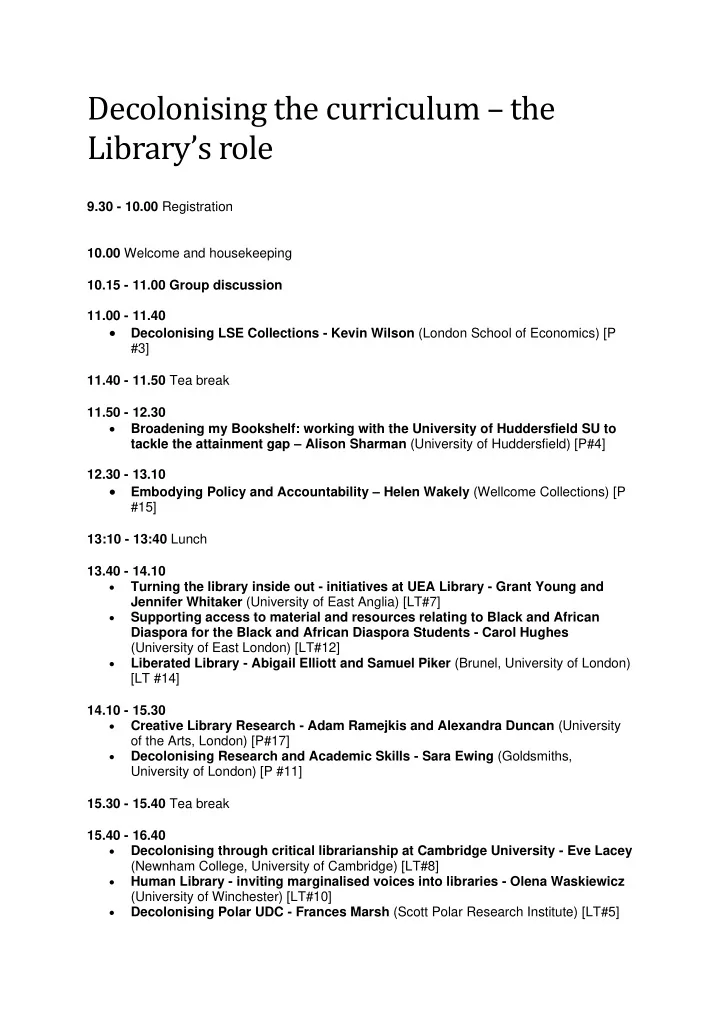
Decolonising the curriculum the Librarys role 9.30 - 10.00 Registration 10.00 Welcome and housekeeping 10.15 - 11.00 Group discussion 11.00 - 11.40 Decolonising LSE Collections - Kevin Wilson (London School of Economics) [P #3] 11.40 -


slide-1
SLIDE 1

Decolonising the curriculum – the Library’s role

9.30 - 10.00 Registration 10.00 Welcome and housekeeping 10.15 - 11.00 Group discussion 11.00 - 11.40

  • Decolonising LSE Collections - Kevin Wilson (London School of Economics) [P

#3] 11.40 - 11.50 Tea break 11.50 - 12.30

  • Broadening my Bookshelf: working with the University of Huddersfield SU to

tackle the attainment gap – Alison Sharman (University of Huddersfield) [P#4] 12.30 - 13.10

  • Embodying Policy and Accountability – Helen Wakely (Wellcome Collections) [P

#15] 13:10 - 13:40 Lunch 13.40 - 14.10

  • Turning the library inside out - initiatives at UEA Library - Grant Young and

Jennifer Whitaker (University of East Anglia) [LT#7]

  • Supporting access to material and resources relating to Black and African

Diaspora for the Black and African Diaspora Students - Carol Hughes (University of East London) [LT#12]

  • Liberated Library - Abigail Elliott and Samuel Piker (Brunel, University of London)

[LT #14] 14.10 - 15.30

  • Creative Library Research - Adam Ramejkis and Alexandra Duncan (University
  • f the Arts, London) [P#17]
  • Decolonising Research and Academic Skills - Sara Ewing (Goldsmiths,

University of London) [P #11] 15.30 - 15.40 Tea break 15.40 - 16.40

  • Decolonising through critical librarianship at Cambridge University - Eve Lacey

(Newnham College, University of Cambridge) [LT#8]

  • Human Library - inviting marginalised voices into libraries - Olena Waskiewicz

(University of Winchester) [LT#10]

  • Decolonising Polar UDC - Frances Marsh (Scott Polar Research Institute) [LT#5]
slide-2
SLIDE 2
  • Liberating Reading Lists - Jess Crilly and Lucy Panesar (University of the Arts,

London) [LT#2]

  • From Black History Month to creating ongoing decolonial dialogue: emerging

collaborative practices at the University of Sussex Library - Alice Corble (University of Sussex) [LT#16]

  • Reading Together: a student-led initiative to promote black writers at LJMU -

Valerie Stevenson (Liverpool John Moores University) [LT#1] 16.50 - 16.55 Next steps and round-up 17.00 End

slide-3
SLIDE 3

Details of the presentations in programme order

Decolonising LSE Collections – Kevin Wilson (London School of Economics)

LSE Library's current operational plan makes a commitment to revising its collection development policies to become more inclusive. We aim to undertake this work in the forthcoming months. We are working with students, researchers and academic staff through the Decolonise LSE Week (October 2019), where I am organising a workshop to discuss ideas and areas for improvement. We have reviewed our collections to identify areas of collection strength but are equally keen to identify gaps and areas of weakness, particular of underrepresented groups and narratives. We have reviewed reading list data of more than 70,000 current items to identify areas of publication and pledge to work with staff who want to diversify their reading lists. We are also conducting an Equality Impact Assessment of our collection development policies and are working with LSE's EDI team to achieve this. We believe that with the project's completion in early 2020, we will have updated our policies so that they are not only more inclusive but will better reflect the teaching and research needs

  • f all of LSE's community.

Broaden my Bookshelf: working with the University of Huddersfield SU to tackle the attainment gap – Alison Sharman (University of Huddersfield)

Broaden my Bookshelf is a collaboration between the University of Huddersfield Library, the SU and our BAME Ambassadors which we launched in October 2018 to increase the number of books in the library by authors from a BAME background. We asked students and staff to suggest books for purchase by the library and promised to buy all suggestions which were still in print. During the launch week, which coincided with Black History Month, we hosted a range of events including readings, sessions for lecturers on broadening their reading lists, a keynote speech and Q&A panel. We were allocated a budget of £20,000 for this project which is still ongoing. In March 2019 we developed it further by including books by LGBT+ authors or about LGBT+ issues. To date we have ordered 244 books under the Broaden my Bookshelf initiative and we hope that this number will continue to rise. We are about to launch a fresh programme of events for the 2019-20 academic year, starting with a "roadshow" around campus with the BAME Ambassadors in October where we hope to gather some qualitative data to support the project.

Embodying Policy and Accountability – Helen Wakely (Wellcome Collections)

Colleagues tasked with embedding Access, Diversity & Inclusion in the Wellcome Collection explore how to develop this approach and the reality of instituting ethical practices across cataloguing, programming, acquisitions, and staff behaviour. With consideration to sustainable and accountability. Helen Wakely - Inclusive Collections Lead and Teresa Cisneros-Inclusive Practice Lead.

Turning the library inside out - initiatives at UEA Library - Grant Young and Jennifer Whitaker (University of East Anglia)

For several years UEA Library has held book displays for Black History Month and sought to diversify its collection, but 2019 has seen a step-change. The Library has become much more active and outward looking in its support for student and staff decolonisation initiatives and at the same time has begun to look at its own collections and practices more critically. It worked with academics to host a researchathon which harvested 500 resources on decolonisation and published these as a Zotero group bibliography -

slide-4
SLIDE 4

https://www.zotero.org/groups/2282515/decolonisingcurriculum ? It has been working with research students over the Summer to launch and develop this further and with another group in the university to add the library to a tour of 'disreputable collections' held by the

  • University. A workshop at our annual library staff conference has outlined several other

activities we will undertake in the coming year in collaboration with key student and staff groups on campus to exploit our space and acquisition budgets and subvert our collections and classifications.

Supporting access to material and resources relating to Black and African Diaspora for the Black and African Diaspora Students - Carol Hughes (University

  • f East London)

A brief description of my experiences in providing support to the Black and African Diaspora students that come to the library specifically asking for these resources and material. A brief description of the experience of attending the Many Voices Reading Group and now co- managing the group.

Liberated Library - Abigail Elliott and Samuel Piker (Brunel, University of London)

The Liberated Library campaign continues to drive the Student Success Project’s goal of increasing student engagement through an inclusive and diverse curriculum and resources. The campaign builds on existing structures to increase meaningful interactions between staff and students by reducing 'isms' and increasing a sense of belonging and community within

  • ur institution.

Decolonising Research and Academic Skills - Sara Ewing (Goldsmiths, University

  • f London)

This presentation will explore the possibilities and practices of integrating decolonizing perspectives with academic skills provision that is embedded into particular modules and/or programmes.

Creative Library Research - Adam Ramejkis and Alexandra Duncan (University of the Arts, London)

Creative Library Research (CLR) workshops at UAL have been co-developed with Academic Support Librarians and an Academic Support tutor. Open to students from all courses and levels across the 6 colleges of UAL, these workshops are held in non-UAL libraries and students engage in discussions around criticality and creativity, and explore library collections as a way of opening a discussion about the curatedness of libraries, and critiquing systems of knowledge. A key aspect of CLR is encouraging students to look beyond the knowledges and definitions presented to them through the institution they are learning at (UAL) - to widen their frames of reference as it were. To date, we have run this workshop mostly in Conway Hall Library, although we have also visited INIVA Library, and Tate Library. We are currently looking for more libraries (and their collections) to run workshops in... We have found that students generally respond really well to the workshops, and in some cases, this has led to further engagement with the libraries and their collections (and, as such, the values and principles of the institutes they are part

  • f).
slide-5
SLIDE 5

In this presentation, we will discuss how CLR came about and share some examples of student feedback, reflections on the experience so far, and ideas of how we hope to further develop "Creative Library Research".

Decolonising through critical librarianship at Cambridge University - Eve Lacey (Newnham College, University of Cambridge)

An introduction to our online-platform-in-progress, which presents resources, case studies, and bibliographies to address decolonisation from the perspectives of cataloguing and classification, information literacy, special collections, and collection development; along with a brief summary of the workshops that led us to the idea of a collaborative platform, and why this seemed the most suitable professional resources in the context of Cambridge libraries.

Human Library - inviting marginalised voices into libraries - Olena Waskiewicz (University of Winchester)

Human Library is a framework where 'books are people, and reading is a conversation'. Visitors to the event can 'borrow' a Human Book for half an hour and ask direct questions about their lived experience, especially in relation to societal bias and prejudice they may have experienced as a result of visible or perceived differences. I will talk about such events I organised at my home institution in the past and the way they enrich library users experience and broaden their horizons. (Twitter @humanlibwinch).

Decolonising Polar UDC - Frances Marsh (Scott Polar Research Institute)

The Polar Library supports the multidisciplinary research of the Scott Polar Research Institute (SPRI). Our holdings cover diverse topics from glaciology to the anthropology of the north, and from climate science to polar geopolitics, all of which is organised using a bespoke polar version of Universal Decimal Classification (Polar UDC). The colonial presence in SPRI endures, not least in the library where we have started to think more explicitly about decolonising our collections and practices. We are planning to revise Polar UDC’s subject headings so that (within the system we have), the catalogue does not reproduce colonial terminology and classification structures. We are organising a workshop, drawing on radical cataloguing methods, to look critically at the scheme and hopefully produce some concrete suggestions for revisions and updates by

  • pening up discussions and drawing on the broader expertise and ideas from students and

staff across the Institute. We hope this might encourage wider conversations about the Polar Library as a practical example of the emergence of the polar regions as an imaginary of colonial knowledge. I would like to use this lightning talk to explain some of our thoughts and plans for the Polar Library’s classification scheme and to invite feedback: to find out if other libraries are planning any similar projects to reform in-house classification schemes through a decolonial lens, or engage their library users in the revision of classification structures and headings.

Liberating Reading Lists - Jess Crilly and Lucy Panesar (University of the Arts, London)

This lightning talk describes the library’s role in the production of an AEM Toolbox Guide: Liberating Reading Lists.

slide-6
SLIDE 6

The Academic Enhancement Model (AEM) is a cross-university enhancement approach that provides support to courses that fall below UAL benchmarked thresholds for student satisfaction, attainment and continuation. The overarching aim of AEM is to deliver coordinated enhancement activity that reduces and eliminates the attainment differential between students of colour and white students. * In order to support AEM’s ambitions a series of downloadable resources have been developed that draw together wide-ranging UAL expertise. These materials offer tried and tested approaches and curate aspects of research into accessible documents to help staff independently address key challenges in teaching, learning and attainment. Library staff have collaborated with AEM colleagues on the production of a Liberating Reading Lists guide, drawing on library expertise and on the learning from a recent collaborative project on liberating reading lists (students, course leaders, librarians). The Guide is an example of the library moving into more mainstream and structural spaces within the university’s decolonisation work and aims to clearly articulate the role of the library in the production of decolonised reading lists. The Guide will be available to share on the day. *UAL’s Academic Enhancement Model was described in the #Closing the Gap report, UUK, NUS, 2019.

From Black History Month to creating ongoing decolonial dialogue: emerging collaborative practices at the University of Sussex Library - Alice Corble (University of Sussex)

This lightening talk focuses on emerging practices at University of Sussex Library to support the decolonisation of curricula and create interdisciplinary dialogue between students, academics and library staff. Our starting point is a user-generated reading list for Black History Month, which is based on books and resources recommended by academic staff and students and in consultation with the Decolonise Sussex student union-led campaign. The list has been promoted both digitally and physically and showcased using the Primo discovery tools' Collections feature. The positive feedback from library users on this initiative is sparking calls for collaborative conversations, beyond Black History Month, to showcase and develop our collections and events to address broader post- and de-colonial contexts. We will also critically reflect on the tensions arising from the whiteness of librarianship and the need to be bolder in our efforts to engage in decolonising LIS at Sussex. Alice Corble (Academic Services Supervisor) and Bethany Logan (Learning and Teaching Librarian).

Reading Together: a student-led initiative to promote black writers at LJMU - Valerie Stevenson (Liverpool John Moores University)

In summer 2019, the BAME representative of Liverpool John Moores University Student Union (JMSU) approached Library Services with her ideas for raising awareness of black scholars and writers. Like many students nationally, she felt her curriculum and reading lists had not been fully representative. In this talk I will summarise the joint project we developed

slide-7
SLIDE 7

for Black History Month 2019, which included the shared reading of a novel by local author Rose Thomas. The lasting benefits of the project will be outlined.