Decimal Fraction Models Visual models for tenths, hundredths and - - PDF document

decimal fraction models
SMART_READER_LITE
LIVE PREVIEW

Decimal Fraction Models Visual models for tenths, hundredths and - - PDF document

Decimal Fraction Models Visual models for tenths, hundredths and thousandths may be used for investigations of decimal fraction notation, equivalent fractions, or decimal fraction multiplication. Suggested Uses Write decimal fractions on


slide-1
SLIDE 1

Handout distributed at Gallery Workshop, NCTM Denver 2013, Dr P Price

Decimal Fraction Models

Visual models for tenths, hundredths and thousandths may be used for investigations of decimal fraction notation, equivalent fractions, or decimal fraction multiplication.

Suggested Uses

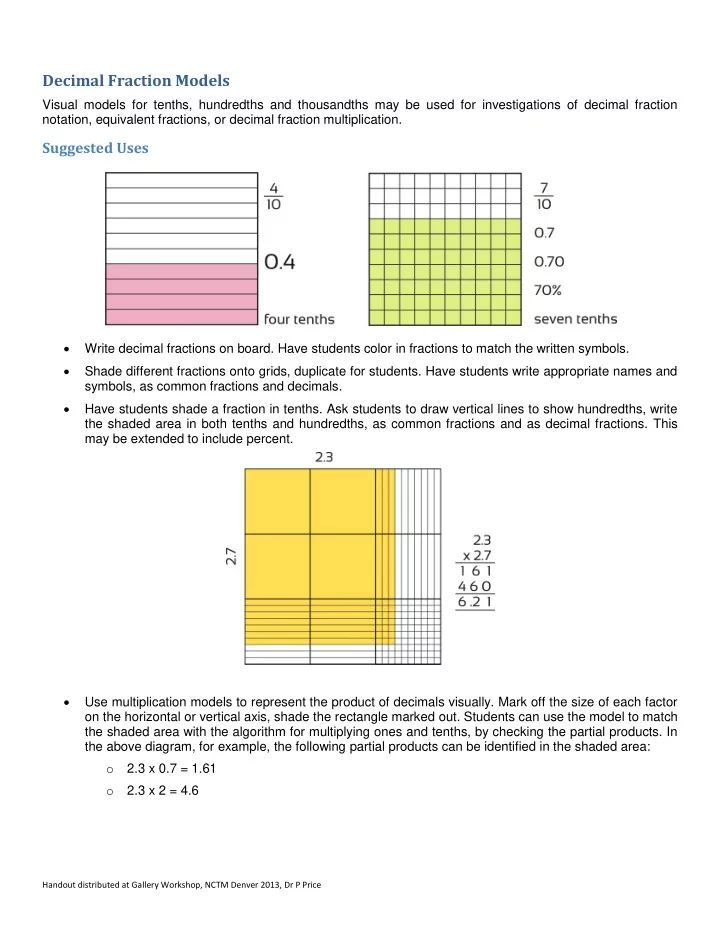
 Write decimal fractions on board. Have students color in fractions to match the written symbols.  Shade different fractions onto grids, duplicate for students. Have students write appropriate names and symbols, as common fractions and decimals.  Have students shade a fraction in tenths. Ask students to draw vertical lines to show hundredths, write the shaded area in both tenths and hundredths, as common fractions and as decimal fractions. This may be extended to include percent.  Use multiplication models to represent the product of decimals visually. Mark off the size of each factor

  • n the horizontal or vertical axis, shade the rectangle marked out. Students can use the model to match

the shaded area with the algorithm for multiplying ones and tenths, by checking the partial products. In the above diagram, for example, the following partial products can be identified in the shaded area:

  • 2.3 x 0.7 = 1.61
  • 2.3 x 2 = 4.6
slide-2
SLIDE 2

Handout distributed at Gallery Workshop, NCTM Denver 2013, Dr P Price

Tenths

slide-3
SLIDE 3

Handout distributed at Gallery Workshop, NCTM Denver 2013, Dr P Price

Name: .......................................................... Date: ................................................

slide-4
SLIDE 4

Handout distributed at Gallery Workshop, NCTM Denver 2013, Dr P Price

Hundredths

slide-5
SLIDE 5

Handout distributed at Gallery Workshop, NCTM Denver 2013, Dr P Price

Name: .......................................................... Date: ................................................

slide-6
SLIDE 6

Handout distributed at Gallery Workshop, NCTM Denver 2013, Dr P Price

Thousandths

slide-7
SLIDE 7

Handout distributed at Gallery Workshop, NCTM Denver 2013, Dr P Price

Name: .......................................................... Date: ................................................

slide-8
SLIDE 8

Handout distributed at Gallery Workshop, NCTM Denver 2013, Dr P Price

Multiplication Grids

Name: .......................................................... Date: ................................................

slide-9
SLIDE 9

Handout distributed at Gallery Workshop, NCTM Denver 2013, Dr P Price

Name: .......................................................... Date: ................................................

slide-10
SLIDE 10

Common Fractions

Licensed for unlimited photocopying by original purchaser only. http://www.classroomprofessor.com

Drawing Fractions

Draw halves and then quarters or fourths on these circles. Cross out any that are not even. Try drawing the first line at different angles. Draw eighths, thirds, sixths and fifths

1

slide-11
SLIDE 11

Common Fractions

Licensed for unlimited photocopying by original purchaser only. http://www.classroomprofessor.com

Finding and Folding Thirds and Sixths

Rectangle Finding a third is trickier than finding a half or quarter.

This is a good way to find thirds of a rectangle:

fold the paper here

  • 5. Open the sheet

and you will see that the page is folded into thirds. fold the paper

  • 1. Take a sheet of paper.

Fold one edge and slide it until the folded part looks the same size as the remaining page. halfway point

1 3 — 1 3 — 1 3 —

2. 4.

  • 3. Fold the last

edge across

To find a third of a circle, think of a clock: find 10, 2 & 6 o’clock and connect the lines to the centre. Or think of holding a steering wheel. Your hands and the bottom of the steering wheel divide it into thirds. To find a sixth of a circle, first draw thirds, then draw lines to divide each third in half.

Circle Try dividing your own circles into thirds and sixths.

2

slide-12
SLIDE 12

Common Fractions

Licensed for unlimited photocopying by original purchaser only. http://www.classroomprofessor.com

1

  • 2. thirds

1

  • 4. sixths

1 1

  • 3. fifths
  • 1. fourths or quarters
  • 2. How many hops?_______ The fractional parts are _______________

Fractions on a Number Line

1 1

Count the hops on these lines and write the fractions above the markers.

  • 1. How many hops?_______ The fractional parts are _______________

1 4 —

3

slide-13
SLIDE 13

Common Fractions

Licensed for unlimited photocopying by original purchaser only. http://www.classroomprofessor.com

4

2. Cross out any number lines that do not show equal hops. Write the fractions on any lines that are show equal hops. 1.

1 1

4. 3.

1 1 1 1

1 2 — 1 6 — 2 6 — 3 6 — 4 6 — 5 6 —

A half is always found at the midway point regardless of the number of other markers on the number line. (Use the finger slide or count the hops)

slide-14
SLIDE 14

Common Fractions

Licensed for unlimited photocopying by original purchaser only. http://www.classroomprofessor.com x2 x2

Cut each Fractional Piece into Two Pieces

Draw lines to cut each fractional piece in two to make new fractions. Write the equivalent fraction that each shape now shows. Equivalent fractions example: 6 2 3 1  8 2 4 1  16 10 8 5  8 6 4 3  4 2 2 1 

= —

6 8

—— =

3 4

—— =

2 7

——

x2 x2

Write the equivalent fraction of each of these if each fractional piece was cut in two.

6 4 3 2 

____ ____ ____ ____ ____

— —

Draw lines to cut each fractional piece in three pieces to make new fractions. Write the equivalent fraction that each shape now shows.

9 6 3 2 

Equivalent fractions example: 9 3 3 1  12 3 4 1 

24 15 8 5 

12 9 4 3  6 3 2 1 

____ ____ ____ ____ ____

=

6 8

—— =

3 4

—— =

2 7

——

x3

5

slide-15
SLIDE 15

Common Fractions

Licensed for unlimited photocopying by original purchaser only. http://www.classroomprofessor.com

Fill in the missing numbers and shade the shapes to match.

— 8 1 8 — 3 8 — 8 — 4 — — 8 — 8 — 8 8 —

1) 8 5 — 2) Counting in fifths 12 5 —

2 1

5 — 3)

1 4 1

4)

  • ne fifth

1

Tenths: Draw or write the missing common or decimal fraction and place it on the number line. 1)

1

—–

0.4

6

slide-16
SLIDE 16

Common Fractions

Licensed for unlimited photocopying by original purchaser only. http://www.classroomprofessor.com

Percentages: Write the missing common or decimal fraction and place it on the num- ber line. When drawing the fraction use the divisions as a guide. N.B. You will need to find the equivalent fraction first.

1) 2)

1 % = 1 2 —— 100 —–– 1 % = —— 100 —–– —— —— = 100 1 % :

3) 4)

: % 1 = —— 100 ——

(Remember to show as recurring decimals and percent, and round to the nearest hundredth)

Ratio = + 1) + =

3 6 2 6

Operations

7

slide-17
SLIDE 17

Common Fractions

Licensed for unlimited photocopying by original purchaser only. http://www.classroomprofessor.com

Add these. Add the whole numbers, then add the fractions.

 

6 5 6 3

3 1

1) Shade then add the fractions below. Remember to use 2 different colors. = + =

 

9 7 9 2

3 3

+ = 2) _________________= ______________ = _________ 3) _________________ = ______________ = _______-

3 2 4 4

1 1  

+ = + = + + =

2

9 12 —

3

3 8 —

2 3

18 24 —

+ + = 5

6

To add mixed numbers, add the whole numbers then add the fractions. It may be necessary to convert the fractions to the Lowest Common Denominator. Once added, change any improper fractions to mixed numbers and then simplify where possible.

9 24 — 27 24 — 3 24 — 6 1 8 —

= 1)

2 7 6 8

2 1  

Add these. Remember to simplify any fractions in the answer.

_________________= _____________ = ______ 2)

 

4 2 5 4

3 2

_________________= _____________ = ______

8