
SLIDE 1
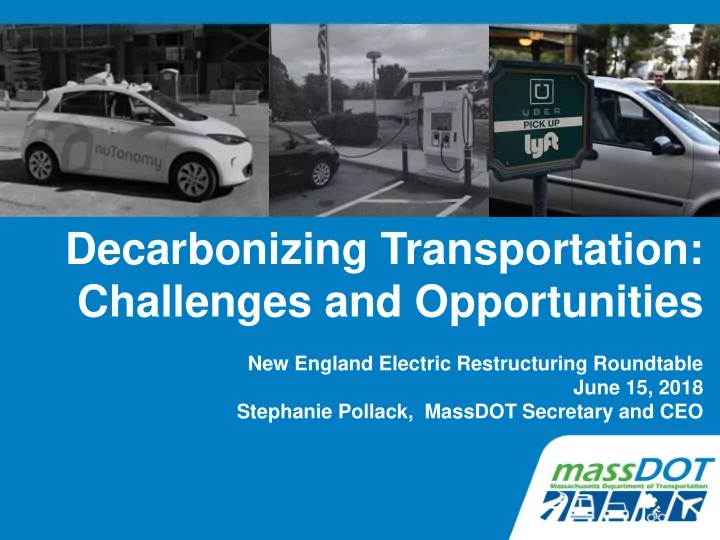
Decarbonizing Transportation: Challenges and Opportunities
New England Electric Restructuring Roundtable June 15, 2018 Stephanie Pollack, MassDOT Secretary and CEO
Decarbonizing Transportation: Challenges and Opportunities New - - PowerPoint PPT Presentation
Decarbonizing Transportation: Challenges and Opportunities New England Electric Restructuring Roundtable June 15, 2018 Stephanie Pollack, MassDOT Secretary and CEO We cant tackle climate change in Massachusetts without addressing
New England Electric Restructuring Roundtable June 15, 2018 Stephanie Pollack, MassDOT Secretary and CEO
2
Source: MassDEP’s Statewide GHG Emissions Baseline and Projection
6/14/2018
“How much energy we use to accomplish
considered a measure less of our success than of our failure - just as the amount of traffic we must endure to get where we want to go is a measure not of well-being but rather of our failure to establish a rational settlement pattern. … [M]uch of our prized personal mobility is really involuntary traffic made necessary by the settlement patterns that cars
Vehicle Miles Travelled Per Unit
Vehicle Miles Travelled (VMT) and VMT Per Capita Trends
business models – is underway and will accelerate
available for a wide range of important types of transportation vehicles
places with no real option but to drive simply punish people and will not change travel behavior or reduce GHGs
alternatives to driving and by influencing land use through transit-
walking or bicycling
6/14/2018 5
6
6/14/2018 9
Will fleets of autonomous, electrified rideshare vehicles be able to serve the needs
Massachusetts?
Transportation in the Commonwealth
Charlie Baker on January 23, 2018
2018
Commission
years from now
to the Governor, Lt. Governor and other decisionmakers
that next)
enables testing and creates Working Group
Enacted and implementing statewide transportation network company legislation
Future of Transportation in the Commonwealth
12
6/14/2018 13
Source: Wall Street Journal
14
transportation GHG emissions in Massachusetts are from gasoline passenger cars
currently do not have cost, performance and range comparable battery electric versions available and it is not clear that production will be available at scale any time soon
Draft
2004: Electric Trolley Bus (ETB) Fleet 2000: First Compressed Natural Gas Bus 2004: Dual Mode Articulated (DMA)- Silver Line Fleet 2010: 60’ Diesel Hybrid Fleet 2015: 40’ Diesel Hybrid Fleet 2015: 40’ Hydrogen Fuel Cell Bus (Pilot) 2018: 60’ New Flyer XE60 – Battery Electric Bus 2017-18: 40’ Battery Electric Bus (BEB) Feasibility Study
6/14/2018 16
Bus availability (Worcester Regional Transit Authority)
Average non-electric bus Average electric bus Average electric bus adjusted
Monthly average bus mileage (LA Metro)
6/14/2018 17
Agency Number of battery electric buses Details WRTA 6 WRTA began running Proterra fast charge buses in 2013 with the help of an FTA Clean Fuels grant PVTA 3 PVTA deployed 3 Proterra Catalyst fast charge buses in 2016, with state and federal
chargers and
slow charger. MBTA 5 (delivered 2018) Won a Low No grant in 2015 to procure five 60’ battery electric buses for the Silver Line from New Flyer. VTA 4 (delivered 2018) Won a Low No grant in 2017 to procure first electric buses from BYD.
18
6/14/2018 19
6/14/2018 20
0% 5% 10% 15% 20% 25% 30% 35% $11,389 (Lowest 20%) $28,976 (Second 20%) $50,563 (Third 20%) $84,173 (Fourth 20%) $198,674 (Highest 20%)
Percentage of annual household income spent on transportation by quintile (US households 2016)
U.S. Bureau of Labor Statistics
6/14/2018 21
22
6/14/2018 23
Source: American Public Transportation Association
24 $414 $469 $522 $502 $700 $795 1,075 1,410 $79 $162 $226 $241 $109 $147 $196 $273 $493 $631 $748 $743 $809 $942 1,271 $1,683
$- $200 $400 $600 $800 $1,000 $1,200 $1,400 $1,600 $1,800
FY13 FY14 FY15 FY16 FY17 FY18 FY19 Average annual spend FY20-23*
Spend in $ Millions
MBTA Capital Spending
State of Good Repair Expansion
* FY20-23 shows the average projected yearly spend
CIP Plan Estimates
SGR/Modernization Capital Spending Total Capital Spending FY13 -17
$2.6 billion $3.4 billion
FY19-23
$6.7 billion $8.0 billion
6/14/2018 25
Data reflects an average weekday in Fall 2015. Routes SL1, SL2, SLW, 71, and some Limited Service routes are excluded due to insufficient data.
This map shows how many passengers experience crowding on inbound trips, totaled across all bus routes that use each street. Long straight lines represent express buses that use highways without stopping.
6/14/2018 26
27
28
Chart based on data from Short and Sweet: Analysis of Shorter Trips Using National Personal Travel Survey Data 18 July 2017 Todd Litman Victoria Transport Policy Institute
6/14/2018 29
The current reality is that Therefore
Transportation disruption – with regard to both technology and business models – is underway and will accelerate We need to adopt policies to harness and shape the future of autonomous vehicles and mobility as a service Electrified vehicles that can meet operational needs are not yet available for a wide range of important types of transportation vehicles While electrification is a critically important strategy, electrification cannot be the sole strategy for addressing near- and mid-term transportation sector greenhouse gas emissions Strategies that increase the cost of transportation for people living in places with no real option but to drive simply punish people and will not change travel behavior or reduce GHGs We need to make walking, biking, transit and sustainable mobility realistic options for more Massachusetts residents and communities Reliable transit services can reduce GHG emissions both by providing alternatives to driving and by influencing land use through transit-
We need to invest in reliable transit in the places where transit use is practically and financially sustainable and where transit-oriented development will be encouraged The easiest trips to de-carbonize are short trips that can be made by walking or bicycling We need to encourage land use that puts homes and jobs closer to each other and to other destinations and make walking and biking safer and more convenient