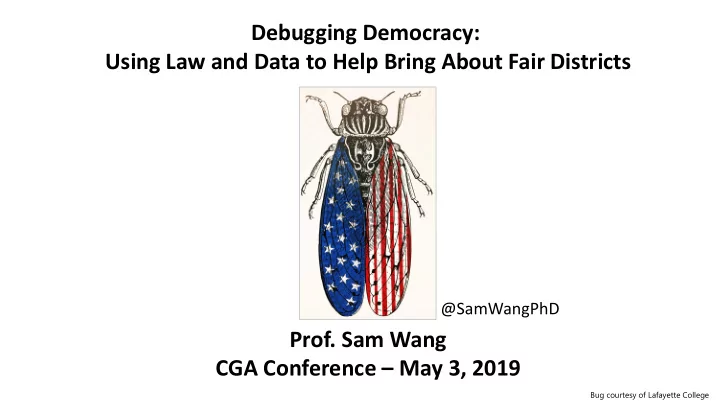
SLIDE 1 Bug courtesy of Lafayette College
Debugging Democracy: Using Law and Data to Help Bring About Fair Districts
CGA Conference – May 3, 2019
@SamWangPhD
SLIDE 2 Educational Ventures
The Princeton Gerrymandering Project team: Will Adler, Ben Williams, James Turk, Hannah Wheelen (and we are hiring!) gerrymander.princeton.edu
Educational Ventures
SLIDE 3
Two Gilded Ages
Racial divisions Technological disruption Increasing inequality Deep partisanship Racial divisions Technological disruption Increasing inequality Deep partisanship
SLIDE 4
SLIDE 5
http://prospect.org/article/slaying-partisan-gerrymander
SLIDE 6
Redistricting Reform in 2019 and Beyond: A Theory Of Change
SLIDE 7
Fix #1: Federal courts Fix #2: State courts Fix #3: Citizen action
Fundamental challenge: breaking the feedback loop
SLIDE 8
SLIDE 9
SLIDE 10
From A Citizen’s Guide To Redistricting in Michigan. http://gerrymander.princeton.edu/michigan
A pretty map can still hide ill intent
SLIDE 11
freedom of speech (50 states) and association (47 states), equal protection (24 states), free and equal elections (28 states)
Carolina and Wisconsin Ober, Williams, and Wang, U. Penn. Journal of Constitutional Law, forthcoming, 2019
SLIDE 12
Chief Justice John Roberts (decision) Associate Justice Elena Kagan (concurrence)
Unequal voter power (Am. XIV) Viewpoint discrimination (Am. I)
SLIDE 13
Who draws Congressional lines? Who draws state legislative lines?
SLIDE 14
Existing public and private databases contain many errors
Problems: free data online, repackaged and sold, little quality control
SLIDE 15
SLIDE 16
SLIDE 17 OpenPrecincts: Helping citizens talk back to redistricters
- Open data cleanup and validation tools
- Crowdsourcing
- Demonstration project: >10 states (OH/VA/PA/MI…)
- Access to redistricting software (Dave’s Redistricting,
ESRI Redistricting, districtr…)
- Expand to all 50 states + DC + Puerto Rico in time for
2021 redistricting
SLIDE 18
Maps from 131 of 133 jurisdictions 98.6% verification using voter rolls
SLIDE 19
OpenPrecincts shared data: Virginia (Bethune-Hill case)
Outlets: Virginian-Pilot, OneVirginia2021, William and Mary Law School
SLIDE 20
The national government belongs to the whole American people. Our whole experiment is meaningless unless we are to make this a democracy in the fullest sense of the word. If the minority is as powerful as the majority there is no use of having political contests at all, for there is no use in having a majority. Theodore Roosevelt 26th President, 1901-1909
SLIDE 21
SLIDE 22
SLIDE 23
Shapes aren’t enough – people matter too
SLIDE 24
Since 2012, gerrymandering has reached new heights
SLIDE 25
In 2018, cracks in the gerrymandered wall
SLIDE 26
On the docket in 2019: North Carolina’s partisan gerrymander
SLIDE 27
SLIDE 28