Debris from dwarf satellites in the Auriga simulations 0 . 0 All - - PowerPoint PPT Presentation

debris from dwarf satellites in the auriga simulations
SMART_READER_LITE
LIVE PREVIEW

Debris from dwarf satellites in the Auriga simulations 0 . 0 All - - PowerPoint PPT Presentation

Debris from dwarf satellites in the Auriga simulations 0 . 0 All sources Random Sub-sample E 10 5 (km 2 s 2 ) Christine Simpson 0 . 5 University of Chicago 1 . 0 1 . 5 N s : 5.1e+05 N s : 3.0e+04 N p : 3.2e+04 N p :


slide-1
SLIDE 1

Debris from dwarf satellites in the Auriga simulations

Christine Simpson University of Chicago

Ignacio Gargiulo Facundo Gómez Rob Grand and The Auriga Collaboration

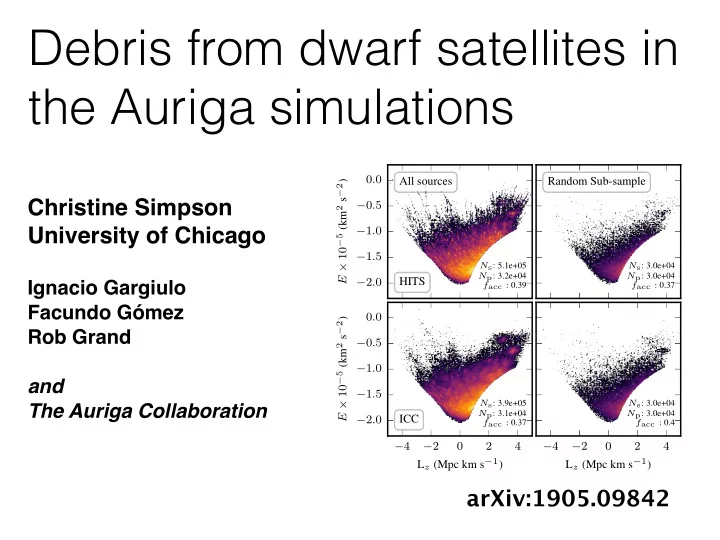
−2.0 −1.5 −1.0 −0.5 0.0 E × 10−5 (km2 s−2) All sources HITS

Ns: 5.1e+05 Np: 3.2e+04 facc : 0.39

Random Sub-sample

Ns: 3.0e+04 Np: 3.0e+04 facc : 0.37

−4 −2 2 4 Lz (Mpc km s−1) −2.0 −1.5 −1.0 −0.5 0.0 E × 10−5 (km2 s−2) ICC

Ns: 3.9e+05 Np: 3.1e+04 facc : 0.37

−4 −2 2 4 Lz (Mpc km s−1)

Ns: 3.0e+04 Np: 3.0e+04 facc : 0.4

arXiv:1905.09842

slide-2
SLIDE 2

AURIGA disks

HIGH-RESOLUTION SIMULATIONS OF MILKY WAY-SIZED HALOS (Grand et al. 2017) The Set-up & Physics

  • Cosmological zoom simulations of 1012 M⊙ halos
  • baryon cell/particle mass ~6 x 10³ M⊙ for 6 halos; ~5 x 10⁴ M⊙ for 40 halos
  • Second-order hydrodynamics on a moving mesh (AREPO)
  • MHD, SF & stellar feedback, AGN feedback, UV background, atomic & metal line cooling
slide-3
SLIDE 3

22 20 18 16 14 12 10 MV 100 101 102 Cumulative Number

d < 300 kpc MW M31 L4

Satellites in Auriga

22 20 18 16 14 12 10 MV 100 101 102 Cumulative Number

d < 300 kpc Au-L3 Au-L6 Au-L7 MW M31 L4

Surviving satellite Luminosity Functions

Mhost: 1-2 x 10¹² M⊙ (30) Mhost: 0.5-1 x 10¹² M⊙ (10)

slide-4
SLIDE 4

Many satellites don’t survive but they are still present in the Galaxy

  • V. Belokurov & SDSS

Bullock & Johnston 2005

Pre-Gaia Picture New GAIA Picture

Belokurov et al. Ibata et al. 2019

slide-5
SLIDE 5

We should expect debris to remain correlated in phase space longer than in position space

.0 .5 .0 .5 .0 Au6

Binding/Orbital Energy: E = v2/2 + ɸ Angular Momentum: L = r x v

Binding Energy z-component Angular Momentum

Prograde (rotating with disk) Retrograde

slide-6
SLIDE 6

Accreted material in Auriga shows a diversity of phase space structure

−2.0 −1.5 −1.0 −0.5 0.0 E × 10−5 (km2 s−2)

Au-24

facc = 0.1 f acc

ret = 0.16

N acc

p

= 1.8e+04

Au-21

facc = 0.07 f acc

ret = 0.24

N acc

p

= 1.7e+04

−4 −2 2 4 Lz (Mpc km s−1) −2.0 −1.5 −1.0 −0.5 0.0 E × 10−5 (km2 s−2)

Au-23

facc = 0.1 f acc

ret = 0.09

N acc

p

= 2.1e+04

−4 −2 2 4 Lz (Mpc km s−1)

Au-6

facc = 0.03 f acc

ret = 0.39

N acc

p

= 5.1e+03

  • (Currently) Highest

resolution Auriga simulations: 5 x 10³ M⊙ per star particle

  • Accreted stars in

2.5 kpc sphere positioned 8 kpc from center are shown

slide-7
SLIDE 7

−1.0 −0.5 0.0 0.5 1.0 cos(θ) 0.0 0.1 0.2 0.3 0.4 0.5 0.6 0.7 0.8 0.9 pdf

Angle between Lorb and Lhost-disk Red: Dark Satellites Cyan: Luminous satellites

Satellite-Host Disk connection

Lhost-disk host satellite Lorb 𝜄 Grand et al. 2017 Simpson in prep

slide-8
SLIDE 8

−2.0 −1.5 −1.0 −0.5 0.0 E × 10−5 (km2 s−2) Accreted Np = 20224 facc = 1.0 fret,pro

acc

= 1.0, 1.0 fret = 0.11 −4 −2 2 4 Lz (Mpc km s−1) −2.0 −1.5 −1.0 −0.5 0.0 E × 10−5 (km2 s−2) [Fe/H] < 0 [Mg/Fe] > −0.3 ✏ < 0.7 Np = 21055 facc = 0.38 fret,pro

acc

= 0.45, 0.36 fret = 0.22

Chemical and dynamical cuts (aka GAIA doesn’t have accretion flags)

Accreted Only Chemically & Dynamically Selected

  • Apply cuts in Fe,

Mg, and circularity

  • Structures in this

case created by massive satellite (Mstar = 5 x 10⁹ Msun) disrupted 3 Gyr ago

slide-9
SLIDE 9

−2.0 −1.5 −1.0 −0.5 0.0 E × 10−5 (km2 s−2)

All sources HITS mock

Ns = 5.1e+05 Np = 3.2e+04 facc = 0.39

Random Sub-sample

Ns = 3.0e+04 Np = 3.0e+04 facc = 0.37

−4 −2 2 4 Lz (Mpc km s−1) −2.0 −1.5 −1.0 −0.5 0.0 E × 10−5 (km2 s−2)

ICC mock

Ns = 3.9e+05 Np = 3.1e+04 facc = 0.37

−4 −2 2 4 Lz (Mpc km s−1)

Ns = 3.0e+04 Np = 3.0e+04 facc = 0.4

Mock Observations: Aurigaia

  • Use mock-Gaia catalogues of our

simulations (Grand et al. 2018).

  • Two methods applied with different

assumptions about phase space smoothing (HITS,ICC)

  • Use a 3 component fit for the galaxy

potential with mock (use true potential for simulations)

−4 −2 2 4 Lz (Mpc km s−1) −2.0 −1.5 −1.0 −0.5 0.0 E × 10−5 (km2 s−2) [Fe/H] < 0 [Mg/Fe] > −0.3 ✏ < 0.7 Np = 21055 facc = 0.38 fret,pro

acc

= 0.45, 0.36 fret = 0.22

101 102 103 104 105 106 Number HITS ICC Simulation −2.0 −1.5 −1.0 −0.5 0.0 E × 10−5 (km2 s−2) 2 4 6 8 Normalized Number

slide-10
SLIDE 10

−2.0 −1.5 −1.0 −0.5 0.0 E × 10−5 (km2 s−2)

All sources HITS mock

Ns = 5.1e+05 Np = 3.2e+04 facc = 0.39

Random Sub-sample

Ns = 3.0e+04 Np = 3.0e+04 facc = 0.37

−4 −2 2 4 Lz (Mpc km s−1) −2.0 −1.5 −1.0 −0.5 0.0 E × 10−5 (km2 s−2)

ICC mock

Ns = 3.9e+05 Np = 3.1e+04 facc = 0.37

−4 −2 2 4 Lz (Mpc km s−1)

Ns = 3.0e+04 Np = 3.0e+04 facc = 0.4

Mock Observations: Aurigaia

  • 2pt correlation functions measure the

excess of star pairs as a function of their velocity difference

  • Low velocity difference excess doesn’t

seem to correlate with phase space structures

  • High velocity excess does not indicate

a counter rotating disk

−4 −2 2 4 Lz (Mpc km s−1) −2.0 −1.5 −1.0 −0.5 0.0 E × 10−5 (km2 s−2) [Fe/H] < 0 [Mg/Fe] > −0.3 ✏ < 0.7 Np = 21055 facc = 0.38 fret,pro

acc

= 0.45, 0.36 fret = 0.22

0.9 1.1 1.3 1.5 1.7 1.9 ξ + 1 Au-23

Sim, all accreted Sim, all CHDYN HITS-mock, CHDYN, unique parents (UP) HITS-mock, CHDYN, non-UP ICC-mock, CHDYN, UP ICC-mock, CHDYN, non-UP

100 200 300 400 500 600 700 800 |vi − vj| (km s−1) 0.9 1.1 1.3 1.5 1.7 1.9 ξ + 1 ICC-mock volumes

Au-6 Au-16 Au-21 Au-23 Au-24 Au-27
slide-11
SLIDE 11

z=0.1 d=48 kpc z=0.11 d=61 kpc

Satellite Quenching in Auriga

1010 1011 Host Stellar Mass (M) 2 4 6 8 10 12 Number of quenched satellites within 300 kpc quenched Auriga quenched SAGA 1010 1011 Host Stellar Mass (M) 2 4 6 8 10 12 Number of SF satellites within 300 kpc SF Auriga SF SAGA

Magnitude Limit: Mr < -12.3

106 107 108 109 1010 1011 Final Mstar (M) 0.0 0.2 0.4 0.6 0.8 1.0 Fraction of Quenched Satellites

distance < 300 kpc Level 4: all (356) Level 4: subset (76) Level 3: subset (83)

Simpson et al. 2018

Is the MW typical? The SAGA survey

slide-12
SLIDE 12

Conclusions

  • Auriga hosts satellite debris that

can be seen in position & phase space

  • There is a diversity in accreted

structures between halos

  • Mock observations are

necessary to make

  • bservational predictions, but

challenges remain in this step of the process

  • Future work will entail

connecting debris structures to progenitor properties & orbits and modifying simulations to better capture dynamical mixing

−2.0 −1.5 −1.0 −0.5 0.0 E × 10−5 (km2 s−2) All sources HITS

Ns: 5.1e+05 Np: 3.2e+04 facc : 0.39

Random Sub-sample

Ns: 3.0e+04 Np: 3.0e+04 facc : 0.37

−4 −2 2 4 Lz (Mpc km s−1) −2.0 −1.5 −1.0 −0.5 0.0 E × 10−5 (km2 s−2) ICC

Ns: 3.9e+05 Np: 3.1e+04 facc : 0.37

−4 −2 2 4 Lz (Mpc km s−1)

Ns: 3.0e+04 Np: 3.0e+04 facc : 0.4

slide-13
SLIDE 13

−2.0 −1.5 −1.0 −0.5 0.0 E × 10−5 (km2 s−2)

All sources HITS mock

Ns = 5.1e+05 Np = 3.2e+04 facc = 0.39

Random Sub-sample

Ns = 3.0e+04 Np = 3.0e+04 facc = 0.37

−4 −2 2 4 Lz (Mpc km s−1) −2.0 −1.5 −1.0 −0.5 0.0 E × 10−5 (km2 s−2)

ICC mock

Ns = 3.9e+05 Np = 3.1e+04 facc = 0.37

−4 −2 2 4 Lz (Mpc km s−1)

Ns = 3.0e+04 Np = 3.0e+04 facc = 0.4

A note on ‘stretching’

Child star c comes from Parent particle p: r(c) = r(p) + dr v(c) = v(p) + dv Ekin(c) = Ekin(p) + v(p)·dv + 0.5 dv2 Even if E(p1) = E(p2), the energy of their children won’t be E(c1) ≠ E(c2)

slide-14
SLIDE 14

Chemical and Dynamical Selection cuts

−4 −2 2 4 Lz (Mpc km s−1) −2.0 −1.5 −1.0 −0.5 0.0 E × 10−5 (km2 s−2) All Np: 240077 fret: 0.02 fret,pro

acc

0.44, 0.08 −400 −200 200 400 vrad (km s−1) −400 −200 200 400 vcirc (km s−1) All −3 −2 −1 1 [Fe/H] −0.5 −0.4 −0.3 −0.2 −0.1 0.0 0.1 0.2 [Mg/Fe] All −1.0 −0.5 0.0 0.5 1.0 Circularity ✏ −0.5 −0.4 −0.3 −0.2 −0.1 0.0 0.1 0.2 [Mg/Fe] All −4 −2 2 4 Lz (Mpc km s−1) −2.0 −1.5 −1.0 −0.5 0.0 E × 10−5 (km2 s−2) Accreted Np: 20224 fret: 0.11 −4 −2 2 4 Lz (Mpc km s−1) −2.0 −1.5 −1.0 −0.5 0.0 E × 10−5 (km2 s−2) CHDYN Np: 21055 fret: 0.22 fret,pro

acc

0.45, 0.36

slide-15
SLIDE 15