Debate: A 17-Year-Old Lacrosse Player with an Isolated ACL Tear - - PowerPoint PPT Presentation

debate a 17 year old lacrosse player with an isolated acl
SMART_READER_LITE
LIVE PREVIEW

Debate: A 17-Year-Old Lacrosse Player with an Isolated ACL Tear - - PowerPoint PPT Presentation

Debate: A 17-Year-Old Lacrosse Player with an Isolated ACL Tear Pro: Transtibial Drilling Works: I Am Not Changing I Will Show You the Results David R. McAllister, MD Professor and Chief, Sports Medicine Service Department of Orthopaedic


slide-1
SLIDE 1

1

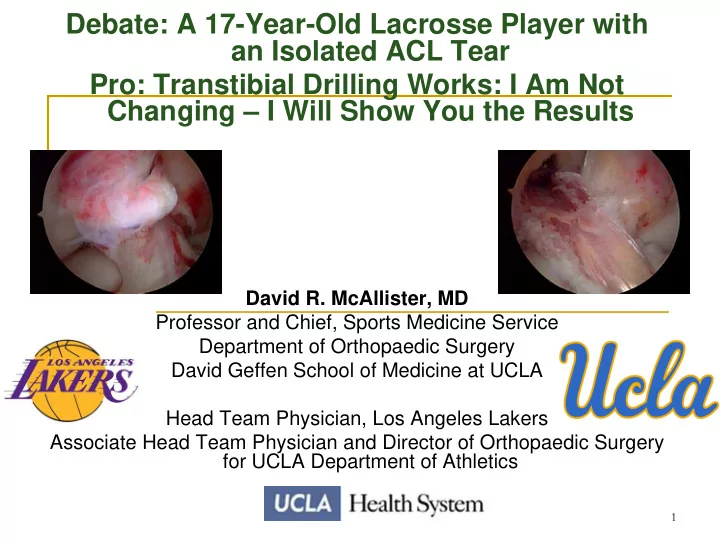
Debate: A 17-Year-Old Lacrosse Player with an Isolated ACL Tear Pro: Transtibial Drilling Works: I Am Not Changing – I Will Show You the Results

David R. McAllister, MD Professor and Chief, Sports Medicine Service Department of Orthopaedic Surgery David Geffen School of Medicine at UCLA Head Team Physician, Los Angeles Lakers Associate Head Team Physician and Director of Orthopaedic Surgery for UCLA Department of Athletics

slide-2
SLIDE 2

Disclosure

 Biomet: IP royalties; Paid consultant  Elsevier: Publishing royalties, financial or material

support

 Musculoskeletal Transplant Foundation/Conmed:

Paid consultant

 Ossur: Paid presenter or speaker  Smith & Nephew: Unpaid consultant

2

slide-3
SLIDE 3

Normal ACL

3

slide-4
SLIDE 4

4

Recent Trends in ACL Reconstruction: “Anatomic” ACL Reconstruction

 Lower femoral tunnel position  Transtibial vs. AM portal creation of femoral

tunnel

slide-5
SLIDE 5

5

Is Lower Femoral Tunnel Position Better?

 A number of

surgeons have recently advocated a lower femoral tunnel position as more “anatomic”

 However, is lower

necessarily more “anatomic”?

slide-6
SLIDE 6

6

Is Lower Femoral Tunnel Position Better?

 Does placing the femoral tunnel

at 9:30 to 10 o'clock provide the graft with a better mechanical advantage?

 No change in pivot-shift,

kinematics or AP laxity

 The rationale for placing the

femoral tunnel at a more oblique position in the notch to reduce the pivot shift is questioned.

 Markolf et. al. AJSM 2010  Markolf et. al. JOR 2002

slide-7
SLIDE 7

7

Is Lower Femoral Tunnel Position Better?

 Recent Clinical Study  Report of the Danish

ACL registry that the revision rate for failed reconstruction for the anteromedial portal technique was two times greater than that for the transtibial technique

 Wagner et. al. KSSTA

2012

slide-8
SLIDE 8

8

Transtibial vs. Anteromedial Reaming of Femoral Tunnel

 There are multiple

studies with conflicting results

 However, many of the

studies favor of anteromedial reaming

 Bowers et al,

Arthroscopy, 2011

 Bedi et al, Arthroscopy,

2011

 Gadikota, AJSM 2012

slide-9
SLIDE 9

9

Transtibial vs. Anteromedial Reaming of Femoral Tunnel

 The femoral tunnel can be positioned in a

highly anatomic manner using a transtibial technique but require careful choice of the tibial starting position.

 Piasecki et al, AJSM, 2011

 The key is to place the femoral tunnel in the

correct position regardless of technique

slide-10
SLIDE 10

10

Oblique Tibial Tunnel

slide-11
SLIDE 11

11

Tibial Tunnel Placement

 Adjacent to anterior

horn of lateral meniscus

 Native ACL footprint  In between the tibial

spines

slide-12
SLIDE 12

12

Femoral Tunnel Placement

 As deep in the notch as

possible without violation of the posterior cortical wall

 1:30 or 10:30 o’clock position

within footprint

 Tunnel that is too vertical

has good AP control but will impinge on PCL

 Lower is not always better!

 Tunnel that is too low results in

high graft tension

slide-13
SLIDE 13

13 Femoral Tunnel

12 9 12 9

Femoral Tunnel Placement

slide-14
SLIDE 14

14

Femoral Tunnel Preparation

Free hand technique Femoral “over the top” aimer

slide-15
SLIDE 15

Femoral Tunnel Position

 Isometry  Direct Fibers  Eccentric/Equidistant  Anatomic  Low tension

 Midway between PCL and

LFC articular cartilage

 1 mm posterior wall

15

slide-16
SLIDE 16

16

Graft Position/No Impingement

slide-17
SLIDE 17

Femoral Tunnel Position

 Isometry  Direct Fibers  Eccentric/Equidistant  Anatomic  Low tension

 Midway between PCL

and LFC articular cartilage

 1 mm posterior wall

Pearle et al, AJO 2015

17

slide-18
SLIDE 18

Tibial Tunnel Position

 Within native ACL

tibial footprint

 Adjacent to anterior

horn of lateral meniscus

 In between the tibial

spines

 Avoid notch/roof

impingement

18

slide-19
SLIDE 19

19

Graft Position/No Impingement

slide-20
SLIDE 20

20

Thank You