Dealing with PBGC Reportable Events: A Practical Guide for Employers - - PowerPoint PPT Presentation

dealing with pbgc reportable events a practical guide for
SMART_READER_LITE
LIVE PREVIEW

Dealing with PBGC Reportable Events: A Practical Guide for Employers - - PowerPoint PPT Presentation

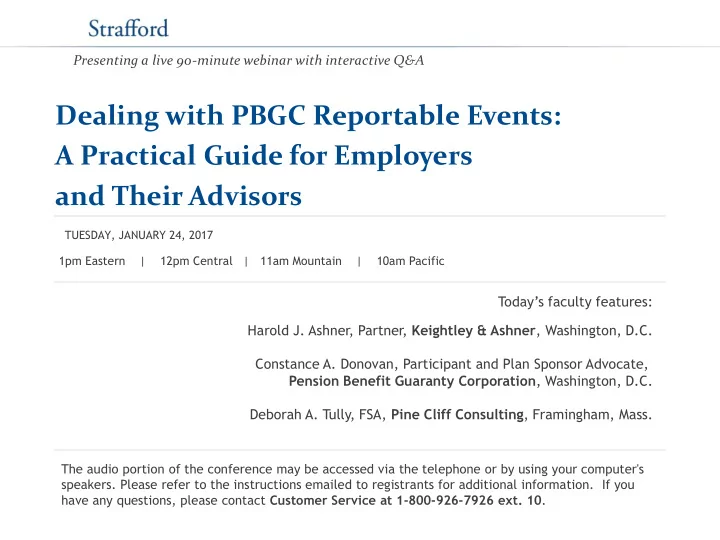
Presenting a live 90-minute webinar with interactive Q&A Dealing with PBGC Reportable Events: A Practical Guide for Employers and Their Advisors TUESDAY, JANUARY 24, 2017 1pm Eastern | 12pm Central | 11am Mountain | 10am


slide-1
SLIDE 1

The audio portion of the conference may be accessed via the telephone or by using your computer's

  • speakers. Please refer to the instructions emailed to registrants for additional information. If you

have any questions, please contact Customer Service at 1-800-926-7926 ext. 10.

Presenting a live 90-minute webinar with interactive Q&A

Dealing with PBGC Reportable Events: A Practical Guide for Employers and Their Advisors

Today’s faculty features:

1pm Eastern | 12pm Central | 11am Mountain | 10am Pacific TUESDAY, JANUARY 24, 2017

Harold J. Ashner, Partner, Keightley & Ashner, Washington, D.C. Constance A. Donovan, Participant and Plan Sponsor Advocate, Pension Benefit Guaranty Corporation, Washington, D.C. Deborah A. Tully, FSA, Pine Cliff Consulting, Framingham, Mass.

slide-2
SLIDE 2

Tips for Optimal Quality

Sound Quality If you are listening via your computer speakers, please note that the quality

  • f your sound will vary depending on the speed and quality of your internet

connection. If the sound quality is not satisfactory, you may listen via the phone: dial 1-866-258-2056 and enter your PIN when prompted. Otherwise, please send us a chat or e-mail sound@straffordpub.com immediately so we can address the problem. If you dialed in and have any difficulties during the call, press *0 for assistance. Viewing Quality To maximize your screen, press the F11 key on your keyboard. To exit full screen, press the F11 key again.

FOR LIVE EVENT ONLY

slide-3
SLIDE 3

Continuing Education Credits

In order for us to process your continuing education credit, you must confirm your participation in this webinar by completing and submitting the Attendance Affirmation/Evaluation after the webinar. A link to the Attendance Affirmation/Evaluation will be in the thank you email that you will receive immediately following the program. For additional information about continuing education, call us at 1-800-926-7926

  • ext. 35.

FOR LIVE EVENT ONLY

slide-4
SLIDE 4

Program Materials

If you have not printed the conference materials for this program, please complete the following steps:

  • Click on the ^ symbol next to “Conference Materials” in the middle of the left-

hand column on your screen.

  • Click on the tab labeled “Handouts” that appears, and there you will see a

PDF of the slides for today's program.

  • Double click on the PDF and a separate page will open.
  • Print the slides by clicking on the printer icon.

FOR LIVE EVENT ONLY

slide-5
SLIDE 5

Dealing with PBGC Reportable Events:

A Practical Guide for Employers and Their Advisors

Strafford Publications, Inc. Webinar/Teleconference January 24, 2017 Harold J. Ashner Deborah A. Tully, FSA Keightley & Ashner LLP Pine Cliff Consulting Inc.

slide-6
SLIDE 6

Early Warning Program: PBGC Focus

6

  • PBGC focus: increased risk to PBGC and/or pension

plans resulting from transaction, event, or trend

 Effect on credit quality of controlled group  Changes in capital structure and effect on PBGC’s/pension plan’s position in structure

  • Joint and several controlled group liability is key
  • “Long-run loss”/legal analysis: likelihood of future

termination, current vs. future PBGC loss

  • Financial/practical analysis for planned transaction: is

transaction good or bad for plan/PBGC?

slide-7
SLIDE 7

Early Warning Program: Triggers and Transactions, Etc.

7

  • Triggers for PBGC monitoring

 Aggregate controlled group underfunding = at least $50M  Aggregate CG participant count = at least 5,000  “Other reasons as appropriate” (e.g., credit rating)

  • PBGC learns of transactions, events, or trends through

 Reportable events filings  Company press releases and SEC filings  Media reports  PBGC’s own monitoring

slide-8
SLIDE 8

Early Warning Program: Triggers and Transactions, Etc. (Cont.)

8

  • Transactions, events, or trends of concern

 Change in controlled group responsible for supporting plan  Major divestiture by employer that retains significant underfunded pension liabilities  Leveraged buyout involving purchase of company using large amount of secured debt  Substitution of secured debt for significant amount of unsecured debt  Payment of very large dividend to shareholders  Significant credit deterioration.  Downward trend in cash flow or other financial factors

  • Most Early Warning Program cases focus on transactions
slide-9
SLIDE 9

Early Warning Program: Providing Information to PBGC

9

  • Consider contacting PBGC first

 Where contact is inevitable, sooner may be better  Avoid last-minute complications  Plan for PBGC involvement

  • PBGC information requests re planned transactions

 Timing flexibility if nothing imminent  Protect confidentiality (confidentiality agreement and/or 4043(f) coverage as reportable event follow-up)  Generally best to comply (subpoena authority)  Request will cover transaction, plan(s), and makeup and financial status of pre- and post-transaction controlled group  Demonstrate viability of post-transaction controlled group!

slide-10
SLIDE 10

Early Warning Program: PBGC Analysis

10

  • Contribution/financial projections may be key factors

in Early Warning Program analysis

  • PBGC recovery analysis may also be a key factor

 PBGC’s analysis will include assessment of  Likely PBGC recovery if plan terminates pre-transaction  Likelihood of future plan termination and likely PBGC recovery if transaction occurs with future plan termination  Many variables (e.g., fire-sale pricing, claims of other creditors) can affect and complicate analysis

slide-11
SLIDE 11

Early Warning Program: PBGC Leverage

11

  • PBGC “clearance”

 No legal requirement to get PBGC “clearance” of transaction  But PBGC concerns can block transaction unless settlement reached

  • Primary PBGC leverage: “involuntary termination”

(pre-transaction)

 Requires court approval or plan administrator agreement  Would increase/accelerate liability, add termination premium, and likely lead to bankruptcy, job losses  Initiation would likely trigger various defaults

slide-12
SLIDE 12

Early Warning Program: PBGC Leverage (Cont.)

12

  • PBGC can quickly set termination date

 PBGC publishes notice  “Locks in” termination date, related liability  But subject to later court approval or agreement

  • Potential 4069 or fraudulent conveyance action

(post-transaction)

  • PBGC’s pre-transaction remedy can be too extreme

and its post-transaction remedy can be too uncertain

  • But parties to transaction may be unwilling to proceed

absent pre-transaction PBGC settlement

slide-13
SLIDE 13

Early Warning Program: Settlement Options

13

  • PBGC has broad settlement authority (more like private

entity than government agency)

  • Settlement possibilities include:

 Additional contributions to plan  May have other reasons to pay above minimum  Agreement will prohibit using excess as prefunding balance  But effect will be to reduce future minimum contributions  Retention of plan by strong seller  Guarantee by seller if future plan termination  Grant to plan or PBGC of security interest

  • Direct actuary-to-actuary, lawyer-to-lawyer, business-to-

business discussions can work well

slide-14
SLIDE 14

Reportable Events: The Basics

 Reportable event: an event that may be indicative of a need to terminate a plan  Reportable event may be a plan event or a corporate event  Post-event reporting

 Obligation is imposed on plan administrator and contributing sponsor (but filing by either is deemed to be filing by both)  Filing is due 30 days after actual or constructive knowledge of the occurrence of the event

14

slide-15
SLIDE 15

Reportable Events: The Basics (Cont.)

 Advance reporting

 Only required if:  Neither sponsor nor controlled group member to which event relates is “public company,” and  Controlled group maintains plans that, in the aggregate (and disregarding plans with no unfunded vested benefits) have  Unfunded vested benefits above $50M, and  Funded vested benefits percentage below 90%  Obligation is imposed only on contributing sponsor  Filing is due 30 days before the effective date of the reportable event (without regard to actual or constructive knowledge)

 Post-event or advance reporting delinquencies: PBGC may assess ERISA Section 4071 penalties of up to $2,063 per day

15

slide-16
SLIDE 16

Reportable Events: The Basics (Cont.)

 Plan events (post-event reporting):

 Active participant reduction  Failure to make required minimum funding payment  Inability to pay benefits when due  Distribution to a substantial

  • wner

 Transfer of benefit liabilities*  Application for minimum funding waiver*

16

 Corporate events (post-event reporting):

 Change in contributing sponsor

  • r controlled group*

 Liquidation*  Extraordinary dividend or stock redemption*  Loan default*  Insolvency or similar settlement (previously “Bankruptcy or similar settlement”)*

* Also subject to advance reporting

slide-17
SLIDE 17

Reportable Events: The Basics (Cont.)

 Waivers and extensions

 Waiver for multiemployer plans  Waiver for terminating plans if notice due on or after distribution/trusteeship date  Unconditional waivers for certain statutory events  Conditional waivers/extensions for various regulatory events  Case-by-case waiver/extension if PBGC “finds convincing evidence” that waiver/extension is “appropriate under the circumstances”

 Caution: multiple events or single events for multiple plans!

 One set of facts may give rise to two events  Or one event may occur “for” two or more plans  Determine waivers, extensions, and required information separately for each event and for each plan

17

slide-18
SLIDE 18

Reportable Events Final Rule: Applicability

 Final rule published 9/11/15 (80 Fed. Reg. 54980)  Post-event reporting: effective for reportable events

  • ccurring on or after 1/1/16

 Advance reporting: effective for reports due on or after 1/1/16

18

slide-19
SLIDE 19

Reportable Events Final Rule: Effect on Corporate Agreements

 Consider effect of changes on loan agreements and

  • ther corporate agreements!

 Representations and warranties  Notice requirements  Possible default triggers

 Changes will result in:

 Events that were not previously reportable being reportable  Events that were previously reportable not being reportable

 Interpretive issue regarding existing agreements: reference to old vs. new PBGC regulations?

19

slide-20
SLIDE 20

Reportable Events Final Rule: In General

 Significant changes to waiver rules, including:

 New “low-default risk” waiver  More stringent waiver based on plan funding level

 Significant changes to various reportable events, including:

 Active participant reduction  Change in contributing sponsor or controlled group  Extraordinary dividends  Transfer of benefit liabilities  Loan default

20

slide-21
SLIDE 21

Reportable Events Final Rule: “Low-Default-Risk” Waiver

 New “low-default risk” waiver applies (post-event) to:

 Active participant reduction  Distribution to substantial owner  Change in contributing sponsor or controlled group  Extraordinary dividends  Transfer of benefit liabilities

 Requires “low-default-risk” status for both contributing sponsor(s) and highest-level U.S. parent(s)  Test is determined as of “financial information date”  Status remains in effect for 13 months or (if sooner) until next “financial information date”

21

slide-22
SLIDE 22

Reportable Events Final Rule: “Low-Default-Risk” Waiver (Cont.)

 “Financial information date” is:

 10-K filing date  Date company closes annual accounting period that results in production of audited or unaudited financial statements, if audited financial statements not required to be filed with SEC  Date company files annual tax return or Form 990 with IRS, if there are then no annual financial statements for year at issue

 To qualify for “low-default-risk” status (based on seven specified criteria), must meet:

 First two of seven criteria, or  Any four of seven criteria

 Exception: no “low-default-risk” status if audit/review report expresses material adverse view or qualification

22

slide-23
SLIDE 23

Reportable Events Final Rule: “Low-Default-Risk” Waiver (Cont.)

 First criterion: commercial measures

 Company’s probability of default must be no more than either:  4% over next 5 years, or  0.4% over next year  Determination must be based on “widely available financial information on the company’s credit quality”

 Second criterion: secured debt

 Company’s secured debt (subject to carve-out) must not exceed 10% of company’s total assets  Carve-out: leases and debt incurred to acquire or improve property and secured only by that property

 Third criterion: ratio of retained earnings to total assets must be at least 0.25

23

slide-24
SLIDE 24

Reportable Events Final Rule: “Low-Default-Risk” Waiver (Cont.)

 Fourth criterion: ratio of total debt to EBITDA must be no more than 3.0  Fifth criterion: company must have positive net income for the two most recently completed fiscal years  Sixth criterion: company must not have experienced loan default reportable event in past two years (regardless of whether reporting was waived)  Seventh criterion: company must not have experienced missed contribution reportable event in past two years (unless reporting was waived)

24

slide-25
SLIDE 25

Reportable Events Final Rule: “Well-Funded Plan” Waiver

 “Well-funded plan” waiver applies (post-event) to same five events as does “low-default-risk” waiver

 Active participant reduction  Distribution to substantial owner  Change in contributing sponsor or controlled group  Extraordinary dividends  Transfer of benefit liabilities

 Plan is “well-funded plan” for events occurring in current plan year if no PBGC variable-rate premium was required for preceding plan year

25

slide-26
SLIDE 26

Reportable Events Final Rule: “Well-Funded Plan” Waiver (Cont.)

 PBGC Blue Book guidance: new plan resulting from spinoff or consolidation automatically qualifies  Status does not change during current plan year, even after variable-rate premium filing done for current year  Significantly more stringent test than prior “80% funded” waiver (also tied to variable-rate premium)

26

slide-27
SLIDE 27

Reportable Events Final Rule: Public Company Waiver

 “Public company” waiver applies (post-event) to same five events as does “low-default-risk” waiver:  Active participant reduction  Distribution to substantial owner  Change in contributing sponsor or controlled group  Extraordinary dividends  Transfer of benefit liabilities  For waiver to apply, a contributing sponsor must:  Be a public company, and  Timely file 8-K disclosing event (but not under 8-K items relating primarily to operations or financial statements)  See Q&A 15 of PBGC 2016 Blue Book for guidance on what information is needed to “disclose” the event

27

slide-28
SLIDE 28

Reportable Events Final Rule: Small Plan Waiver

 “Small plan” waiver applies (post-event) to:

 Active participant reduction  Failure to make required minimum funding payment (but waiver applies only to quarterlies)  Change in contributing sponsor or controlled group  Extraordinary dividends  Transfer of benefit liabilities

 For waiver to apply, plan must have 100 or fewer participants for flat-rate premium purposes for plan year preceding plan year in which event occurs

28

slide-29
SLIDE 29

Reportable Events Final Rule: Foreign Entity Waivers/Extensions

 “Foreign entity” waiver applies (post-event) to:

 Change in contributing sponsor or controlled group  Liquidation  Extraordinary dividend  Loan default  Insolvency or similar settlement

 For waiver to apply, entity(ies) to which event relate(s) must be foreign entity(ies) other than direct/indirect parent(s)  Note: final rule drops foreign parent and “foreign-linked entity” reporting extensions (tied to actual knowledge)

 Potential penalty exposure based on constructive knowledge!  Set up systems to find out about these events!

29

slide-30
SLIDE 30

Reportable Events Final Rule: De Minimis Segment Waiver

 “De minimis 10-percent segment” waiver applies (post-event) to:

 Change in contributing sponsor or controlled group  Liquidation (if non-sponsor)  Extraordinary dividend  Loan default (if non-sponsor)  Insolvency or similar settlement (if non-sponsor)

 For waiver to apply, entity(ies) must have:

 Revenue not exceeding 10% of controlled group’s revenue  Annual operating income not exceeding greater of 10% of controlled group’s annual operating income, or $5M, and  Net tangible assets not exceeding greater of 10% of controlled group’s net tangible assets, or $5M

30

slide-31
SLIDE 31

Reportable Events Final Rule: De Minimis Segment Waiver (Cont.)

 Similar waiver (but substituting 5% for 10%) applies to advance reporting for:

 Change in contributing sponsor or controlled group  Liquidation (if each plan that was maintained by liquidating entity is maintained by another controlled group member)  Extraordinary dividend

31

slide-32
SLIDE 32

Reportable Events Final Rule: Advance Reporting Threshold

 Advance reporting threshold is updated

 Threshold (applicable only if neither sponsor nor member to which event relates is public company) tied to variable-rate premium  Reporting required where aggregate controlled group underfunding > $50M and funded vested benefit % < 90%, disregarding plans with no VRP underfunding  VRP rules changed by Pension Protection Act of 2006 and implementing PBGC regulations  Final rule updates reportable events regulations to reflect VRP rule changes (ties threshold tests to VRP determinations for plan year preceding plan year in which event becomes effective)

32

slide-33
SLIDE 33

Reportable Events Final Rule: Active Participant Reduction

 Under old regulation, event may occur on any day of plan year  Final rule provides that event can occur on any day of plan year only when, as result of “single cause,” active participant count reduced to less than:

 80% of count at beginning of current plan year, or  75% of count at beginning of prior plan year

 “Single cause” examples:

 Reorganization  Discontinuance of an operation  Natural disaster  Mass layoff  Early retirement incentive program

33

slide-34
SLIDE 34

Reportable Events Final Rule: Active Participant Reduction (Cont.)

 Under final rule, “attrition” event occurs at end of plan year if active participant count is then less than:

 80% of count at beginning of current plan year, or  75% of count at beginning of prior plan year

 Reductions tied to timely reported 4062(e) or 4063 event would be disregarded for purposes of “single-cause” event  Extension for “attrition” event until premium due date for following plan year  Can determine count (for single-cause or attrition) as of:

 Beginning of plan year by using end-of-prior-plan-year count  End of plan year by using beginning-of-next-plan-year count

34

slide-35
SLIDE 35

Reportable Events Final Rule: Active Participant Reduction (Cont.)

 Note PBGC-specific definition of “active participant”!  “Single-cause” event may occur any day of plan year  May have two “single-cause” events (based on same or different causes) in same plan year (two different thresholds)  May have to report attrition event in addition to “single-cause” event(s)  Spinoff may trigger event, even if within same controlled group  4063(a) notice of 4062(e) event: no 4063(a) waivers/extensions!

35

slide-36
SLIDE 36

Reportable Events Final Rule: Missed Contributions

 Final rule codifies expanded version of Technical Update 13-1 (reporting relief for missed quarterly contributions)

 Drops requirement in Technical Update 13-1 that failure not have been due to financial inability to make the contribution  Expands availability of waiver to larger plans  Technical Update 13-1 waiver: plans with fewer than 25 participants  Final rule waiver: plans with up to 100 participants

 Final rule retains waiver where missed contribution is paid within 30 days  Final rule adds waiver if failure is solely because of sponsor’s failure to timely make funding balance election

36

slide-37
SLIDE 37

Reportable Events Final Rule: Inability to Pay Benefits When Due

 Reportable event occurs based on current or projected inability to pay benefits when due (waived for large plans)

 Current inability: failure to provide full benefits when due and in form due (but subject to exceptions)  Projected inability: “liquid assets” are less than two times “disbursements from the plan” (determined quarterly)

 Old regulatory exceptions from “current inability” event:

 Need to verify person’s eligibility for benefits (no explicit time limit)  Inability to locate person (no explicit time limit)  Any other administrative delay if delay is for shorter of two months or two full benefit periods

37

slide-38
SLIDE 38

Reportable Events Final Rule: Inability to Pay Benefits When Due (Cont.)

 Final rule preamble: clarifies that “inability to locate person” is not subject to two-month/period time limit  Final rule regulatory language: imposes two-month/period time limit on “need to verify person’s eligibility for benefits”  PBGC informal guidance: this result was not intended and relief is being considered (Q&A 18(a) of 2016 Blue Book)

38

slide-39
SLIDE 39

Reportable Events Final Rule: Distribution to Substantial Owner

 Under final rule, event (involving distributions exceeding $10K over past year) occurs only if distributions over past year exceed:

 1% of plan assets as of end of each of two prior plan years (for any one substantial owner), or  5% of plan assets as of end of each of two prior plan years (for all substantial owners)

 Final rule requires reporting only once (even if amount increases) for distributions in annuity form

39

slide-40
SLIDE 40

Reportable Events Final Rule: Change in Contributing Sponsor or Controlled Group

 Event occurs when there is “transaction” that results, or will result, in person ceasing to be member of controlled group  “Transaction” includes “legally binding agreement”  Final rule provides that “legally binding” is determined “without regard to any conditions in the agreement”  So filing may be due long before transaction is effective!  Final rule eliminates reporting based on merger of one controlled group member into another  But liquidation of one controlled group member into another is a liquidation reportable event!

40

slide-41
SLIDE 41

Reportable Events Final Rule: Extraordinary Dividend

 Extraordinary dividend (or stock redemption)

 Old regulation reporting threshold

 Reporting required if distributions exceed specified levels  Threshold levels differ for cash and non-cash distributions  Cash distributions: test on 1-year and 4-year basis  Non-cash distributions: test on 1-year basis  Methodology for combining cash/non-cash distributions  Intra-controlled group distributions are taken into account

 Final rule simplifies reporting threshold

 Reporting required where distributions during current fiscal year exceed 100% of prior year net income (w/adjustments)  Intra-controlled group distributions are disregarded

 De minimis segment waiver expanded from 5% to 10%

41

slide-42
SLIDE 42

Reportable Events Final Rule: Transfer of Benefit Liabilities

 Event occurs when plan transfers (outside controlled group, within 12-month period) 3% or more of its benefit liabilities  Final rule eliminates all old regulation event-specific post-event waivers for transfer of benefit liabilities

 Complete plan transfer  Transfer of < 3% of assets  Section 414(l) safe harbor  Fully funded plans

 But final rule adds several general post-event waivers (small plan, low-default risk, well-funded plan, public company)  Final rule clarifies that lump sums and irrevocable commitments are not reportable transfers

42

slide-43
SLIDE 43

Reportable Events Final Rule: Loan Default

 Old regulation defined event as default on loan with

  • utstanding balance of at least $10M, but only if:

 Payment is more than 30 days late,  Lender accelerates loan, or  Lender issues written notice of default due to:

 Drop in debtor’s cash reserves below agreed-upon level  Unusual or catastrophic event experienced by debtor, or  Persisting failure by debtor to attain agreed-upon financial performance levels

 Old regulation provided following waivers:

 “Foreign entity” waiver (where debtor is foreign non-parent)  “Plan funding” waiver (based on various tests tied to VRP)  “Default cured” waiver (where default is cured, or waived by lender, within 30 days, or by end of longer cure period)

43

slide-44
SLIDE 44

Reportable Events Final Rule: Loan Default (Cont.)

 Old regulation provided extensions until one day after:

 Loan agreement cure period (for “payment” defaults)  Acceleration date (for “acceleration” defaults)  Date of receipt of notice of default (for “notice of default” defaults)

 Final rule greatly expands reporting of loan defaults:

 Captures any/all defaults on loan with $10M-plus balance  Captures also situations in which there is no default because lender waives or agrees to amendment of covenant, the effect

  • f which is to cure or avoid breach that would trigger default

 Eliminates “default cured” waiver, “plan funding” waiver, and all extensions  Provides waivers only where debtor is foreign non-parent or is (non-sponsor) de minimis 10% segment

44

slide-45
SLIDE 45

Reportable Events Final Rule: Loan Default (Cont.)

 For advance reporters, final rule eliminates extension

 Old regulation extended “advance” reporting until (at least) 10 days after default  Final rule requires that advance report be filed at least 30 days before effective date of default or lender waiver/amendment

45

slide-46
SLIDE 46

Reportable Events Final Rule: Insolvency or Similar Settlement

 Reportable event under old regulation captured:

 Bankruptcy Code proceedings  Any other insolvency proceeding  Proceeding to effect composition, extension, or settlement with creditors  General assignment for benefit of creditors  Any other nonjudicial composition, extension, or settlement with substantially all creditors

 Final rule:

 Eliminates Bankruptcy Code cases from post-event and advance reporting  Eliminates (except for involuntary proceedings) existing regulation’s extension of advance reporting until 10 days after event

46

slide-47
SLIDE 47

Reportable Events Final Rule: Forms, Instructions, and Filing

 Information requirements moved from regulation to instructions (to facilitate later changes)  More information required with initial filing

 Largely same information as previously required in response to follow-up requests  Much of this change was already in effect under then-recently-revised “optional” forms/instructions  Plan in advance for filing (don’t wait until due date)!

 Use of (previously optional) reportable events forms is mandatory  Electronic filing (previously optional) is also mandatory

47

slide-48
SLIDE 48

PBGC Reportable Events: Monitoring Effectively

48

  • Avoid surprises by ensuring communication lines are open

regarding potential transactions and business events

 Ensure key finance and HR staff have a basic understanding of the types of events that may be reportable  Establish central point of contact within controlled group  Involve central point of contact when evaluating transactions

  • Consider working evaluation of possible reportable events

into existing internal controls procedures

  • Coordinate closely with outside advisors to evaluate

events

  • Determine qualification of “low-default-risk,” “well-funded

plan” and “small plan” waivers on annual basis

slide-49
SLIDE 49

PBGC Reportable Events: Reporting Effectively

49

  • For reportable events, explain (where applicable) why

event should not be of concern to PBGC

 Go beyond required information where doing so is helpful to your case  May obviate need for PBGC follow-up

  • Multiple events or events for multiple plans can be

combined in one filing

  • In general, expect follow-up inquiry from PBGC for

more information re event and re plan

  • Note: statutory confidentiality applies (4043(f))
slide-50
SLIDE 50

PBGC Reporting Requirements: Dealing with Penalties

50

  • Late reporting penalties

 Not mechanical/automatic (considerable discretion)  $2,063 daily penalty max, lower guideline penalties

  • If reporting late:

 Explain reason for delinquency  State steps taken to help ensure future compliance  Note (where applicable) that late filing resulted in no harm

  • r potential harm to PBGC or participants
  • If penalty is assessed:

 Review 2001 proposed waiver guidance issued (still reasonably current, per PBGC Blue Book/JCEB guidance)  PBGC won’t accept “it’s the consultant’s fault”

slide-51
SLIDE 51

Early Warning Program: Key PBGC Reporting Requirements in M&A Context

51

  • Stock sale

 Reportable event for controlled group change  Advance reporting: 30 days before effective date  Post-event reporting: 30 days after “legally binding agreement” (may be due before advance reporting!)  Possible “transfer of benefit liabilities” reportable event (post-event or advance)  Possible “active participant reduction” reportable event (post-event only)

slide-52
SLIDE 52

Early Warning Program: Key PBGC Reporting Requirements in M&A Context (Cont.)

52

  • Asset sale

 Not a reportable event in and of itself  Possible “extraordinary dividend” reportable (post-event or advance)  Possible “transfer of benefit liabilities” reportable event (post-event or advance)  Possible “active participant reduction” reportable event (post-event only)  Transfer of full plan outside controlled group (with controlled group remaining intact) is reportable event

  • Stock or asset sale: possible 4062(e)/4063(a)

reporting

slide-53
SLIDE 53

53

Questions?

Harold Ashner Keightley & Ashner LLP 700 12th Street, NW, Suite 700 Washington, DC 20005 www.keightleyashner.com haroldashner@keightleyashner.com (202) 558-5150

  

Deborah Tully, FSA Pine Cliff Consulting Inc. 45 Concord Street Framingham, MA 01701 www.pinecliffconsulting.com deborah.tully@pinecliffconsulting.com (508) 620-4778   